



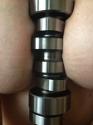




mid range/torquey/road race cam?
 mid range/torquey/road race cam?
 going in a forged 347, stage 2 862 heads(might swap to stock LS6), Fast 90 LS1. Road Race track car.
currently running a MJ2 232/240 .607/.608 112
its from my old drag days and is a peaky drag/dyno queen cam. It sat on its *** until you were above 5500.
looking for something with some more guts down low to get me out of the corners.
Id like to stick around 600 lift (+- .005 or so)
say something that pulls 3000-6000 rpm or so? or 4000-6400?
thoughts?
currently running a MJ2 232/240 .607/.608 112
its from my old drag days and is a peaky drag/dyno queen cam. It sat on its *** until you were above 5500.
looking for something with some more guts down low to get me out of the corners.
Id like to stick around 600 lift (+- .005 or so)
say something that pulls 3000-6000 rpm or so? or 4000-6400?
thoughts?

Cam motion Titan 4, tick SNS2. Anything around 227-228 intake duration will make great midrange power.
FWIW, my cam is a custom job with valve events split between those two cans because I couldn't decide between them.
Mine comes into its own at 3K and carries to 6800. Still decent down low, but 3000 kicks in hard. Almost like turbo lag.
FWIW, my cam is a custom job with valve events split between those two cans because I couldn't decide between them.
Mine comes into its own at 3K and carries to 6800. Still decent down low, but 3000 kicks in hard. Almost like turbo lag.
In my 5.7 I had very good luck and a nice fat torque band with a FTI Streetsweeper HT. It was a .612/.600 228/232 111+2. If my lifter hadn't eaten it I would still be running it. Make great power from 2,500 up into the mid-6,000s. It drove on the street with no surge down into 1,200 and made over 400 RWHP with stock 241 heads too. Many people have had the same results

TECH Fanatic

Joined: Aug 2004
Posts: 1,373
Likes: 4
From: Auckland, Nth Is, New Zealand.
Tick sns stg 3.
Had this cam fitted back in Dec 2013 but never managed to race with it due to a faulty gearbox.
Box now rebuilt
2 weekends ago I went to a road track day at my local circuit 'Pukekohe' run by a Honda guy.
I ended up in one of two fast groups, 20 per group, stripped out Honda cup cars/street Hondas/evos/R32skyline/Aussie XR6T falcon & a 08 Clubsport Commodore.
Thought I was going to get my **** kicked, turned out the opposite. Only car that could match me was the Falcon on the back straight, hit the corners & I was gone.
Love this cam
Had this cam fitted back in Dec 2013 but never managed to race with it due to a faulty gearbox.
Box now rebuilt
2 weekends ago I went to a road track day at my local circuit 'Pukekohe' run by a Honda guy.
I ended up in one of two fast groups, 20 per group, stripped out Honda cup cars/street Hondas/evos/R32skyline/Aussie XR6T falcon & a 08 Clubsport Commodore.
Thought I was going to get my **** kicked, turned out the opposite. Only car that could match me was the Falcon on the back straight, hit the corners & I was gone.
Love this cam
My combo was making 350 ftlbs at the wheels by 3000 with the cam I had. The heads helped out there too, but if I had to do it over again with road racing in mind, I'd go in the high 220's with ~ 3-5 degrees of exhaust split on a 111 LSA or even 110. The tighter LSA in my case made my combo very torquey for a 5.7. Also, go with a mild lobe that's easy on springs to ensure good valve control.
Jason
Jason
My combo was making 350 ftlbs at the wheels by 3000 with the cam I had. The heads helped out there too, but if I had to do it over again with road racing in mind, I'd go in the high 220's with ~ 3-5 degrees of exhaust split on a 111 LSA or even 110. The tighter LSA in my case made my combo very torquey for a 5.7. Also, go with a mild lobe that's easy on springs to ensure good valve control. Jason
Trending Topics
LS1 Tech Stories
The Best V8 Stories One Small Block at Time

6 Common C5 Corvette Failures and What's Involved In Repairing Them
Pouria Savadkouei
Retro Modern Bandit Pontiac Trans AM Comes With Burt Reynolds' Autograph
Verdad Gallardo
Top 10 Greatest Cadillac V Series Performance Models Ever, Ranked
Pouria Savadkouei
Top 10 Most Powerful Chevy Trucks Ever Made!

Hennessey's New Supercharged Silverado ZR2 Has 700 HP
Verdad Gallardo
Coachbuilt N2A Anteros Is an LS2-Powered C6 Corvette In Italian Clothes
Verdad Gallardo
Awesome K5 Blazer Restomod Comes With C7 Corvette Power
Verdad Gallardo
10 Camaros You Should Never Buy

10 LS Engine Myths That Refuse to Die
Verdad Gallardo
Take a peak at the huge stickied thread called "Why LSA doesn't matter" and you'll get all your answers from some of the most knowledgeable guys in the business.
What THAT means is the intake centerline is 107 degrees.
A113 LSA with no + on it will means the intake centerline is at 113, which will in general mean it makes for higher RPM power at the expense of low end and midrange torque - comparatively.
Earlier intake center lines help build good cylinder pressure at slower engine speeds for good midrange torque.
Then, there is valve overlap, which is necessary with lower LSA cams to still make big power at the top end. Overlap means both valves are open at the same time and results in that choppy cammed sound we love.
There's a lot more to it, but there is a primer for you. I spent months studying cam theory and I'm still a damned amateur.

and you have grown quite knowledgeable.
STANG KILLA SS 2 , if you want power between 3k and 6.4k that's not too hard. Pulling to 7k is where compromises take place. If your road racing you'll also want crisp throttle response so it will be predictable. You don't want something that will "kick in".
If you read the big LSA sticky, you learned that Martin thinks in terms of valve events instead of cam measurements. You have a FAST 90 that tends to make peak power at 6350 rpm. A IVC (intake valve close) of 43 or 44 would match up to that intake well. For throttle response you need manifold vacuum, less overlap. 0 to 4 will drive like stock, 4 to 8 can be tuned to run well on the street, 8 to 12 will cost throttle response but make more peak power.
Overlap is IVO (intake valve open) plus EVC (exhaust valve close).
I think you should be in the 4 to 8 range. If your exhaust is high velocity and has equal length headers a IVO of 2 and EVC of 4 could make alot of power when the engine is in the 4800 to 6200 range because the exhaust would pull on the intake port but you would lose power at other rpm because of less cylinder filling. A IVO of 5 and EVC of 1 would fill the cylinder better at other rpm by having the intake valve at a higher lift point when the piston starts pulling on the intake port. If you don't have, say, a C5 w/ the LG headers then the 5~1 exhaust biased overlap could be better for you.
That leaves EVO, when you end the power stroke and start spilling the exhaust, to determine. Your 232/240 112+3 (+3 is a guess) has events of 8IVO, 44 IVC, 56 EVO, 4 EVC. 12* overlap The 8~44 did a great job of filling the cylinder but the 56 EVO let your power stroke end too soon for low rpm torque. It's benefit was giving more time to evacuate the exhaust at high rpm. I'm guessing it could hold on to peak hp to 7400 or beyond. At low rpm there is less cylinder filling in the intake stroke, less cylinder pressure on the power stroke, the mixture burns slower and was not finished when the exhaust valve opened.
For your goals, I would pick a EVO of 47. Beyond 6600 rpm it may not give enough time to empty the exhaust and cause intake charge contamination and limit ability to carry power. Not the thing a drag racer would want. At lower rpm it would give a longer power stroke and boost torque.
So this long winded reply from someone with a low post count ends up with this recomendation : IVO 5 ~ IVC 43 ~ EVO 47 ~ EVC 1 which translates to a 228/228 111+2
I don't think anyone who replied to you gave bad advice; I just wanted to give you a idea of what effect the changing of valve events produce. To really zoom in on the RIGHT cam for you, download the cam recomendation sheet from Tick and let Martin spec a dialed-in grind for you.
STANG KILLA SS 2 , if you want power between 3k and 6.4k that's not too hard. Pulling to 7k is where compromises take place. If your road racing you'll also want crisp throttle response so it will be predictable. You don't want something that will "kick in".
If you read the big LSA sticky, you learned that Martin thinks in terms of valve events instead of cam measurements. You have a FAST 90 that tends to make peak power at 6350 rpm. A IVC (intake valve close) of 43 or 44 would match up to that intake well. For throttle response you need manifold vacuum, less overlap. 0 to 4 will drive like stock, 4 to 8 can be tuned to run well on the street, 8 to 12 will cost throttle response but make more peak power.
Overlap is IVO (intake valve open) plus EVC (exhaust valve close).
I think you should be in the 4 to 8 range. If your exhaust is high velocity and has equal length headers a IVO of 2 and EVC of 4 could make alot of power when the engine is in the 4800 to 6200 range because the exhaust would pull on the intake port but you would lose power at other rpm because of less cylinder filling. A IVO of 5 and EVC of 1 would fill the cylinder better at other rpm by having the intake valve at a higher lift point when the piston starts pulling on the intake port. If you don't have, say, a C5 w/ the LG headers then the 5~1 exhaust biased overlap could be better for you.
That leaves EVO, when you end the power stroke and start spilling the exhaust, to determine. Your 232/240 112+3 (+3 is a guess) has events of 8IVO, 44 IVC, 56 EVO, 4 EVC. 12* overlap The 8~44 did a great job of filling the cylinder but the 56 EVO let your power stroke end too soon for low rpm torque. It's benefit was giving more time to evacuate the exhaust at high rpm. I'm guessing it could hold on to peak hp to 7400 or beyond. At low rpm there is less cylinder filling in the intake stroke, less cylinder pressure on the power stroke, the mixture burns slower and was not finished when the exhaust valve opened.
For your goals, I would pick a EVO of 47. Beyond 6600 rpm it may not give enough time to empty the exhaust and cause intake charge contamination and limit ability to carry power. Not the thing a drag racer would want. At lower rpm it would give a longer power stroke and boost torque.
So this long winded reply from someone with a low post count ends up with this recomendation : IVO 5 ~ IVC 43 ~ EVO 47 ~ EVC 1 which translates to a 228/228 111+2
I don't think anyone who replied to you gave bad advice; I just wanted to give you a idea of what effect the changing of valve events produce. To really zoom in on the RIGHT cam for you, download the cam recomendation sheet from Tick and let Martin spec a dialed-in grind for you.
thanks everyone keep the suggestions coming. Ive just ordered the short block and misc parts, but still need to find that right cam for what i do. 95% are all designed for peak dyno/drag power.
exhaust is SLP LTs with a Y into a single 3" bullet dumping under the passenger. no cats.
squaler TSP makes a 228/228 .600"/.600" Camshaft similar to your recommendations. with a 114 LSA standard but 110-115 available.
for some reason the matching duration and lift bug me even though i know zero about cam design. everyones else have the second number bigger for LS1s.
i did a little general cam reading(way below what your typing) and they mentioned lowering the LSA lowers the powerband and makes a choppier idle. two things i want.
exhaust is SLP LTs with a Y into a single 3" bullet dumping under the passenger. no cats.
squaler TSP makes a 228/228 .600"/.600" Camshaft similar to your recommendations. with a 114 LSA standard but 110-115 available.
for some reason the matching duration and lift bug me even though i know zero about cam design. everyones else have the second number bigger for LS1s.
i did a little general cam reading(way below what your typing) and they mentioned lowering the LSA lowers the powerband and makes a choppier idle. two things i want.
and you have grown quite knowledgeable.
STANG KILLA SS 2 , if you want power between 3k and 6.4k that's not too hard. Pulling to 7k is where compromises take place. If your road racing you'll also want crisp throttle response so it will be predictable. You don't want something that will "kick in".
If you read the big LSA sticky, you learned that Martin thinks in terms of valve events instead of cam measurements. You have a FAST 90 that tends to make peak power at 6350 rpm. A IVC (intake valve close) of 43 or 44 would match up to that intake well. For throttle response you need manifold vacuum, less overlap. 0 to 4 will drive like stock, 4 to 8 can be tuned to run well on the street, 8 to 12 will cost throttle response but make more peak power.
Overlap is IVO (intake valve open) plus EVC (exhaust valve close).
I think you should be in the 4 to 8 range. If your exhaust is high velocity and has equal length headers a IVO of 2 and EVC of 4 could make alot of power when the engine is in the 4800 to 6200 range because the exhaust would pull on the intake port but you would lose power at other rpm because of less cylinder filling. A IVO of 5 and EVC of 1 would fill the cylinder better at other rpm by having the intake valve at a higher lift point when the piston starts pulling on the intake port. If you don't have, say, a C5 w/ the LG headers then the 5~1 exhaust biased overlap could be better for you.
That leaves EVO, when you end the power stroke and start spilling the exhaust, to determine. Your 232/240 112+3 (+3 is a guess) has events of 8IVO, 44 IVC, 56 EVO, 4 EVC. 12* overlap The 8~44 did a great job of filling the cylinder but the 56 EVO let your power stroke end too soon for low rpm torque. It's benefit was giving more time to evacuate the exhaust at high rpm. I'm guessing it could hold on to peak hp to 7400 or beyond. At low rpm there is less cylinder filling in the intake stroke, less cylinder pressure on the power stroke, the mixture burns slower and was not finished when the exhaust valve opened.
For your goals, I would pick a EVO of 47. Beyond 6600 rpm it may not give enough time to empty the exhaust and cause intake charge contamination and limit ability to carry power. Not the thing a drag racer would want. At lower rpm it would give a longer power stroke and boost torque.
So this long winded reply from someone with a low post count ends up with this recomendation : IVO 5 ~ IVC 43 ~ EVO 47 ~ EVC 1 which translates to a 228/228 111+2
I don't think anyone who replied to you gave bad advice; I just wanted to give you a idea of what effect the changing of valve events produce. To really zoom in on the RIGHT cam for you, download the cam recomendation sheet from Tick and let Martin spec a dialed-in grind for you.
STANG KILLA SS 2 , if you want power between 3k and 6.4k that's not too hard. Pulling to 7k is where compromises take place. If your road racing you'll also want crisp throttle response so it will be predictable. You don't want something that will "kick in".
If you read the big LSA sticky, you learned that Martin thinks in terms of valve events instead of cam measurements. You have a FAST 90 that tends to make peak power at 6350 rpm. A IVC (intake valve close) of 43 or 44 would match up to that intake well. For throttle response you need manifold vacuum, less overlap. 0 to 4 will drive like stock, 4 to 8 can be tuned to run well on the street, 8 to 12 will cost throttle response but make more peak power.
Overlap is IVO (intake valve open) plus EVC (exhaust valve close).
I think you should be in the 4 to 8 range. If your exhaust is high velocity and has equal length headers a IVO of 2 and EVC of 4 could make alot of power when the engine is in the 4800 to 6200 range because the exhaust would pull on the intake port but you would lose power at other rpm because of less cylinder filling. A IVO of 5 and EVC of 1 would fill the cylinder better at other rpm by having the intake valve at a higher lift point when the piston starts pulling on the intake port. If you don't have, say, a C5 w/ the LG headers then the 5~1 exhaust biased overlap could be better for you.
That leaves EVO, when you end the power stroke and start spilling the exhaust, to determine. Your 232/240 112+3 (+3 is a guess) has events of 8IVO, 44 IVC, 56 EVO, 4 EVC. 12* overlap The 8~44 did a great job of filling the cylinder but the 56 EVO let your power stroke end too soon for low rpm torque. It's benefit was giving more time to evacuate the exhaust at high rpm. I'm guessing it could hold on to peak hp to 7400 or beyond. At low rpm there is less cylinder filling in the intake stroke, less cylinder pressure on the power stroke, the mixture burns slower and was not finished when the exhaust valve opened.
For your goals, I would pick a EVO of 47. Beyond 6600 rpm it may not give enough time to empty the exhaust and cause intake charge contamination and limit ability to carry power. Not the thing a drag racer would want. At lower rpm it would give a longer power stroke and boost torque.
So this long winded reply from someone with a low post count ends up with this recomendation : IVO 5 ~ IVC 43 ~ EVO 47 ~ EVC 1 which translates to a 228/228 111+2
I don't think anyone who replied to you gave bad advice; I just wanted to give you a idea of what effect the changing of valve events produce. To really zoom in on the RIGHT cam for you, download the cam recomendation sheet from Tick and let Martin spec a dialed-in grind for you.

Darth_V8R, didn't realize that about that Tick cam lol. I'm not familiar with their grinds.
Jason
Last edited by Camaro99SS; Sep 25, 2015 at 06:21 PM.
thanks everyone keep the suggestions coming. Ive just ordered the short block and misc parts, but still need to find that right cam for what i do. 95% are all designed for peak dyno/drag power.
exhaust is SLP LTs with a Y into a single 3" bullet dumping under the passenger. no cats. Better change the EVO from 47 to 49~51 range with that setup
squaler TSP makes a 228/228 .600"/.600" Camshaft similar to your recommendations. with a 114 LSA standard but 110-115 available. The 228r, Pac beehives and TSP 228r's do NOT play nice together. XE-R lobes that it uses can be rpm limited without the right setup.
for some reason the matching duration and lift bug me even though i know zero about cam design. everyones else have the second number bigger for LS1s. Having the second (exhaust)number bigger means traditional split. First number (intake) bigger is reverse split. Both the same is "single pattern". Statements like "lowering the LSA lowers the powerband" or "adding advance improves low end torque" make alot more sense when you look at a cam's events. Check out the cam calculator at Walace Racing and their event calculator.
i did a little general cam reading(way below what your typing) and they mentioned lowering the LSA lowers the powerband and makes a choppier idle. two things i want.
exhaust is SLP LTs with a Y into a single 3" bullet dumping under the passenger. no cats. Better change the EVO from 47 to 49~51 range with that setup
squaler TSP makes a 228/228 .600"/.600" Camshaft similar to your recommendations. with a 114 LSA standard but 110-115 available. The 228r, Pac beehives and TSP 228r's do NOT play nice together. XE-R lobes that it uses can be rpm limited without the right setup.
for some reason the matching duration and lift bug me even though i know zero about cam design. everyones else have the second number bigger for LS1s. Having the second (exhaust)number bigger means traditional split. First number (intake) bigger is reverse split. Both the same is "single pattern". Statements like "lowering the LSA lowers the powerband" or "adding advance improves low end torque" make alot more sense when you look at a cam's events. Check out the cam calculator at Walace Racing and their event calculator.
i did a little general cam reading(way below what your typing) and they mentioned lowering the LSA lowers the powerband and makes a choppier idle. two things i want.
Say what you want, you make some damned intelligent suggestions when you make them.
thanks everyone. lots of great advice here. most of it over my head as a newb, but greatly appreciated. been taking in what you guys have been saying, and also emailed several of the "bigs" in the industry, some I immediately dismissed(forms, fees, etc), some I liked.
Heres kinda the list I think ive about narrowed it down to:
Cams Ive picked:
227/235 .61x"/.62x" LSA110+3 (Tick SNS 2)
226/234 .60x"/.61x" LSA110+3 (Tick SNS 2 Mild)
228/228 .600"/.600" LSA??? (TSP 228R)
232/234 .600"/.600" LSA??? (TSP Torquer 2)
Cams Suggested to me:
226/234 .604"/.604" LSA113+3 (Geoff @ engpwrsys)
224/230 .612/.604 LSA114 Int. c/l 111 (Kip @ cammotion)
227/235 .618/.600 LSA112.5+3 (Martin @ Tick)
as you can see lots of different specs. which really makes it tough.
Thoughts?
Heres kinda the list I think ive about narrowed it down to:
Cams Ive picked:
227/235 .61x"/.62x" LSA110+3 (Tick SNS 2)
226/234 .60x"/.61x" LSA110+3 (Tick SNS 2 Mild)
228/228 .600"/.600" LSA??? (TSP 228R)
232/234 .600"/.600" LSA??? (TSP Torquer 2)
Cams Suggested to me:
226/234 .604"/.604" LSA113+3 (Geoff @ engpwrsys)
224/230 .612/.604 LSA114 Int. c/l 111 (Kip @ cammotion)
227/235 .618/.600 LSA112.5+3 (Martin @ Tick)
as you can see lots of different specs. which really makes it tough.
Thoughts?
Most of those will perform about the same. The torquer2 will be the biggest pain in the *** to drive. The one Kip suggested will be the easiest daily driver. The 227,228 cams will all be within 3-5 hp of each other. The tick SNS will get the most looks from dudes in mullets and night ranger t-shirts. The cam Geoff spec'ed and the cam Kip spec'ed will both be the gentlest on the valve train.
Martin designed the SNS2 and still made a slightly different recommendation for you.
I would go with the cam Martin spec'ed. Tick usually has Kip grind them. I would request that. Kip will not only send a cam card, but a cam doctor report of the cam so you know you got what you wanted.
Martin designed the SNS2 and still made a slightly different recommendation for you.
I would go with the cam Martin spec'ed. Tick usually has Kip grind them. I would request that. Kip will not only send a cam card, but a cam doctor report of the cam so you know you got what you wanted.
ive looked at the things you said, and compared the specs to try to figure out why
one pattern that I noticed is none of the cams suggested to me were traditional split. two reverse splits and one neutral split. I wonder why that is?
tsp had told me traditional was more for cathedral port motors, and reverse split was more for square port motors, due to intake efficiency or something. maybe my fast90 overrules that.
keep the info coming fellas
Most of those will perform about the same.
The torquer2 will be the biggest pain in the *** to drive. Because of the close duration numbers? how will it be a pain?
The one Kip suggested will be the easiest daily driver. because of the highest LSA/smoothest idle?
The 227,228 cams will all be within 3-5 hp of each other.
The tick SNS will get the most looks from dudes in mullets and night ranger t-shirts. super choppy idle? Because of the lowest LSA? will it be harder to tune?
The cam Geoff spec'ed and the cam Kip spec'ed will both be the gentlest on the valve train. why? that's something important to me because of long sustained rpms.
Martin designed the SNS2 and still made a slightly different recommendation for you.
I would go with the cam Martin spec'ed. Tick usually has Kip grind them. I would request that. Kip will not only send a cam card, but a cam doctor report of the cam so you know you got what you wanted.
The torquer2 will be the biggest pain in the *** to drive. Because of the close duration numbers? how will it be a pain?
The one Kip suggested will be the easiest daily driver. because of the highest LSA/smoothest idle?
The 227,228 cams will all be within 3-5 hp of each other.
The tick SNS will get the most looks from dudes in mullets and night ranger t-shirts. super choppy idle? Because of the lowest LSA? will it be harder to tune?
The cam Geoff spec'ed and the cam Kip spec'ed will both be the gentlest on the valve train. why? that's something important to me because of long sustained rpms.
Martin designed the SNS2 and still made a slightly different recommendation for you.
I would go with the cam Martin spec'ed. Tick usually has Kip grind them. I would request that. Kip will not only send a cam card, but a cam doctor report of the cam so you know you got what you wanted.
one pattern that I noticed is none of the cams suggested to me were traditional split. two reverse splits and one neutral split. I wonder why that is?
tsp had told me traditional was more for cathedral port motors, and reverse split was more for square port motors, due to intake efficiency or something. maybe my fast90 overrules that.
keep the info coming fellas
This is going to get a bit deeper, but it'll help if you can absorb it.
When you read engine displacement like "402", it's really just short hand notation for 4" bore and 4" stroke.
When you read "227/235 110+3", it's really short hand notation for the underlying valve events. That's why Squalors post was so good. He took the time to translate the cam to valve events. There are four - intake valve close is considered most important, or IVC.
In a street car, you typically want the IVC near 44 degrees after bottom dead center. Earlier than 40 and you start risking detonation and impede the cars ability to rev higher. But you gain low end torque. As IVC increases, you gain the ability to breathe at higher rpm, but you sacrifice low end due to reducing cylinder pressure at lower speeds.
Exhaust valve open, or EVO is sort of similar. As you open the exhaust valve sooner, you allow the engine to breathe to support higher rpm. As you open it later, you hold cylinder pressures in to support better low end torque. But you sacrifice high tons to gain the torque. Typically, I like near 50-55 degrees before bottom dead center for a good balance.
Now once those two are set, your intake valve open (IVO) and exhaust valve close (EVC) determine the durations of the intake and exhaust. Typically you will see around 2-6 before top dead center for IVO and something similar for EVC. But not necessarily the same number. So say the IVO is 3 before TDC and the EVC is 2 after TDC. The imaginary cam would be -
IVC-44, EVO-53, IVO-3, EVC-2, which makes
227/235 for your durations. This is a traditional split. A reverse split would have a longer intake duration vs exhaust duration.
Now, the intake centerline would be 110.5, and the exhaust centerline would be 115.5. This makes the lobe separation angle 113, and since the intake centerline is lower than the lobe separation angle by 2.5 degrees, this is recorded as 2.5 degrees of advance.
So, 227/235 113+2.5 becomes the spec, but the real info is the valve events. So far so good?
One last detail is valve overlap, which in this case is 5 degrees. That's the duration both valves are open at the same time. Now, the more overlap you have, you improve power, but you sacrifice daily drive ability for it.
So far so good?
When you read engine displacement like "402", it's really just short hand notation for 4" bore and 4" stroke.
When you read "227/235 110+3", it's really short hand notation for the underlying valve events. That's why Squalors post was so good. He took the time to translate the cam to valve events. There are four - intake valve close is considered most important, or IVC.
In a street car, you typically want the IVC near 44 degrees after bottom dead center. Earlier than 40 and you start risking detonation and impede the cars ability to rev higher. But you gain low end torque. As IVC increases, you gain the ability to breathe at higher rpm, but you sacrifice low end due to reducing cylinder pressure at lower speeds.
Exhaust valve open, or EVO is sort of similar. As you open the exhaust valve sooner, you allow the engine to breathe to support higher rpm. As you open it later, you hold cylinder pressures in to support better low end torque. But you sacrifice high tons to gain the torque. Typically, I like near 50-55 degrees before bottom dead center for a good balance.
Now once those two are set, your intake valve open (IVO) and exhaust valve close (EVC) determine the durations of the intake and exhaust. Typically you will see around 2-6 before top dead center for IVO and something similar for EVC. But not necessarily the same number. So say the IVO is 3 before TDC and the EVC is 2 after TDC. The imaginary cam would be -
IVC-44, EVO-53, IVO-3, EVC-2, which makes
227/235 for your durations. This is a traditional split. A reverse split would have a longer intake duration vs exhaust duration.
Now, the intake centerline would be 110.5, and the exhaust centerline would be 115.5. This makes the lobe separation angle 113, and since the intake centerline is lower than the lobe separation angle by 2.5 degrees, this is recorded as 2.5 degrees of advance.
So, 227/235 113+2.5 becomes the spec, but the real info is the valve events. So far so good?
One last detail is valve overlap, which in this case is 5 degrees. That's the duration both valves are open at the same time. Now, the more overlap you have, you improve power, but you sacrifice daily drive ability for it.
So far so good?
Now, if you look at two cams with equal durations, but different LSA, the difference is in overlap. So a 227/235 110 has more overlap than a 227/235 113. The lower LSA will chop more and be more of a pain to drive, but will have more midrange and top end power. Some report this as the power band being more peaky.
Now, consider our same 227/235 113 vs a 232/234 113. The 232/234 will have more overlap AND a later IVC compared to our imaginary cam. This will allow it to make more power at the high end, but sacrificing low end torque and drive ability to get there.
Lastly, the reason I keep harping on overlap is that with both valves open at the same time, you literally have a vacuum leak at the valves, hence the choppy idle and low rpm surging. However, if you have long tubes, the pressures in the headers are lower than in the cylinder, which is lower than the intake manifold. The benefit is that you take advantage of this and use the intake pressures to purge the remaining exhaust gases, making for a cleaner air charge, making more power. However, some unburned fuel will go out the tailpipe, resulting in a fuel smell to the exhaust at idle and low RPM. At high rpm the events happen so fast that the vacuum doesn't leak as bad, the cylinder pressures are higher, and the motor sort of comes into itself and makes a lot more power.
Still with me?
Now, consider our same 227/235 113 vs a 232/234 113. The 232/234 will have more overlap AND a later IVC compared to our imaginary cam. This will allow it to make more power at the high end, but sacrificing low end torque and drive ability to get there.
Lastly, the reason I keep harping on overlap is that with both valves open at the same time, you literally have a vacuum leak at the valves, hence the choppy idle and low rpm surging. However, if you have long tubes, the pressures in the headers are lower than in the cylinder, which is lower than the intake manifold. The benefit is that you take advantage of this and use the intake pressures to purge the remaining exhaust gases, making for a cleaner air charge, making more power. However, some unburned fuel will go out the tailpipe, resulting in a fuel smell to the exhaust at idle and low RPM. At high rpm the events happen so fast that the vacuum doesn't leak as bad, the cylinder pressures are higher, and the motor sort of comes into itself and makes a lot more power.
Still with me?