



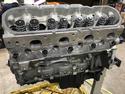

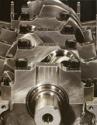



243 valve question.

I'd weigh the valves to see if I had the hollow intakes and sodium-filled exhaust valves. Maybe you got lucky.
First off, they aren't going to bore .005". Thats not enough material to use the boring bar. They're just going to hone it. The stock block isn't torque plate honed, so when the heads are bolted on, the cylinders aren't perfectly round or straight. Using a torque plate will simulate the heads being clamped on and will make the cylinders rounder and straighter when the engine is actually running. This will help seal the cylinder better.
The stock rings are 1.5/1.5/3.0mm thick. Some aftermarket pistons use smaller rings, like Wiseco with their 1.2/1.2/3.0mm rings and Mahle with their 1.0/1.0/2.0mm rings. Smaller rings have less friction and conform to the cylinder better so they will also seal the cylinder better.
If the shop takes advantage of both of those options while honing it .005" larger, it will be worth some power.
They told me they were re sleeving the block and putting new pistons in. Does this usually call for a bore, or do they just pop the old sleeves out and insert new ones?
If they're resleeving, that's a completely different animal. The LS1 iron sleeves are cast in place, so you have to bore out the old sleeves and press new ones in. There were a bunch of problems back in the day with sleeving the LS1 blocks, but personally, I would only trust one of the sponsors (RED in Cali for example) to sleeve an LS for me.
LS1 Tech Stories
The Best V8 Stories One Small Block at Time

Topdon ONE vs. Artidiag 800 BT2: Which is the Diagnostic Tablet For You?
Pouria Savadkouei
Gas Monkey Built a 6-Wheel Ferrari Testarossa With a Corvette LT4 Engine
Verdad Gallardo
7 Most Reliable High-Performance Engines GM Has Ever Built
Verdad Gallardo
Amazing '71 Camaro Restomod Is Modern Muscle Car Under the Skin
Verdad Gallardo
6 Common C5 Corvette Failures and What's Involved In Repairing Them
Pouria Savadkouei
Retro Modern Bandit Pontiac Trans AM Comes With Burt Reynolds' Autograph
Verdad Gallardo
Top 10 Greatest Cadillac V Series Performance Models Ever, Ranked
Pouria Savadkouei
Top 10 Most Powerful Chevy Trucks Ever Made!

Hennessey's New Supercharged Silverado ZR2 Has 700 HP
Verdad Gallardo Apparently there was a miscommunication about the work being done. I spoke with the main guy at the machine shop rebuilding my engine. He says they just gave the bores a light hone and and including new pistons to factory spec. He said the factory pistons and rings were two/thousanths smaller and the new pistons would give a better seal.
Are there rings you can put on the stock pistons to get a better seal, or are the stock rings good enough?
I'm wondering if it would be a good idea to upgrade to Clevite bearings or a thicker/better head gasket....or will the factory parts be fine. I don't plan on adding boost or nos.
Are there rings you can put on the stock pistons to get a better seal, or are the stock rings good enough?
I'm wondering if it would be a good idea to upgrade to Clevite bearings or a thicker/better head gasket....or will the factory parts be fine. I don't plan on adding boost or nos.
I just measured my intake and it's a 102mm.
I'm thinking of upgrading the valves while the heads are being worked. What's the max size valves I can use on a 3.90 stock bore? Is it the 2.4 and 1.6?
I'm thinking of upgrading the valves while the heads are being worked. What's the max size valves I can use on a 3.90 stock bore? Is it the 2.4 and 1.6?
The intake seats are only 2.02" so that is usually the max diameter. If the seats are replaced, you can go a lot bigger; 2.125" will fit easily. 1.6" is fine for the exhausts.
I planned on replacing the seats and using the biggest valves possible. I read somewhere that 2.125 and 1.6 for exhaust or these bigger valves would hurt low end torque. Is that true?
It could. Depends on too many variables, but if so, it's usually to boost horsepower.
The 243 heads had 60,000 miles when I got them. I.asked them if they were putting new seats in, and they said they are checking them. If any seats are worn they will replace them. Is that good practice? If nothing is wrong with them, should I opt for new seats?
There shouldn't be anything wrong with them unless the engine blew up or something. A simple valve job should be all you need.

Banned
Joined: Aug 2006
Posts: 326
Likes: 0
From: North Bay, CA
The actual valve job quality is more important than .020" in valve head size...and many guys don't even put the seat contact width at valve head diameter so you have wasted size....
I've picked up power and torque plenty of times by decreasing valve size and simply making the valve job correct, including times where shops have put in bigger valves to try to make more power, and because they do it wrong, the engine actually makes less power.
I've picked up power and torque plenty of times by decreasing valve size and simply making the valve job correct, including times where shops have put in bigger valves to try to make more power, and because they do it wrong, the engine actually makes less power.
The actual valve job quality is more important than .020" in valve head size...and many guys don't even put the seat contact width at valve head diameter so you have wasted size....
I've picked up power and torque plenty of times by decreasing valve size and simply making the valve job correct, including times where shops have put in bigger valves to try to make more power, and because they do it wrong, the engine actually makes less power.
I've picked up power and torque plenty of times by decreasing valve size and simply making the valve job correct, including times where shops have put in bigger valves to try to make more power, and because they do it wrong, the engine actually makes less power.
Ten different shops can put in larger valves for you and you can get 10 different results. There is more to it than just the size of the valves.
The guy rebuilding my engine says these handported heads are going to flow 30-40 hp more with just the stock 2.0 valves. I imagine it would be best to keep the 2.0 & 1.55 valves in, since they have been ported all ready. If I wanted to upgrade, they might charge me more for the blending etc, and take a bit longer. I think it's best to see what I get on the dyno with this set up, and if for some reason the heads have to come off again, I'll get them reworked with bigger valves.
He said Greg Good does the best hand porting in Houston, but he is way backed up. So he chose the next best head porter. I forgot his name, I will ask him and post to see if anyone has heard of him.
He said Greg Good does the best hand porting in Houston, but he is way backed up. So he chose the next best head porter. I forgot his name, I will ask him and post to see if anyone has heard of him.
