

ARP Head Stud Problem, and Solution

Thread Starter
TECH Resident
iTrader: (1)
Joined: Jan 2014
Posts: 897
Likes: 33
From: Colorado Springs, CO
 ARP Head Stud Problem, and Solution
 I'v been using ARP fasteners for many years. First time they've ever let me down.
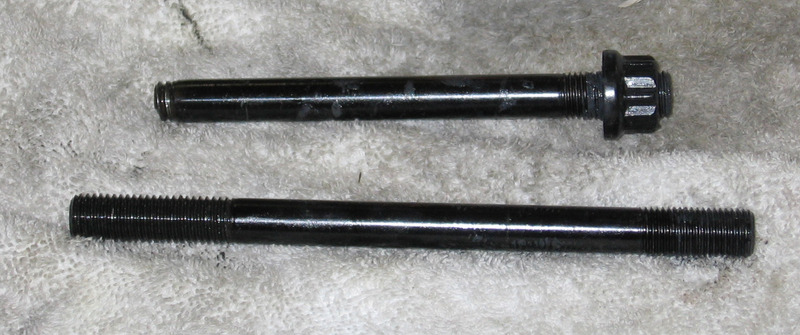


I had planned to have the engine nearly assembled by the end of the week end. But, now I have to buy a set of bolt extractors to get the broken stud out. And I won't get replacement parts until the middle or end of the week. Maybe I can get the engine assembled next week end.


I had planned to have the engine nearly assembled by the end of the week end. But, now I have to buy a set of bolt extractors to get the broken stud out. And I won't get replacement parts until the middle or end of the week. Maybe I can get the engine assembled next week end.
Thread Starter
TECH Resident
iTrader: (1)
Joined: Jan 2014
Posts: 897
Likes: 33
From: Colorado Springs, CO
I'm a big believer in reading and following directions that come with the parts. So here are the directions that I followed.
- Clean the washers with solvent prior to installation.
- Make sure the aluminum head surface is thoroughly clean and free of oil
- Install the washers
- lubricate the threads of the studs and the bottom of the nuts
- Torque in three steps, with the final torque to 100 ft/lbs.
I spoke a very nice gentleman at ARP a few minutes ago. They're going to send me a new set by overnight mail. But, he said there will be new instructions. The problem is that the washers are too smooth and slippery, even if everything is cleaned well. The washer acts like a Torrington bearing, and starts to spin. The stud snaps before proper torque is reached. It's a problem on the Chevy LS and Ford Modular engines.
Currently, the answer is two fold. After cleaning the washers, rough up one side with some coarse sand paper. That side goes against the aluminum head, and shouldn't be allowed to spin. I think I'll put a paint mark on the washers so I can observe for spinning. In the future, the washers will come with a texture one side that looks like fish scales.
Second, the torque spec will be reduced from 100 ft/lbs to 80 ft/lbs.
Over the last couple of years, I'v read about people breaking an ARP stud. But this is the first time I'v heard why, and what to do about it.
- Clean the washers with solvent prior to installation.
- Make sure the aluminum head surface is thoroughly clean and free of oil
- Install the washers
- lubricate the threads of the studs and the bottom of the nuts
- Torque in three steps, with the final torque to 100 ft/lbs.
I spoke a very nice gentleman at ARP a few minutes ago. They're going to send me a new set by overnight mail. But, he said there will be new instructions. The problem is that the washers are too smooth and slippery, even if everything is cleaned well. The washer acts like a Torrington bearing, and starts to spin. The stud snaps before proper torque is reached. It's a problem on the Chevy LS and Ford Modular engines.
Currently, the answer is two fold. After cleaning the washers, rough up one side with some coarse sand paper. That side goes against the aluminum head, and shouldn't be allowed to spin. I think I'll put a paint mark on the washers so I can observe for spinning. In the future, the washers will come with a texture one side that looks like fish scales.
Second, the torque spec will be reduced from 100 ft/lbs to 80 ft/lbs.
Over the last couple of years, I'v read about people breaking an ARP stud. But this is the first time I'v heard why, and what to do about it.
I'm a big believer in reading and following directions that come with the parts. So here are the directions that I followed.
- Clean the washers with solvent prior to installation.
- Make sure the aluminum head surface is thoroughly clean and free of oil
- Install the washers
- lubricate the threads of the studs and the bottom of the nuts
- Torque in three steps, with the final torque to 100 ft/lbs.
I spoke a very nice gentleman at ARP a few minutes ago. They're going to send me a new set by overnight mail. But, he said there will be new instructions. The problem is that the washers are too smooth and slippery, even if everything is cleaned well. The washer acts like a Torrington bearing, and starts to spin. The stud snaps before proper torque is reached. It's a problem on the Chevy LS and Ford Modular engines.
Currently, the answer is two fold. After cleaning the washers, rough up one side with some coarse sand paper. That side goes against the aluminum head, and shouldn't be allowed to spin. I think I'll put a paint mark on the washers so I can observe for spinning. In the future, the washers will come with a texture one side that looks like fish scales.
Second, the torque spec will be reduced from 100 ft/lbs to 80 ft/lbs.
Over the last couple of years, I'v read about people breaking an ARP stud. But this is the first time I'v heard why, and what to do about it.
- Clean the washers with solvent prior to installation.
- Make sure the aluminum head surface is thoroughly clean and free of oil
- Install the washers
- lubricate the threads of the studs and the bottom of the nuts
- Torque in three steps, with the final torque to 100 ft/lbs.
I spoke a very nice gentleman at ARP a few minutes ago. They're going to send me a new set by overnight mail. But, he said there will be new instructions. The problem is that the washers are too smooth and slippery, even if everything is cleaned well. The washer acts like a Torrington bearing, and starts to spin. The stud snaps before proper torque is reached. It's a problem on the Chevy LS and Ford Modular engines.
Currently, the answer is two fold. After cleaning the washers, rough up one side with some coarse sand paper. That side goes against the aluminum head, and shouldn't be allowed to spin. I think I'll put a paint mark on the washers so I can observe for spinning. In the future, the washers will come with a texture one side that looks like fish scales.
Second, the torque spec will be reduced from 100 ft/lbs to 80 ft/lbs.
Over the last couple of years, I'v read about people breaking an ARP stud. But this is the first time I'v heard why, and what to do about it.
Trending Topics
LS1 Tech Stories
The Best V8 Stories One Small Block at Time

6 Gifts Neither Your Dad Nor Grad Will Shove Into the 'Trinket Drawer'
Brett Foote
Topdon ONE vs. Artidiag 800 BT2: Which is the Diagnostic Tablet For You?
Pouria Savadkouei
Gas Monkey Built a 6-Wheel Ferrari Testarossa With a Corvette LT4 Engine
Verdad Gallardo
7 Most Reliable High-Performance Engines GM Has Ever Built
Verdad Gallardo
Amazing '71 Camaro Restomod Is Modern Muscle Car Under the Skin
Verdad Gallardo
6 Common C5 Corvette Failures and What's Involved In Repairing Them
Pouria Savadkouei
Retro Modern Bandit Pontiac Trans AM Comes With Burt Reynolds' Autograph
Verdad Gallardo
Top 10 Greatest Cadillac V Series Performance Models Ever, Ranked
Pouria Savadkouei
Top 10 Most Powerful Chevy Trucks Ever Made!


Thread Starter
TECH Resident
iTrader: (1)
Joined: Jan 2014
Posts: 897
Likes: 33
From: Colorado Springs, CO
The specs were 100 ft/lbs, clearly stated in the instruction. When I talked with the rep, he told me they were changing that spec from 100 to 80 ft/lbs.
If you look up the new instructions on the ARP web site, it says 85 ft/lbs. But it doesn't say anything about roughing up the washer, just that it needs to be clean and dry, no lube between the washer and the alum head surface.
In the past, I'v always lubed both sides of the washer before installation. Even though I'v installed ARP head studs many times, I read and followed the instructions anyway.
If you look up the new instructions on the ARP web site, it says 85 ft/lbs. But it doesn't say anything about roughing up the washer, just that it needs to be clean and dry, no lube between the washer and the alum head surface.
In the past, I'v always lubed both sides of the washer before installation. Even though I'v installed ARP head studs many times, I read and followed the instructions anyway.

Joined: Mar 2007
Posts: 1,151
Likes: 64
From: Saskatchewan, Canada - where arguing "DA" is for the slow and weak...
ARP has been flip-flopping on torque specs and installation procedures for years. Now you have to modified the parts before install? Laughable. It seems like they have been caught up in the "only game in town" mentality, and subsequently dropped the ball. Hell, I mentioned weeks ago the difficulty I suffered trying to get ARP studs into an aluminum block LS1 because ARP choose the wrong class of bolt thread to insert into a production part, and was told to pound salt as a result.
I have decided that if it isn't my only option, I will be shopping somewhere else for my critical fasteners.
I have decided that if it isn't my only option, I will be shopping somewhere else for my critical fasteners.


The specs were 100 ft/lbs, clearly stated in the instruction. When I talked with the rep, he told me they were changing that spec from 100 to 80 ft/lbs.
If you look up the new instructions on the ARP web site, it says 85 ft/lbs. But it doesn't say anything about roughing up the washer, just that it needs to be clean and dry, no lube between the washer and the alum head surface.
In the past, I'v always lubed both sides of the washer before installation. Even though I'v installed ARP head studs many times, I read and followed the instructions anyway.
If you look up the new instructions on the ARP web site, it says 85 ft/lbs. But it doesn't say anything about roughing up the washer, just that it needs to be clean and dry, no lube between the washer and the alum head surface.
In the past, I'v always lubed both sides of the washer before installation. Even though I'v installed ARP head studs many times, I read and followed the instructions anyway.
Joined: Mar 2007
Posts: 1,151
Likes: 64
From: Saskatchewan, Canada - where arguing "DA" is for the slow and weak...
https://www.fastenal.com/content/fed...0Fasteners.pdf
You don't need ARP's approval to torque something properly.
You don't need ARP's approval to torque something properly.
Last edited by mOtOrHeAd MiKe; Jan 24, 2017 at 09:59 PM.
Joined: Mar 2007
Posts: 1,151
Likes: 64
From: Saskatchewan, Canada - where arguing "DA" is for the slow and weak...
Fixed it, I was mobile and Google loves to monkey with links.
Exactly.
My point is that ARP didn't invent fastener standards, fancy lube or not; when in doubt check your sources.
Exactly.
My point is that ARP didn't invent fastener standards, fancy lube or not; when in doubt check your sources.