



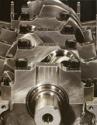



Horsepower seems to be down.

If he had an exhaust or intake restriction it would usually show up as downward sloping torque nearing redline, and the power would "cap" off. The torque is just as high at 2500 as it is nearing redline so we can clearly see that the cylinder is just as full at 2500 as it is nearing redline.
If he had an exhaust or intake restriction it would usually show up as downward sloping torque nearing redline, and the power would "cap" off. The torque is just as high at 2500 as it is nearing redline so we can clearly see that the cylinder is just as full at 2500 as it is nearing redline.
Again I think he's lacking some airflow. Lets do some math. A single 3" ID pipe has 7.065 sq inches of area in any one part of the system. A dual 2.5" ID system would have 9.8125 sq inches of area in any cross section of the exhaust. Dual 3s would give you 14.13 sq inches of area. A single 4 would give you 12.56 sq inches of area, and a single 3.5" would give you 9.61625 sq inches of area.
He should be running dual 2.5"s at the minimum or a single 3.5" (assuming 500 flywheel HP is the goal) given the size of the cam and how far up the RPM band he has moved the torque curve.
Other than the package being alittle oversized the motor seems healthy.
Personally if it were my truck and being it has a set of long tubes on it already I'd be asking the dyno guy if I could drop the exhaust at the header collectors and do a pull with open headers to confirm what I am thinking before I would purchase another part.
Last edited by kossuth; Mar 8, 2018 at 09:39 PM.
Thread Starter
Staging Lane
Joined: Nov 2009
Posts: 68
Likes: 0
From: Norman Park, GA
I ordered new compression tester and plan to try this weekend to see if that’s what’s causing the low reading before i swap cams and all and wind up in same boat. Tuner thinks it’s either compression down in a cylinder or cam just doesn’t fit this combo. The exhaust doesn’t “t” in from driver side to passenger side. It merges together in a y pipe for about 12” or so and then becomes a single.
I ordered new compression tester and plan to try this weekend to see if that’s what’s causing the low reading before i swap cams and all and wind up in same boat. Tuner thinks it’s either compression down in a cylinder or cam just doesn’t fit this combo. The exhaust doesn’t “t” in from driver side to passenger side. It merges together in a y pipe for about 12” or so and then becomes a single.
I ordered new compression tester and plan to try this weekend to see if that’s what’s causing the low reading before i swap cams and all and wind up in same boat. Tuner thinks it’s either compression down in a cylinder or cam just doesn’t fit this combo. The exhaust doesn’t “t” in from driver side to passenger side. It merges together in a y pipe for about 12” or so and then becomes a single.
LS1 Tech Stories
The Best V8 Stories One Small Block at Time

6 Common C5 Corvette Failures and What's Involved In Repairing Them
Pouria Savadkouei
Retro Modern Bandit Pontiac Trans AM Comes With Burt Reynolds' Autograph
Verdad Gallardo
Top 10 Greatest Cadillac V Series Performance Models Ever, Ranked
Pouria Savadkouei
Top 10 Most Powerful Chevy Trucks Ever Made!

Hennessey's New Supercharged Silverado ZR2 Has 700 HP
Verdad Gallardo
Coachbuilt N2A Anteros Is an LS2-Powered C6 Corvette In Italian Clothes
Verdad Gallardo
Awesome K5 Blazer Restomod Comes With C7 Corvette Power
Verdad Gallardo
10 Camaros You Should Never Buy

10 LS Engine Myths That Refuse to Die
Verdad Gallardo

That was what I meant in an earlier post. I made that mistake myself. But if you have a good merge, it is not the problem at your power level - like KCS said.

Launching!


Joined: Dec 2017
Posts: 241
Likes: 45
In for info. I doubt it's the cam. That cam looks really good for the setup. My build is 1996 c1500 SBE ls1, Frankenstein 243's, BTR Stage 2 LS3 225/238 ( really good deal on it local, planned on the stage 2-3 for ls1/2) and possibly hi ram as well. Good luck finding issue
you are looking for something that would affect cylinder fill across the board, but especially at 2500rpm. Thats the best way to look at this.
Could be:
-poor timing, low compression, injector tuning (injector phase)
-too high of octane fuel (you didnt use 116 did you...)
-Very hot, dyno IAT & low O2 conc. (was the engine sitting, running for a long time, esp. in an enclosed area, before the dyno pass, or at high altitude)
-dragging brakes (try pushing the vehicle by hand)
-poor converter performance / improper converter application
-unusually heavy drivetrain parts (are any of the drivetrain parts far more heavy than original, i.e. wheels, tires, driveshaft, transmission swaps (4l80e), etc..)
-Power robbing accessories like A/C compressor or smog pump dragging
-poor ignition performance (unlikely but, worth mentioning) it would have to be poor in every cylinder though, which is global and points to improper plug/pluggap/coil/wires or a mismatched head/cylinder shape causing poor distribution of fuel.
Stuff it probably isnt:
-air filter/air filter tube
-cam
-exhaust related
-head flow (unless some machining were done to the head that screwed them all up somehow)
cam theory:
If the cam were installed too far retarded the torque should be low to begin with. And the reverse if it were too advanced. The torque however fills the center like it should makes me think good cam degree in play. Low torque at 2500rpm could be **** cylinder fill from too much overlap and too large of header primary; which would correct itself and rise after around 5000rpm, which this dyno chart does not do, it has a good cylinder fill at 2500 which points to a well mated overlap/exhaust tube.
The way I would do this is compare torque from the same size engine with the same transmission. Find out where you WANT to be, what is the difference? Do most engines make 50 ft*lbs more? Then strike all the things off that list that wouldn't fill the difference, whatever is left is the next thing you check.
Judging by how good the curve is I want to say it was just a poor set of running conditions. I dont know how much torque is missing though so its just a guess. If you can, get the engine oil nice and hot, 200*F+ then let the whole engine/truck cool off completely so that the intake manifold is ambient temp again, the cylinder heads are almost cool to the touch. The oil will still be hot though. Restart the engine, give it a moment to thin the oil out again then make the dyno pass that way with the cooler parts and cooler underhood temps. I bet it would read 20+ higher. But that might not be enough for you.
Could be:
-poor timing, low compression, injector tuning (injector phase)
-too high of octane fuel (you didnt use 116 did you...)
-Very hot, dyno IAT & low O2 conc. (was the engine sitting, running for a long time, esp. in an enclosed area, before the dyno pass, or at high altitude)
-dragging brakes (try pushing the vehicle by hand)
-poor converter performance / improper converter application
-unusually heavy drivetrain parts (are any of the drivetrain parts far more heavy than original, i.e. wheels, tires, driveshaft, transmission swaps (4l80e), etc..)
-Power robbing accessories like A/C compressor or smog pump dragging
-poor ignition performance (unlikely but, worth mentioning) it would have to be poor in every cylinder though, which is global and points to improper plug/pluggap/coil/wires or a mismatched head/cylinder shape causing poor distribution of fuel.
Stuff it probably isnt:
-air filter/air filter tube
-cam
-exhaust related
-head flow (unless some machining were done to the head that screwed them all up somehow)
cam theory:
If the cam were installed too far retarded the torque should be low to begin with. And the reverse if it were too advanced. The torque however fills the center like it should makes me think good cam degree in play. Low torque at 2500rpm could be **** cylinder fill from too much overlap and too large of header primary; which would correct itself and rise after around 5000rpm, which this dyno chart does not do, it has a good cylinder fill at 2500 which points to a well mated overlap/exhaust tube.
The way I would do this is compare torque from the same size engine with the same transmission. Find out where you WANT to be, what is the difference? Do most engines make 50 ft*lbs more? Then strike all the things off that list that wouldn't fill the difference, whatever is left is the next thing you check.
Judging by how good the curve is I want to say it was just a poor set of running conditions. I dont know how much torque is missing though so its just a guess. If you can, get the engine oil nice and hot, 200*F+ then let the whole engine/truck cool off completely so that the intake manifold is ambient temp again, the cylinder heads are almost cool to the touch. The oil will still be hot though. Restart the engine, give it a moment to thin the oil out again then make the dyno pass that way with the cooler parts and cooler underhood temps. I bet it would read 20+ higher. But that might not be enough for you.
Thread Starter
Staging Lane
Joined: Nov 2009
Posts: 68
Likes: 0
From: Norman Park, GA
I will take all things into consideration you’ve mentioned. I have a list I’m that I’m going to start striking off and it’s the simple things first. Only thing I’ve thought of too is knock sensors and if tuner desensitized them of cut them off because if they are picking up false knock it would pull timing on the big end. I wasn’t at tuner shop the day he dynoed due to having a simple procedure done that day. As far as fuel i use 93 octane mixed with a couple gallon of 116 due to the nitrous I’ll be spraying and wanted to make sure i have good fuel. Only other question is possible could be ground wrong or be off? To be honest when vehicle is idling it sounds like a small cam, even though specs put it a little high but even people that have heard it says it sounds on the small side if that makes sense.

Ah there is the global 
Truly 87 octane gasoline has the most energy per unit weight of what we find common at stations. There is such thing as 0-octane "n-heptane" and I feel that examining the structures them selves (100-octane is 2,2,4 trimethylpentane) will yield some insight how they got those octane ratings. If you have some chemistry background
Truly 87 octane gasoline has the most energy per unit weight of what we find common at stations. There is such thing as 0-octane "n-heptane" and I feel that examining the structures them selves (100-octane is 2,2,4 trimethylpentane) will yield some insight how they got those octane ratings. If you have some chemistry background