







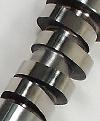


LSK lobes...

The lobes are great as long as you set the valvetrain up properly, ie proper spring selection, proper spring pressure, proper rocker rocker/lifter (stock works great). I have 0 valve float issues with my TRak cam.
LSK lobes have the benefit of kinder, gentler ramps off the seat (for longer seat life) and faster ramps past .050" with greater lift (for more power).
LSK lobes have the benefit of kinder, gentler ramps off the seat (for longer seat life) and faster ramps past .050" with greater lift (for more power).
__________________

2013 Corvette Grand Sport A6 LME forged 416, Greg Good ported TFS 255 LS3 heads, 222/242 .629"/.604" 121LSA Pat G blower cam, ARH 1 7/8" headers, ESC Novi 1500 Supercharger w/8 rib direct drive conversion, 747rwhp/709rwtq on 93 octane, 801rwhp/735rwtq on race fuel, 10.1 @ 147.25mph 1/4 mile, 174.7mph Half Mile.
2016 Corvette Z51 M7 Magnuson Heartbeat 2300 supercharger, TSP LT headers, Pat G tuned, 667rwhp, 662rwtq, 191mph TX Mile.
2009.5 Pontiac G8 GT 6.0L, A6, AFR 230v2 heads. 506rwhp/442rwtq. 11.413 @ 121.29mph 1/4 mile, 168.7mph TX Mile
2000 Pewter Ram Air Trans Am M6 heads/cam 508 rwhp/445 rwtq SAE, 183.092 TX Mile
2022 Cadillac Escalade 6.2L A10 S&B CAI, Corsa catback.
2023 Corvette 3LT Z51 soon to be modified.
Custom LSX tuning in person or via email press here.
2013 Corvette Grand Sport A6 LME forged 416, Greg Good ported TFS 255 LS3 heads, 222/242 .629"/.604" 121LSA Pat G blower cam, ARH 1 7/8" headers, ESC Novi 1500 Supercharger w/8 rib direct drive conversion, 747rwhp/709rwtq on 93 octane, 801rwhp/735rwtq on race fuel, 10.1 @ 147.25mph 1/4 mile, 174.7mph Half Mile.
2016 Corvette Z51 M7 Magnuson Heartbeat 2300 supercharger, TSP LT headers, Pat G tuned, 667rwhp, 662rwtq, 191mph TX Mile.
2009.5 Pontiac G8 GT 6.0L, A6, AFR 230v2 heads. 506rwhp/442rwtq. 11.413 @ 121.29mph 1/4 mile, 168.7mph TX Mile
2000 Pewter Ram Air Trans Am M6 heads/cam 508 rwhp/445 rwtq SAE, 183.092 TX Mile
2022 Cadillac Escalade 6.2L A10 S&B CAI, Corsa catback.
2023 Corvette 3LT Z51 soon to be modified.
Custom LSX tuning in person or via email press here.
Originally Posted by Beast96Z
Any clues as to what they are geared for.....

TECH Resident
Joined: Sep 2003
Posts: 848
Likes: 1
From: Working in the shop 24/7

Originally Posted by Patrick G
Enthusiasts with heads that flow well in the .600-.700" range, enthusiasts that are willing to add the proper valvetrain components (a little $$ premium compared to running XE-R lobes) to make them work as intended, enthusiasts with a matched combination of intake/heads/block/chassis for the intended application, and the LSK lobes are geared for enthusiasts who don't believe everything they read on the internet. They work.

Trending Topics
Originally Posted by Patrick G
Enthusiasts with heads that flow well in the .600-.700" range, enthusiasts that are willing to add the proper valvetrain components (a little $$ premium compared to running XE-R lobes) to make them work as intended, enthusiasts with a matched combination of intake/heads/block/chassis for the intended application, and the LSK lobes are geared for enthusiasts who don't believe everything they read on the internet. They work.
LS1 Tech Stories
The Best V8 Stories One Small Block at Time

Gas Monkey Built a 6-Wheel Ferrari Testarossa With a Corvette LT4 Engine
Verdad Gallardo
7 Most Reliable High-Performance Engines GM Has Ever Built
Verdad Gallardo
Amazing '71 Camaro Restomod Is Modern Muscle Car Under the Skin
Verdad Gallardo
6 Common C5 Corvette Failures and What's Involved In Repairing Them
Pouria Savadkouei
Retro Modern Bandit Pontiac Trans AM Comes With Burt Reynolds' Autograph
Verdad Gallardo
Top 10 Greatest Cadillac V Series Performance Models Ever, Ranked
Pouria Savadkouei
Top 10 Most Powerful Chevy Trucks Ever Made!

Hennessey's New Supercharged Silverado ZR2 Has 700 HP
Verdad Gallardo
Coachbuilt N2A Anteros Is an LS2-Powered C6 Corvette In Italian Clothes
Verdad Gallardo TECH Resident
Joined: Sep 2003
Posts: 848
Likes: 1
From: Working in the shop 24/7
Originally Posted by Beast96Z
So my ETP 265 cc 11* heads with PSI 1225 premium springs (.700") along with Xledyne retainers/locks, 454 ci LS2, and a Harrop 8 TB intake might work ok with them huh?
Ed

TECH Resident
Joined: Dec 2004
Posts: 881
Likes: 1
Mr. Beast, you aren' running a solid roller cam?
Pat is right on everything except limiting to heads that flow well in the .600-.700 range. It will work well on all heads, even those with a slight loss above .6"
Remember, even with these lobes, the valve is open over .6" for maybe 40-60 degrees. And even there it flow more than at .4". However, these cams open the valve sooner and have more time above .2", .3", 4", and .5" then lobes with less aggressive opening.
For example, the LSK 231@.050 is a 281 @ .006. The XER 232 is also 281@.006. However the LSK is 156 @ .2", vs. 153 for the XE-R. The 156deg number falls between the 234 and 236 XE-Rs. It is like a 4deg bigger cam without the overlap or loss of dynamic compression.
Keep in mind, the most aggressive hydraulic roller profiles are comparable to the least aggressive solid roller profiles.
Mr. Beast, regardless of application (street, track), that engine really wants a solid roller!!! Take a TK lobe for example. At the 281deg seat time of the LSK 231@.050 lobe, the TK lobe has 253 deg @ .050. At .200" lobe lift, the comparison is 179 vs 156. Now you probably have to spot the LSK 5-10 deg because of the lash.
Pat is right on everything except limiting to heads that flow well in the .600-.700 range. It will work well on all heads, even those with a slight loss above .6"
Remember, even with these lobes, the valve is open over .6" for maybe 40-60 degrees. And even there it flow more than at .4". However, these cams open the valve sooner and have more time above .2", .3", 4", and .5" then lobes with less aggressive opening.
For example, the LSK 231@.050 is a 281 @ .006. The XER 232 is also 281@.006. However the LSK is 156 @ .2", vs. 153 for the XE-R. The 156deg number falls between the 234 and 236 XE-Rs. It is like a 4deg bigger cam without the overlap or loss of dynamic compression.
Keep in mind, the most aggressive hydraulic roller profiles are comparable to the least aggressive solid roller profiles.
Mr. Beast, regardless of application (street, track), that engine really wants a solid roller!!! Take a TK lobe for example. At the 281deg seat time of the LSK 231@.050 lobe, the TK lobe has 253 deg @ .050. At .200" lobe lift, the comparison is 179 vs 156. Now you probably have to spot the LSK 5-10 deg because of the lash.
Last edited by DavidNJ; Dec 28, 2005 at 05:18 PM.
Originally Posted by DavidNJ
Mr. Beast, you aren' running a solid roller cam?
Pat is right on everything except limiting to heads that flow well in the .600-.700 range. It will work well on all heads, even those with a slight loss above .6"
Remember, even with these lobes, the valve is open over .6" for maybe 40-60 degrees. And even there it flow more than at .4". However, these cams open the valve sooner and have more time above .2", .3", 4", and .5" then lobes with less aggressive opening.
Keep in mind, the most aggressive hydraulic roller profiles are comparable to the least aggressive solid roller profiles.
Mr. Beast, regardless of application (street, track), that engine really wants a solid roller!!! Take a TK lobe for example. At the 281deg seat time of the LSK 231@.050 lobe, the TK lobe has 253 deg @ .050. At .200" lobe lift, the comparison is 179 vs 156. No you probably have to spot the LSK 5-10 deg because of the lash.
Pat is right on everything except limiting to heads that flow well in the .600-.700 range. It will work well on all heads, even those with a slight loss above .6"
Remember, even with these lobes, the valve is open over .6" for maybe 40-60 degrees. And even there it flow more than at .4". However, these cams open the valve sooner and have more time above .2", .3", 4", and .5" then lobes with less aggressive opening.
Keep in mind, the most aggressive hydraulic roller profiles are comparable to the least aggressive solid roller profiles.
Mr. Beast, regardless of application (street, track), that engine really wants a solid roller!!! Take a TK lobe for example. At the 281deg seat time of the LSK 231@.050 lobe, the TK lobe has 253 deg @ .050. At .200" lobe lift, the comparison is 179 vs 156. No you probably have to spot the LSK 5-10 deg because of the lash.
__________________
2013 Corvette Grand Sport A6 LME forged 416, Greg Good ported TFS 255 LS3 heads, 222/242 .629"/.604" 121LSA Pat G blower cam, ARH 1 7/8" headers, ESC Novi 1500 Supercharger w/8 rib direct drive conversion, 747rwhp/709rwtq on 93 octane, 801rwhp/735rwtq on race fuel, 10.1 @ 147.25mph 1/4 mile, 174.7mph Half Mile.
2016 Corvette Z51 M7 Magnuson Heartbeat 2300 supercharger, TSP LT headers, Pat G tuned, 667rwhp, 662rwtq, 191mph TX Mile.
2009.5 Pontiac G8 GT 6.0L, A6, AFR 230v2 heads. 506rwhp/442rwtq. 11.413 @ 121.29mph 1/4 mile, 168.7mph TX Mile
2000 Pewter Ram Air Trans Am M6 heads/cam 508 rwhp/445 rwtq SAE, 183.092 TX Mile
2022 Cadillac Escalade 6.2L A10 S&B CAI, Corsa catback.
2023 Corvette 3LT Z51 soon to be modified.
Custom LSX tuning in person or via email press here.
2013 Corvette Grand Sport A6 LME forged 416, Greg Good ported TFS 255 LS3 heads, 222/242 .629"/.604" 121LSA Pat G blower cam, ARH 1 7/8" headers, ESC Novi 1500 Supercharger w/8 rib direct drive conversion, 747rwhp/709rwtq on 93 octane, 801rwhp/735rwtq on race fuel, 10.1 @ 147.25mph 1/4 mile, 174.7mph Half Mile.
2016 Corvette Z51 M7 Magnuson Heartbeat 2300 supercharger, TSP LT headers, Pat G tuned, 667rwhp, 662rwtq, 191mph TX Mile.
2009.5 Pontiac G8 GT 6.0L, A6, AFR 230v2 heads. 506rwhp/442rwtq. 11.413 @ 121.29mph 1/4 mile, 168.7mph TX Mile
2000 Pewter Ram Air Trans Am M6 heads/cam 508 rwhp/445 rwtq SAE, 183.092 TX Mile
2022 Cadillac Escalade 6.2L A10 S&B CAI, Corsa catback.
2023 Corvette 3LT Z51 soon to be modified.
Custom LSX tuning in person or via email press here.
Originally Posted by DavidNJ
Mr. Beast, you aren' running a solid roller cam?
Pat is right on everything except limiting to heads that flow well in the .600-.700 range. It will work well on all heads, even those with a slight loss above .6"
Remember, even with these lobes, the valve is open over .6" for maybe 40-60 degrees. And even there it flow more than at .4". However, these cams open the valve sooner and have more time above .2", .3", 4", and .5" then lobes with less aggressive opening.
For example, the LSK 231@.050 is a 281 @ .006. The XER 232 is also 281@.006. However the LSK is 156 @ .2", vs. 153 for the XE-R. The 156deg number falls between the 234 and 236 XE-Rs. It is like a 4deg bigger cam without the overlap or loss of dynamic compression.
Keep in mind, the most aggressive hydraulic roller profiles are comparable to the least aggressive solid roller profiles.
Mr. Beast, regardless of application (street, track), that engine really wants a solid roller!!! Take a TK lobe for example. At the 281deg seat time of the LSK 231@.050 lobe, the TK lobe has 253 deg @ .050. At .200" lobe lift, the comparison is 179 vs 156. Now you probably have to spot the LSK 5-10 deg because of the lash.
Pat is right on everything except limiting to heads that flow well in the .600-.700 range. It will work well on all heads, even those with a slight loss above .6"
Remember, even with these lobes, the valve is open over .6" for maybe 40-60 degrees. And even there it flow more than at .4". However, these cams open the valve sooner and have more time above .2", .3", 4", and .5" then lobes with less aggressive opening.
For example, the LSK 231@.050 is a 281 @ .006. The XER 232 is also 281@.006. However the LSK is 156 @ .2", vs. 153 for the XE-R. The 156deg number falls between the 234 and 236 XE-Rs. It is like a 4deg bigger cam without the overlap or loss of dynamic compression.
Keep in mind, the most aggressive hydraulic roller profiles are comparable to the least aggressive solid roller profiles.
Mr. Beast, regardless of application (street, track), that engine really wants a solid roller!!! Take a TK lobe for example. At the 281deg seat time of the LSK 231@.050 lobe, the TK lobe has 253 deg @ .050. At .200" lobe lift, the comparison is 179 vs 156. Now you probably have to spot the LSK 5-10 deg because of the lash.
Ed, I noticed in some of your other threads you talked about how you like a fast ramp on the exaust side. It made me wonder why Comp's XFI lobes have a less aggressive set of lobes set aside for the exaust. Seems that one would want the aggressive pattern on both sides instead of a slower exaust opening. Do you have any insight into that line of lobes?
TECH Resident
Joined: Dec 2004
Posts: 881
Likes: 1
Well, I'm not Ed. However...
Generally the exhausts have a very fast opening off the seat, then soften near the top and have a slow close. There is no advantage to have a fast exhaust close on a race engine. Since the valve is quite hot, it is not something you really want to slam close. By contrast, the intake has just had cool air blowing on it before it closes.
On a street engine, a late closing throwing gas out the exhaust is not a good thing for emissions.
Mr. Beast, with that setup, the hydraulic lifter really is in a different league. Some others should chime in...you have 265 11deg heads with BBC flow levels, indiviudal port throttle bodies, Jesel rockers, and a BBC sized engine.
The 1225 takes advantage of ET's big spring pocket. However it is a flat tappet spring...similar to a Comp 26094.
That head and engine probably would like over .7" lift. probably a spring with specs of over 200# on the seat and in the high 500s or low 600s over the nose.
The only way to get that is to go solid. While not common on mass market street engines meeting emissions (which can't describe your motor), they were used in all performance Corvettes in the 60's (LT1, L71), Z28s, Boss 302s, Boss 351, etc. My Supra is solid. I can't detect any lifter noise...even with a stock exhaust.
Are you using Morel or Schubeck lifters?
Generally the exhausts have a very fast opening off the seat, then soften near the top and have a slow close. There is no advantage to have a fast exhaust close on a race engine. Since the valve is quite hot, it is not something you really want to slam close. By contrast, the intake has just had cool air blowing on it before it closes.
On a street engine, a late closing throwing gas out the exhaust is not a good thing for emissions.
Mr. Beast, with that setup, the hydraulic lifter really is in a different league. Some others should chime in...you have 265 11deg heads with BBC flow levels, indiviudal port throttle bodies, Jesel rockers, and a BBC sized engine.
The 1225 takes advantage of ET's big spring pocket. However it is a flat tappet spring...similar to a Comp 26094.
That head and engine probably would like over .7" lift. probably a spring with specs of over 200# on the seat and in the high 500s or low 600s over the nose.
The only way to get that is to go solid. While not common on mass market street engines meeting emissions (which can't describe your motor), they were used in all performance Corvettes in the 60's (LT1, L71), Z28s, Boss 302s, Boss 351, etc. My Supra is solid. I can't detect any lifter noise...even with a stock exhaust.
Are you using Morel or Schubeck lifters?

TECH Junkie
Joined: Aug 2002
Posts: 3,726
Likes: 0
From: Fort Collins, CO
Originally Posted by Beast96Z
So my ETP 265 cc 11* heads with PSI 1225 premium springs (.700") along with Xledyne retainers/locks, 454 ci LS2, and a Harrop 8 TB intake might work ok with them huh?
Welcome to the world of LS1's...

I will be trying the lsk 239 at .050 intake lobe on a customers car very very soon. Just some careful attention to detail seems to be the key according to those who've had success with them, one being in this thread
Originally Posted by Ben R
All that and you're not using a solid lifter valvetrain?
Welcome to the world of LS1's...
Welcome to the world of LS1's...
Especially with the heads, intake, and size of the motor Beast intends to run. David, I'm trying to figure out why it seems iminent that I run a solid. I see no reason for it unless i was trying to build a all out 8k rpm strip motor. All the parts I listed above, plus a big solid roller will equal big rpm's, and that's not what I'm looking for. I'm figuring something in the 250ish range with .650" lift and a peak of 7k rpm's max. With the cubes and the longer runner of the Harrop intake, I don't think it will be a problem. If I were trying to get every last hp out of the motor, then yes, I'd go solid. But I'm trying to seek some longevity out of this thing. I'm also using the Morel lifters.
TECH Resident
Joined: Dec 2004
Posts: 881
Likes: 1
Revs aren't the issue here. BBC's don't spin to 8k on the fly.
The reason for solids (in this case) are because there isn't a hydraulic cam that is suited to those heads. Hydraulic lifters have limitations.
The broadest power curve with the best street drivablity will come with a solid cam. Probably .7" or a little more lift. A program I use (I actually took the time to program this combo!) came out peaking somewhere in the mid 600s, with around a 590hp average between 3250 and 6500 (the range it was set to optimize for). It liked a cam like 262/272 112/+7 with around .75" lift. It torque peaked at 5500 and power at 6250.
I don't think you will find a hydraulic roller that can do that.
The reason for solids (in this case) are because there isn't a hydraulic cam that is suited to those heads. Hydraulic lifters have limitations.
The broadest power curve with the best street drivablity will come with a solid cam. Probably .7" or a little more lift. A program I use (I actually took the time to program this combo!) came out peaking somewhere in the mid 600s, with around a 590hp average between 3250 and 6500 (the range it was set to optimize for). It liked a cam like 262/272 112/+7 with around .75" lift. It torque peaked at 5500 and power at 6250.
I don't think you will find a hydraulic roller that can do that.
Dave, does your program actually have a LS-1 file or is it just another simulation that dosen't take in LSX parameters? The LSX motor in itself is far diffrent when it comes to what parameters do what. They just don't act the same as the older motors for some reason. Personally, I'd be completly appauled if this combo only made 590hp on motor at 6500 rpm's. I personally plan to hit around 700 hp on motor (650 rwhp) by 7k rpm's with a hydraulic roller. Some of the graphs I recieved from Harrop show there 427's making 625 rwhp at 6100 rpm's with 240ish cams. I know the lifters have limitations, so that's why I'm probablly going to use the LSK lobes. They provide the most lift avalible and still have a easier lobe than the XE-R. The 1225 PSI springs should be able to control them quite easily. I've seen far worse CI to cc to cam size parameters work just fine. I'm not trying ot say your wrong at all. I just don't think you have to have a solid roller to promote proper cylinder filling.
TECH Resident
Joined: Dec 2004
Posts: 881
Likes: 1
I used Performance Trends Engne Analyzer Plus. I put in the actual head flow numbers from the ET site. Input cam specs as duration @ .050, max lobe lift, and icl/ecl. Used aggressive solid roller and aggressive hydralulic roller default profiles because I didn't have a cam doctor file. Used 11:1 compression, compact wedge chamber, 6.125 rod, 4.200x4.125 engine. Picked 2.25 individual tb manifold from their spec page, used headers that were 1.87x32. Used huge 1900cfm exhaust.
The peak was 678 @ 6250. The average from 3250 to 6500 was 590+. When I asked it to optimize intake and exhaust duraton, lift, and cl, max average hp was the goal and 10psi idle vacuum was the restriction. It optimizes by brute force.
If the optimization range was set from 4000-7000, peak power was the goal, or idle vacuum wasn't an issue, the results would have been different. However, you specified that this was a street car.
This is not as good as Engine Analyser Pro, but a nice first order.
Note: Is that the most Harrop has seen? There is always the question if their TBs are big enough for engines with more than 600hp. Was that achieved with their 52mm or 55mm TB?
The peak was 678 @ 6250. The average from 3250 to 6500 was 590+. When I asked it to optimize intake and exhaust duraton, lift, and cl, max average hp was the goal and 10psi idle vacuum was the restriction. It optimizes by brute force.
If the optimization range was set from 4000-7000, peak power was the goal, or idle vacuum wasn't an issue, the results would have been different. However, you specified that this was a street car.
This is not as good as Engine Analyser Pro, but a nice first order.
Note: Is that the most Harrop has seen? There is always the question if their TBs are big enough for engines with more than 600hp. Was that achieved with their 52mm or 55mm TB?