






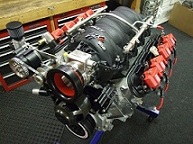



Vengence Vindicator .022" Piston To Valve WTF?

Originally Posted by MeentSS02
Good info...and as witnessed by one of the videos I saw of your car, you can bang the gears like a ****.
Originally Posted by JimMueller
If .080/.100 is the general minimum for a solid valvetrain, what is the minimum/ideal recommended for a hydraulic valvetrain?
Originally Posted by brad8266
More than that. read post 58
Originally Posted by JimMueller
I already did. Tony makes generalizations about the PTV possibly dropping >=.05 and says it needs 'more'. I'd like 'more' converted into a numeric value range. Is he saying that because it can drop .05, that we need to run at least .05 more on hydraulic than on solid?
I would try to keep it at the .080/.100
In most situations you dont plan for or hope will never happen (over rev, missed shift, parts breakage allowing the engine to flare instantly, etc., etc.) that should be enough to keep you out of serious trouble.
But the more aggressive the cam and the higher the RPM, the more you want to see that spec and then some (if possible) with a hyd. roller set-up.
As I mentioned previously, a solid roller has much better valve control when things go astray and as such offer a little more room for error.
This is a topic that will vary with each engine builder that you poll, but if it was an engine I was building I would keep it at the textbook .080/.100
Half the battle with that is checking it properly (you need a welded or solid lifter to do so) but thats another situation entirely.
It all comes down to when the gamble isnt worth the time and money it may take to flycut, and IMO, if your under the specs mentioned above break out the flycutting tool IF you want a reasonable margin of error from a mishap.
Tony

TECH Senior Member
Joined: Mar 2004
Posts: 14,620
Likes: 17
From: BFE
Originally Posted by Tony Mamo @ AFR
Is most of you are talking about hydraulic rollers.....the textbook .080/.100 minimums were more aimed towards a solid valvetrain although a properly set-up solid valvetrain could be tweaked tighter.
A hydraulic roller valvetrain at the RPM levels most of us routunely spin them to (7K ish) is always on the verge of valvefloat and in fact all suffer from varying degree of valve control loss at those RPM's. What does that mean....it means the valves aren't precisely following the cam lobe any longer and what started as .076 P to V is now .020 or worse. Many of you are lightly tagging pistons and wont know about it till your engine comes apart and see the small eyebrows in the pistons the valves started forming from lightly tagging at high RPM's.
A high revving hyraulic roller set-up needs more P to V than a similar solid roller set-up. A solid roller has no lifters pumping up and bleeding down with oil creating potential stability issues and also has the benefit of more seat and open pressure to keep that cam lobe (and valve) glued to the lifter and following the exact events the valve and piston have in relation to one another (and making more power by being able to do so).
I also agree that running less piston to valve is a better gamble with an A4 car, but none the less the operative word is gamble. I'm a pretty good manual transmission driver as I have been banging gears as long as some of you reading this have been on the planet and all I can tell you with a manual trans car is stuff happens....I missed a shift trying to pull 3-4 in a nanosecond and hit 2nd instead of 4th....it happens to the best of us with a tight "H" pattern shifter. Needless to say I logged 8508 RPM's and I felt I clutched in and saved it pretty quickly (oooops!). This was with my solid roller 383 I normally shift around 7300....if I had a hydraulic roller and even the textbook minimum P to V clearance I would have bent a bunch of valves if I was lucky or simply grenaded the engine. Moral of the story is you have to be more conservative with an aggressive hyd. roller combination and pushing those tolerances closer and closer just begins to quickly narrow your window for a mishap. And dont think "it wont happen to me"....it will and it's just a matter of time.
IMO if you have much less than the .080/.100 rule, take the extra time to notch your pistons.....its really not that big a deal.
Tony M.
A hydraulic roller valvetrain at the RPM levels most of us routunely spin them to (7K ish) is always on the verge of valvefloat and in fact all suffer from varying degree of valve control loss at those RPM's. What does that mean....it means the valves aren't precisely following the cam lobe any longer and what started as .076 P to V is now .020 or worse. Many of you are lightly tagging pistons and wont know about it till your engine comes apart and see the small eyebrows in the pistons the valves started forming from lightly tagging at high RPM's.
A high revving hyraulic roller set-up needs more P to V than a similar solid roller set-up. A solid roller has no lifters pumping up and bleeding down with oil creating potential stability issues and also has the benefit of more seat and open pressure to keep that cam lobe (and valve) glued to the lifter and following the exact events the valve and piston have in relation to one another (and making more power by being able to do so).
I also agree that running less piston to valve is a better gamble with an A4 car, but none the less the operative word is gamble. I'm a pretty good manual transmission driver as I have been banging gears as long as some of you reading this have been on the planet and all I can tell you with a manual trans car is stuff happens....I missed a shift trying to pull 3-4 in a nanosecond and hit 2nd instead of 4th....it happens to the best of us with a tight "H" pattern shifter. Needless to say I logged 8508 RPM's and I felt I clutched in and saved it pretty quickly (oooops!). This was with my solid roller 383 I normally shift around 7300....if I had a hydraulic roller and even the textbook minimum P to V clearance I would have bent a bunch of valves if I was lucky or simply grenaded the engine. Moral of the story is you have to be more conservative with an aggressive hyd. roller combination and pushing those tolerances closer and closer just begins to quickly narrow your window for a mishap. And dont think "it wont happen to me"....it will and it's just a matter of time.
IMO if you have much less than the .080/.100 rule, take the extra time to notch your pistons.....its really not that big a deal.
Tony M.
Last edited by PREDATOR-Z; Mar 29, 2007 at 01:12 AM.
Originally Posted by brad8266
I saw that vid too, he was hitting them quick.
Looks like Tony is reaching that 7k-ish rpm alright. And, yes, nice shifting but he jumped the gun lol.
LS1 Tech Stories
The Best V8 Stories One Small Block at Time

6 Common C5 Corvette Failures and What's Involved In Repairing Them
Pouria Savadkouei
Retro Modern Bandit Pontiac Trans AM Comes With Burt Reynolds' Autograph
Verdad Gallardo
Top 10 Greatest Cadillac V Series Performance Models Ever, Ranked
Pouria Savadkouei
Top 10 Most Powerful Chevy Trucks Ever Made!

Hennessey's New Supercharged Silverado ZR2 Has 700 HP
Verdad Gallardo
Coachbuilt N2A Anteros Is an LS2-Powered C6 Corvette In Italian Clothes
Verdad Gallardo
Awesome K5 Blazer Restomod Comes With C7 Corvette Power
Verdad Gallardo
10 Camaros You Should Never Buy

