









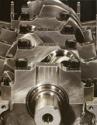


Let's talk Aluminum blocks

Thread Starter
Joined: Jun 2005
Posts: 5,221
Likes: 1
From: Skiatook, OK
 Let's talk Aluminum blocks
 Ok, so I'm goin to start a build up of a stock 2000 Ls block. I have never assembled an entire engine to date, so this will be a first for me. I have a couple question I'd like to get anwsered if you guys could.
I'm not sure exactly what to ask the machine shop to do with this block. I do know it has to be jet washed instead of vatted since it's Aluminum. And I know I'll need it honed to fit the 3.905 Diamond pistons I'm gonna run.
Is there anything else I should ask them to do??
Also there was a spun bearing before the motor was tore down, so I'm pretty sure I'll have to have the crank re-ground. So that means I'll probably have to find a little different bearings(rod & main) than normal correct??
I have already contacted a shop about balancing my internals & having the crank ground. So I was also wondering about weather or not to have the internal balancing stuff done first. My reason for asking is that I have heard of some machine shops align honing the mains. So if the crank is gonna get ground, wouldn't I need to get that done first before taking the block into the machine shop??
And I wanted to paint the block Blue to match my valve/timing covers, but I have heard both that it's ok & that it's not. If any professional engine builders could comment on this with some concrete facts I'd greatly appreciate it. I know the Aluminum by nature will loose heat easier than a iron block, but I wouldn't imagine a thin coat of paint would hurt it that much. But I want to be 100% sure it's not harmful to the block in the long run before actually painting it.
Sorry if some of these questions are easily anwsered but I have been reading thru threads for days on end & haven't found exact anwsers on these questions. Thankx in advance for any help.
I'm not sure exactly what to ask the machine shop to do with this block. I do know it has to be jet washed instead of vatted since it's Aluminum. And I know I'll need it honed to fit the 3.905 Diamond pistons I'm gonna run.
Is there anything else I should ask them to do??
Also there was a spun bearing before the motor was tore down, so I'm pretty sure I'll have to have the crank re-ground. So that means I'll probably have to find a little different bearings(rod & main) than normal correct??
I have already contacted a shop about balancing my internals & having the crank ground. So I was also wondering about weather or not to have the internal balancing stuff done first. My reason for asking is that I have heard of some machine shops align honing the mains. So if the crank is gonna get ground, wouldn't I need to get that done first before taking the block into the machine shop??
And I wanted to paint the block Blue to match my valve/timing covers, but I have heard both that it's ok & that it's not. If any professional engine builders could comment on this with some concrete facts I'd greatly appreciate it. I know the Aluminum by nature will loose heat easier than a iron block, but I wouldn't imagine a thin coat of paint would hurt it that much. But I want to be 100% sure it's not harmful to the block in the long run before actually painting it.
Sorry if some of these questions are easily anwsered but I have been reading thru threads for days on end & haven't found exact anwsers on these questions. Thankx in advance for any help.
I'm not sure exactly what to ask the machine shop to do with this block. I do know it has to be jet washed instead of vatted since it's Aluminum. And I know I'll need it honed to fit the 3.905 Diamond pistons I'm gonna run.
Is there anything else I should ask them to do??
Also there was a spun bearing before the motor was tore down, so I'm pretty sure I'll have to have the crank re-ground. So that means I'll probably have to find a little different bearings(rod & main) than normal correct??
I have already contacted a shop about balancing my internals & having the crank ground. So I was also wondering about weather or not to have the internal balancing stuff done first. My reason for asking is that I have heard of some machine shops align honing the mains. So if the crank is gonna get ground, wouldn't I need to get that done first before taking the block into the machine shop??
Hopefully the crank isn't so messed up they can't turn it. If they turn your crank .010", you will need a .010" undersize bearing generally and so on. This is to get you started. I'm not sure how accurate and presice you are trying to make your clearances but you should pick your bearings to acheive the proper clearance.
I would have them chamfer the oil holes on the crankshaft. Have them balance the rotating assembly. They need the entire rotating assembly usually, balancer, flywheel, rods, pistons, crank.
Since that motor spun a main last time I'd have them align hone the mains.
I am no pro though, I've only built a few.
Thread Starter
Joined: Jun 2005
Posts: 5,221
Likes: 1
From: Skiatook, OK
Hey Jordan, Carbone racing here in town told me all they needed to balance my stuff was my pistons, rings, crank, bearings & rods. No balancer or flywheel. How much of a difference is that gonna make??
The crank isn't super bad. I just don't want to attempt to get by with only having it polished. You can feel a uneven surface with a fingernail, so hopefully they can just barely turn it.
The crank isn't super bad. I just don't want to attempt to get by with only having it polished. You can feel a uneven surface with a fingernail, so hopefully they can just barely turn it.
Hey Jordan, Carbone racing here in town told me all they needed to balance my stuff was my pistons, rings, crank, bearings & rods. No balancer or flywheel. How much of a difference is that gonna make??
The crank isn't super bad. I just don't want to attempt to get by with only having it polished. You can feel a uneven surface with a fingernail, so hopefully they can just barely turn it.
The crank isn't super bad. I just don't want to attempt to get by with only having it polished. You can feel a uneven surface with a fingernail, so hopefully they can just barely turn it.
Thread Starter
Joined: Jun 2005
Posts: 5,221
Likes: 1
From: Skiatook, OK
I'd rather not pay someone else to assemble it. I like doin this kinda stuff. I did my H/C swap no problem, so I'm confident with the right specs & tool that I can do this just fine.
Trending Topics
I'm tryin to do this as much within my budget as I can. I'll be workin on this probably till the end of the year between buyin all the parts, getting the machine stuff done & then my assembly.
I'd rather not pay someone else to assemble it. I like doin this kinda stuff. I did my H/C swap no problem, so I'm confident with the right specs & tool that I can do this just fine.
I'd rather not pay someone else to assemble it. I like doin this kinda stuff. I did my H/C swap no problem, so I'm confident with the right specs & tool that I can do this just fine.
After the crank has been ground, give them the rods, pistons, rings and piston pins so they can hone the cylinders to size and then pre assemble the shortblock to determine how much they need to take off the deck or piston tops. They can also balance the rotating assembly as well.
After that, it's all yours. Make sure you know how much they torqued the mains and rod bolts to and in what sequence (for the mains) when they machined the block, so that you can repeat that. Keep everything clean. Use acetone or laquer thinner and paper towels, not rags.
Good luck,
Kent
LS1 Tech Stories
The Best V8 Stories One Small Block at Time

Gas Monkey Built a 6-Wheel Ferrari Testarossa With a Corvette LT4 Engine
Verdad Gallardo
7 Most Reliable High-Performance Engines GM Has Ever Built
Verdad Gallardo
Amazing '71 Camaro Restomod Is Modern Muscle Car Under the Skin
Verdad Gallardo
6 Common C5 Corvette Failures and What's Involved In Repairing Them
Pouria Savadkouei
Retro Modern Bandit Pontiac Trans AM Comes With Burt Reynolds' Autograph
Verdad Gallardo
Top 10 Greatest Cadillac V Series Performance Models Ever, Ranked
Pouria Savadkouei
Top 10 Most Powerful Chevy Trucks Ever Made!

Hennessey's New Supercharged Silverado ZR2 Has 700 HP
Verdad Gallardo
Coachbuilt N2A Anteros Is an LS2-Powered C6 Corvette In Italian Clothes
Verdad Gallardo
Align honing the mains is a good idea but not completely necessary unless you plan on using main studs. I didn't see where you said but I assume it was a rod bearing you spun so the mains should not have been affected and should be fine as long as you are using stock bolts. However if it was a main I would probably go ahead and have it align honed. Like everybody else mentioned bring them your pistons, rings, rods etc. to balance. They shouldn't need the flywheel/flexplate/clutch. Chances are for 3.905 they may have to bore a bit as well as hone which is not a big deal but make sure they use a torque plate if they do bore. Its very important to do so on the aluminum block. Assembling these engines isn't too bad at all and I thought it was fun. I used a book by Will Handzel as a reference and it had some nice tricks that helped with the build as well as most (not all) of the torque specs as well as the torque sequences.
Align honing the mains is a good idea but not completely necessary unless you plan on using main studs. I didn't see where you said but I assume it was a rod bearing you spun so the mains should not have been affected and should be fine as long as you are using stock bolts. However if it was a main I would probably go ahead and have it align honed. Like everybody else mentioned bring them your pistons, rings, rods etc. to balance. They shouldn't need the flywheel/flexplate/clutch. Chances are for 3.905 they may have to bore a bit as well as hone which is not a big deal but make sure they use a torque plate if they do bore. Its very important to do so on the aluminum block. Assembling these engines isn't too bad at all and I thought it was fun. I used a book by Will Handzel as a reference and it had some nice tricks that helped with the build as well as most (not all) of the torque specs as well as the torque sequences.

Thread Starter
Joined: Jun 2005
Posts: 5,221
Likes: 1
From: Skiatook, OK
After the crank has been ground, give them the rods, pistons, rings and piston pins so they can hone the cylinders to size and then pre assemble the shortblock to determine how much they need to take off the deck or piston tops. They can also balance the rotating assembly as well.
I wasn't sure if the deck would need to be messed with since I'm using a 6.125 rod & the Diamond pistons are made to work on a stock length rod. Well that & the fact the engine never had a head sealing issue, so I wouldn't expect it to be warped or uneven.
Sorry if I ask some questions that others would already know. I just wanna make sure I'm armed with as much "correct" information as possible on this project.
You don't really know what the history of that engine was unless you built it and worked on it. I'd never take someone's word for it. I would have it decked, how ever much it is .005" just to ensure straightness. Or you could deck it a bit more to up your C/R.
Never expect something to be right on a used motor, the only way to know if its right or not is actually measuring up on it, otherwise your just guessing.
Never expect something to be right on a used motor, the only way to know if its right or not is actually measuring up on it, otherwise your just guessing.

TECH Veteran
Joined: Aug 2002
Posts: 4,055
Likes: 1
From: Hartsdale, NY
Have the machine shop assemble the shortblock. You will never regret it; one self inflicted boo-boo and your $ is wasted.
Heads and cam swap are easy without the need for a lot of specialized tools; a shortblock is not the same.
Heads and cam swap are easy without the need for a lot of specialized tools; a shortblock is not the same.
 balance
 The balancer is a moot point since it is not keyed and can go on in any position , if you want them to balance the flywheel - why not shouldnt add much to the entire balance job
my .02c
my .02c
x2. Its not exactly a heads cam swap and if you mess something up it will cost you. And its easy to mess up, especially your first time, even more if you have no experience at all with them. I had seen about 4 built before I even thought about building one. Its your call though good luck to ya which ever way you go.
So they will pre-assemble it & then tear it down again before giving it back to me??
I wasn't sure if the deck would need to be messed with since I'm using a 6.125 rod & the Diamond pistons are made to work on a stock length rod. Well that & the fact the engine never had a head sealing issue, so I wouldn't expect it to be warped or uneven.
Sorry if I ask some questions that others would already know. I just wanna make sure I'm armed with as much "correct" information as possible on this project.
I wasn't sure if the deck would need to be messed with since I'm using a 6.125 rod & the Diamond pistons are made to work on a stock length rod. Well that & the fact the engine never had a head sealing issue, so I wouldn't expect it to be warped or uneven.
Sorry if I ask some questions that others would already know. I just wanna make sure I'm armed with as much "correct" information as possible on this project.
1)Get the piston in/out of the hole a desired amount to get the compression ratio and quench right.
2)With a special fixture, called a Block Tru, you can get the deck suface perfectly perpendicular to the crankshaft centerline
3)Leave a smooth surface for the gasket to seal better.
When they pre-assemble, all they're going to do is throw on one or two caps and bearings and then stick a couple pistons and rods in to see how far the piston is in or out above the deck surface. If it's too far in or out, then it could affect what headgasket you can use and also require milling of the cylinder head, if not the deck of the block. It's just a good idea to do this when rebuiolding any engine (except maybe a derby car).
He knows, as well as I, that boring and honing ARE NOT the same thing. Boring cuts more material at a time than honing, and leaves a rough surface of sharp peaks.
Honing, more or less, wears the material away with stones (as opposed to a cutter) and leaves the desired surface finish for the piston rings to wear into.
Bore-before honing, to remove alot of material
Hone-to remove less material, and achieve desired surface finish.