



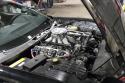


LS7 intake vs carb style.which flows better?

Teching In
Joined: Feb 2007
Posts: 42
Likes: 0

A carb manifold will flow much more than a factory LS intake, or any intake of similar design. The short, large runners, and smoother transition from plenum to runner allow much better flow than the long runner sharp transition of the LS intake. 20-50% increase in flow is reasonable.
There is a trade off. You will loose some torque down low if you only change the manifold. With some cam adjustments (advance or retard a few degrees, not nessescarily a new cam) and tuning, no issues. And you will have plenty of air flow to out rev a LS intake. Then you get into the dual plane vs single plane. But AFAIK, the onlt LS7 carb manifold is the GMPP single plane, so no real point in covering that.
There is a trade off. You will loose some torque down low if you only change the manifold. With some cam adjustments (advance or retard a few degrees, not nessescarily a new cam) and tuning, no issues. And you will have plenty of air flow to out rev a LS intake. Then you get into the dual plane vs single plane. But AFAIK, the onlt LS7 carb manifold is the GMPP single plane, so no real point in covering that.

Thread Starter
Banned
Joined: Dec 2007
Posts: 34
Likes: 0
Whats the difference in a dual plane and single plane?
What carb style intake will work best with an elbow on top of the ETP LS7 rectangular port heads and say a 454ci N/A engine?
Teching In
Joined: Feb 2007
Posts: 42
Likes: 0
On a 454, oh yeah, Carb style is the way to go. A LS7 manifold would have a hard time flowing the air needed to feed a 454 over 6000 rpms.
Dual plane manifolds have dual plenums. Each half feeds 4 cylinders, two on each bank. This provides more low end torque than a sinlge plane, where all 8 cyls draw from the same plenum. The trade off is Single planes can support much higher RPMs.
Having the right cam for the intake is key. A proper cam will mitigate the low end torque losses. Its all about balance.
Dual plane manifolds have dual plenums. Each half feeds 4 cylinders, two on each bank. This provides more low end torque than a sinlge plane, where all 8 cyls draw from the same plenum. The trade off is Single planes can support much higher RPMs.
Having the right cam for the intake is key. A proper cam will mitigate the low end torque losses. Its all about balance.
Thread Starter
Banned
Joined: Dec 2007
Posts: 34
Likes: 0
On a 454, oh yeah, Carb style is the way to go. A LS7 manifold would have a hard time flowing the air needed to feed a 454 over 6000 rpms.
Dual plane manifolds have dual plenums. Each half feeds 4 cylinders, two on each bank. This provides more low end torque than a sinlge plane, where all 8 cyls draw from the same plenum. The trade off is Single planes can support much higher RPMs.
Having the right cam for the intake is key. A proper cam will mitigate the low end torque losses. Its all about balance.
Dual plane manifolds have dual plenums. Each half feeds 4 cylinders, two on each bank. This provides more low end torque than a sinlge plane, where all 8 cyls draw from the same plenum. The trade off is Single planes can support much higher RPMs.
Having the right cam for the intake is key. A proper cam will mitigate the low end torque losses. Its all about balance.
Not a drag car either, will never see a drag track. Just a street driven car on weekends for fun and to go to shows..
Trending Topics
LS1 Tech Stories
The Best V8 Stories One Small Block at Time

6 Common C5 Corvette Failures and What's Involved In Repairing Them
Pouria Savadkouei
Retro Modern Bandit Pontiac Trans AM Comes With Burt Reynolds' Autograph
Verdad Gallardo
Top 10 Greatest Cadillac V Series Performance Models Ever, Ranked
Pouria Savadkouei
Top 10 Most Powerful Chevy Trucks Ever Made!

Hennessey's New Supercharged Silverado ZR2 Has 700 HP
Verdad Gallardo
Coachbuilt N2A Anteros Is an LS2-Powered C6 Corvette In Italian Clothes
Verdad Gallardo
Awesome K5 Blazer Restomod Comes With C7 Corvette Power
Verdad Gallardo
10 Camaros You Should Never Buy

10 LS Engine Myths That Refuse to Die
Verdad Gallardo Teching In
Joined: Feb 2007
Posts: 42
Likes: 0
Like i said, it varies by model. performer RPM and victor series stuff isnt apples to apples. The GMPP L92 single plane has a 5" height.


Thread Starter
Banned
Joined: Dec 2007
Posts: 34
Likes: 0

I know your saying that the carb intake is extremely not just mildly but extremely superior to the LS7 intake but I have not seen a test that supports this. I know it does do a bit better up top but a pretty nice hit to the lower end and lonely a bit better up top. But these disprove that theroy not trying to start anything just curious what makes you so sure as I have an LS7 ported intake and heads and if the intake is holding me back I would change. Plus I see the aluminum as a heat sink causing further problems with being better.
https://ls1tech.com/forums/dynamometer-results-comparisons/770891-l92-370ci-gm-carb-intake-vs-l76.html
&highlight=intake+carb
In this comparison that GM high tech did yeah in the end the carb intake did finally get a better result but look at what it lost not even worth the mild gain.
http://www.gmhightechperformance.com...ads/index.html
https://ls1tech.com/forums/dynamometer-results-comparisons/770891-l92-370ci-gm-carb-intake-vs-l76.html
&highlight=intake+carb
In this comparison that GM high tech did yeah in the end the carb intake did finally get a better result but look at what it lost not even worth the mild gain.
http://www.gmhightechperformance.com...ads/index.html
Teching In
Joined: Feb 2007
Posts: 42
Likes: 0
I know your saying that the carb intake is extremely not just mildly but extremely superior to the LS7 intake but I have not seen a test that supports this. I know it does do a bit better up top but a pretty nice hit to the lower end and lonely a bit better up top. But these disprove that theroy not trying to start anything just curious what makes you so sure as I have an LS7 ported intake and heads and if the intake is holding me back I would change. Plus I see the aluminum as a heat sink causing further problems with being better.
https://ls1tech.com/forums/showthread.php?t=770891
&highlight=intake+carb
In this comparison that GM high tech did yeah in the end the carb intake did finally get a better result but look at what it lost not even worth the mild gain.
http://www.gmhightechperformance.com...ads/index.html
https://ls1tech.com/forums/showthread.php?t=770891
&highlight=intake+carb
In this comparison that GM high tech did yeah in the end the carb intake did finally get a better result but look at what it lost not even worth the mild gain.
http://www.gmhightechperformance.com...ads/index.html
Post #3, this thread i mention that cam taiming can alter the low end loss. Tuning can cover the rest. Near as I can tell from GMHTP's writeup, they did neither.
Flow for flow, a carb intake will walk all over a LS intake. But how you apply it to the engine for power is key. Heads, intake, and cam are the key parts in the induction system. An IC engine is an air pump, and we know that more air is more power. None of that is disputed. But what most people done know is the physics of HOW and WHY. We've known for years that more air makes more power. And weve known that for dsome reason, the height of the carb over the intake (a spacer) can affect power. But its fairly recently that we've learned why. and the reason is the pulse effect. Natural supercharging. This is when we started seeing "tuned length' intakes. These instakes were computer designed to manage the pulses for max power. This is also why truck motors use a different intake than cars. Changing the pulse effects moves the power around, along with increasing or reducing output.
How do pulses apply to the intakes at hand? Well, LS intakes have very long runners, meaning they have a longer pulse width. And the pulse runs all the way back to the TB blade. Longer runner means more time (even at the near mach 1 speed of the pulse) between pulses, so the natural supercharging occurs at lower RPMs. A carb manifold has shorter runners, so they are more suited to Higher RPM, faster pulses. Again, this is all general, and really requires advanced computer modeling to be shown, because pulses collide and combine, and can also reduce each other, just like sound waves and waves in water.
So Im not at all shocked that GMHTP did not get stellar results with the carb manifold. The setup wasnt right. The total system has to be considered. FAST intakes work, because the general design, and thus the pulsing, is identical to the stock manifold.
Compared to the LS family (10 years) these carb manifolds are very new to us. And there isnt much data out there. Unless you get a full custom cam, you cant really buy one that is made to work with a carb manifold. We are used to cams that are bigger duration and lift to get the high RPM flow we need, that the intake steals from us. On a carb manifold, the cam can be more balanced, as th high rpm flow is there, if not totally reversed in theory.
Most of the carb intakes went on to FI cars so far. Pulsing doesnt affect them near as much, so its pure flow. NA cars are just begining to experiment with them, and much of what we know works on these cars goes out the window with those intakes.
Im currently building a 427 LSX, with L92 heads and GMPP carb manifold. I've done extensive testing of the carb manifold and the L76 manifold. The carb out flows the L76 by 50%. Compared to the 5% flow gain of a FAST over the comparable LS intake. If i were to run the L76 intake, My torque would peak at 5800 (if i was lucky), and id have a nice NA motor with maybe 550 rwhp. As it sits, Im expecting a torque peak at ~6800, with a 2500-7400 rpm power band. So basically, if I did the opposite of GMHTP and put the L76 manifold on my engine thats built around the carb manifold, it would choke it, and make the L76 look like a horrible Intake. But that doesnt mean that it is, just that the setup is wrong.
And setup is key. If you only look at one part of the system, you are boned, and you wont get the right result. Flow is not the only thing to consider.

TECH Apprentice
Joined: Oct 2007
Posts: 385
Likes: 0
From: Granada Hills, Ca
Yeah, the LS7 manifold is a decent piece and compared to the regular victor jr, not the super victor, they make nearly the same power.
Chevy High Performance did a 402 with dart heads and a carb and it made 583hp@6600 and 529tq@ 5200
Then they switched it to f/i with an ls7 manifold and it made the 520tq@4500 and 580hp@6200rpm. Not much of a loss at all...
Granted, it was more of a fuel injected cam, hydraulic roller with 230 duration and 112 l/c, but with both it idled at 800rpm and got 12 inches of vaccum.
Konnie, that 427 LSX sounds like it is going to be one bad bitch. good luck.
Chevy High Performance did a 402 with dart heads and a carb and it made 583hp@6600 and 529tq@ 5200
Then they switched it to f/i with an ls7 manifold and it made the 520tq@4500 and 580hp@6200rpm. Not much of a loss at all...
Granted, it was more of a fuel injected cam, hydraulic roller with 230 duration and 112 l/c, but with both it idled at 800rpm and got 12 inches of vaccum.
Konnie, that 427 LSX sounds like it is going to be one bad bitch. good luck.
nice reply that what i like to see is more physics and not theroy. So if I were ot change to a LS7 carb intake and find someone who could design the right cam I would see some serious gains over the LS7 intake?? correct?? What kind of cam specs are the carbed intakes liking this would be going on the engine in my sig. I have been trying to get harrop to make one for the LS7 but to no avail. Lets see what can be accomplished cause this would make a nice comparison. Thanks in advance
TECH Apprentice
Joined: Oct 2007
Posts: 385
Likes: 0
From: Granada Hills, Ca
Not sure exactly, but the cam I am putting in my engine (since it is a carb intake and 750 carb), will be more in the 248-255 duration, around .670 lift and have a 106-108 l/c.
The cams I have seen work with the f/i and carbs are similar to what works with a SBF because of the symmetrical port design. I'll let you know when I get the engine back on the dyno or in the car.
The cams I have seen work with the f/i and carbs are similar to what works with a SBF because of the symmetrical port design. I'll let you know when I get the engine back on the dyno or in the car.
Last edited by Qwiknotch; Dec 21, 2007 at 11:30 PM.
Teching In
Joined: Feb 2007
Posts: 42
Likes: 0
Cam specs, youare looking at a tighter LSA, say 110ish to help bring the low end torque back, and a few less degrees duration. You rely on exhaust velocity to help pull in the low RPM air, since youve lost some of the low speed pulsing. Really, with the carb manifold cam the goal is to minimize the low end loss as much as posssible (there will alwasy be some loss from idle to ~2500rpm) but by expanding the power into higher RPMS, you are going to increase the average torque, and the area under both the Torque and HP curves. Area under the curve is more important than peak, and to avoid the calculus, taking the average is an accurate way to gauge the improvement in that area. Plus the motor should rev faster. So if you gear it right, you should be comming thru the traps near 7200 rpm in 4th.
With the average increase, the low end loss is not important. by 2500-3000, they are about equal. Most auto's are stalled over 3000. Personally, I drive a manual. In a 06 GTO, which has a severe lack of rubber to begin with. So I dont really want full torque commong off the line, it wont get to the ground anyway. and when I shift at 7400ish, its going to drop me back to the High 4k's, the meat of the power band. So thats another area to consider.
With the average increase, the low end loss is not important. by 2500-3000, they are about equal. Most auto's are stalled over 3000. Personally, I drive a manual. In a 06 GTO, which has a severe lack of rubber to begin with. So I dont really want full torque commong off the line, it wont get to the ground anyway. and when I shift at 7400ish, its going to drop me back to the High 4k's, the meat of the power band. So thats another area to consider.

This is one of the most excellent displays of a thread I've ever seen. I've been following along going, "uh huh. yeah. Oh, that makes sense..." the whole time this has been up. I'm building a bigger cube LSX myself and have had some of the same concerns as the original poster.
What you're saying about the pulse and the natural supercharging is dead on with what I was taught at UTI a few years ago.
My build is a 441 ci LSX block that I'm putting a carb on. It's easier for me to tune a carb than it is to bust out a laptop and change things. It's not that it wouldn't be easy to change tunes if you're experienced with the software, but I'm not and I plan on running E85 most of the time, but have to be able to re-tune for 92 octane when I can't find E85.
Anyway, I'm building a high revver that will make a lot more use out of the broader power band of the carb intake and upper RPMs, especially with my ported and polished LS7 heads. I'll need that broader power band considering it'll be pushing a heavy, brick-in-the-wind '57 Bel Air.
Thanks again for sharing your knowledge guys. I love seeing threads like this.
What you're saying about the pulse and the natural supercharging is dead on with what I was taught at UTI a few years ago.
My build is a 441 ci LSX block that I'm putting a carb on. It's easier for me to tune a carb than it is to bust out a laptop and change things. It's not that it wouldn't be easy to change tunes if you're experienced with the software, but I'm not and I plan on running E85 most of the time, but have to be able to re-tune for 92 octane when I can't find E85.
Anyway, I'm building a high revver that will make a lot more use out of the broader power band of the carb intake and upper RPMs, especially with my ported and polished LS7 heads. I'll need that broader power band considering it'll be pushing a heavy, brick-in-the-wind '57 Bel Air.
Thanks again for sharing your knowledge guys. I love seeing threads like this.
Post #3, this thread i mention that cam taiming can alter the low end loss. Tuning can cover the rest. Near as I can tell from GMHTP's writeup, they did neither.
Flow for flow, a carb intake will walk all over a LS intake. But how you apply it to the engine for power is key. Heads, intake, and cam are the key parts in the induction system. An IC engine is an air pump, and we know that more air is more power. None of that is disputed. But what most people done know is the physics of HOW and WHY. We've known for years that more air makes more power. And weve known that for dsome reason, the height of the carb over the intake (a spacer) can affect power. But its fairly recently that we've learned why. and the reason is the pulse effect. Natural supercharging. This is when we started seeing "tuned length' intakes. These instakes were computer designed to manage the pulses for max power. This is also why truck motors use a different intake than cars. Changing the pulse effects moves the power around, along with increasing or reducing output.
How do pulses apply to the intakes at hand? Well, LS intakes have very long runners, meaning they have a longer pulse width. And the pulse runs all the way back to the TB blade. Longer runner means more time (even at the near mach 1 speed of the pulse) between pulses, so the natural supercharging occurs at lower RPMs. A carb manifold has shorter runners, so they are more suited to Higher RPM, faster pulses. Again, this is all general, and really requires advanced computer modeling to be shown, because pulses collide and combine, and can also reduce each other, just like sound waves and waves in water.
So Im not at all shocked that GMHTP did not get stellar results with the carb manifold. The setup wasnt right. The total system has to be considered. FAST intakes work, because the general design, and thus the pulsing, is identical to the stock manifold.
Compared to the LS family (10 years) these carb manifolds are very new to us. And there isnt much data out there. Unless you get a full custom cam, you cant really buy one that is made to work with a carb manifold. We are used to cams that are bigger duration and lift to get the high RPM flow we need, that the intake steals from us. On a carb manifold, the cam can be more balanced, as th high rpm flow is there, if not totally reversed in theory.
Most of the carb intakes went on to FI cars so far. Pulsing doesnt affect them near as much, so its pure flow. NA cars are just begining to experiment with them, and much of what we know works on these cars goes out the window with those intakes.
Im currently building a 427 LSX, with L92 heads and GMPP carb manifold. I've done extensive testing of the carb manifold and the L76 manifold. The carb out flows the L76 by 50%. Compared to the 5% flow gain of a FAST over the comparable LS intake. If i were to run the L76 intake, My torque would peak at 5800 (if i was lucky), and id have a nice NA motor with maybe 550 rwhp. As it sits, Im expecting a torque peak at ~6800, with a 2500-7400 rpm power band. So basically, if I did the opposite of GMHTP and put the L76 manifold on my engine thats built around the carb manifold, it would choke it, and make the L76 look like a horrible Intake. But that doesnt mean that it is, just that the setup is wrong.
And setup is key. If you only look at one part of the system, you are boned, and you wont get the right result. Flow is not the only thing to consider.
Flow for flow, a carb intake will walk all over a LS intake. But how you apply it to the engine for power is key. Heads, intake, and cam are the key parts in the induction system. An IC engine is an air pump, and we know that more air is more power. None of that is disputed. But what most people done know is the physics of HOW and WHY. We've known for years that more air makes more power. And weve known that for dsome reason, the height of the carb over the intake (a spacer) can affect power. But its fairly recently that we've learned why. and the reason is the pulse effect. Natural supercharging. This is when we started seeing "tuned length' intakes. These instakes were computer designed to manage the pulses for max power. This is also why truck motors use a different intake than cars. Changing the pulse effects moves the power around, along with increasing or reducing output.
How do pulses apply to the intakes at hand? Well, LS intakes have very long runners, meaning they have a longer pulse width. And the pulse runs all the way back to the TB blade. Longer runner means more time (even at the near mach 1 speed of the pulse) between pulses, so the natural supercharging occurs at lower RPMs. A carb manifold has shorter runners, so they are more suited to Higher RPM, faster pulses. Again, this is all general, and really requires advanced computer modeling to be shown, because pulses collide and combine, and can also reduce each other, just like sound waves and waves in water.
So Im not at all shocked that GMHTP did not get stellar results with the carb manifold. The setup wasnt right. The total system has to be considered. FAST intakes work, because the general design, and thus the pulsing, is identical to the stock manifold.
Compared to the LS family (10 years) these carb manifolds are very new to us. And there isnt much data out there. Unless you get a full custom cam, you cant really buy one that is made to work with a carb manifold. We are used to cams that are bigger duration and lift to get the high RPM flow we need, that the intake steals from us. On a carb manifold, the cam can be more balanced, as th high rpm flow is there, if not totally reversed in theory.
Most of the carb intakes went on to FI cars so far. Pulsing doesnt affect them near as much, so its pure flow. NA cars are just begining to experiment with them, and much of what we know works on these cars goes out the window with those intakes.
Im currently building a 427 LSX, with L92 heads and GMPP carb manifold. I've done extensive testing of the carb manifold and the L76 manifold. The carb out flows the L76 by 50%. Compared to the 5% flow gain of a FAST over the comparable LS intake. If i were to run the L76 intake, My torque would peak at 5800 (if i was lucky), and id have a nice NA motor with maybe 550 rwhp. As it sits, Im expecting a torque peak at ~6800, with a 2500-7400 rpm power band. So basically, if I did the opposite of GMHTP and put the L76 manifold on my engine thats built around the carb manifold, it would choke it, and make the L76 look like a horrible Intake. But that doesnt mean that it is, just that the setup is wrong.
And setup is key. If you only look at one part of the system, you are boned, and you wont get the right result. Flow is not the only thing to consider.
This was an out of box test, niether were ported. This was on a 347" engine as well, so probably not the most stellar setup for the Vic Jr. I was disssapointed with the results, but I bet the right cam in there may have brought it back up to par with the FAST. The Vic Jr actually idled much better, was easier to tune and loved lots of timing down low.
Now that I'm switching to FI, I have a Vic Jr going in again with some porting.
You make alot of good points and wish more info like this was around during my experiment.
Dan