



WTF, large amount of oil in the intake? (pics)

honestly you may have 2 distinct problems (low oil pressure and oil in intake) or you may just have one which is causeing the other. i can almost doubt that the low oil pressure is causing the oil to get into the intake...but oil getting into the intake maybe lowering your oil pressure. another thing you can check is the bolt holes for your rocker studs (which are over each intake port)...i remember something about if the machining on the head was not done right oil can seap in.
So can it be confirmed that since I have equal distribution of oil in every intake port, that a valve stem seal issue is unlikely? Additionally, there is no oil on the valve stem itself nor on top of the valve as seen in pic 3. This couldn't some how be the result of lower than normal oil pressure could it?
Maybe someone can correct me, but I dont see how an oil leak up there can change the oil pressure. Isn't oil pressure read from someone else? As long as that "somewhere else" is being fed with oil, your pressure won't change. I've run my oil so low that my oil pressure needle starting dropping to zero and then right back up to normal as the pick-up tube caught the splashing oil in the pan. So as long as oil is going into the tube you should show normal oil pressure.
How about a leakdown check, isn't that supposed to tell if valve seals are bad?
Do you have white smoke on start up from the tail pipes?
Do you leave a trail of white/blue smoke behind when you nail the gas pedal from a rolling start? This is a tell-tale sign of bad valve seals.

Thread Starter
TECH Regular
Joined: Dec 2004
Posts: 440
Likes: 0
From: Alpharetta, Ga
There is no smoke at start up or during driving. However, I haven't driven it but 30 miles since getting her back together. The low oil pressure is likely either the oil pressure sensor or a pinched O-ring on the pick up tube even though I used the correct install procedure. I don't think the valve stem seals could be bad, they only have 8k miles on them.
There is no smoke at start up or during driving. However, I haven't driven it but 30 miles since getting her back together. The low oil pressure is likely either the oil pressure sensor or a pinched O-ring on the pick up tube even though I used the correct install procedure. I don't think the valve stem seals could be bad, they only have 8k miles on them.
How low is low on the pressure?
Im still sticking with its coming past the rings. If by some reason the rings were clocked straight up, meaning tha the gap in the compression, scrapper and oil ring are in the same spot then a s*&t load of oil will come past them. Then depending on your cams overlap, reversion will bring into the intake and distribute it around the intake. If you have a bad valve seal that port will have a lot of residue on it. What 427 was talking about with the breather is a load of crap. Look at any race team and they have breathers on their valvecover and no pcv. They have a catch can because they cant allow any oil on the track. It has to be a valve seal or blow by.
Im still sticking with its coming past the rings. If by some reason the rings were clocked straight up, meaning tha the gap in the compression, scrapper and oil ring are in the same spot then a s*&t load of oil will come past them. Then depending on your cams overlap, reversion will bring into the intake and distribute it around the intake. If you have a bad valve seal that port will have a lot of residue on it. What 427 was talking about with the breather is a load of crap. Look at any race team and they have breathers on their valvecover and no pcv. They have a catch can because they cant allow any oil on the track. It has to be a valve seal or blow by.
Also, he has VERY few miles since his freshen up, so there hasn't been enough time for the residue to build up on the valve stems.
He needs to cap the breather and if that doesn't help replace the valve seals. Look at any race team, and see they REPLACE the PCV system with the breathers. They usually don't run them in tandum as thats not the proper way to setup the system as you may suck up a lot of oil. Some run the breathers at the catch can which is fine as well.

TECH Apprentice


Joined: Oct 2007
Posts: 302
Likes: 20
The one way that rings may be contributing is if you have bad ring-bore seal and a lot of blow by is pushing oil thru the PCV and into the intake.
Oil coming past the guides wouldn't end up that far up the intake tract, it'll be drawn into the cylinders.
Since the valley is isolated from the intakes, it has to be getting pushed or drawn into the intake somehow, IMHO.
Thread Starter
TECH Regular
Joined: Dec 2004
Posts: 440
Likes: 0
From: Alpharetta, Ga
Well I guess it is possible that my pistons hitting my valves could fubar my rings a bit, but the break occured at 3500rpm so the impacts could have definitely been worse. I wouldn't think it would be a "bad ring" case but hell, I broke a timing chain after only 8k miles on a flawlessly installed cam only setup, it would be just my luck.
LS1 Tech Stories
The Best V8 Stories One Small Block at Time

Topdon ONE vs. Artidiag 800 BT2: Which is the Diagnostic Tablet For You?
Pouria Savadkouei
Gas Monkey Built a 6-Wheel Ferrari Testarossa With a Corvette LT4 Engine
Verdad Gallardo
7 Most Reliable High-Performance Engines GM Has Ever Built
Verdad Gallardo
Amazing '71 Camaro Restomod Is Modern Muscle Car Under the Skin
Verdad Gallardo
6 Common C5 Corvette Failures and What's Involved In Repairing Them
Pouria Savadkouei
Retro Modern Bandit Pontiac Trans AM Comes With Burt Reynolds' Autograph
Verdad Gallardo
Top 10 Greatest Cadillac V Series Performance Models Ever, Ranked
Pouria Savadkouei
Top 10 Most Powerful Chevy Trucks Ever Made!

Hennessey's New Supercharged Silverado ZR2 Has 700 HP
Verdad Gallardo Thread Starter
TECH Regular
Joined: Dec 2004
Posts: 440
Likes: 0
From: Alpharetta, Ga
Thread Starter
TECH Regular
Joined: Dec 2004
Posts: 440
Likes: 0
From: Alpharetta, Ga
Not right now. I have the intake manifold off and am waiting on my new oil pressure sensor. From talking with the boys down at RevXtreme, apparently there are pulses both into and out of the intake ports and any amount of oil coming down from the valve stem would be distributed back into the intake manifold via those pulses. However, the amount of oil that was found in the intake mani seems excessive if valve stem seals were the case. That and everyone I have ever heard talk about valve stem issues has always reported blue smoke when coming off the throttle at speed, something my car showed now signs of.

On my 402 I have no pcv or crankcase lines hooked to the intake they are all hooked together and go to a catch can that has a breather on it, and I still get that film of oil on the floor of the intake I have also heard that its reversion. My motor only has 1000 miles on it, new valve seals and has done this since day one, but definatly put a good sealer on those bolts that protrude into the intake port cause I've noticed that the teflon disolves with the heat and oil, i'm going to use silicone next time.
Not right now. I have the intake manifold off and am waiting on my new oil pressure sensor. From talking with the boys down at RevXtreme, apparently there are pulses both into and out of the intake ports and any amount of oil coming down from the valve stem would be distributed back into the intake manifold via those pulses. However, the amount of oil that was found in the intake mani seems excessive if valve stem seals were the case. That and everyone I have ever heard talk about valve stem issues has always reported blue smoke when coming off the throttle at speed, something my car showed now signs of.
If you have bad valve seals, the abrupt pressure DROP when you mash the gas pedal from the pistons picking up speed from say a 50mph roll, will cause oil from under the valve covers to get sucked into the bad valve seals, into the cylinders, and then go right out your exhaust. When you come off the pedal it will clear immediately. Also, when you mash the pedal and begin that trail of smoke from bad seals, if you stay into the throttle and keep accelerating, it will slowly clear up and go away too, unless the seals are really really bad, then the trail will stay.
I had this issue. Put the new rebuilt heads on, zero smoke when I nailed the pedal from a roll.
This is why I asked if you could go for a drive. 60-70mph and mash it to the floor, if you get any smoke, the seals are gone.

For what it's worth, I had a brand new set of L92 heads with comp 921's on them. (from one of our vendors) I did some porting work before installing them on my 402, I had to replace all of the valve stem seals because they where damaged on install at the vendor. If I would have taken them out of the box and installed them I would have been in the same boat.
Thread Starter
TECH Regular
Joined: Dec 2004
Posts: 440
Likes: 0
From: Alpharetta, Ga
Well, I installed them myself. I know they weren't defective prior to installation because in the 8k miles they were used, the car burned no oil. How can they be damaged upon install? I am not trying to be sarcastic, but there is only one way these seals can go on, ya know?
For me, I installed the seal onto the guide before putting the valve in. I just took a hammered and tapped it down until it was completely seated. Then I took the slightest amount of oil to lubricate the shaft of the valve(very fine glaze) and slid it up through the guide and seal. Could this have damaged it?
For me, I installed the seal onto the guide before putting the valve in. I just took a hammered and tapped it down until it was completely seated. Then I took the slightest amount of oil to lubricate the shaft of the valve(very fine glaze) and slid it up through the guide and seal. Could this have damaged it?

I run the Rev Xtreme catch can and wind up with oil on the floor of my intake as well. I agree the seals would need to be in real bad shape to cause that much oil to get inside the intake. I'd think the oil would wind up inside the cylinder before the intake anyway and you would have to see some side effects from that. The only thing I dont like about the Rev Xetreme setup is the lack of any type of media for the oil to acculmulate on inside the can. It relys on the oil contacting the walls on the can where others have a mesh type media providing a better surface area for the hot oil vapor to accumulate on. I'm no expert on catch cans but it makes sense. My opinion here is your oil is being introduced into the intake via the PCV system.

Respectfully, they're all wrong.
If you have bad valve seals, the abrupt pressure DROP when you mash the gas pedal from the pistons picking up speed from say a 50mph roll, will cause oil from under the valve covers to get sucked into the bad valve seals, into the cylinders, and then go right out your exhaust. When you come off the pedal it will clear immediately. Also, when you mash the pedal and begin that trail of smoke from bad seals, if you stay into the throttle and keep accelerating, it will slowly clear up and go away too, unless the seals are really really bad, then the trail will stay.
I had this issue. Put the new rebuilt heads on, zero smoke when I nailed the pedal from a roll.
This is why I asked if you could go for a drive. 60-70mph and mash it to the floor, if you get any smoke, the seals are gone.
If you have bad valve seals, the abrupt pressure DROP when you mash the gas pedal from the pistons picking up speed from say a 50mph roll, will cause oil from under the valve covers to get sucked into the bad valve seals, into the cylinders, and then go right out your exhaust. When you come off the pedal it will clear immediately. Also, when you mash the pedal and begin that trail of smoke from bad seals, if you stay into the throttle and keep accelerating, it will slowly clear up and go away too, unless the seals are really really bad, then the trail will stay.
I had this issue. Put the new rebuilt heads on, zero smoke when I nailed the pedal from a roll.
This is why I asked if you could go for a drive. 60-70mph and mash it to the floor, if you get any smoke, the seals are gone.
Example: Drop an intake valve in cyl #7, but when you tear down you will see parts of the valve have traveled to nearly EVERY cylinder and caused damage...even in the few seconds it took to shut down. This is due to the reversion pulses throughout the intake runners. With composite intakes such as our LS based motors run, you will see sharapnel embeded in the intake runners (and if you reuse the intake chances are subsequent damage will occur when the pieces work loose). Oil most generally enters the intake via the PCV system or the fresh air intake (throttle body on LS motors) but can enter & be evenly distributed throughout the intake in several other ways as some of the more knowledgable posters earlier in this thread have pointed out. Valve seals, even when looking good (NEVER reuse valve stem seals as chances of a poor seal are high) can allow a substantial amount of oil into the intake runner of a cylinder head, and the reversion pulse will distribute it back into the intake. Same with a single ring/piston/cyl bore issue. Also, a bent or poorly sealing intake valve will casue tremendous reversion through the intake.
The big "air pump" that our motors are is not as simple as sucking air in one end & pumping it out the other.. Just do a google search on "intake reversion in race engines" to find slo-mo videos of IRL motors with reversion clounds pushing back out the injector inlets at 16,000 RPM! You would never in a million years think that can happen, but it does & even in our motors not spun over 6-7k, there is substantial reversion going on at all times in the mid-higher rpm range. Look at Reher Morrisons product listings & read how anti reversion rings are machined into intake spacers, etc. to reduce this (as it robs power by reducing velocity)...So, if the oil was entering through the catch can, the can would catch the majority of the oil, and he states it is not. The issue I suspect, is in the heads/valves....pull them & send them to a good machine shop for a professional valve job w/new seals (a broken timing chain no matter what rpm it occurs at will result in v-p interference). and I bet the issue dissapears. I truely do NOT think it is piston/ring related in his case.
I run the Rev Xtreme catch can and wind up with oil on the floor of my intake as well. I agree the seals would need to be in real bad shape to cause that much oil to get inside the intake. I'd think the oil would wind up inside the cylinder before the intake anyway and you would have to see some side effects from that. The only thing I dont like about the Rev Xetreme setup is the lack of any type of media for the oil to acculmulate on inside the can. It relys on the oil contacting the walls on the can where others have a mesh type media providing a better surface area for the hot oil vapor to accumulate on. I'm no expert on catch cans but it makes sense. My opinion here is your oil is being introduced into the intake via the PCV system.


Staging Lane
Joined: Dec 2006
Posts: 55
Likes: 0
Before reading TLewis's post I was of the mindset that it couldn't be the valve seals. I was thinking if the seals were bad the oil would be drawn into the cylinder and burned. Now I think otherwise. If you think about it, the entire intake is under vacuum created by the all the pistons going down. The intake area actually includes every runner all the way to the back of the intake valves. If cylinder 1 had a bad valve seal it would be drawing oil into the runner always and not just when cylinder 1's intake valved opened. The vacuum created by the other cylinders will cause the reversion effect drawing the oil into the entire intake.

Thats a crazy amount of oil. You will start to get build up on your pistons after shutdown each time and then that build-up will get hot spots and you will then get detonation/pre-ignition.
I was just asking about that crankcase breather line, it should be capped if you have the breather and catch can.
Looks like that catch can isn't working and maybe your PCV valve is staying wide open all the time.
Here's what you'll get soon: detonated at normal operating temps becauxse of hot spots pre-igniting the fuel/air.
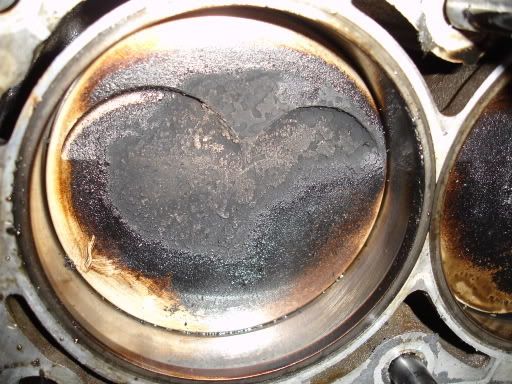
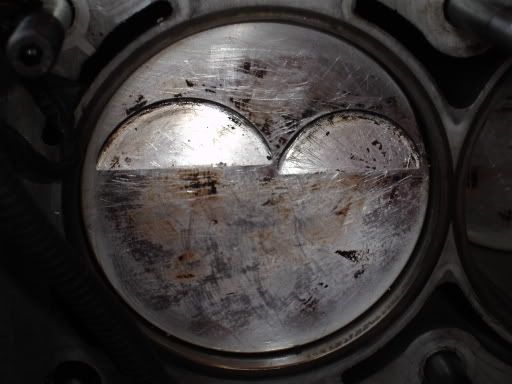
Cleaned:
I was just asking about that crankcase breather line, it should be capped if you have the breather and catch can.
Looks like that catch can isn't working and maybe your PCV valve is staying wide open all the time.
Here's what you'll get soon: detonated at normal operating temps becauxse of hot spots pre-igniting the fuel/air.
Cleaned:
Wow..how many miles were on that? My pistons were 3x worse and were fully covered in what looked like burn oil...it was pretty thick too. The intake was coated as well..and this is on a 100% stock LS2. Since then ive installed new valve seals,springs,head gaskets,completely cleaned off the pistons and cleaned out the intake. I plan on installing a catch can too in hopes to prevent this from happening again.