


Piston valve clearance: clay vs indicator

Thread Starter


Joined: Apr 2010
Posts: 2,816
Likes: 86
From: Instagram @chevyhotrodder
 Piston valve clearance: clay vs indicator
 I'm putting a high lift cam in my LY6 and I'm debating which method to use for checking piston-valve clearance.
Method 1 (clay): remove the head, put modeling clay on the piston top, reassemble heads & valvetrain, turn the engine over 2rev min, disassemble, slice the clay and measure
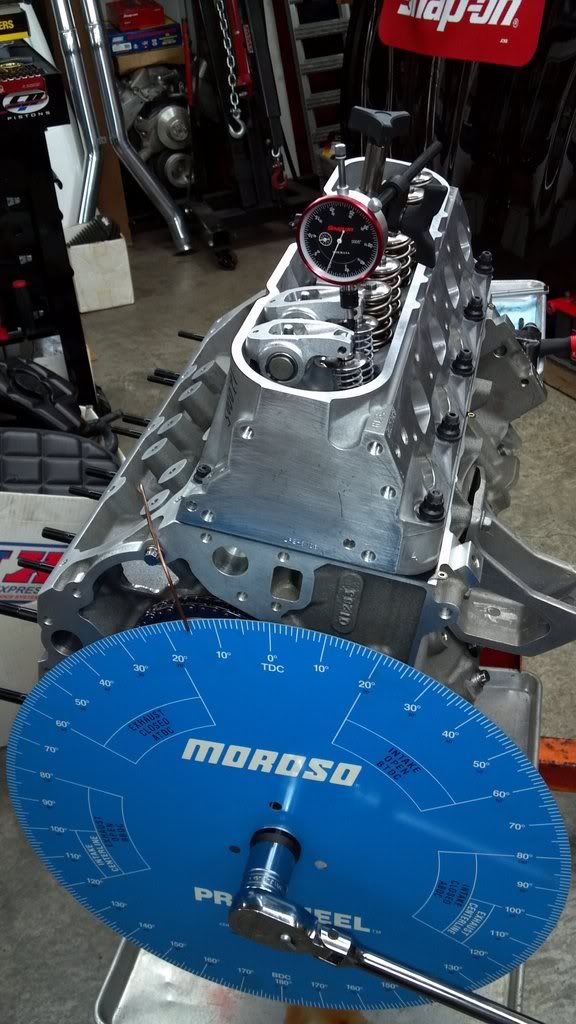
Method 2 (indicator): install checker valve springs, reassemble valvetrain, place an indicator on the valve retainer, move piston to pre-TDC during valve overlap events, rotate crank in 2 deg increments, press on each valve until it contacts piston measuring clearance at each crank angle until minimum clearance is found
I'd like to use method 2 because it doesn't require R&Ring the heads or new head bolts and gaskets. Is there any reason to prefer one method over the other?
*EDIT* Here's a pretty decent overview showing both methods. They start with the clay method then show the indicator method. I can see the indicator wouldn't necessarily get you radial clearance.
http://www.youtube.com/watch?v=ifoGVT4G0m0
Method 1 (clay): remove the head, put modeling clay on the piston top, reassemble heads & valvetrain, turn the engine over 2rev min, disassemble, slice the clay and measure
Method 2 (indicator): install checker valve springs, reassemble valvetrain, place an indicator on the valve retainer, move piston to pre-TDC during valve overlap events, rotate crank in 2 deg increments, press on each valve until it contacts piston measuring clearance at each crank angle until minimum clearance is found
I'd like to use method 2 because it doesn't require R&Ring the heads or new head bolts and gaskets. Is there any reason to prefer one method over the other?
*EDIT* Here's a pretty decent overview showing both methods. They start with the clay method then show the indicator method. I can see the indicator wouldn't necessarily get you radial clearance.
http://www.youtube.com/watch?v=ifoGVT4G0m0
Last edited by -TheBandit-; Mar 18, 2012 at 12:56 AM.
Teching In
Joined: Jan 2011
Posts: 36
Likes: 0
From: Illinois

I prefer method #2, with checking in incremental degrees. Used that method on SBF's and on the one DOHC modular build I did. The problem I ran into while employing this method on the one LS build I've done so far, is that the checker springs I have are too stiff and noticed that the lifter was very, very slowly collapsing (per the dial indicator telling me so, using morel 5206 link bars). Rather than searching for a lighter spring, or fiddling with modifying the set I've been using for years, now, I ended up pulling the head and building a couple solids out of the lifters that were in the engine that came with the car. I bought three head gaskets, using one solely for mock up, so doing so wasn't an issue and the block was already dry, etc. (fresh build).
So, as long as you have a "soft" enough set of checker springs and don't notice any lifter bleed-off on the dial indicator, once you roll up on mid/max lift, then the #2 method ought to work effectively for you.
The same could be mentioned, regarding the lifters bleeding down, using the clay method as well. If you wind up pulling the head, then you may as well source/build a couple solid lifters (built to the same dimension as the uncompressed lifter you're going actually run) and use them for the P2V exercise.
And unless you're running an aftermarket set of pistons and/or larger valves, then radial clearance shouldn't be an issue with OEM-paired parts.
Are you going to be using a degree wheel? ...checking cam timing events also?
So, as long as you have a "soft" enough set of checker springs and don't notice any lifter bleed-off on the dial indicator, once you roll up on mid/max lift, then the #2 method ought to work effectively for you.
The same could be mentioned, regarding the lifters bleeding down, using the clay method as well. If you wind up pulling the head, then you may as well source/build a couple solid lifters (built to the same dimension as the uncompressed lifter you're going actually run) and use them for the P2V exercise.
And unless you're running an aftermarket set of pistons and/or larger valves, then radial clearance shouldn't be an issue with OEM-paired parts.
Are you going to be using a degree wheel? ...checking cam timing events also?










