





VVT tuning with compcams limiter

My thinking was to approach this whole build as simply as possible. 1. Get it running 2. Make a safe street tune 3. Hit the dyno and see whats what with this VVT stuff. Sounds great right? well....
Ran into seemingly endless obstacles just trying to get the thing running normally, never mind tuning for power plus im new to laptop tuning so lots of learning going on. Seriously it was hellish to figure this thing out to where its at now. When i finally got it running halfway normal I met up with a local friend who tunes all the time and we attacked it on a Sunday for the first power tune stint. Turns out I had a lot of other issues going on I wasnt aware of ( Throttle was closing after 20mph etc. LS7 MAF I installed the day before was wired incorrectly ) so after some driveway harness rework and more tune related gremlins we finally had it to where we could start to tune for power. About 4hrs or so has passed by this point but lots of yakking too ( I can talk a while about cars.....)
Being that VVT tuning was new to him as well, we decided to basically bypass it and tune it as if it were a normal cam first, which we did, by zero'ing out all the VVT tables. Took 3 or 4 passes to dial in the a/f which was PIG rich and THEN we started to talk about tuning VVT and tried a couple of profiles and ended up with a curve that starts rolling in retard at 4200RPM and stops at -4deg @ 6400RPM so commanding 8deg as I have +4 in the grind. We copied these values on low, med, and high base angle and the other three DOD ( not applicable in my case ) Cold, and Minimum we zero'd. This whole time leaving VVT spark zero'd. After this the car was running fantastic but we did start to get a bit of KR up top when we started applying VVT so theres still some stuff to work out but we were out of time that day and the car was running well so off I went. Car was running great overall, and I was simply tired of all my "fun" becoming so much hassle so thats as far as my tune got even though I was supposed to connect for a second tune session at a dyno where we could work on it some more. But this stuff to me is a sidetrack from my day to day responsibilities I run a business and this economy hasnt been fun so my priorities have been elsewhere and it just hasnt happened yet. Plus the car ran great so I just drove it.
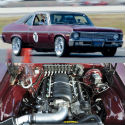
After a couple months driving it on a test and tune night I did manage to get to the track for some shake downs. Well.... I only got one complete pass unfortunately because the over zealous driver ( me ) made a BIG mistake and broke a bunch of mechanical parts... It still ran so I drove it home in pain but I had to shut it off to change gears so..... use your imagination to what I hurt... Cars apart again now but on my very first and only complete pass it ran a 12.1 @ 119 with a 2.4 60' just sizzling the et streets through 2 gears I was pedaling it too so its making some good power. Its a fully loaded car too with no weight reduction and Im only running a 2.5" y pipe into a single 3" exhaust too so keep that in mind its a bit choked as is but im not after a max effort car. I just wanted ( and got ) and wickedly quick street machine thats very civilized and fun to drive, which it most certainly is. I figure with that trap speed mid to low 11's are there and with a bit of weight drop and a couple supporting mods ( bigger exh, gear swap etc. ) maybe a ten in it. Car weighs about 3650lbs with me in it.
I drove the hell out of it on the streets though, I put just over 15k kms ( about 12K miles ) on it this summer bombing around everywhere loving it. So much so i pretty much stopped thinking about the car or the tune.
Mike when you started this thread I swear you made my head HURT. I was happily trying to forget about all this stuff for the past 6 months and just reading all this info and trying to digest it from such a long hiatus was putting me on tilt.
But I am looking forward to seeing what we can do with nailing down exactly what we can and should do with our tunes. I'll keep adding what I learn, where I can, when relevant. Its certainly going to become more and more mainstream as the new LT1 utilizes pretty much the exact same system as ours so we are definitely on the right track. Hopefully by the time we start swapping those we'll have tuning VVT all figured out

TECH Junkie
Joined: Dec 2005
Posts: 3,092
Likes: 11
"I tend to think the TSP L99 tune would be a better starting point"
That is what I am going to do. I will have their VVT3 camshaft and PRC heads. I think using their L99 tune they should be able to get my car pretty close. Thats what I am counting on anyways. Then have a local shop dial in the tune.
That is what I am going to do. I will have their VVT3 camshaft and PRC heads. I think using their L99 tune they should be able to get my car pretty close. Thats what I am counting on anyways.
Then have a local shop dial in the tune. I think there's a lot more to it than that unfortunately. You could tune the engine for a fixed cam position using conventional methods, but I think once you start changing the cam phasing you are dealing with multivariable optimization. For example you might get the same torque at a given RPM for two different combinations of cam + ignition + fuel, perhaps with different volumetric efficiency, combustion temps, BSFC, transient response, detonation resistance etc etc. It could get tricky trying to find the balance which I think is why some tuners shy away. Different cam timing will need different fuel & spark, so it will take some time and potentially a lot of iterations to get it right.
I also think there's flaw in comparing the patG cam to your cam. The difference in cam timing is not negligible (2 deg of duration and different lift). Also do you know if it uses the same LSL lobes as our VVT-2? I think a better starting point for comparison would be the nonVVT version of the cam I pointed out in another thread. If you personally want to prove out the merits of VVT, you could command fixed phasing over the whole table and tune it for that, but data is available already for a similar setup and I don't think I would waste my tuning time on arguing VVT merits. I just don't think it's worth trying to settle a bench racing argument when you could be driving toward the right tune for your VVT enabled setup. I tend to think the TSP L99 tune would be a better starting point given whatever hours they put into developing both the cam and tune, but from there it's going to take dyno and driving time to sort it out.
I also think there's flaw in comparing the patG cam to your cam. The difference in cam timing is not negligible (2 deg of duration and different lift). Also do you know if it uses the same LSL lobes as our VVT-2? I think a better starting point for comparison would be the nonVVT version of the cam I pointed out in another thread. If you personally want to prove out the merits of VVT, you could command fixed phasing over the whole table and tune it for that, but data is available already for a similar setup and I don't think I would waste my tuning time on arguing VVT merits. I just don't think it's worth trying to settle a bench racing argument when you could be driving toward the right tune for your VVT enabled setup. I tend to think the TSP L99 tune would be a better starting point given whatever hours they put into developing both the cam and tune, but from there it's going to take dyno and driving time to sort it out.
 ) At least by having a "close" non-VVT cam in specs in a similar trimmed motor, you can see how the curve and numbers track.
 I just registered for a dyno session on the 24th, so hopefully I'll have something to talk about then..
Yeah sure it makes me want to scream maybe just a little bit, but I don't think VVT is the right answer for everyone. Even though it has obvious benefits, it does take more skill and I think a little more money to implement. Just the process of checking PTV clearance is a lot more complicated. Speccing the cam takes some more thought since you need room to retard but don't want to advance so far that you run into intake clearance issues. It's also not clear yet what compromises are appropriate for taking advantage of VVT. For example can you change the specs in a way that loses peak power, but increases average power when phasing is implemented? I do think if you can get a cam on a nonVVT core and grind the same pattern on a VVT core and phase limit or cut reliefs to allow some phaser movement, you will see a performance advantage. That is just simple science. But who wants to run the risk of needing additional valve relief or having to do trail & error if a nonVVT cam is out there making good power and not require it?
I do think the gains with VVT are substantial - it's been shown for the last ~60years of small block development (and combustion engine development in general) that cam timing moves the peak around. They don't sell adjustable timing sets for nothing. VVT lets you get the most at each RPM level. The issue right now is there aren't a lot of pre-packaged options or proven combinations with VVT, so for every new VVT cam there is some trial and error to go through which you can avoid by getting an already established nonVVT package.
Even if you show that for that cam you see a substantial gain with VVT, someone will point to a non-VVT cam that is more aggressive, makes more power and is already shown to "fit" and be tuneable using common methods. The debate will rage on. Meanwhile you and I will be comfortable knowing that for the level of aggressiveness we selected, we are able to maximize output over the whole RPM range with respect to cam phasing.
I do think the gains with VVT are substantial - it's been shown for the last ~60years of small block development (and combustion engine development in general) that cam timing moves the peak around. They don't sell adjustable timing sets for nothing. VVT lets you get the most at each RPM level. The issue right now is there aren't a lot of pre-packaged options or proven combinations with VVT, so for every new VVT cam there is some trial and error to go through which you can avoid by getting an already established nonVVT package.
Even if you show that for that cam you see a substantial gain with VVT, someone will point to a non-VVT cam that is more aggressive, makes more power and is already shown to "fit" and be tuneable using common methods. The debate will rage on. Meanwhile you and I will be comfortable knowing that for the level of aggressiveness we selected, we are able to maximize output over the whole RPM range with respect to cam phasing.
Last edited by -TheBandit-; Nov 6, 2012 at 01:02 PM.

TECH Fanatic
Joined: Jul 2006
Posts: 1,732
Likes: 0
From: K.C.
the most i can pull in actual degree's is a flicker of 8.4 without pissing the ecm off at part throttle. at 6k im pulling back 6 degree's. i need to double the logs i have of this crap. apparently trying to pull a commanded 16.5 won't happen. thanks comp
....
....
Good to see you in here I know you've been working on this a while too. Do you use the VVT spark adder or no? Any general input we have overlooked that you care to add?

Teching In
Joined: Nov 2004
Posts: 31
Likes: 0
I've been reading this old thread on HP tuners about tuning the VE coefficients. This Post below was by Bluecat, the genius that co wrote the EQ<>VE program to tune the newer ECM's that don't have regular VE tables. According to him there isn't a need to have VVT retard in the part throttle portions of our tunes with bigger cams. I have to agree with the comp limiter at 8.5 degrees the part throttle retard isn't able to do anything near like it did stock anyway. If you do want to tune the VE coefficients then the part throttle retard has to go away for the current EQ<>VE program to work correctly.
For a daily driver I still would like to know if there is any fuel mileage advantage from using the part throttle retard and if it would work better if we machined the limiter to give us the max retard our cam can stand without pistons kissing the exhaust valves? If its just to reduce emissions, most of us on here don't care that much. But a lot of these cars/trucks are multi purpose and fuel mileage is important.
Quote
"With all these goodies I wish the public version and my version hadn't broken into different branches. You've got all this time tied up in polishing and streamlining. I've got all my time in making the VVT stuff functional. It's a shame my lack of time kept us from doing this in tandem.
I might even start using your version out in the shop. Both my tuning laptops are dual cores. I never even use the VVT stuff after I made it anyway. With an aftermarket cam there isn't any need to retard the cam any for EGR effect at low rpm/ low load. So in my tunes the cam phase tables are all rpm dependant, with the load axis cells all being the same. Then the cam position is only effected by rpm and never varies with load, so a single ve table setup works just fine. The only thing I'd be missing from what I'm used to is my data manipulatining functions in the ve table editor. And I've got a stub program that does that for me that I can start using again."
For a daily driver I still would like to know if there is any fuel mileage advantage from using the part throttle retard and if it would work better if we machined the limiter to give us the max retard our cam can stand without pistons kissing the exhaust valves? If its just to reduce emissions, most of us on here don't care that much. But a lot of these cars/trucks are multi purpose and fuel mileage is important.
Quote
"With all these goodies I wish the public version and my version hadn't broken into different branches. You've got all this time tied up in polishing and streamlining. I've got all my time in making the VVT stuff functional. It's a shame my lack of time kept us from doing this in tandem.
I might even start using your version out in the shop. Both my tuning laptops are dual cores. I never even use the VVT stuff after I made it anyway. With an aftermarket cam there isn't any need to retard the cam any for EGR effect at low rpm/ low load. So in my tunes the cam phase tables are all rpm dependant, with the load axis cells all being the same. Then the cam position is only effected by rpm and never varies with load, so a single ve table setup works just fine. The only thing I'd be missing from what I'm used to is my data manipulatining functions in the ve table editor. And I've got a stub program that does that for me that I can start using again."
TECH Fanatic
Joined: Jul 2006
Posts: 1,732
Likes: 0
From: K.C.

others may remove the part throttle timing side of it, i left mine for a gas mileage increase. there is a noticeable increase in mileage with the vvt working at part throttle. confirmed this with my r&d guy for an auto maker. aside from trying to make up for the pumping loss that occurs, i just did it for the mpg. plus it felt lazy at part throttle without it. ran it for a couple weeks without it, and ran it with. i have left it in.
what i do know on the vvt side is, there is a lot more tables in the background that are running for various conditions that we don't/can't see. due to various yes and no's between hpt and gm, and aql code restraints. so in short. what we have is what we get. at some point in time we may run into a resolution problem with the vvt tables vs the others. which could very well be happening now above a certain commanded degree change. just have to set a group of cells at a certain known degree, then log, change, repeat.
LS1 Tech Stories
The Best V8 Stories One Small Block at Time

Topdon ONE vs. Artidiag 800 BT2: Which is the Diagnostic Tablet For You?
Pouria Savadkouei
Gas Monkey Built a 6-Wheel Ferrari Testarossa With a Corvette LT4 Engine
Verdad Gallardo
7 Most Reliable High-Performance Engines GM Has Ever Built
Verdad Gallardo
Amazing '71 Camaro Restomod Is Modern Muscle Car Under the Skin
Verdad Gallardo
6 Common C5 Corvette Failures and What's Involved In Repairing Them
Pouria Savadkouei
Retro Modern Bandit Pontiac Trans AM Comes With Burt Reynolds' Autograph
Verdad Gallardo
Top 10 Greatest Cadillac V Series Performance Models Ever, Ranked
Pouria Savadkouei
Top 10 Most Powerful Chevy Trucks Ever Made!

Hennessey's New Supercharged Silverado ZR2 Has 700 HP
Verdad Gallardo Lots of info here for sure thanks for the input. Strangely enough mines extremely snappy at part throttle with no VVT or spark adder. Might just be the different feel of stick vs auto though.
As for tables we cant see? Yeah tell me about it I got into a real jam with this thing trying to run the t56 behind it. Without the really good help I got from Chris at HP I'd still be stuck at 4000 RPM
Anyways I'll dyno it and report what happens whenever I get there.
Area47 did you dyno yours I cant recall. IIRC your running a similar cam to most of us in the 220/230 range yes?
As for tables we cant see? Yeah tell me about it I got into a real jam with this thing trying to run the t56 behind it. Without the really good help I got from Chris at HP I'd still be stuck at 4000 RPM
Anyways I'll dyno it and report what happens whenever I get there.
Area47 did you dyno yours I cant recall. IIRC your running a similar cam to most of us in the 220/230 range yes?
TECH Fanatic
Joined: Jul 2006
Posts: 1,732
Likes: 0
From: K.C.
Lots of info here for sure thanks for the input. Strangely enough mines extremely snappy at part throttle with no VVT or spark adder. Might just be the different feel of stick vs auto though.
As for tables we cant see? Yeah tell me about it I got into a real jam with this thing trying to run the t56 behind it. Without the really good help I got from Chris at HP I'd still be stuck at 4000 RPM
Anyways I'll dyno it and report what happens whenever I get there.
Area47 did you dyno yours I cant recall. IIRC your running a similar cam to most of us in the 220/230 range yes?
As for tables we cant see? Yeah tell me about it I got into a real jam with this thing trying to run the t56 behind it. Without the really good help I got from Chris at HP I'd still be stuck at 4000 RPM
Anyways I'll dyno it and report what happens whenever I get there.
Area47 did you dyno yours I cant recall. IIRC your running a similar cam to most of us in the 220/230 range yes?
i missed your last question on the variable spark stuff. yes, im still running it. mainly part throttle stuff, and 1-2 degree's up top. i factored all of that in when i was first doing the tune on the truck so i never dicked with it or got rid of it. i did get rid of it when i had the ls9 cam in it. {bad idea}. i spent 6 hours on the rollers with the stock cam and changing the vvt tables one day. zeroing out the table made the power tank past 4k. a slight change at the 3600-3800 range made the transition into the cam retard a lot smoother. {drive a stock vvt ls engine, you will see what i mean} and added one degree above 6k to flatten out the hp peak and pull the engine higher in the revs.
i have not dynoed the truck since i did the cam swap so mess with the top end numbers a bit to do the same thing with it. the whole 100+ mph on the stock drive shaft and exploding thing has prevented me from doing so. only thing i have to go off of is air flow logs in hpt. i also think my ls9 springs are pissed at me on this cam as well.
Reposting some info here because it's relevant to the phaser travel subject.
After unspringing my phaser to do PTV checks, I had to buy a replacement of the same -358 part number and swamp the Comp limiter to the new one. I had concerns with replacing the phaser since I degreed my cam and checked valve piston clearance with the old one and didn't know if the new one would throw it off. Even though it is the same PN there is always some manufacturing variation. So I decided to check a few things. First I measured the new phaser travel using calipers between the vanes. With the limiter, the available travel measured at the tip of the vanes was .264in where the original phaser was .257in. Based on the numbers from earlier in this thread, I approximated the diameter of the vanes at 3.294in (it's very hard to measure) and calculate the following phaser travel:
OLD: 360*.257/(3.294*3.14)=8.94deg cam travel = 17.89deg crank travel
NEW: 360*.264/(3.294*3.14)=9.19deg cam travel = 18.38deg crank travel
So there appears to be about 0.5deg of additional retard travel in the new replacement phaser. I don't think this will have a significant effect on the valve-piston clearance and will give me just a tiny bit more retard without throwing codes if I want to use it. So far so good.
The next question to answer was if the cam was installed on the same ICL. To check this, I installed the new phaser along with the new Katech C5.R timing chain and new spring tensioner. One note on this, the Katech chain felt a lot tighter than the original - it was hard to install the cam sproket and the tensioner hardly moved when I pulled the pin. I installed my degree wheel again, found TDC, and looked for the intake opening angle @050. It matched up exactly with what I measured before, 7deg BTDC. That put my concerns to bed.
After unspringing my phaser to do PTV checks, I had to buy a replacement of the same -358 part number and swamp the Comp limiter to the new one. I had concerns with replacing the phaser since I degreed my cam and checked valve piston clearance with the old one and didn't know if the new one would throw it off. Even though it is the same PN there is always some manufacturing variation. So I decided to check a few things. First I measured the new phaser travel using calipers between the vanes. With the limiter, the available travel measured at the tip of the vanes was .264in where the original phaser was .257in. Based on the numbers from earlier in this thread, I approximated the diameter of the vanes at 3.294in (it's very hard to measure) and calculate the following phaser travel:
OLD: 360*.257/(3.294*3.14)=8.94deg cam travel = 17.89deg crank travel
NEW: 360*.264/(3.294*3.14)=9.19deg cam travel = 18.38deg crank travel
So there appears to be about 0.5deg of additional retard travel in the new replacement phaser. I don't think this will have a significant effect on the valve-piston clearance and will give me just a tiny bit more retard without throwing codes if I want to use it. So far so good.
The next question to answer was if the cam was installed on the same ICL. To check this, I installed the new phaser along with the new Katech C5.R timing chain and new spring tensioner. One note on this, the Katech chain felt a lot tighter than the original - it was hard to install the cam sproket and the tensioner hardly moved when I pulled the pin. I installed my degree wheel again, found TDC, and looked for the intake opening angle @050. It matched up exactly with what I measured before, 7deg BTDC. That put my concerns to bed.
So If i lock the tune at 4 in every cell of all 3 baro tables, I
should basically have a 228/236 .614/.619 113+2 cam to
ballpark test against this non-VVT cam. Then by dropping back in the VVT variable tables, get an idea of how much, if any, the VVT system benefits..
Thoughts? It would be running a MAF tune, so there's shouldn't be much variability between the two runs.
should basically have a 228/236 .614/.619 113+2 cam to
ballpark test against this non-VVT cam. Then by dropping back in the VVT variable tables, get an idea of how much, if any, the VVT system benefits..
Thoughts? It would be running a MAF tune, so there's shouldn't be much variability between the two runs.
I managed 8 dyno pulls in my allotted 1hr session yesterday, 1 didn't record and I used 5 trying to dial in the WOT fueling. I did finish off the day with 2 quick VVT tests, locking the phaser table at 2 ( which should be +4) and locking the table at 4 (which should be +2).
Some non-scientific observations:
At 3000rpms, fueling was slightly lean, but the 3 tunes managed:
VVTcam = 334 lb-ft (+5 tune)
+4 cam = 331 lb-ft
+2 cam = 314 lb-ft
At peak TQ RPM (4500)
VVTcam = 413 lb-ft (+2.4 tune)
+4 cam = 415 lb-ft
+2 cam = 406 lb-ft
At cross-over RPM (5250)
VVTcam = 408 lb-ft and hp (+1 tune)
+4 cam = 414 lb-ft and hp
+2 cam = 408 lb-ft and hp
At peak HP RPM (6300 rev-limit)
VVTcam = 447 hp (-1 tune)
+4 cam = 446 hp
+2 cam = 448 hp

Blue Run is VVT, Red Run is +4 cam, Green Run is +2 cam.
So The variable cam on the VVT-2 grind does help somewhat with the
low-end, but nowhere near what it would with a small stock cam. The
insight of the dyno tests does give me some direction on where to take
the VVT tables. Also the phaser limiter range that originally started
this post doesn't matter much since you don't really need
much more than 4 cam degrees of freedom with a larger VVT cam..
Those pulls are all so close its almost moot to even suggest the cam phase is doing much of anything. I spent a good amount of time last night gawking at my tune trying to think about what I could tweak for testing. You made some very small variances in your tune though, im going to try some more radical changes to the phase profile to see if it makes the curve move around more and im going to play with ign timing vs phase to see if something jumps out. I also plan on spinning the thing a lot higher, probably 7200 or so to see whats what.
TECH Junkie
Joined: Dec 2005
Posts: 3,092
Likes: 11
TSP provides VVT tables for their camshafts. Are those the ones you are initially using? Being new to this can you not change the degrees for the rpm range to get the best results for the particular RPM range?
I have the VVT-3 camshaft and I was just going to send my E38 ECM to TSP and let them program it. Probably the tables would be something along the lines of a moded L99 2010 Camaro seeing as my motor should be very similiar.
Edit: So this post on another forum by Jason of TSP.
"Just thought I'd give you guys a update & let you know we're right at the 475 rear wheel horsepower number & 430 lb ft of torque out of our heads cam L99 automatic camaro! The VVT & PRC CNC ported L99 heads are doing great! The combo is virtually stock compression so it's easy to see how the PRC aftermarket casting heads might very well put this car very close to the 500rwhp range! Move over LS3 cars the L99 cars are really starting to shine!"
I have the same cam, intake, heads but with a ported throttle body. Also a good free flowing exhaust and CAI. So hopefully I can make the same power.
I have the VVT-3 camshaft and I was just going to send my E38 ECM to TSP and let them program it. Probably the tables would be something along the lines of a moded L99 2010 Camaro seeing as my motor should be very similiar.
Edit: So this post on another forum by Jason of TSP.
"Just thought I'd give you guys a update & let you know we're right at the 475 rear wheel horsepower number & 430 lb ft of torque out of our heads cam L99 automatic camaro! The VVT & PRC CNC ported L99 heads are doing great! The combo is virtually stock compression so it's easy to see how the PRC aftermarket casting heads might very well put this car very close to the 500rwhp range! Move over LS3 cars the L99 cars are really starting to shine!"
I have the same cam, intake, heads but with a ported throttle body. Also a good free flowing exhaust and CAI. So hopefully I can make the same power.
Last edited by 1989GTA; Nov 25, 2012 at 12:51 PM.
Does TSP publish the mod list of their dyno mule? Do they use 1-7/8" headers? Cats or not? My car is a T56 6-speed, so the TSP VVT tunes may not be optimal for my vehicle.
Those pulls are all so close its almost moot to even suggest the cam phase is doing much of anything. I spent a good amount of time last night gawking at my tune trying to think about what I could tweak for testing. You made some very small variances in your tune though, im going to try some more radical changes to the phase profile to see if it makes the curve move around more and im going to play with ign timing vs phase to see if something jumps out. I also plan on spinning the thing a lot higher, probably 7200 or so to see whats what.
TECH Junkie
Joined: Dec 2005
Posts: 3,092
Likes: 11
Yes, started with the TSP VVT tables for the VVT2 cam. I can reprogram the tables now with the dyno feedback..
Does TSP publish the mod list of their dyno mule? Do they use 1-7/8" headers? Cats or not? My car is a T56 6-speed, so the TSP VVT tunes may not be optimal for my vehicle.
Does TSP publish the mod list of their dyno mule? Do they use 1-7/8" headers? Cats or not? My car is a T56 6-speed, so the TSP VVT tunes may not be optimal for my vehicle.
I have to hand it to you guys doing your own programming.

mike when you were doing your fixed phasing tests, did you monitor airflow / VE for those engine speeds? I think monitoring the airflow at different cam phasing would help you find the best cam timing for that engine speed without having to completely dial in the fuel & ignition timing. Your output torque dyno numbers may not mean a lot if the ignition/fuel weren't optimized, but if you have the VE you can figure out what cam timing brought the most air in for a given engine speed, use that cam timing, and start optimizing ignition/fuel from there.
Also there is some really interesting info here. Skip past the basics stuff at the top of the thread and you'll find more tech buried within: http://www.hptuners.com/forum/showthread.php?t=35092
mike when you were doing your fixed phasing tests, did you monitor airflow / VE for those engine speeds? I think monitoring the airflow at different cam phasing would help you find the best cam timing for that engine speed without having to completely dial in the fuel & ignition timing. Your output torque dyno numbers may not mean a lot if the ignition/fuel weren't optimized, but if you have the VE you can figure out what cam timing brought the most air in for a given engine speed, use that cam timing, and start optimizing ignition/fuel from there.
VVTcam = 334 lb-ft (+5 tune) 150 g/sec
+4 cam = 331 lb-ft 149 g/sec
+2 cam = 314 lb-ft 147 g/sec
At peak TQ RPM (4500)
VVTcam = 413 lb-ft (+2.4 tune) 268 g/sec
+4 cam = 415 lb-ft 271 g/sec
+2 cam = 406 lb-ft 268 g/sec
At cross-over RPM (5250)
VVTcam = 408 lb-ft and hp (+1 tune) 328 g/sec
+4 cam = 414 lb-ft and hp 330 g/sec
+2 cam = 408 lb-ft and hp 325 g/sec
At peak HP RPM (6300 rev-limit)
VVTcam = 447 hp (-1 tune) 383 g/sec
+4 cam = 446 hp 368 g/sec
+2 cam = 448 hp 392 g/sec