



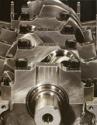


Ls3 Spun Bearing.
Thread Starter
Joined: Apr 2017
Posts: 305
Likes: 11
From: Washington NC

^^^^^^^^^Absolutely a Precision high-volume pump, along with
Other Oil mods (scraper, Lance's return porting suggestion, Sac City
Barbell & Diverter is the best way to ensure Oiling /Survival at
RPMs north of 7500, short of a Real Dry-Sump System such as
Daily for example.
Other Oil mods (scraper, Lance's return porting suggestion, Sac City
Barbell & Diverter is the best way to ensure Oiling /Survival at
RPMs north of 7500, short of a Real Dry-Sump System such as
Daily for example.
Do I go with the old school 10psi per 100rpms? that would be 80+ psi
or do i use a lower psi pump?
I know people say a higher psi pump uses more horsepower to turn.

TECH Fanatic


Joined: Aug 2009
Posts: 1,845
Likes: 255
From: Coast of San Mateo County Between Pacifica & HMB
So 50-65 PSI @ 8000 RPM would be the
sweet spot for me, with 70+ being wasted HP with the following conditions,
at least 190*-230* Oil Temp with the correct viscosity for your clearances.
I use AMSOIL 5W-30/10W-30 (User/Dealer since 1989 full disclosure).
Flow is more important then pressure and the lowest viscosity that
meets requirements will transfer more heat then a heavier viscosity
as well as make more HP.
Thread Starter
Joined: Apr 2017
Posts: 305
Likes: 11
From: Washington NC
6-8 PSI per 1000 RPM with NO CAVITATION!
So 50-65 PSI @ 8000 RPM would be the
sweet spot for me, with 70+ being wasted HP with the following conditions,
at least 190*-230* Oil Temp with the correct viscosity for your clearances.
I use AMSOIL 5W-30/10W-30 (User/Dealer since 1989 full disclosure).
Flow is more important then pressure and the lowest viscosity that
meets requirements will transfer more heat then a heavier viscosity
as well as make more HP.
Just call a few reputable companies that offer oil pumps/systems for an LS and get their opinion.
You still haven't said if you measured ALL the components and provided results.
I don't think replacing the oil pump is going to solve your issues. If you want it to live at 8000 RPM then you have to put a bit more effort into it than that. Not trying to be a jerk, just don't want to see you back on here with the same problem down the potentially short road.
You still haven't said if you measured ALL the components and provided results.
I don't think replacing the oil pump is going to solve your issues. If you want it to live at 8000 RPM then you have to put a bit more effort into it than that. Not trying to be a jerk, just don't want to see you back on here with the same problem down the potentially short road.
Thread Starter
Joined: Apr 2017
Posts: 305
Likes: 11
From: Washington NC
Just call a few reputable companies that offer oil pumps/systems for an LS and get their opinion.
You still haven't said if you measured ALL the components and provided results.
I don't think replacing the oil pump is going to solve your issues. If you want it to live at 8000 RPM then you have to put a bit more effort into it than that. Not trying to be a jerk, just don't want to see you back on here with the same problem down the potentially short road.
You still haven't said if you measured ALL the components and provided results.
I don't think replacing the oil pump is going to solve your issues. If you want it to live at 8000 RPM then you have to put a bit more effort into it than that. Not trying to be a jerk, just don't want to see you back on here with the same problem down the potentially short road.
Also a comment was made about oil flow with the stock filter housing. I am using one of the sheet metal pans with a remote oil filter. Do you think this could cause a flow issue?
I realize that the oil pump isnt gonna fix everything but i might as well use the best one I can. The crank and rods are at the machine shop getting checked out currently. I should know something today.
Also a comment was made about oil flow with the stock filter housing. I am using one of the sheet metal pans with a remote oil filter. Do you think this could cause a flow issue?
Also a comment was made about oil flow with the stock filter housing. I am using one of the sheet metal pans with a remote oil filter. Do you think this could cause a flow issue?
Thread Starter
Joined: Apr 2017
Posts: 305
Likes: 11
From: Washington NC
The rod journal on the number one piston is out of round 3 thousands. Guess im gonna just buy a new crank. Question is, should i just order new pistons too and stroke it?
Would you still try to turn it 8000 RPM? A lot of people are having issues with the crank flexing at higher RPM and big power levels with the 4” stroke stuff, but the 4.1” and 4.250” don’t seem to have that problem.
LS1 Tech Stories
The Best V8 Stories One Small Block at Time

Gas Monkey Built a 6-Wheel Ferrari Testarossa With a Corvette LT4 Engine
Verdad Gallardo
7 Most Reliable High-Performance Engines GM Has Ever Built
Verdad Gallardo
Amazing '71 Camaro Restomod Is Modern Muscle Car Under the Skin
Verdad Gallardo
6 Common C5 Corvette Failures and What's Involved In Repairing Them
Pouria Savadkouei
Retro Modern Bandit Pontiac Trans AM Comes With Burt Reynolds' Autograph
Verdad Gallardo
Top 10 Greatest Cadillac V Series Performance Models Ever, Ranked
Pouria Savadkouei
Top 10 Most Powerful Chevy Trucks Ever Made!

Hennessey's New Supercharged Silverado ZR2 Has 700 HP
Verdad Gallardo
Coachbuilt N2A Anteros Is an LS2-Powered C6 Corvette In Italian Clothes
Verdad Gallardo Thread Starter
Joined: Apr 2017
Posts: 305
Likes: 11
From: Washington NC
no i was thinking if I stroked it I could dial back the rpms a little. Maybe try to keep it under 7500. I wonder why the 4 inch cranks have more problems then the bigger ones?


At this point absolutely! To live at 8,000 is a tall order though. Purchase a quality forged rotating assembly along with some good bearings and be sure to verify ALL of your clearances prior to assembly. Your also going to need a quality set of heads and serious valve train to live upstairs as we are getting into solid cam territory here. I prefer to run high volume oil pumps over high pressure pumps as you want the oil moving through the bearings as quickly as possible. Like I said earlier I've learned some things along the way. It's always something, it's never enough, **** happens, and it gets real expensive!
I forgot to mention the most important component to any big power build. I hope your not doing all of this on a factory aluminum block. Not to say it can't be done but your rolling the dice!
Some of those guy suspect counterweight placement is to blame. When they went to a crank with 8 counterweights instead of 6 and the problems went away.
Thread Starter
Joined: Apr 2017
Posts: 305
Likes: 11
From: Washington NC
It's not necessarity the block "clearance" that you have to worry about. It the pin height in the piston and the skirt coming out of the bottom of the cylinder.
I know people are going to say "I've put 186,000 miles on my 4.xxx" stroke LS wonder machine", but I don't really think you'll find many "real world" street cars that actually get driven on a regular basis that have very many miles on them. Sure, they may be just fine and have lived, but a lot of times these are performance engines that are torn apart for the next upgrade before the actual service life is determined, so actual real world life expectancy can be skewed.
I say put whatever stroke you're cylinder heads ans RPM goal will support in it and follow suit with the rest of the build. If that means you have 280+cc heads and a big *** solid roller with a stout shaft rocker system, then spin it to the moon no matter what stroke you put in it. If you have "normal" LS performance heads (CNC ported stock castings or "street" type aftermarket heads), then be realistic with your goals and turn as many RPM's as your components AND WALLET will support.
Don't try to be a "hero" and say I have an 8,000 RPM engine, when in fact you have a much better chance of having a reliable 7,000 RPM engine.
Set realistic goals and complete them. You will be MUCH happier in the end when you can enjoy your car/hobby than letting it sit in a shop/garage collecting dust because it failed or didn't meet your expectations.
Good luck.
I know people are going to say "I've put 186,000 miles on my 4.xxx" stroke LS wonder machine", but I don't really think you'll find many "real world" street cars that actually get driven on a regular basis that have very many miles on them. Sure, they may be just fine and have lived, but a lot of times these are performance engines that are torn apart for the next upgrade before the actual service life is determined, so actual real world life expectancy can be skewed.
I say put whatever stroke you're cylinder heads ans RPM goal will support in it and follow suit with the rest of the build. If that means you have 280+cc heads and a big *** solid roller with a stout shaft rocker system, then spin it to the moon no matter what stroke you put in it. If you have "normal" LS performance heads (CNC ported stock castings or "street" type aftermarket heads), then be realistic with your goals and turn as many RPM's as your components AND WALLET will support.
Don't try to be a "hero" and say I have an 8,000 RPM engine, when in fact you have a much better chance of having a reliable 7,000 RPM engine.
Set realistic goals and complete them. You will be MUCH happier in the end when you can enjoy your car/hobby than letting it sit in a shop/garage collecting dust because it failed or didn't meet your expectations.
Good luck.
Thread Starter
Joined: Apr 2017
Posts: 305
Likes: 11
From: Washington NC
It's not necessarity the block "clearance" that you have to worry about. It the pin height in the piston and the skirt coming out of the bottom of the cylinder.
I know people are going to say "I've put 186,000 miles on my 4.xxx" stroke LS wonder machine", but I don't really think you'll find many "real world" street cars that actually get driven on a regular basis that have very many miles on them. Sure, they may be just fine and have lived, but a lot of times these are performance engines that are torn apart for the next upgrade before the actual service life is determined, so actual real world life expectancy can be skewed.
I say put whatever stroke you're cylinder heads ans RPM goal will support in it and follow suit with the rest of the build. If that means you have 280+cc heads and a big *** solid roller with a stout shaft rocker system, then spin it to the moon no matter what stroke you put in it. If you have "normal" LS performance heads (CNC ported stock castings or "street" type aftermarket heads), then be realistic with your goals and turn as many RPM's as your components AND WALLET will support.
Don't try to be a "hero" and say I have an 8,000 RPM engine, when in fact you have a much better chance of having a reliable 7,000 RPM engine.
Set realistic goals and complete them. You will be MUCH happier in the end when you can enjoy your car/hobby than letting it sit in a shop/garage collecting dust because it failed or didn't meet your expectations.
Good luck.
I know people are going to say "I've put 186,000 miles on my 4.xxx" stroke LS wonder machine", but I don't really think you'll find many "real world" street cars that actually get driven on a regular basis that have very many miles on them. Sure, they may be just fine and have lived, but a lot of times these are performance engines that are torn apart for the next upgrade before the actual service life is determined, so actual real world life expectancy can be skewed.
I say put whatever stroke you're cylinder heads ans RPM goal will support in it and follow suit with the rest of the build. If that means you have 280+cc heads and a big *** solid roller with a stout shaft rocker system, then spin it to the moon no matter what stroke you put in it. If you have "normal" LS performance heads (CNC ported stock castings or "street" type aftermarket heads), then be realistic with your goals and turn as many RPM's as your components AND WALLET will support.
Don't try to be a "hero" and say I have an 8,000 RPM engine, when in fact you have a much better chance of having a reliable 7,000 RPM engine.
Set realistic goals and complete them. You will be MUCH happier in the end when you can enjoy your car/hobby than letting it sit in a shop/garage collecting dust because it failed or didn't meet your expectations.
Good luck.
I currently have trickflow 255's, Shaft Rockers, CamMotion Solid Cam, Sheet Metal intake, je +10 dome pistons around 13.8:1 compression. If my power with my stock stroke isnt peaking until after 8000 i am hoping with a stroker it will peak much earlier. I am leaning toward a 4inch stroke but i was wondering if anyone had expirence running a 4.1. The car will rarely be driven on the street. Maybe a few hundred miles a year.

Could it be your intake runners are too short? Longer runners usually peak out earlier.
Heres another thought, ever thought about de stroking? Theres a good write up in HR about how to do it.
http://www.hotrod.com/articles/4-8l-...pm-ls-stroker/
Little less torque than the longer stroke but you can turn some Rs.
Heres another thought, ever thought about de stroking? Theres a good write up in HR about how to do it.
http://www.hotrod.com/articles/4-8l-...pm-ls-stroker/
Little less torque than the longer stroke but you can turn some Rs.
Last edited by Gasoholic; May 3, 2018 at 12:42 AM. Reason: added link
I currently have trickflow 255's, Shaft Rockers, CamMotion Solid Cam, Sheet Metal intake, je +10 dome pistons around 13.8:1 compression. If my power with my stock stroke isnt peaking until after 8000 i am hoping with a stroker it will peak much earlier. I am leaning toward a 4inch stroke but i was wondering if anyone had expirence running a 4.1. The car will rarely be driven on the street. Maybe a few hundred miles a year.
If I were you, I would call up Erik Koenig of Horsepower Research (HPR). They do a lot of combos like this for road race applications and can give you feedback on what to expect with a combo like that. The do a 442ci combo with a stock LS3 block pretty regularly.

Staging Lane
Joined: Dec 2012
Posts: 91
Likes: 0
I say keep the stock stroke and spin it to the moon! :-)
Seriously though, I think you've got some fairly simple oiling system problems that caused this. There's a lot of opinions out there on pressure, but the #1 thing you need to prevent is cavitation. Personally, I'd like to see 70+ psi at high revs and not worry about losing a couple HP. Don't forget that standard LS blocks don't have priority main oiling, so the pressure you see at the factory port will be lower than what you have at the mains. The real ticket would be a dry sump system to ensure a consistent flow of non-aerated oil, but I think you can make the wet sump work.
Seriously though, I think you've got some fairly simple oiling system problems that caused this. There's a lot of opinions out there on pressure, but the #1 thing you need to prevent is cavitation. Personally, I'd like to see 70+ psi at high revs and not worry about losing a couple HP. Don't forget that standard LS blocks don't have priority main oiling, so the pressure you see at the factory port will be lower than what you have at the mains. The real ticket would be a dry sump system to ensure a consistent flow of non-aerated oil, but I think you can make the wet sump work.