







Ls3 Spun Bearing.
Thread Starter
Joined: Apr 2017
Posts: 305
Likes: 11
From: Washington NC
 Ls3 Spun Bearing.
 As usual with my new motor I cant catch a break. I had the issues with the head then got it back together and had issues with tuning.
This morning i got it back on the dyno with the new torque convertor and the new holley efi.
The new cam is amazing but the power hadnt peaked at 8000 rpms. I continued to work on the tune and I bumped up the rev limiter little by little.
After one run i noticed a little bit of a knock coming from the engine. I pulled the motor out this afternoon and the number one rod bearing had spun.
So where do i go from here?
Is 8000+ rpms unrealistic with stock style oiling system?
Oil pressure was rock solid on all the runs.
Should I just stroke the motor to acheive my power goals with less rpms?
my orginal thread is here https://ls1tech.com/forums/generatio...-my-focus.html
This morning i got it back on the dyno with the new torque convertor and the new holley efi.
The new cam is amazing but the power hadnt peaked at 8000 rpms. I continued to work on the tune and I bumped up the rev limiter little by little.
After one run i noticed a little bit of a knock coming from the engine. I pulled the motor out this afternoon and the number one rod bearing had spun.
So where do i go from here?
Is 8000+ rpms unrealistic with stock style oiling system?
Oil pressure was rock solid on all the runs.
Should I just stroke the motor to acheive my power goals with less rpms?
my orginal thread is here https://ls1tech.com/forums/generatio...-my-focus.html
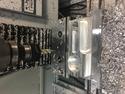
Bearing Picture Read Hi TS, send/post some pictures of the other bearings.
MOST here can "read" the bearings.
Did you "port" / "drill" the Oil Pan in the filter insert area ?
Lance
MOST here can "read" the bearings.
Did you "port" / "drill" the Oil Pan in the filter insert area ?
Lance
Thread Starter
Joined: Apr 2017
Posts: 305
Likes: 11
From: Washington NC
Thread Starter
Joined: Apr 2017
Posts: 305
Likes: 11
From: Washington NC
Pretty ugly for sure. The black color leads me to think there may have been some detonation, and the "good" bearing doesn't look terrible, but there was definitely some trash going through the oil or the surface finish of the crankshaft wasn't that great.
Can you give us some details on the components (brand, part number, material, etc.) and what the oil clearances were set to on the rods and mains. How do the main bearings and caps look?
Also, what weight oil and what "habits" were used when making passes or pulls? Full temp or cold runs where viscosity/flow might have been compromised?
Be sure to check the housing bore of that rod and see if it's still round and if it is any smaller/larger than the other 7.
Can you give us some details on the components (brand, part number, material, etc.) and what the oil clearances were set to on the rods and mains. How do the main bearings and caps look?
Also, what weight oil and what "habits" were used when making passes or pulls? Full temp or cold runs where viscosity/flow might have been compromised?
Be sure to check the housing bore of that rod and see if it's still round and if it is any smaller/larger than the other 7.
Trending Topics
Black Death = Bearing Failure Hi TS, good pictures, thanks.
The Black area in the bearing center IS CAUSED by the Oil being "fried" OR burned as in a Frying Pan. (brown butter)
This, as stated by an above poster, is the result of LOW Oil Flow Volume.
I would add, inspect your Oil Pan filter insert area AND Port that area with a bypass hole added.
Lance
The Black area in the bearing center IS CAUSED by the Oil being "fried" OR burned as in a Frying Pan. (brown butter)
This, as stated by an above poster, is the result of LOW Oil Flow Volume.
I would add, inspect your Oil Pan filter insert area AND Port that area with a bypass hole added.
Lance
LS1 Tech Stories
The Best V8 Stories One Small Block at Time

6 Common C5 Corvette Failures and What's Involved In Repairing Them
Pouria Savadkouei
Retro Modern Bandit Pontiac Trans AM Comes With Burt Reynolds' Autograph
Verdad Gallardo
Top 10 Greatest Cadillac V Series Performance Models Ever, Ranked
Pouria Savadkouei
Top 10 Most Powerful Chevy Trucks Ever Made!

Hennessey's New Supercharged Silverado ZR2 Has 700 HP
Verdad Gallardo
Coachbuilt N2A Anteros Is an LS2-Powered C6 Corvette In Italian Clothes
Verdad Gallardo
Awesome K5 Blazer Restomod Comes With C7 Corvette Power
Verdad Gallardo
10 Camaros You Should Never Buy

10 LS Engine Myths That Refuse to Die
Verdad Gallardo I just noticed something.
You say at 8000 RPM it hadn't reached peak power.
In the photos, I see what appear to be H-Beam Rods and forged Pistons, but I don't see the crankshaft.
Are you using "stock" rod bearings on an aftermarket crank that requires a narrowed bearing to clear the fillet radius OR are you using a stock OEM crank and "stock" rod bearings expecting them to live at 8000 RPM?
Either way, I don't see it being a reliable combination. If it's stock bearings on a stock crankshaft, the crank flex at that RPM is probably what is ultimately causing you heartburn. Either increase your component strength or lower your intended RPM.
Also, some details on the "stock style" oiling system enabling it to run 8000 RPM would be helpful.
You say at 8000 RPM it hadn't reached peak power.
In the photos, I see what appear to be H-Beam Rods and forged Pistons, but I don't see the crankshaft.
Are you using "stock" rod bearings on an aftermarket crank that requires a narrowed bearing to clear the fillet radius OR are you using a stock OEM crank and "stock" rod bearings expecting them to live at 8000 RPM?
Either way, I don't see it being a reliable combination. If it's stock bearings on a stock crankshaft, the crank flex at that RPM is probably what is ultimately causing you heartburn. Either increase your component strength or lower your intended RPM.
Also, some details on the "stock style" oiling system enabling it to run 8000 RPM would be helpful.
Thread Starter
Joined: Apr 2017
Posts: 305
Likes: 11
From: Washington NC
I just noticed something.
You say at 8000 RPM it hadn't reached peak power.
In the photos, I see what appear to be H-Beam Rods and forged Pistons, but I don't see the crankshaft.
Are you using "stock" rod bearings on an aftermarket crank that requires a narrowed bearing to clear the fillet radius OR are you using a stock OEM crank and "stock" rod bearings expecting them to live at 8000 RPM?
Either way, I don't see it being a reliable combination. If it's stock bearings on a stock crankshaft, the crank flex at that RPM is probably what is ultimately causing you heartburn. Either increase your component strength or lower your intended RPM.
Also, some details on the "stock style" oiling system enabling it to run 8000 RPM would be helpful.
You say at 8000 RPM it hadn't reached peak power.
In the photos, I see what appear to be H-Beam Rods and forged Pistons, but I don't see the crankshaft.
Are you using "stock" rod bearings on an aftermarket crank that requires a narrowed bearing to clear the fillet radius OR are you using a stock OEM crank and "stock" rod bearings expecting them to live at 8000 RPM?
Either way, I don't see it being a reliable combination. If it's stock bearings on a stock crankshaft, the crank flex at that RPM is probably what is ultimately causing you heartburn. Either increase your component strength or lower your intended RPM.
Also, some details on the "stock style" oiling system enabling it to run 8000 RPM would be helpful.
It is a stock ls1 crankshaft.
I am using a melling standard flow oil pump.

 Cast/Steel Crankshaft Flex
 Hi TS, YOUR pictures ARE VERY clear, NO sign of Fillet Contact.
AGAIN, bad "tech" as a Steel crankshaft WILL Flex a greater amount then a Cast crankshaft, just ask Jake. (our metal engineer)
I have MEASURED crankshaft flex with MY ECU-882C and MY 60-2 TW (58x) BOTH Steel/Cast.
The Oil Pressure for 8K RPM should be 100 psi with 80 Psi min seen on the gauge, Data Logger ?
Lance
AGAIN, bad "tech" as a Steel crankshaft WILL Flex a greater amount then a Cast crankshaft, just ask Jake. (our metal engineer)
I have MEASURED crankshaft flex with MY ECU-882C and MY 60-2 TW (58x) BOTH Steel/Cast.
The Oil Pressure for 8K RPM should be 100 psi with 80 Psi min seen on the gauge, Data Logger ?
Lance
Thread Starter
Joined: Apr 2017
Posts: 305
Likes: 11
From: Washington NC
Hi TS, YOUR pictures ARE VERY clear, NO sign of Fillet Contact.
AGAIN, bad "tech" as a Steel crankshaft WILL Flex a greater amount then a Cast crankshaft, just ask Jake. (our metal engineer)
I have MEASURED crankshaft flex with MY ECU-882C and MY 60-2 TW (58x) BOTH Steel/Cast.
The Oil Pressure for 8K RPM should be 100 psi with 80 Psi min seen on the gauge, Data Logger ?
Lance
AGAIN, bad "tech" as a Steel crankshaft WILL Flex a greater amount then a Cast crankshaft, just ask Jake. (our metal engineer)
I have MEASURED crankshaft flex with MY ECU-882C and MY 60-2 TW (58x) BOTH Steel/Cast.
The Oil Pressure for 8K RPM should be 100 psi with 80 Psi min seen on the gauge, Data Logger ?
Lance
Also what is the probability that the rod bolts stretched? should i be running L19 bolts?
Hi TS, YOUR pictures ARE VERY clear, NO sign of Fillet Contact.
AGAIN, bad "tech" as a Steel crankshaft WILL Flex a greater amount then a Cast crankshaft, just ask Jake. (our metal engineer)
I have MEASURED crankshaft flex with MY ECU-882C and MY 60-2 TW (58x) BOTH Steel/Cast.
AGAIN, bad "tech" as a Steel crankshaft WILL Flex a greater amount then a Cast crankshaft, just ask Jake. (our metal engineer)
I have MEASURED crankshaft flex with MY ECU-882C and MY 60-2 TW (58x) BOTH Steel/Cast.
In summary, you're saying all these endurance and drag motors with forged crankshafts and 60 psi oil pressure turning 8000+ RPM should have blown up long ago? Doesn't make sense. What about a billet steel crankshaft, where does that rate in your scale of capabilities?
How long has your engine been together and how much run time, passes, dyno pulls, etc. do you think you have on it? Any tuning problems along the way? How much knock retard have you seen? Not just during recent tuning, but all prior tuning as well where it may have been damaged previously and progressively gotten worse until failure.
50 psi at 8000 is not really that big of a concern if you have enough oil flow and the correct viscosity with enough temperature in the oil before you turn that kind of RPM.
I'd go back and measure ALL components (crank journals for size, roundness and taper), rod big end (size, roundness, taper), bearing crush, oil clearances, crank straightness across all mains, etc. I think this will shed some light on your issues.
Regardless, get rid of the stock crank if you want to turn that kind of RPM and develop a better oiling system to ensure consistent oil supply at that RPM.

I was looking into a company called Precision Oil Pumps.
Something else I wanted to point out. Look at this graph posted by a vendor in this thread.
https://ls1tech.com/forums/generatio...l#post18902513
Last edited by 1FastBrick; Apr 30, 2018 at 05:43 PM.
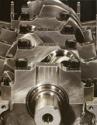
The specs on that second bearing pic looks like you had a cavitation problem. That may or may not have anything to do with the other bearing spinning though, but it isn’t good. Pretty much inherent with this style of oiling system at that RPM. The Melling pumps (10295/10296) do have features meant to help. Also, too little pan to pickup clearance could exaggerate the problem too.
Any pics of the main bearings?
Any pics of the main bearings?
Thread Starter
Joined: Apr 2017
Posts: 305
Likes: 11
From: Washington NC
The specs on that second bearing pic looks like you had a cavitation problem. That may or may not have anything to do with the other bearing spinning though, but it isn’t good. Pretty much inherent with this style of oiling system at that RPM. The Melling pumps (10295/10296) do have features meant to help. Also, too little pan to pickup clearance could exaggerate the problem too.
Any pics of the main bearings?
Any pics of the main bearings?


TECH Fanatic


Joined: Aug 2009
Posts: 1,845
Likes: 255
From: Coast of San Mateo County Between Pacifica & HMB
Spinning it to 8K, I would recommend looking into a Blueprinted oil pump from a company that specialize in them.
I was looking into a company called Precision Oil Pumps.
Something else I wanted to point out. Look at this graph posted by a vendor in this thread.
https://ls1tech.com/forums/generatio...l#post18902513
I was looking into a company called Precision Oil Pumps.
Something else I wanted to point out. Look at this graph posted by a vendor in this thread.
https://ls1tech.com/forums/generatio...l#post18902513
^^^^^^^^^Absolutely a Precision high-volume pump, along with
Other Oil mods (scraper, Lance's return porting suggestion, Sac City
Barbell & Diverter is the best way to ensure Oiling /Survival at
RPMs north of 7500, short of a Real Dry-Sump System such as
Daily for example.