





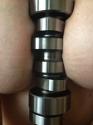


Spinmonster cam specs 2009

LS1Tech Sponsor


Joined: Jan 2008
Posts: 2,235
Likes: 1,526
From: Ohio, Georgia, Nevada, Texas

Darth has pointed out the importance of springs, lifters, pushrods etc. and doing the most with commercially available parts. Spanky, the following post is for people reliant on commercially available bolt-on parts. They don't own a copy of Don Hubbard's book or a cam grinder and rely on a manufacturer to develop and prescribe lobe profiles that keep their valvetrain happy, We're going to illustrate why the best cam vendors think in valve events and changed behaviors, but need to be able to speak with customers at all levels.
Step 1 is knowing what the valve events are and how they influence behavior. An engine lives by its valve events and it doesn't understand concepts like duration, LSA, advance etc. Setting the four events separately allows for more customization to the customers needs, -not less. Idle, gear and gear spacing, efficiency, powerband, converter, vehicle weight, compression, boost, etc.
Imagine trying to apply notions of duration, lobe separation, or advance across different engine platforms/architectures. The engine will almost certainly be a stinking pile of doo. Instead, using separate events CAN help you decipher what can work across different engine platforms with drastically different deck heights, runner lengths, etc. Top engine developers think the same way and we'll give an example in a historical context.
Some forum members remember when people were taught to think in Duration, LSA, and cams were delivered ground straight up. People put them in at "4 advanced" no matter what. At least 1 (if not 2 or 3 or 4) of the events were off. Beginning and intermediate engine builders would order a pile of cams and plug them in without knowing what's doing what. This is inefficient, expensive, and holds them back. To illustrate why thinking in events is important, the following experiment applies to any new engine combination we're attacking, but we'll approach it from the history that's near and dear to you in particular.
Mr. forum member...imagine working on your first LS1 engine in 1997. Imagine you're competing against John Lingenfelter, Geoff, Jason, Jud, Alan and many other notables. Bob Fox invented the Spintron 4 years ago and no one had heard of it. CSA wasn't a term known to any in the LS Market other than John Lingenfelter perhaps. Runner volumes were being advertised to equate velocity vs. volume. Flowbenches weren't rare but few understood their limitations. The Cathedral port looks goofy as heck and the engine had a very tiny beehive spring on it. You know is you want to make the biggest baddest cam in the land and you're going to call it Megalodon. Lift is dictated by commercially available spring packs of the day along with lifter oil band, rocker swipe, etc. and you don't own a cam grinder. Lets get into the latitudes you have.
You start by measuring your factory cam with it's 39 E/O, -12 E/C, -17 I/O and 33 I/C depending on whether it was ground on a Friday at the end of first shift.
Advance it until you hit minimum intake p to v. Retard it until you hit minimum exhaust p to v. Record those two numbers and know those are your constraints. Lets use 13 I/O and 12 E/C as an example.
You order your first test cam knowing what your mechanical constraints are. Looking at the constraints, you want the ability to move Test cam one around 10 degrees in the engine. Your I/O becomes -3 and your E/C becomes -2. If you just made those changes to the factory cam, it would result in a 210/217 109 + 1...but it's just a number. You forge ahead and add 10 degrees to I/C and it becomes 43 and your E/O becomes 49 (We'll save you the time here-it's a 220/227 114+1). The events that the old masters were looking at 49 E/O, -2 E/C, -3 I/O, 43 I/C.
What's special about this little guy is it's square in the middle of the mechanical constraints and you can move it either way up to 10 degrees. You can advance in 2 degree increments to see what it does for low end torque and idle KPA. You can retard it in 2 degree increments and see where power peak moves before airflow and runner length close the door.
I/C being most important to powerband, you find the cam produced the most peak power retarded to roughly 50 degrees abdc. Most people are going to buy the cam for the peak hp number so you leave that in place knowing you will shaving degrees for your smarter customer interested in shift recovery/average power, idle etc.with your smaller offerings. You set intake opening at 13 btdc for Test cam 2.
On the exhaust side, it's harder to identify the right events because they were overwhelmed by the most important one (i/C). You know people are going to buy Megaldon for it's sound and peak horsepower number. After you've experimented, you add 5 to exhaust opening to make it louder and set the closing to the mechanical restraint of 12 atdc E/O.
So your numbers for test cam 2 become 54 E/O, 12 E/C, 13 I/O, 50 I/C. (243/246 110 + 1). You're now your within spitball range of MS3, MS4, Trex, G5X4, Vindicator and GM's Grand Am cam. Nobody can tune it to idle well, but it runs great at the track with open headers and it wins some races.
What about stage 1,2,3 for people that run on the street? Start pulling back I/O to your kpa targets you tested for earlier. Bring back you I/C to maximize shift recovery. Bring back E/O to build a little more bottom end at part throttle. Bring back E/C. to minimize reversion with a real world exhaust system. Wash, Rinse, Repeat and stay in business as new engine combinations come out.
The point of this exercise for aspiring engine builders is knowing what changes with the individual events. It will certainly make you faster, more quickly, and at less expense. Think how many years (decades) and sub-par camshafts have come and gone. Then ask yourself if you want to think in valve events or be influenced by ghosts. Next, pop up your cam vendors of choice on our website and narrow down your choices. There's an article on how to search across multiple vendors quickly here.
Step 1 is knowing what the valve events are and how they influence behavior. An engine lives by its valve events and it doesn't understand concepts like duration, LSA, advance etc. Setting the four events separately allows for more customization to the customers needs, -not less. Idle, gear and gear spacing, efficiency, powerband, converter, vehicle weight, compression, boost, etc.
Imagine trying to apply notions of duration, lobe separation, or advance across different engine platforms/architectures. The engine will almost certainly be a stinking pile of doo. Instead, using separate events CAN help you decipher what can work across different engine platforms with drastically different deck heights, runner lengths, etc. Top engine developers think the same way and we'll give an example in a historical context.
Some forum members remember when people were taught to think in Duration, LSA, and cams were delivered ground straight up. People put them in at "4 advanced" no matter what. At least 1 (if not 2 or 3 or 4) of the events were off. Beginning and intermediate engine builders would order a pile of cams and plug them in without knowing what's doing what. This is inefficient, expensive, and holds them back. To illustrate why thinking in events is important, the following experiment applies to any new engine combination we're attacking, but we'll approach it from the history that's near and dear to you in particular.
Mr. forum member...imagine working on your first LS1 engine in 1997. Imagine you're competing against John Lingenfelter, Geoff, Jason, Jud, Alan and many other notables. Bob Fox invented the Spintron 4 years ago and no one had heard of it. CSA wasn't a term known to any in the LS Market other than John Lingenfelter perhaps. Runner volumes were being advertised to equate velocity vs. volume. Flowbenches weren't rare but few understood their limitations. The Cathedral port looks goofy as heck and the engine had a very tiny beehive spring on it. You know is you want to make the biggest baddest cam in the land and you're going to call it Megalodon. Lift is dictated by commercially available spring packs of the day along with lifter oil band, rocker swipe, etc. and you don't own a cam grinder. Lets get into the latitudes you have.
You start by measuring your factory cam with it's 39 E/O, -12 E/C, -17 I/O and 33 I/C depending on whether it was ground on a Friday at the end of first shift.
Advance it until you hit minimum intake p to v. Retard it until you hit minimum exhaust p to v. Record those two numbers and know those are your constraints. Lets use 13 I/O and 12 E/C as an example.
You order your first test cam knowing what your mechanical constraints are. Looking at the constraints, you want the ability to move Test cam one around 10 degrees in the engine. Your I/O becomes -3 and your E/C becomes -2. If you just made those changes to the factory cam, it would result in a 210/217 109 + 1...but it's just a number. You forge ahead and add 10 degrees to I/C and it becomes 43 and your E/O becomes 49 (We'll save you the time here-it's a 220/227 114+1). The events that the old masters were looking at 49 E/O, -2 E/C, -3 I/O, 43 I/C.
What's special about this little guy is it's square in the middle of the mechanical constraints and you can move it either way up to 10 degrees. You can advance in 2 degree increments to see what it does for low end torque and idle KPA. You can retard it in 2 degree increments and see where power peak moves before airflow and runner length close the door.
I/C being most important to powerband, you find the cam produced the most peak power retarded to roughly 50 degrees abdc. Most people are going to buy the cam for the peak hp number so you leave that in place knowing you will shaving degrees for your smarter customer interested in shift recovery/average power, idle etc.with your smaller offerings. You set intake opening at 13 btdc for Test cam 2.
On the exhaust side, it's harder to identify the right events because they were overwhelmed by the most important one (i/C). You know people are going to buy Megaldon for it's sound and peak horsepower number. After you've experimented, you add 5 to exhaust opening to make it louder and set the closing to the mechanical restraint of 12 atdc E/O.
So your numbers for test cam 2 become 54 E/O, 12 E/C, 13 I/O, 50 I/C. (243/246 110 + 1). You're now your within spitball range of MS3, MS4, Trex, G5X4, Vindicator and GM's Grand Am cam. Nobody can tune it to idle well, but it runs great at the track with open headers and it wins some races.
What about stage 1,2,3 for people that run on the street? Start pulling back I/O to your kpa targets you tested for earlier. Bring back you I/C to maximize shift recovery. Bring back E/O to build a little more bottom end at part throttle. Bring back E/C. to minimize reversion with a real world exhaust system. Wash, Rinse, Repeat and stay in business as new engine combinations come out.
The point of this exercise for aspiring engine builders is knowing what changes with the individual events. It will certainly make you faster, more quickly, and at less expense. Think how many years (decades) and sub-par camshafts have come and gone. Then ask yourself if you want to think in valve events or be influenced by ghosts. Next, pop up your cam vendors of choice on our website and narrow down your choices. There's an article on how to search across multiple vendors quickly here.
Last edited by Summitracing; Jun 25, 2019 at 12:52 PM.
Step 1 is knowing what the valve events are and how they influence behavior. An engine lives by its valve events and it doesn't understand concepts like duration, LSA, advance etc. Setting the four events separately allows for more customization to the customers needs, -not less. Idle, gear and gear spacing, efficiency, powerband, converter, vehicle weight, compression, boost, etc.

Thread Starter
TECH Addict
Joined: Sep 2010
Posts: 2,898
Likes: 467
Originally Posted by Jenson
99% of my customers want "the heaviest craziest lope" and "500-600 N/A rwhp" and "drive like stock". So if someone can make that happen you will be rich!!!
LS1Tech Sponsor
Joined: Jan 2008
Posts: 2,235
Likes: 1,526
From: Ohio, Georgia, Nevada, Texas
Yes we do, but not under Summit Pro LS. Those are done in large production runs to keep the price down. What we'll commonly do is calculate what you need base on your usage. From there, we get custom grinds from Cam Motion, Comp, and others using lobe profiles designed for your needs. Just PM us and we'll get you on the right track. Thank you for your interest.
LS1 Tech Stories
The Best V8 Stories One Small Block at Time

Gas Monkey Built a 6-Wheel Ferrari Testarossa With a Corvette LT4 Engine
Verdad Gallardo
7 Most Reliable High-Performance Engines GM Has Ever Built
Verdad Gallardo
Amazing '71 Camaro Restomod Is Modern Muscle Car Under the Skin
Verdad Gallardo
6 Common C5 Corvette Failures and What's Involved In Repairing Them
Pouria Savadkouei
Retro Modern Bandit Pontiac Trans AM Comes With Burt Reynolds' Autograph
Verdad Gallardo
Top 10 Greatest Cadillac V Series Performance Models Ever, Ranked
Pouria Savadkouei
Top 10 Most Powerful Chevy Trucks Ever Made!

Hennessey's New Supercharged Silverado ZR2 Has 700 HP
Verdad Gallardo
Coachbuilt N2A Anteros Is an LS2-Powered C6 Corvette In Italian Clothes
Verdad Gallardo Thread Starter
TECH Addict
Joined: Sep 2010
Posts: 2,898
Likes: 467
Yes we do, but not under Summit Pro LS. Those are done in large production runs to keep the price down. What we'll commonly do is calculate what you need base on your usage. From there, we get custom grinds from Cam Motion, Comp, and others using lobe profiles designed for your needs. Just PM us and we'll get you on the right track. Thank you for your interest.
LS1Tech Sponsor
Joined: Jan 2008
Posts: 2,235
Likes: 1,526
From: Ohio, Georgia, Nevada, Texas
Yes, m-f usually and sometimes on the weekends. If not just call in. What I can do is get a quick read for what you're doing and send you to the appropriate tech for ordering.
Thread Starter
TECH Addict
Joined: Sep 2010
Posts: 2,898
Likes: 467

TECH Senior Member

Joined: Jun 2016
Posts: 22,298
Likes: 3,619
From: Central Cal.


I tell them to buy a C6Z... can make high 500's-600hp pretty easy, has valved mufflers to be loud or quiet when you want to, drives nicely with a good tune and is lightweight enough to have fun with that power level.
Be way cheaper than trying to make 500rwhp N/A with a 5.3L

