





LSX cylinder wall length?

Thread Starter
Tin Foil Hat Wearin' Fool
iTrader: (36)
Joined: Oct 2004
Posts: 23,027
Likes: 0
From: Austin, TX
 LSX cylinder wall length?
 I know the iron 6.0 block has a shorter length then the LS2 block, Im wondering if the cylinder wall is longer on the LSX block then the 6.0 or the LS2 block, Im trying to fight bad piston rock at BDC with my 4.1" crank. I have gotten mixed reports on cylinder wall length on the LSx block. I hope one of my sources are wrong the LSX is longer then the iron 6.0 block.

On The Tree

Joined: Apr 2007
Posts: 147
Likes: 0
From: Grand Rapids MI
I've read about this and have questions , too . Something about the standard deck LSX not allowing 3 rings after a certain stroke , due to piston pin height . Does this mean my 511 will never happen ?
Thread Starter
Tin Foil Hat Wearin' Fool
iTrader: (36)
Joined: Oct 2004
Posts: 23,027
Likes: 0
From: Austin, TX
So how are the motors with 4.1 and 4.125 stroke cranks lasting and not burning oil? I have had two different sets of pistons in my iron 6.0L block with my 4.1 stroke crank and both burn oil. The first motor burnt oil to the tune of 1 quart every 80 miles , the second motor burns a quart every 200ish miles. First set was JE's second set are wiseco's. Im running a 6.125 rod, is there something Im missing here?
, the second motor burns a quart every 200ish miles. First set was JE's second set are wiseco's. Im running a 6.125 rod, is there something Im missing here? Thread Starter
Tin Foil Hat Wearin' Fool
iTrader: (36)
Joined: Oct 2004
Posts: 23,027
Likes: 0
From: Austin, TX
I think he means the same as the iron blocks because I have heard the LSX and the 6.0 iron block have the same length cylinders. The LS2 block has a .2" longer sleeve.
Trending Topics

LS1 Tech Stories
The Best V8 Stories One Small Block at Time

6 Common C5 Corvette Failures and What's Involved In Repairing Them
Pouria Savadkouei
Retro Modern Bandit Pontiac Trans AM Comes With Burt Reynolds' Autograph
Verdad Gallardo
Top 10 Greatest Cadillac V Series Performance Models Ever, Ranked
Pouria Savadkouei
Top 10 Most Powerful Chevy Trucks Ever Made!

Hennessey's New Supercharged Silverado ZR2 Has 700 HP
Verdad Gallardo
Coachbuilt N2A Anteros Is an LS2-Powered C6 Corvette In Italian Clothes
Verdad Gallardo
Awesome K5 Blazer Restomod Comes With C7 Corvette Power
Verdad Gallardo
10 Camaros You Should Never Buy

10 LS Engine Myths That Refuse to Die
Verdad Gallardo



FormerVendor
Joined: Nov 2001
Posts: 3,065
Likes: 6
From: Houston, Tx.

All the stock OEM cylinders on LS1 type engines (including iron 6.0 and LS1, LS2, L92 etc.) are only 5.500-ish besides the LS7 which is much longer at 5.900-ish.
Most people aren't measuring the cylinders correctly and the LS2 has aluminum casting that goes further down but the cylinders are still as short as an iron block.
The LSX bowtie block is also only 5.500 so far on all the ones we have worked on. It is undercut at the bottoms of the cylinders for honing overtravel and core shift.
Again if you stuck a tape measure down any you will get an incorrect measurement as you aren't measuring the cylinder but rather the casting only.
The older original Darton MIDs are 5.625 long but the newer ones are 5.800 including the dry sleeves.
Most people aren't measuring the cylinders correctly and the LS2 has aluminum casting that goes further down but the cylinders are still as short as an iron block.
The LSX bowtie block is also only 5.500 so far on all the ones we have worked on. It is undercut at the bottoms of the cylinders for honing overtravel and core shift.
Again if you stuck a tape measure down any you will get an incorrect measurement as you aren't measuring the cylinder but rather the casting only.
The older original Darton MIDs are 5.625 long but the newer ones are 5.800 including the dry sleeves.
FormerVendor
Joined: Nov 2001
Posts: 3,065
Likes: 6
From: Houston, Tx.
So how are the motors with 4.1 and 4.125 stroke cranks lasting and not burning oil? I have had two different sets of pistons in my iron 6.0L block with my 4.1 stroke crank and both burn oil. The first motor burnt oil to the tune of 1 quart every 80 miles, the second motor burns a quart every 200ish miles. First set was JE's second set are wiseco's. Im running a 6.125 rod, is there something Im missing here?
, the second motor burns a quart every 200ish miles. First set was JE's second set are wiseco's. Im running a 6.125 rod, is there something Im missing here?
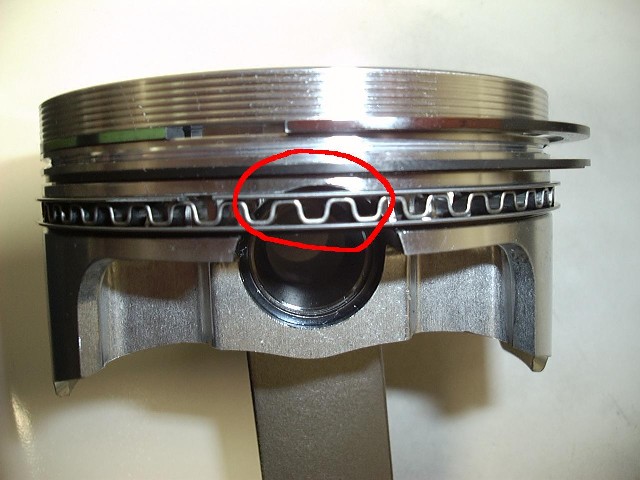
We installed Weisco pistons that had a ring package that allowed a sliver of the pin bore to protrude past the upper oil scraper. I was told by Weisco that there would be no problem running these. We prepped the cylinder bores very carefully making making oil consumption a high priority. The engine burned a quart every 200 miles. It also filled the catch can. We'll have the engine back this week and take a closer look at it.
Below is a pic of the relationship between the oil ring land and the pin bore. We used a napier second ring in this ring package.
I'd appreciate any comments about this.
Richard
Below is a pic of the relationship between the oil ring land and the pin bore. We used a napier second ring in this ring package.
I'd appreciate any comments about this.
Richard
We installed Weisco pistons that had a ring package that allowed a sliver of the pin bore to protrude past the upper oil scraper. I was told by Weisco that there would be no problem running these. We prepped the cylinder bores very carefully making making oil consumption a high priority. The engine burned a quart every 200 miles. It also filled the catch can. We'll have the engine back this week and take a closer look at it.
Below is a pic of the relationship between the oil ring land and the pin bore. We used a napier second ring in this ring package.
I'd appreciate any comments about this.
http://www.proheads.com/webshots/Weisco1a.jpg
Richard
Below is a pic of the relationship between the oil ring land and the pin bore. We used a napier second ring in this ring package.
I'd appreciate any comments about this.
http://www.proheads.com/webshots/Weisco1a.jpg
Richard
FormerVendor
Joined: Nov 2001
Posts: 3,065
Likes: 6
From: Houston, Tx.
Richard,
Whats the cylinder bore length and the ring stack and the CH? Thats a huge top land? I've done hundreds of engines with absolutely no problems but I don't have any pistons that look like that although I use Wiseco and Diamonds all the time. Your break point might be outside the bore at the bottom allowing the piston to suck oil past the rings on the intake stroke at BDC when the cylinder pressure is low and the crankcase pressure is higher which it always is on a normal engine. If the pistons are excessively rocking down there the rings may not stay sealed.
Whats the cylinder bore length and the ring stack and the CH? Thats a huge top land? I've done hundreds of engines with absolutely no problems but I don't have any pistons that look like that although I use Wiseco and Diamonds all the time. Your break point might be outside the bore at the bottom allowing the piston to suck oil past the rings on the intake stroke at BDC when the cylinder pressure is low and the crankcase pressure is higher which it always is on a normal engine. If the pistons are excessively rocking down there the rings may not stay sealed.