








Chevy Engineer drops details on LT4

That's some pretty awesome power. I bet it gets way better MPG than a GT500 too. I wonder how tall it is. The lack of titanium fancyness might make it cheaper than the 26K crate LS9.
I highly doubt that 1.7L blower will have much head room on it though since it's already 5000RPM higher.
I highly doubt that 1.7L blower will have much head room on it though since it's already 5000RPM higher.
That's some pretty awesome power. I bet it gets way better MPG than a GT500 too. I wonder how tall it is. The lack of titanium fancyness might make it cheaper than the 26K crate LS9.
I highly doubt that 1.7L blower will have much head room on it though since it's already 5000RPM higher.
I highly doubt that 1.7L blower will have much head room on it though since it's already 5000RPM higher.
They actually went over this when they unveiled the engine. While its smaller its still much more efficient than the ls9's blower runs cooler temps and is capable of more rpm's. It's got much more room to grown, I'll bet with a decent port job, pulley and supporting bolt ons these things will near 800whp no problem
"General Motors (GM) has released the official SAE-certified power statistics on the all-new 2015 Chevrolet Corvette Z06's LT4 supercharged engine, revealing the Z06 to be the most powerful production car ever made by GM. The 2015 Z06 features a 6.2-liter V-8 engine that will crank up to 650 horsepower and can deliver 650 lb.-ft. of torque at 3,600 rpm."
"The LT4 small block sets a new benchmark for power and torque at GM," said Steve Kiefer, vice president, GM Powertrain Engineering. "The engine also puts the new Corvette Z06 on par with the most powerful supercars offered in America, while delivering performance with impeccable manners that make it suitable for daily driving."
Just off idle, the LT4 engine produces 457 lb.-ft. of torque, and at 2,800 rpm it's producing 625 lb.-ft. By comparison, says GM, the V-12 engine in the Ferrari F12 Berlinetta, which features 12% more horsepower, doesn't reach its peak torque of 509 lb.-ft. until it's running at 6,000 rpm.
"Torque is the pulling power of an engine and the LT4's abundance of it at every rpm helps the Z06 accelerate quicker and respond nearly instantaneously," explained Jordan Lee, chief engineer for small-block engines. "It's the very definition of power on demand."
"It's also worth mentioning that the LT4's supercar performance numbers are achieved with an engine that is nearly the same size as the very compact LT1 engine introduced in the 2014 Corvette Stingray," Lee said. "The power density of the LT4 makes it one of the smallest and lightest 650-horsepower engines in the industry."
Features specific to the Z06's new LT4 engine include:
aluminum cylinder heads;
lightweight titanium intake valves;
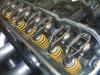
machined, forged powder metal steel connecting rods for reduced reciprocating mass;
compression ratio of 10.0:1, enabled by direct injection;
forged aluminum pistons with stronger structure;
stainless steel exhaust manifolds and an aluminum balancer that are lighter than their LT1 counterparts.
"The LT4 small block sets a new benchmark for power and torque at GM," said Steve Kiefer, vice president, GM Powertrain Engineering. "The engine also puts the new Corvette Z06 on par with the most powerful supercars offered in America, while delivering performance with impeccable manners that make it suitable for daily driving."
Just off idle, the LT4 engine produces 457 lb.-ft. of torque, and at 2,800 rpm it's producing 625 lb.-ft. By comparison, says GM, the V-12 engine in the Ferrari F12 Berlinetta, which features 12% more horsepower, doesn't reach its peak torque of 509 lb.-ft. until it's running at 6,000 rpm.
"Torque is the pulling power of an engine and the LT4's abundance of it at every rpm helps the Z06 accelerate quicker and respond nearly instantaneously," explained Jordan Lee, chief engineer for small-block engines. "It's the very definition of power on demand."
"It's also worth mentioning that the LT4's supercar performance numbers are achieved with an engine that is nearly the same size as the very compact LT1 engine introduced in the 2014 Corvette Stingray," Lee said. "The power density of the LT4 makes it one of the smallest and lightest 650-horsepower engines in the industry."
Features specific to the Z06's new LT4 engine include:
aluminum cylinder heads;
lightweight titanium intake valves;
machined, forged powder metal steel connecting rods for reduced reciprocating mass;
compression ratio of 10.0:1, enabled by direct injection;
forged aluminum pistons with stronger structure;
stainless steel exhaust manifolds and an aluminum balancer that are lighter than their LT1 counterparts.
forged powder metal steel connecting rods
LS1 Tech Stories
The Best V8 Stories One Small Block at Time

Gas Monkey Built a 6-Wheel Ferrari Testarossa With a Corvette LT4 Engine
Verdad Gallardo
7 Most Reliable High-Performance Engines GM Has Ever Built
Verdad Gallardo
Amazing '71 Camaro Restomod Is Modern Muscle Car Under the Skin
Verdad Gallardo
6 Common C5 Corvette Failures and What's Involved In Repairing Them
Pouria Savadkouei
Retro Modern Bandit Pontiac Trans AM Comes With Burt Reynolds' Autograph
Verdad Gallardo
Top 10 Greatest Cadillac V Series Performance Models Ever, Ranked
Pouria Savadkouei
Top 10 Most Powerful Chevy Trucks Ever Made!

Hennessey's New Supercharged Silverado ZR2 Has 700 HP
Verdad Gallardo
Coachbuilt N2A Anteros Is an LS2-Powered C6 Corvette In Italian Clothes
Verdad Gallardo
On The Tree
Joined: Oct 2012
Posts: 106
Likes: 4
They put the weaker rods in there so you guys with heavy feet can break throw one and they'll gladly charge you an arm and a leg to repair it.  And GM surely knows that you Vette owner's are gonna drive like bats out of hell. So, for the 25% of powdered rods that breaks, it'll be ok. No different than the all-too-common LS7 cylinder wall probably that was known to crack, but we all still loved the LS7. Do y'all get how all this works now? How else does a car company make extra money. Trust and believe, dealerships don't make majority of their money on car sales. It's the service that rakes it in.
And GM surely knows that you Vette owner's are gonna drive like bats out of hell. So, for the 25% of powdered rods that breaks, it'll be ok. No different than the all-too-common LS7 cylinder wall probably that was known to crack, but we all still loved the LS7. Do y'all get how all this works now? How else does a car company make extra money. Trust and believe, dealerships don't make majority of their money on car sales. It's the service that rakes it in. I'm not saying they're "inferior". I'm just wondering why they would be going backwards in the company's halo car that's costing over 100k when they've already done such a piece before.
I mean it seems every single bit of the new engine is an improvement over the old one. Yet for some reason they go with a heavier weaker rod. I get not upgrading it and just staying with something strong that worked before, but going backwards when everything else moved forward?
I mean it seems every single bit of the new engine is an improvement over the old one. Yet for some reason they go with a heavier weaker rod. I get not upgrading it and just staying with something strong that worked before, but going backwards when everything else moved forward?
On The Tree
Joined: Oct 2012
Posts: 106
Likes: 4
Last edited by 214Chevelle; Jun 18, 2014 at 03:10 PM.

Only thing I can guess is they strengthened the pistons and put less in the rods bc the rods haven't ever been a problem. Nothing but good though having a better piston.


On The Tree

Joined: Jan 2008
Posts: 109
Likes: 6
From: Where you least expect me
They obviously handle 650 HP well enough that GM will put a warranty on them.
The Ti rods are just lighter and more expensive (and subject to fatigue failures because Titanium, like aluminum, doesn't have a fatigue limit...)