


More Tech - What makes a plug "colder"


 More Tech - What makes a plug "colder"
 There has been a lot of spark plug talk lately so we thought we would contribute a little bit of tech information about them. Everyone recommends colder plugs, but we figured most newbies and amatuers do not really know what that means, only that they should use one.
The basic "science" behind a colder plug is to dissipate heat more quickly out of the cylinder to the heads. The heat rating of a spark plug is a measurement of its ability to dissipate that heat. If you take a look at the picture I attached below, it shows a cut-away comparison of varying heat ranges. Hottest on the left and coldest on the right. Don't pay attention to the text in the picture...as different manufacturers have varying heat range numbers (ie NGK-higher # = colder, Champion lower # = colder). If you look at the colder plug, you'll notice that the insulator is very short which makes way for lots of surface area being available for thermal conduction. The heat is able to transfer to the metal casing of the plug and in turn to the cylinder head a lot more quickly than it would if the insulator nose had a larger surface area exposed to the combustion chamber atmosphere. So, now that we understand what makes a plug “colder” we can move on to why we need a colder plug. The addition of nitrous oxide in the combustion chamber causes cylinder temperatures to dramatically increase. A colder plug as we illustrated will dissipate this additional heat faster than hotter one. A spark plug has two primary functions, first being ignition of the A/F mixture in the cylinder. The second is to transfer heat from the combustion chamber, through the spark plug and into the head. So, as we increase cylinder temperatures with the use of nitrous we need to be able to dissipate that heat faster. As we have shown, the insulator design is what is going to establish its ability to remove heat, not plug material.
As for how to choose a plug, there really is no 100% accurate way of doing so without analyzing all the components of the motor. We could establish general guidelines such as, +1 for every additional compression point or +1 for every additional 50 hp of flow. It’s never going to be that simple to determine the right plug. The best thing to do is contact one of us or some of the more knowledgeable members on the board. 99% of the time I will always suggest a plug that is 1 range colder than what you think you need. Timing is very much the same in that there is never going to be an exact recommendation. Factors like, shot size, compression ratio, cam selection, bore size, chamber design, etc. all factor into plug choice. So you can understand that designing a plug selection chart is almost impossible.
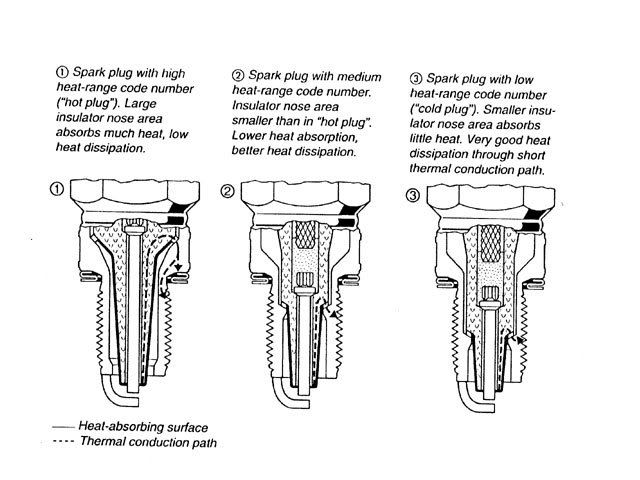
The basic "science" behind a colder plug is to dissipate heat more quickly out of the cylinder to the heads. The heat rating of a spark plug is a measurement of its ability to dissipate that heat. If you take a look at the picture I attached below, it shows a cut-away comparison of varying heat ranges. Hottest on the left and coldest on the right. Don't pay attention to the text in the picture...as different manufacturers have varying heat range numbers (ie NGK-higher # = colder, Champion lower # = colder). If you look at the colder plug, you'll notice that the insulator is very short which makes way for lots of surface area being available for thermal conduction. The heat is able to transfer to the metal casing of the plug and in turn to the cylinder head a lot more quickly than it would if the insulator nose had a larger surface area exposed to the combustion chamber atmosphere. So, now that we understand what makes a plug “colder” we can move on to why we need a colder plug. The addition of nitrous oxide in the combustion chamber causes cylinder temperatures to dramatically increase. A colder plug as we illustrated will dissipate this additional heat faster than hotter one. A spark plug has two primary functions, first being ignition of the A/F mixture in the cylinder. The second is to transfer heat from the combustion chamber, through the spark plug and into the head. So, as we increase cylinder temperatures with the use of nitrous we need to be able to dissipate that heat faster. As we have shown, the insulator design is what is going to establish its ability to remove heat, not plug material.
As for how to choose a plug, there really is no 100% accurate way of doing so without analyzing all the components of the motor. We could establish general guidelines such as, +1 for every additional compression point or +1 for every additional 50 hp of flow. It’s never going to be that simple to determine the right plug. The best thing to do is contact one of us or some of the more knowledgeable members on the board. 99% of the time I will always suggest a plug that is 1 range colder than what you think you need. Timing is very much the same in that there is never going to be an exact recommendation. Factors like, shot size, compression ratio, cam selection, bore size, chamber design, etc. all factor into plug choice. So you can understand that designing a plug selection chart is almost impossible.



Great info as usuall, Mike. Also, extended tip and non extended tip plug plays a role in how quickly a plug can disapate heat. those long extended tipped plugs have a harder and slower time on getting the heat out of the tip. I don't like the rec that most give to run a TR6, as it is not the best plug unless you stay small in the hp addition, imo. The TR6 is an extended tip style plug, though not as bad as some stock plugs. the NGK 7 is much better suited for a spray plug (non extended tip) in general street/strip applications, however, it will not last as long as the extended reach TR6. So do as suggested and always start with colder than you think you need, then you can fine tune what you need later, after reading the plugs. It's great to be able and have some tech talk without a crybaby coming in and trying to discredit someone's input, and claiming they invented the wheel. 
Robert
Robert


