



Tuning drop throttle response

Thread Starter
Teching In
Joined: Dec 2005
Posts: 26
Likes: 0
 Tuning drop throttle response
 Looking to get immediate and linear response to lifting throttle in gear. There is a delay and hanging of throttle effect i'd like to tone down for autocross and road rAce.
I saw charts in efilive for timing, min air, fuel under these conditions and made major changes with only minor results on a basically stock ls7.
How do you get more accurate and linear throttle response?
Thx.
I saw charts in efilive for timing, min air, fuel under these conditions and made major changes with only minor results on a basically stock ls7.
How do you get more accurate and linear throttle response?
Thx.
throttle cracker/follower? don't know if that's just available on fbodies, as they have a cable driven throttle and IAC. if it's drive by wire I guess it uses the throttle body itself but maybe something similar
Thread Starter
Teching In
Joined: Dec 2005
Posts: 26
Likes: 0
ok a few things, you can lower the spark in the COASTING spark table. That will pull it down faster, you can also go and REMOVE some minimum idle airflow from the higher rpms, The lower that value, the faster it will pull down, However make sure you don't go to low as it will stall the engine. Also, make sure not to modify anything from 2000rpm down so you don't have issues with idle and startup.
Thread Starter
Teching In
Joined: Dec 2005
Posts: 26
Likes: 0
Posting that is.
We tried all that but it really made no difference at all. I was hoping there was some direct input to program the throttle response, both as you open and close the accellerator pedal. Any ideas?
Thx.
We tried all that but it really made no difference at all. I was hoping there was some direct input to program the throttle response, both as you open and close the accellerator pedal. Any ideas?
Thx.
The opening and closing of the throttle is just the min idle airflow as suggested. If it is still hanging, then put it to 0 at the 3000 rpm and higher range and watch what happens.
That or if you want quicker response change the B1620 table, But changing that will affect the idling.
The Throttle follower tables that are in the software can be modified but the base tables are what they are using for multipliers.
That or if you want quicker response change the B1620 table, But changing that will affect the idling.
The Throttle follower tables that are in the software can be modified but the base tables are what they are using for multipliers.
Trending Topics
LS1 Tech Stories
The Best V8 Stories One Small Block at Time

Amazing '71 Camaro Restomod Is Modern Muscle Car Under the Skin
Verdad Gallardo
6 Common C5 Corvette Failures and What's Involved In Repairing Them
Pouria Savadkouei
Retro Modern Bandit Pontiac Trans AM Comes With Burt Reynolds' Autograph
Verdad Gallardo
Top 10 Greatest Cadillac V Series Performance Models Ever, Ranked
Pouria Savadkouei
Top 10 Most Powerful Chevy Trucks Ever Made!

Hennessey's New Supercharged Silverado ZR2 Has 700 HP
Verdad Gallardo
Coachbuilt N2A Anteros Is an LS2-Powered C6 Corvette In Italian Clothes
Verdad Gallardo
Awesome K5 Blazer Restomod Comes With C7 Corvette Power
Verdad Gallardo
10 Camaros You Should Never Buy

The speed of engine deceleration has more to do with inertia than tuning. I would bet if you scan your car and watch the throttle %, it closes rapidly when you release the pedal. The rotating mass has enough inertia that it revs down slowly. Want it to decelerate quicker, put a lighter flywheel in it.
If you shove a board to block the throttlebody while it is running on the engine dyno. It will show you how fast a motor can go back to 0. If the engine doesn't get air into it, it can't move. Rotating mass will not effect that test much as you will see..
The deceleration rate on the engine is gratefully influenced by the throttle blade % as it is ramped down on purpose with the throttle follower and cracker tables.
rotating mass does some things, but not all... It effects acceleration rates much more than deceleration sorry to say..
When you have 0% throttle, then it will pull down very fast.
The problem with pulling down really fast is an over shoot of target rpm speeds.
One reason for the higher cracker tables at high rpm was to ease the load on the transmission and to help it get into gear when you press the clutch down it hangs the rpms a bit for you.
At full throttle, then letting out for a gear change, Without use of a clutch, by the time it drops you should be at the ideal rpm for it to have just slid into gear from the rev match. "most of the time"
The deceleration rate on the engine is gratefully influenced by the throttle blade % as it is ramped down on purpose with the throttle follower and cracker tables.
rotating mass does some things, but not all... It effects acceleration rates much more than deceleration sorry to say..
When you have 0% throttle, then it will pull down very fast.
The problem with pulling down really fast is an over shoot of target rpm speeds.
One reason for the higher cracker tables at high rpm was to ease the load on the transmission and to help it get into gear when you press the clutch down it hangs the rpms a bit for you.
At full throttle, then letting out for a gear change, Without use of a clutch, by the time it drops you should be at the ideal rpm for it to have just slid into gear from the rev match. "most of the time"
You can slam the throttle blade completely closed on an engine, and if there is enough inertia, the engine will continue to turn for some time. The fact that you've blocked the air doesn't make a hill of beans.
Thread Starter
Teching In
Joined: Dec 2005
Posts: 26
Likes: 0
Well, for accelleration, drop throttle wont help. For handling though, when you are entering or in a corner, you want a certain responsiveness in throttle to help transfer weight forward and tuck the car in. Engine torque when you ease off or lift will do that. It is critical for proper handling. Chevy probably tunes it out to prevent uneducated drivers from spinning out when they lift.
The c5z throttle was brilliant. The c6 is pretty miserable because it hangs the throttle and forces the car into a push, and thus offline.
The c5z throttle was brilliant. The c6 is pretty miserable because it hangs the throttle and forces the car into a push, and thus offline.
We can argue about this all day long. FACT is you can cut off the air COMPLETELY to an engine, and if you have enough inertia, the engine will spin and spin and spin. You decrease the rotating mass, and the engine deceleration rate increases, sometimes dramatically.
To further the discussion, it sounds like the OP is talking about engine braking, which would increase the inertia, which would then cause the engine to decelerate even slower. You could slam the throttle blade completely shut, or put a board across the throttle body, or whatever you want to do and you'll only slow the engine down at a certain rate. It's not like the engine will come to a complete stop because you've cut off the air. The inertia of the entire driveline spinning will drag it down slowly.
To further the discussion, it sounds like the OP is talking about engine braking, which would increase the inertia, which would then cause the engine to decelerate even slower. You could slam the throttle blade completely shut, or put a board across the throttle body, or whatever you want to do and you'll only slow the engine down at a certain rate. It's not like the engine will come to a complete stop because you've cut off the air. The inertia of the entire driveline spinning will drag it down slowly.
I'm not trying to argue about it. I asked a simple question, and you shouldn't respond unless you know for a fact about what happens. It is a simple request for you. HAVE YOU DONE IT? Therefor you do NOT know what happens as if you did you wouldn't be arguing about it.. Inertia of the engine is not going to keep it spinning for very long. Think of when you shut off your car. It spins maybe 5 rpm. That was just shutting off the car. Not when trying to slow it down... Rotating mass isn't going to keep a motor spinning all on its own for very long at all.
Think of a JAKE brake on a diesel. What happens even when you block the exhaust on the engine.. It slows it WAY down and they aren't even fully blocking it.
An engine is an air pump. If it cant get air, it will stop things as it cant get any air. It Can't move if it doesn't get air. If it does move, then it is getting air, from either a leaking ring pack, or from the pvc system allowing air to sneak in..
Think of a JAKE brake on a diesel. What happens even when you block the exhaust on the engine.. It slows it WAY down and they aren't even fully blocking it.
An engine is an air pump. If it cant get air, it will stop things as it cant get any air. It Can't move if it doesn't get air. If it does move, then it is getting air, from either a leaking ring pack, or from the pvc system allowing air to sneak in..
I'm not trying to argue about it. I asked a simple question, and you shouldn't respond unless you know for a fact about what happens. It is a simple request for you. HAVE YOU DONE IT? Therefor you do NOT know what happens as if you did you wouldn't be arguing about it.. Inertia of the engine is not going to keep it spinning for very long. Think of when you shut off your car. It spins maybe 5 rpm. That was just shutting off the car. Not when trying to slow it down... Rotating mass isn't going to keep a motor spinning all on its own for very long at all.
Think of a JAKE brake on a diesel. What happens even when you block the exhaust on the engine.. It slows it WAY down and they aren't even fully blocking it.
An engine is an air pump. If it cant get air, it will stop things as it cant get any air. It Can't move if it doesn't get air. If it does move, then it is getting air, from either a leaking ring pack, or from the pvc system allowing air to sneak in..
Think of a JAKE brake on a diesel. What happens even when you block the exhaust on the engine.. It slows it WAY down and they aren't even fully blocking it.
An engine is an air pump. If it cant get air, it will stop things as it cant get any air. It Can't move if it doesn't get air. If it does move, then it is getting air, from either a leaking ring pack, or from the pvc system allowing air to sneak in..
Putting a piece of wood over a throttle body on an engine dyno is a stupid reference/analogy. The load of an engine dyno is completely different. Have I tried it? No. Have I slammed the throttle blade shut on an engine on the dyno? Yes, many times. On an engine dyno you're not only shutting off the air to the engine, you've got a water brake braking the engine. Of course on an engine dyno shutting off the air the engine decelerates quicker than in a car without the benefit of a water brake and with the added inertia of a spinning drive train.
Your anology of shutting off our car doesn't work either. We're not talking about shutting it down from idle, we're talking about deceleration from higher RPMs.
By your theory, you would have to pull a perfect vacuum (unachievable) on the manifold, to the point that the rotating assembly couldn't be spun over by the inertia of the spinning driveline.
Simple example. Run a car to 6K on the chassis dyno. Let off the throttle. Don't push in the clutch. Hit the brake on the dyno. How long does it take to wind down? Shutting off the air doesn't overpower the inertia of the drivetrain. If it did, it would lock the rear tires up.
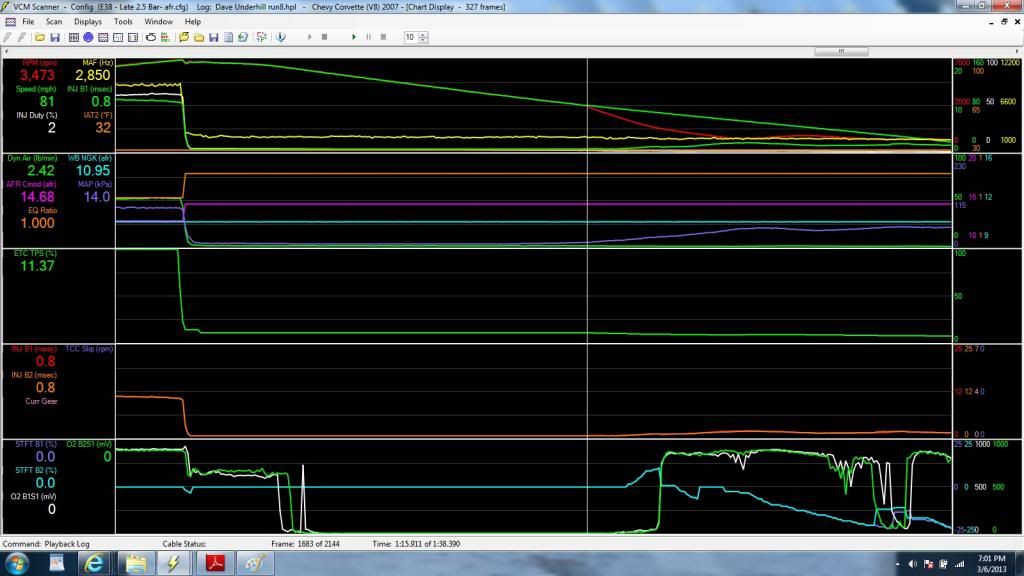
Below is a perfect example of exactly this, since it seems I need pictures to explain myself. At the end of the pull, I hit the dyno brake, and don't push in the clutch. You can see the throttle body closes to 11% almost immediately. It does not decay, it slams almost all the way shut. The RPMs match the MPH exactly as the engine winds down. About 2 seconds after I lift, it cuts the fuel too. RPMs still match the MPH. Why? Inertia. The drivetrain is spinning the engine. Now, even if you put a board over the throttle body at this point, the engine would still turn over. Why? Inertia. Then, about 5.5 seconds after I lifted and hit the dyno brake (right where the cursor is), I push the clutch in, and it takes about 2 seconds for the engine to go from about 3500 RPM to idle. Why? Inertia. If it had a lighter flywheel, it would have dropped much quicker.
Ever been to watch the Top Fuel cars? At the end of the run, they shut them down by turning off the fuel. They can't kill the ignition because by then they're auto igniting. But anyways, after the run, the clutch is welded together so they can't take them out of gear. What happens? The engine continues to turn over until the car comes to a stop. Why? Inertia. Even though the bird catcher is closed, and the fuel it cut off, the engine will continue to turn over if there is a force great enough to turn it over. Blocking off the air intake will not stop the engine from turning over if there is enough inertia.
I could state a bunch of other examples, but there's no point. If there is enough inertia, you can put whatever you want in front of the throttle body to kill the airflow, and the engine will still spin.
Thread Starter
Teching In
Joined: Dec 2005
Posts: 26
Likes: 0
You are both partially right. A lighter flywheel certainly drops more quickly, but inertia is not the only force at play: if the throttle is shut, each piston stroke is pulling against a vacuum and this is a powerful decellerant. Much more powerful than inertia. I just want a throttle plate that opens and shut when and how much my foot tells it to, and not what some overfed ee thinks is best for me.
Well, for accelleration, drop throttle wont help. For handling though, when you are entering or in a corner, you want a certain responsiveness in throttle to help transfer weight forward and tuck the car in. Engine torque when you ease off or lift will do that. It is critical for proper handling. Chevy probably tunes it out to prevent uneducated drivers from spinning out when they lift.
The c5z throttle was brilliant. The c6 is pretty miserable because it hangs the throttle and forces the car into a push, and thus offline.
The c5z throttle was brilliant. The c6 is pretty miserable because it hangs the throttle and forces the car into a push, and thus offline.
You are both partially right. A lighter flywheel certainly drops more quickly, but inertia is not the only force at play: if the throttle is shut, each piston stroke is pulling against a vacuum and this is a powerful decellerant. Much more powerful than inertia. I just want a throttle plate that opens and shut when and how much my foot tells it to, and not what some overfed ee thinks is best for me.
Flywheel weight is a great example. Just by changing the weight of the flywheel you can drastically change the way the engine decelerates. Heavier flywheel, the engine decelerates slower, lighter=faster, all without changing the throttle closing rate.
I'm not at all saying the vacuum of an engine does not slow it down, what I'm saying, is shutting off the air completely to an engine will not keep it from turning over when there is inertia at play. Inertia is the more powerful force here, provided there is enough inertia. And secondly, changing the inertia (to a lighter flywheel) has more of an impact than shutting the blade more or quicker. I can't believe I have to argue that point with who is supposed to be another experienced tuner. All you have to do is tune one and you'll know.
DBW and DBC can both have problems with hanging idle when coming to a stop, and that would greatly reduce engine braking. If your car comes back to idle cleanly and consistantly, this shouldn't be a problem.