




 g/sec baby!

VE Table Airflow Correlation to Horsepower?

Thread Starter
Joined: Aug 2004
Posts: 11,258
Likes: 146
From: Pace, FL
 VE Table Airflow Correlation to Horsepower?
 Just wanted to start a discussion thread for tuning reference. With EFILive, the VE table can be displayed g/sec which is a pretty good indicator of HP. With HPTuners, it's a percentage, which can still be useful.
Just curious what you guys have seen as a correlation of power with increases across the VE table? I recognize the fuel injectors specs may play some part there, but if the data is good, the assumption is you can swap injectors and the VE table shouldn't change.
So, what is the max VE values you typically see for 400rwhp cars? 450? 500? 600? NA.
Any observations? For example, big cams typically take a nose-dive in the lower RPM range and higher kPa ranges due to inefficiency to idle correctly, but increase the VE values over 4000-4500 indicating more topend power.
Just curious what you guys have seen as a correlation of power with increases across the VE table? I recognize the fuel injectors specs may play some part there, but if the data is good, the assumption is you can swap injectors and the VE table shouldn't change.
So, what is the max VE values you typically see for 400rwhp cars? 450? 500? 600? NA.
Any observations? For example, big cams typically take a nose-dive in the lower RPM range and higher kPa ranges due to inefficiency to idle correctly, but increase the VE values over 4000-4500 indicating more topend power.
Couldn't say for VE but any time my HP has gone up so have the MAF readings at WOT.
It seems to suggest at least to a point of educated guessing that lbs/min MAF could have some correlation to flywheel HP, the trick is the fluctuation in readings and also whether or not injector data and things like that are accurate.
For example before my recent cam swap I could see ~51 lbs/min airflow on the maf somewhat consistently over repeated WOT runs. Running the cars ET/trap and dyno RWHP calculators all put the car in the ballpark of having ~500 flywheel HP. After the cam swap I see 53 lbs/min pretty consistent and the car went close to 1.5 mph faster even running a little rich with a headwind.
Nothing I would put a lot of faith in but it seems to give me some idea when I'm picking up power. The truck also responded similar...picked up around 3.5 lbs/min and 40rwhp on the dyno.
It seems to suggest at least to a point of educated guessing that lbs/min MAF could have some correlation to flywheel HP, the trick is the fluctuation in readings and also whether or not injector data and things like that are accurate.
For example before my recent cam swap I could see ~51 lbs/min airflow on the maf somewhat consistently over repeated WOT runs. Running the cars ET/trap and dyno RWHP calculators all put the car in the ballpark of having ~500 flywheel HP. After the cam swap I see 53 lbs/min pretty consistent and the car went close to 1.5 mph faster even running a little rich with a headwind.
Nothing I would put a lot of faith in but it seems to give me some idea when I'm picking up power. The truck also responded similar...picked up around 3.5 lbs/min and 40rwhp on the dyno.
Last edited by thunderstruck507; Feb 24, 2016 at 04:15 PM.
Not sure if this is what you're looking for, but this table pulled 370:
Peak MAF reading was 327.4 g/sec on a logged WOT pull.
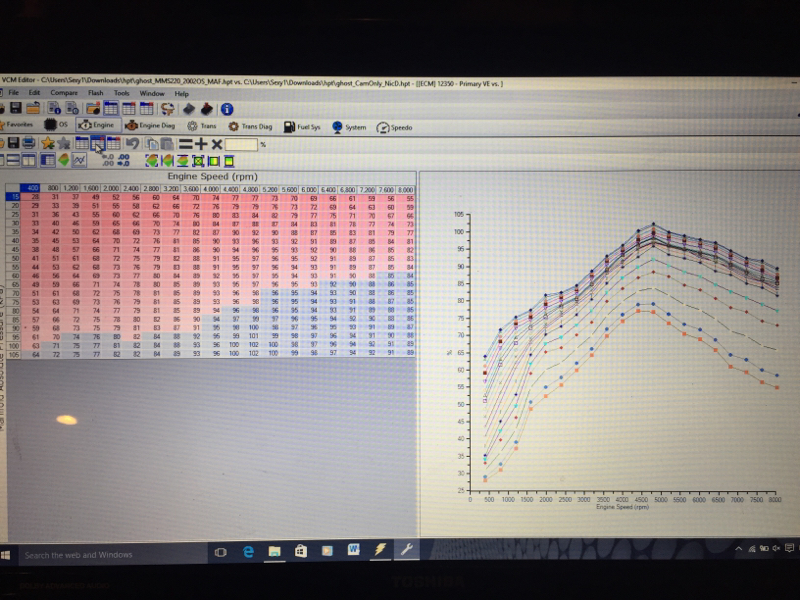
Peak MAF reading was 327.4 g/sec on a logged WOT pull.
Last edited by Darth_V8r; Feb 25, 2016 at 08:30 PM.

Staging Lane
Joined: Nov 2015
Posts: 96
Likes: 0
Yes, that is correct. The VE is determined by the engine design... the fuel injectors you choose to use plays no part in it.
Trending Topics
Staging Lane
Joined: Nov 2015
Posts: 96
Likes: 0
LS1 Tech Stories
The Best V8 Stories One Small Block at Time

6 Common C5 Corvette Failures and What's Involved In Repairing Them
Pouria Savadkouei
Retro Modern Bandit Pontiac Trans AM Comes With Burt Reynolds' Autograph
Verdad Gallardo
Top 10 Greatest Cadillac V Series Performance Models Ever, Ranked
Pouria Savadkouei
Top 10 Most Powerful Chevy Trucks Ever Made!

Hennessey's New Supercharged Silverado ZR2 Has 700 HP
Verdad Gallardo
Coachbuilt N2A Anteros Is an LS2-Powered C6 Corvette In Italian Clothes
Verdad Gallardo
Awesome K5 Blazer Restomod Comes With C7 Corvette Power
Verdad Gallardo
10 Camaros You Should Never Buy

10 LS Engine Myths That Refuse to Die
Verdad Gallardo Staging Lane
Joined: Nov 2015
Posts: 96
Likes: 0
Torque is directly related to the engines VE so increase the VE and you increase the torque. Larger cams allow the engine to breathe better at higher rpms so you get more torque at those higher rpms.
Horsepower is related to torque and rpm, so more torque will give you more horsepower... but so will more rpm. The stock engine will only spin up to 6000rpm, whereas a built engine might spin up to 6500-7000rpm. Just having the engine spinning faster will give you more horsepower as long as the VE isn't falling away too quickly at those higher rpms.
Higher compression will produce more power, but you need a higher grade of fuel to avoid engine knock. Using low grade fuel in a high compression engine requires significantly retarded timing, which robs you of some of the power you're trying to make.
Thread Starter
Joined: Aug 2004
Posts: 11,258
Likes: 146
From: Pace, FL
Should say VE table values. It's a calculation and routinely exceeds 100 in my engine with HPTuners. Kind of wish I could see in g/sec... Hint hint HPTuners.

I plotted my last dynojet data file against my 100 kPa VE row and the curves weren't even similar. I randomly multiplied the VE values by 4 and some parts are close and others are not. I also mapped my g/s against the VE table for comparison.


My ratios of airflow vs. dynojet HP, not that it means anything or that it's repeatable:
Code:
2000	71.8%
2400	77.3%
2800	77.3%
3200	80.0%
3600	82.3%
4000	71.6%
4400	80.4%
4800	81.8%
5200	82.6%
5600	82.3%
6000	85.1%
6400	88.5%

Moderator


Joined: Aug 2010
Posts: 7,323
Likes: 529
From: Ann Arbor, MI
Keep in mind that the VE table is not the "real" VE of the engine, but rather a multiplier used by the PCM algorithm to calculate the correct injector pulse width.
If e.g. the injector tables don't quite agree with the injectors, or the fuel pressure is wrong, the VE table could be quite different from the "real" VE.
I would expect the peak in the VE table to correspond to peak torque.
Jake, my peak VE values are in the 115 range too.
I suspect that resonant frequencies of the intake and exhaust systems could cause an engine to exceed 100% of its theoretical value.
If e.g. the injector tables don't quite agree with the injectors, or the fuel pressure is wrong, the VE table could be quite different from the "real" VE.
I would expect the peak in the VE table to correspond to peak torque.
Jake, my peak VE values are in the 115 range too.
I suspect that resonant frequencies of the intake and exhaust systems could cause an engine to exceed 100% of its theoretical value.
Thread Starter
Joined: Aug 2004
Posts: 11,258
Likes: 146
From: Pace, FL
Well that's why I want to see g/sec. I can't in the VE table in HPTuners. Would love to have someone with EFILive pull my tune off the car and look.
But the VE table is about airflow calculations leading to the correct fueling as you say, Ted.
But the VE table is about airflow calculations leading to the correct fueling as you say, Ted.

Moderator
Joined: Aug 2010
Posts: 7,323
Likes: 529
From: Ann Arbor, MI
I suspect any g/sec air value displayed by HPT or EFILive without a MAF is simply the g/sec fuel value (calculated using the VE and injector tables) multiplied by the specified AFR value.
Only the MAF can really calculate the actual air volume in g/sec.
Only the MAF can really calculate the actual air volume in g/sec.
Thread Starter
Joined: Aug 2004
Posts: 11,258
Likes: 146
From: Pace, FL
And yes, only the MAF reads it in reality, but the PCM back-calculates from the values in the VE table based on IAT and MAP input, which is tuned against the wideband for corrected A/F. So it's close. In EFI Live, you can tune the VE table from the MAF actuals (assuming the injector info is good) - so it cuts down on the time quite a bit. I still haven't got that to work with HPTuners.
Staging Lane
Joined: Nov 2015
Posts: 96
Likes: 0
The MAF is a true reading of the airflow, but the reading is sent to the PCM as a frequency signal (which is how the airflow is actually read). That signal is converted by the MAF transfer into an airflow in g/s... and that's where things can go wrong. If the injectors data tables are wrong, then when you 'tune' the MAF, you're actually distorting the airflow values to try to suit that bad injector data. The MAF is not very forgiving towards bad injector data, so you'll never get a good MAF tune if your injector data is wrong.
The VE is far more forgiving towards bad injector data. You can put any junk into the injector data tables (within reason) and when you tune the VE, it will bend to suit that bad data. The problem with speed density tuning is that the VE table is very much dependent on intake air temperature for calculating cylinder charge. If the injector data is wrong, the VE will only be correct at the temperature it was tuned at... as soon as the intake temperature changes, so does your tune.
The VE is far more forgiving towards bad injector data. You can put any junk into the injector data tables (within reason) and when you tune the VE, it will bend to suit that bad data. The problem with speed density tuning is that the VE table is very much dependent on intake air temperature for calculating cylinder charge. If the injector data is wrong, the VE will only be correct at the temperature it was tuned at... as soon as the intake temperature changes, so does your tune.

TECH Senior Member


Joined: Apr 2002
Posts: 6,080
Likes: 17
From: So.Cal.
In EFILive, you can select the units of the VE tables from the following:
- g*K/kPa (default units, comes from the binary),
- g/cyl (calculated using T and P),
- g/s (calculated using T, P and RPM),
- % of theoretical volume (calculated using Ideal Gas Law);
the VE table being the model of the cylinder air mass for MAP vs RPM;
if you study "g*K/kPa" you see that it is the air mass (g) normalized for temperature (K) and pressure (kPa)
( and note that rearranging the IGL P*V=(m/M)*R*T gives m*T/P=V*M/R ).
Last edited by joecar; Mar 8, 2016 at 03:08 PM. Reason: added units