



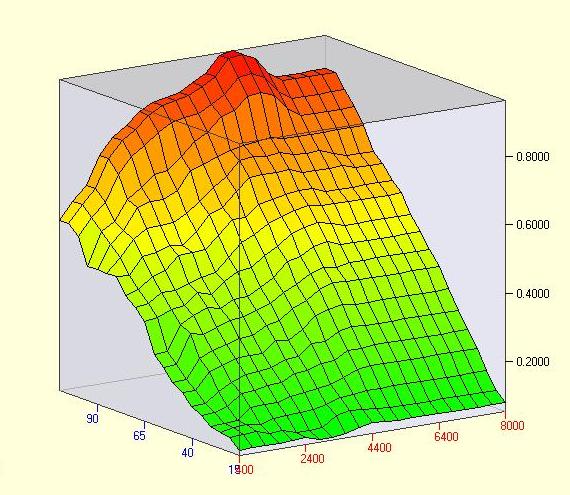
VE table shape

80 kpa is not a magic number, I just wanted 14.7:1 at low load and 13:1 at high load and somewhere in between there has to be a transition. That's just the way I chose to do it, i'd rather have a smooth transition than an abrupt change. If the reason you're bringing this up has to do with only having one or two values in the olfa table for simplicity, I don't really care about that, I can still keep track of where its rich and lean easily enough.
Originally Posted by MeentSS02
That's why I'll always recommend that you tune your car like you drive it (as in don't disable PE mode, etc when you are tuning it).
Also, for those who are new to tuning that are following this thread... PE is a fuel adder which comes into play under heavier loads to protect your engine by adding fuel. Whenever PE kicks in, it invalidates your fuel trim data, so you need to filter those cells/values out in excel, or just keep in mind that the data isn't completely accurate. When PE kicks in, trim data will be reported as zero's. I can't remember the exact values for PE off the top of my head, but they go something similar to this. PE kicks in when:
<4000RPM @ 80%+ throttle
4000 - 4400 @ 35% throttle
4400-7000 @ 25% throttle
If someone else wants to correct me on the RPM values and percentages feel free. A quick search didn't yield what I was looking for.
if u want to avoid going into pe, shouldnt you change your TPS% to something higher and also make your tables 1.00 so it will be the leaner of the 2 and the computer should then use only your OLFA tables...at least thats how i understand it.
I believe you -do- want the OLFA table to contain "power
enrichment", and I think it's the best place to handle the
load enrichment needs in general. I'm coming to think that
PE table is really best left for fuel fade, other things that
really need an RPM based enrichment modifier. But the "real"
power enrichment, and the real need, relates to cylinder
pressure and that is MAP, the OLFA table basis. I say,
tune for power first with the OLFA and then use PE to fix
any top-end fueling problems (if you have them). This means
using a low PE MAP and TPS threshold (to get you open loop
when you are trying to make power) but keeping the PE less
than the OLFA except where you want more on a RPM basis.
And since the hot tip seems to be a fading fuel-air multiplier
anyway (fat for torque, leaner for HP & decreased burn-time
up top) maybe the PE table is just a don't-care if the MAP
based enrichment is right.
PE is swell for WOT-only power but best part-throttle action,
smoothness / continuity / economy, depends on how you bed
in the OLFA. Using PE values tuned for 100kPa, just because
you exceeded the 30kPa (say) MAP threshold you picked, is
likely wasteful and sub-par performing as well (over-enriched).
What say you?
One thing I wonder about, is whether there is (perhaps hidden)
a separate enable logic for open loop, not-PE.
enrichment", and I think it's the best place to handle the
load enrichment needs in general. I'm coming to think that
PE table is really best left for fuel fade, other things that
really need an RPM based enrichment modifier. But the "real"
power enrichment, and the real need, relates to cylinder
pressure and that is MAP, the OLFA table basis. I say,
tune for power first with the OLFA and then use PE to fix
any top-end fueling problems (if you have them). This means
using a low PE MAP and TPS threshold (to get you open loop
when you are trying to make power) but keeping the PE less
than the OLFA except where you want more on a RPM basis.
And since the hot tip seems to be a fading fuel-air multiplier
anyway (fat for torque, leaner for HP & decreased burn-time
up top) maybe the PE table is just a don't-care if the MAP
based enrichment is right.
PE is swell for WOT-only power but best part-throttle action,
smoothness / continuity / economy, depends on how you bed
in the OLFA. Using PE values tuned for 100kPa, just because
you exceeded the 30kPa (say) MAP threshold you picked, is
likely wasteful and sub-par performing as well (over-enriched).
What say you?
One thing I wonder about, is whether there is (perhaps hidden)
a separate enable logic for open loop, not-PE.
I've seen PE settings "step on" closed loop trims before. For
purely diagnostic / data collection purposes in a narrowband
O2 setup, you want to be at 1.000 fuel air multiplier. But if
you have reliable WBO2 data then all you want is to look at
commanded vs received, throwing out any transient error
(from WBO2 smoothing or plumbing lag against actual FAM).
purely diagnostic / data collection purposes in a narrowband
O2 setup, you want to be at 1.000 fuel air multiplier. But if
you have reliable WBO2 data then all you want is to look at
commanded vs received, throwing out any transient error
(from WBO2 smoothing or plumbing lag against actual FAM).
So I guess it really doesn't apply to me since I run in full time open loop SD.
Now, is there any way other than just having a large sample to get rid of the lag errors?
Now, is there any way other than just having a large sample to get rid of the lag errors?
Personally, I don't like averaging as a basis. I'd rather get
it into Excel, and pick it over by eye rejecting things I see
as "out of family" or that appear to follow activity that is
prone to muss things up (like sudden changes in TPS,
gear changes, etc.). Many people loves statistics but in
my book it's often because it looks like a short-cut around
the more difficult job of understanding (whether by gut or
science) the behavior.
You'd want to cut the smoothing down until the WBO2
output becomes tolerably noisy (maybe +/- 0.1 AFR point
in steady open loop cruising?). Wouldn't work in closed loop
with all the dithering but all you want, open loop, is to
get some consistency to work from. But not so consistent,
that you miss anything "interesting".
it into Excel, and pick it over by eye rejecting things I see
as "out of family" or that appear to follow activity that is
prone to muss things up (like sudden changes in TPS,
gear changes, etc.). Many people loves statistics but in
my book it's often because it looks like a short-cut around
the more difficult job of understanding (whether by gut or
science) the behavior.
You'd want to cut the smoothing down until the WBO2
output becomes tolerably noisy (maybe +/- 0.1 AFR point
in steady open loop cruising?). Wouldn't work in closed loop
with all the dithering but all you want, open loop, is to
get some consistency to work from. But not so consistent,
that you miss anything "interesting".
LS1 Tech Stories
The Best V8 Stories One Small Block at Time

Gas Monkey Built a 6-Wheel Ferrari Testarossa With a Corvette LT4 Engine
Verdad Gallardo
7 Most Reliable High-Performance Engines GM Has Ever Built
Verdad Gallardo
Amazing '71 Camaro Restomod Is Modern Muscle Car Under the Skin
Verdad Gallardo
6 Common C5 Corvette Failures and What's Involved In Repairing Them
Pouria Savadkouei
Retro Modern Bandit Pontiac Trans AM Comes With Burt Reynolds' Autograph
Verdad Gallardo
Top 10 Greatest Cadillac V Series Performance Models Ever, Ranked
Pouria Savadkouei
Top 10 Most Powerful Chevy Trucks Ever Made!

Hennessey's New Supercharged Silverado ZR2 Has 700 HP
Verdad Gallardo
Coachbuilt N2A Anteros Is an LS2-Powered C6 Corvette In Italian Clothes
Verdad Gallardo
Originally Posted by jimmyblue
Personally, I don't like averaging as a basis. I'd rather get
it into Excel, and pick it over by eye rejecting things I see
as "out of family" or that appear to follow activity that is
prone to muss things up (like sudden changes in TPS,
gear changes, etc.). Many people loves statistics but in
my book it's often because it looks like a short-cut around
the more difficult job of understanding (whether by gut or
science) the behavior.
You'd want to cut the smoothing down until the WBO2
output becomes tolerably noisy (maybe +/- 0.1 AFR point
in steady open loop cruising?). Wouldn't work in closed loop
with all the dithering but all you want, open loop, is to
get some consistency to work from. But not so consistent,
that you miss anything "interesting".
it into Excel, and pick it over by eye rejecting things I see
as "out of family" or that appear to follow activity that is
prone to muss things up (like sudden changes in TPS,
gear changes, etc.). Many people loves statistics but in
my book it's often because it looks like a short-cut around
the more difficult job of understanding (whether by gut or
science) the behavior.
You'd want to cut the smoothing down until the WBO2
output becomes tolerably noisy (maybe +/- 0.1 AFR point
in steady open loop cruising?). Wouldn't work in closed loop
with all the dithering but all you want, open loop, is to
get some consistency to work from. But not so consistent,
that you miss anything "interesting".
No throttle transitions greater then 5% per 100ms
ECT greater then 170*F
Commanded AFR Greater then 14.61
That is just a small list of items I use.


11 Second Club

Joined: Jul 2004
Posts: 123
Likes: 1
From: Sydney, Australia
VE Table Shape Here is my VE Table. Its been made quite accurate with Flashscans autotune procedure now getting very close to desired AFRs at any rpm and map in open loop.
Its a 216 220 Cam 1.8 rockers (555 lift) , Over Radiator CAI, Ported Heads with 10.7:1 compression.
It really flys from 5200 to 6600rpm changes. Note that peak torque is predicted to be in the mid 5000s from this curve. The car is ready to run 11.50 on a cold day - its already done 11.765/115mph at 3625lb.
Its a 216 220 Cam 1.8 rockers (555 lift) , Over Radiator CAI, Ported Heads with 10.7:1 compression.
It really flys from 5200 to 6600rpm changes. Note that peak torque is predicted to be in the mid 5000s from this curve. The car is ready to run 11.50 on a cold day - its already done 11.765/115mph at 3625lb.
Originally Posted by MeentSS02
So I guess it really doesn't apply to me since I run in full time open loop SD.
Now, is there any way other than just having a large sample to get rid of the lag errors?
Now, is there any way other than just having a large sample to get rid of the lag errors?
 If you tune from a narrowband (via fuel trim data), as I mentioned, PE zero's out your trims in the cells where it kicks in.
I need to get the wideband wired up so I can see just how much easier it is to tune with.
BTW, what are these lag errors that you speak of? Wideband related I assume?
Originally Posted by SMOKINV8
It doesn't apply to you because you tune off of a wideband, not because you're in SD. If you tune from a narrowband (via fuel trim data), as I mentioned, PE zero's out your trims in the cells where it kicks in.
I need to get the wideband wired up so I can see just how much easier it is to tune with.
BTW, what are these lag errors that you speak of? Wideband related I assume?
If you tune from a narrowband (via fuel trim data), as I mentioned, PE zero's out your trims in the cells where it kicks in.I need to get the wideband wired up so I can see just how much easier it is to tune with.
BTW, what are these lag errors that you speak of? Wideband related I assume?
Man...I'd be screwed without my wideband. My narrowbands were inaccurate at low RPMs with my headers, so I would have been chasing my tail forever.
I'm not sure exactly what the lag errors are either. Now, one thing I did notice with the LC-1 is that if you set it to report instantaneously, you'll get readings at low RPM -> part throttle cruising that shows lean pockets since the EIO doesn't poll the LC-1 but every 1/10th of a second (if I'm not mistaken, depending on how many parameters you are logging). When I told my LC-1 to report every 1/6th of a second (which reports the average during each 1/6 sec. interval), it changed the shape of my VE table slightly.
He might also be referring to very quick throttle transients that Chad eluded to above with his filter settings. Personally, after I get my VE table dialed in, I go right back behind it and do some nasty throttle transients, and use my Alpha-N VE multiplier table to further adjust my VE table. Seems to be working well so far...
