


bleeding brakes?




you can get fluid cheaper right from amazon. you can bleed the ABS yourself, with a motive. you have to jack the rear, remove the tires. open one bleeder, start the car, put it into gear, and let it get to about 10mph, while having the motive pressure the system. the car needs to be around 8-10mph to cycle the ABS. after letting a few seconds worth of fluid out, shut the bleeder, turn off the car. repeat over and over, for both sides, and that will clear the ABS.


Not all Amazon merchants doesn't spend there time calling back guys with questions at 7:30 at night! I doubt they do much researching into ways to make your car faster! Support the people that support you, shopping will give youa good price point, but don't let a couple of dollars stop you from supporting the people that support us.
Here's the right way to bleed your brakes.
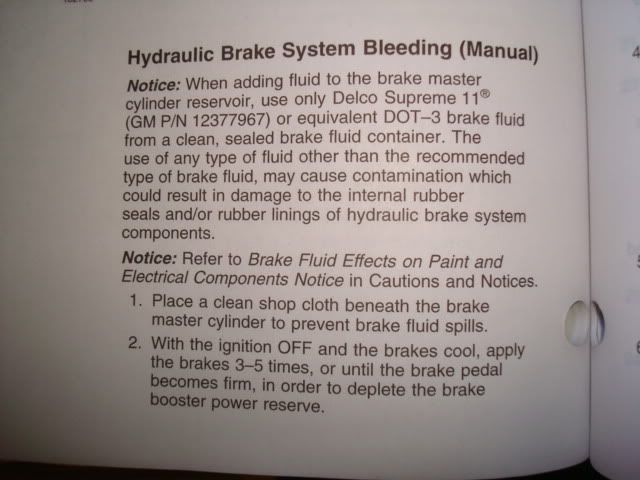
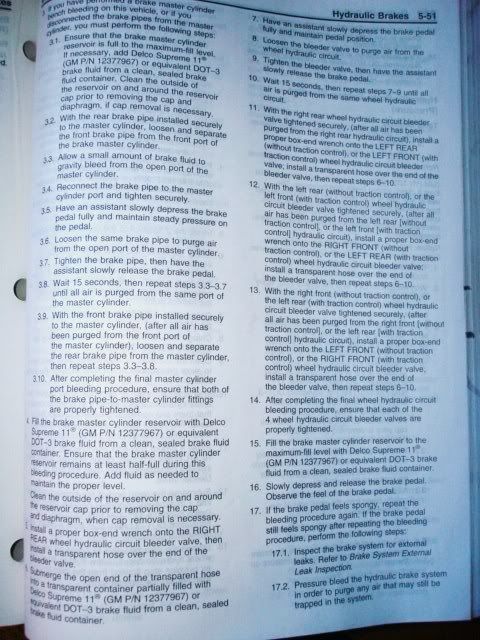
Here's the right way to bleed your brakes.
Last edited by BRD-PREY; Jan 12, 2010 at 04:29 AM. Reason: error
TECH Regular
Joined: Jun 2004
Posts: 418
Likes: 0
From: Houston, Tx
you can get fluid cheaper right from amazon. you can bleed the ABS yourself, with a motive. you have to jack the rear, remove the tires. open one bleeder, start the car, put it into gear, and let it get to about 10mph, while having the motive pressure the system. the car needs to be around 8-10mph to cycle the ABS. after letting a few seconds worth of fluid out, shut the bleeder, turn off the car. repeat over and over, for both sides, and that will clear the ABS.
I found this info at modulemaster.com (they repair ABS systems).
22. Can I bleed my brakes myself? I've been told there is a special procedure.
NOTE: this only applies if brake lines had to be disconnected.
Chevy Brake Bleeding Procedure
If certain steps are followed, you won't have to follow a "special bleeding procedure" which typically requires a certified technician using a computer that sends a set of commands to your ABS controller to open certain valves with the pump running. This procedure flushes out pockets of air trapped within the ABS manifold's labyrinth of orifices and cavities etc. In most cases, this is not necessary. When the pump/manifold is removed from the vehicle, all of the valves are closed sealing the manifold's "insides" from drawing in air. When you re-install the manifold, make sure the battery is disconnected (assuming repaired ABS controller is in place).
Once everything is reinstalled, bleed the brakes as you would any conventional vehicle. When you are confident all the air is out of the lines, connect the vehicle's battery and start the engine, keeping the vehicle stationary. Make sure that the brake pedal is firm and not spongy. Verify that there are no leaks where the hydraulic lines were re-connected and that the brake pedal keeps it position without slowly dropping to the floor. If all is good, take the vehicle for a low speed test drive. The ABS system will then perform a self check once you exceed 5 MPH and the "ABS" and "brake" lamps should turn off. During this test, the controller runs the pump motor and briefly operates all of the valves. If the brake pedal remains firm, then you succeeded in removing any air left in the system, and you're done! If the pedal begins to feel soft or spongy, park the vehicle and manually bleed the brakes again. Test drive again, park and repeat the bleeding process until brakes are firm. This ABS "self-test" is performed every time you start and drive. It is similar to the "special bleeding procedure" a techician would perform, without the need for a tech or his special computer.
We suggest checking for leaks around the manifold every few days or until you are satisfied everything is in good working order. At the same time, keep an eye on the brake fluid level in the reservoir for sudden changes. Remember, your brakes are your vehicle's primary safety feature, so keep them well maintained!
Last edited by MrEddie; Jan 12, 2010 at 10:46 AM.










