


Dual throttle bodies

Thread Starter
Launching!
Joined: Feb 2004
Posts: 271
Likes: 0
From: California
 Dual throttle bodies
 Let me hear your thoughts on how you would engineer twin 90mm throttle bodies on an LS3 drive-by-wire engine. There are two options:
1. Mechanical - extract (with great difficulty) the shaft from a LS3 throttle body and replace with a longer shaft that protrudes from the opposite side. This can be ganged up with standard linkages to drive a "slave" throttle. BTW, has anyone pulled a shaft out of an LS3 TB? - it appears to be welded in place...
2. Electronically - more involved to design & build a voltage following electronic module with error checking between the throttle position sensors. This would be an easy installation though for multiple applications. Not impossible, but difficult and there could be legal issues if it failed.
Hopefully I can figure something out soon..
1. Mechanical - extract (with great difficulty) the shaft from a LS3 throttle body and replace with a longer shaft that protrudes from the opposite side. This can be ganged up with standard linkages to drive a "slave" throttle. BTW, has anyone pulled a shaft out of an LS3 TB? - it appears to be welded in place...
2. Electronically - more involved to design & build a voltage following electronic module with error checking between the throttle position sensors. This would be an easy installation though for multiple applications. Not impossible, but difficult and there could be legal issues if it failed.
Hopefully I can figure something out soon..
I believe he is trying to build a manifold with 2 TB's similar to the Viper's . I've always thought this would be a great idea . Are you fabbing the intake ? I want to fab an ITB but I can't get the info I need and I don't have an engine to build it from .
there was a guy in town with a 426hemi in his magnum and it had twin tb's but it was one in the front and one in the rear, and only opened up in high rpm's it would be interesting to see some research done on this,
possibly ducting run through the firewall to a "cold air" location, i think if the research, and fab work were done well it could turn out some good power increases.
possibly ducting run through the firewall to a "cold air" location, i think if the research, and fab work were done well it could turn out some good power increases.
Thread Starter
Launching!
Joined: Feb 2004
Posts: 271
Likes: 0
From: California
It would be similar to a Viper manifold with two throttles at the front opening in parallel. I will either remake a longer LS3 shaft or make a fixture that bolts onto the throttle body and holds a shaft that slots into a groove in the stubby end of the existing shaft. An electronic module will possibly be in the future.
Below is where the problem lies. It looks like it is laser welded in place (typical OEM non-servicable part).
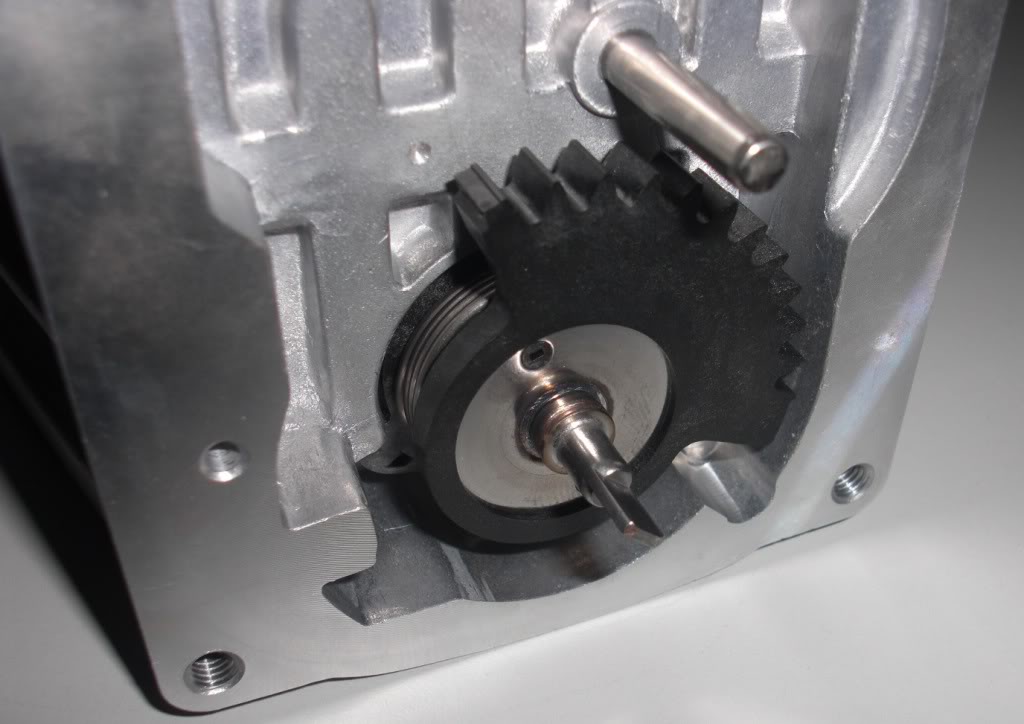
Below is where the problem lies. It looks like it is laser welded in place (typical OEM non-servicable part).
Trending Topics
LS1 Tech Stories
The Best V8 Stories One Small Block at Time

Gas Monkey Built a 6-Wheel Ferrari Testarossa With a Corvette LT4 Engine
Verdad Gallardo
7 Most Reliable High-Performance Engines GM Has Ever Built
Verdad Gallardo
Amazing '71 Camaro Restomod Is Modern Muscle Car Under the Skin
Verdad Gallardo
6 Common C5 Corvette Failures and What's Involved In Repairing Them
Pouria Savadkouei
Retro Modern Bandit Pontiac Trans AM Comes With Burt Reynolds' Autograph
Verdad Gallardo
Top 10 Greatest Cadillac V Series Performance Models Ever, Ranked
Pouria Savadkouei
Top 10 Most Powerful Chevy Trucks Ever Made!

Hennessey's New Supercharged Silverado ZR2 Has 700 HP
Verdad Gallardo
Coachbuilt N2A Anteros Is an LS2-Powered C6 Corvette In Italian Clothes
Verdad Gallardo



Launching!
Joined: Nov 2008
Posts: 231
Likes: 1

Why not just set up mechanical linkage to run both off the electronic signal of one? It might present some tuning issues but I would think that would be easier to overcome than setting up two electronic signals. It wouldn't be very pretty though. Mechanical would be simpler but it would still present tuning issues.
why not make it simple?
flip the throttle bodies so the linkage sides face eachother. then simply make a thrttle cable that looks like this
.
.
.
.
.
.
_____________
. .
. .
. .
. .
flip the throttle bodies so the linkage sides face eachother. then simply make a thrttle cable that looks like this
.
.
.
.
.
.
_____________
. .
. .
. .
. .


Thread Starter
Launching!
Joined: Feb 2004
Posts: 271
Likes: 0
From: California
Back to advanced engineering (not the LSX shootout, Harrop intake or running mechanical throttle activation)
The LS3 drive-by-wire is what I need to run a second throttle off. Has anyone ever driven more than 1 throttle off the late model (non LS1/LS2) drive-by-wire motors? Or has anyone ever pulled a shaft out of a later than mid-2009 LS3 throttle body?
The LS3 error checking of the TB is very sensitive and throws codes easily (e.g. if you flip the TB upside down, or higher torque on the shaft). Also the current draw by linking 2 TBs directly to the computer will throw codes.
The LS3 drive-by-wire is what I need to run a second throttle off. Has anyone ever driven more than 1 throttle off the late model (non LS1/LS2) drive-by-wire motors? Or has anyone ever pulled a shaft out of a later than mid-2009 LS3 throttle body?
The LS3 error checking of the TB is very sensitive and throws codes easily (e.g. if you flip the TB upside down, or higher torque on the shaft). Also the current draw by linking 2 TBs directly to the computer will throw codes.


Thread Starter
Launching!
Joined: Feb 2004
Posts: 271
Likes: 0
From: California
Unfortunately it wont work. The electronic signal uses feedback from the throttle position sensors to determine where the butterfly is. e.g. a 4V input to one drive-by-wire (DBW) motor may yield 80% open, and on another DBW motor it could be 75%. This is due to manufacturing tolerances.
Also, splitting the signal will result in twice the current draw through the computer and it doesnt like this...
The only way I see that it can be done (electronically) is to make an integrated circuit with programming to develop a signal to a second DBW motor based on inputs from the 1st DBW throttle position sensors. Then have error checking between the two throttle position sensors and set a max deviation (e.g. 5%).
Also, splitting the signal will result in twice the current draw through the computer and it doesnt like this...
The only way I see that it can be done (electronically) is to make an integrated circuit with programming to develop a signal to a second DBW motor based on inputs from the 1st DBW throttle position sensors. Then have error checking between the two throttle position sensors and set a max deviation (e.g. 5%).