





Head porting question.
 Head porting question.
 Whats a good final grit to use for the intake ports? I know they're suppose to
be slightly rough, but can someone translate that into a grit for me?
thanks
be slightly rough, but can someone translate that into a grit for me?
thanks
Daniel,
This question would be better asked in the internal engine forum. However, I'd suggest 80 or 100 grit rolls. Don't be heavy-handed.
Best of luck with your project.
Steve
This question would be better asked in the internal engine forum. However, I'd suggest 80 or 100 grit rolls. Don't be heavy-handed.
Best of luck with your project.
Steve
leave it on the rough side for intake because it keeps the charge of fuel and air tumbling slightly. If it gets mirror smooth it pay create puddles of fuel dropping out of the charge and then pushing into cylinder as a puddle of fuel.
Originally Posted by Greg Good
I've settled on 80 for both intake and exhaust. Some guys like like 60 on the intake. Some guys like 120 on the exhaust. It doesn't really make any difference that I can tell.
Sorry about putting it in the wrong forum.
Thanks for the replies.I have both the intake and the exhaust done with
80 so I guess I'll just stop there.
I was asking because I found pics of ported heads and the finish on the
intake and exhaust side 'looked' quite a bit smoother. My ports feel smooth
but they don't 'look' as smooth. I figured maybe they used a higher grit than
I did.
Thanks again
Thanks for the replies.I have both the intake and the exhaust done with
80 so I guess I'll just stop there.
I was asking because I found pics of ported heads and the finish on the
intake and exhaust side 'looked' quite a bit smoother. My ports feel smooth
but they don't 'look' as smooth. I figured maybe they used a higher grit than
I did.
Thanks again
Trending Topics
LS1 Tech Stories
The Best V8 Stories One Small Block at Time

Topdon ONE vs. Artidiag 800 BT2: Which is the Diagnostic Tablet For You?
Pouria Savadkouei
Gas Monkey Built a 6-Wheel Ferrari Testarossa With a Corvette LT4 Engine
Verdad Gallardo
7 Most Reliable High-Performance Engines GM Has Ever Built
Verdad Gallardo
Amazing '71 Camaro Restomod Is Modern Muscle Car Under the Skin
Verdad Gallardo
6 Common C5 Corvette Failures and What's Involved In Repairing Them
Pouria Savadkouei
Retro Modern Bandit Pontiac Trans AM Comes With Burt Reynolds' Autograph
Verdad Gallardo
Top 10 Greatest Cadillac V Series Performance Models Ever, Ranked
Pouria Savadkouei
Top 10 Most Powerful Chevy Trucks Ever Made!

Hennessey's New Supercharged Silverado ZR2 Has 700 HP
Verdad Gallardo Daniel,
What did you do in the bowl area of the intakes and exhausts? Obviously, you'll have to remove the valves first. Smoothing the walls, floor and roof of the runners is important. However, opening up the throat to about 90% of the valve seat internal diameter is more important as is blending the transition from port to bowl and smoothing out any bumps on the short side radius. Use your finger to feel where the radius needs to be smoothed. Leave the floor as high as possible and only smooth the bumps in the short side radius, don't flatten it out. Smoothing this runner to bowl to valve throat transition is where you will get the most benefit. Be careful not to hog things out too much. Less porting is better than more when in doubt. Also, hand lap the valves and seats and clean before reassembling. You could have a shop back cut the valves to 30 degrees and your low lift numbers will be helped. A really good valve job is important.
Steve
What did you do in the bowl area of the intakes and exhausts? Obviously, you'll have to remove the valves first. Smoothing the walls, floor and roof of the runners is important. However, opening up the throat to about 90% of the valve seat internal diameter is more important as is blending the transition from port to bowl and smoothing out any bumps on the short side radius. Use your finger to feel where the radius needs to be smoothed. Leave the floor as high as possible and only smooth the bumps in the short side radius, don't flatten it out. Smoothing this runner to bowl to valve throat transition is where you will get the most benefit. Be careful not to hog things out too much. Less porting is better than more when in doubt. Also, hand lap the valves and seats and clean before reassembling. You could have a shop back cut the valves to 30 degrees and your low lift numbers will be helped. A really good valve job is important.
Steve
I tried to remove as little material as possible. The place where I removed the most
(still not alot) was from the bowl area. There were some deep casting lines that were
on each side of the bowl that I smoothed and blended in with the rest of the area.
The short side radius is giving me trouble because I'm having a hard time reaching all
of it. I went as far as I could from the port side and from the combustion chamber
side, but I still couldn't reach it all. Theres a very thin line of material on every intake
port. I can feel it but I cant see it.
I'll definately get a valve job done before the heads go back on. As of right now I also
plan on running a bigger intake valve, but thats subject to change.
I got these heads for free so I'm just trying to put them to good use.
Thanks
(still not alot) was from the bowl area. There were some deep casting lines that were
on each side of the bowl that I smoothed and blended in with the rest of the area.
The short side radius is giving me trouble because I'm having a hard time reaching all
of it. I went as far as I could from the port side and from the combustion chamber
side, but I still couldn't reach it all. Theres a very thin line of material on every intake
port. I can feel it but I cant see it.
I'll definately get a valve job done before the heads go back on. As of right now I also
plan on running a bigger intake valve, but thats subject to change.
I got these heads for free so I'm just trying to put them to good use.
Thanks

On The Tree
Joined: Sep 2004
Posts: 188
Likes: 1
From: Houston, TX
Get some tapered cartridge rolls and install them backwards on your mandrel. Then you can reach more of the short side. Or you could be a cheap bastard like me and save your used up straight cartridge rolls (that are short and have a taper) and put them on backwards. Hit the short side from the chamber side and the intake flange. What you can't get can be finished out with abrasive rolls by hand. You need a long mandrel for this by the way.
BE EXTREMELY CAREFUL WITH LONG MANDRELS! NEVER TURN ON THE GRINDER UNLESS THE MANDREL IS IN THE PORT. IF YOU FREE WHEEL A LONG MANDREL IT CAN TURN SIDEWAYS AND THEN IT BECOMES A PROPELLER. I had a student almost take his nose completely off by freewheeling a long mandrel. Reconstructive surgery had to be done.
BE EXTREMELY CAREFUL WITH LONG MANDRELS! NEVER TURN ON THE GRINDER UNLESS THE MANDREL IS IN THE PORT. IF YOU FREE WHEEL A LONG MANDREL IT CAN TURN SIDEWAYS AND THEN IT BECOMES A PROPELLER. I had a student almost take his nose completely off by freewheeling a long mandrel. Reconstructive surgery had to be done.
Putting the cartridge rolls on backwards sounds like a plan. I'll try it tomorrow and see
what happens. If not I'll just do it by hand.
And holy crap I didn't know that about the long mandrels. I'll definately keep that
in mind whenever I use it.
Thanks
what happens. If not I'll just do it by hand.
And holy crap I didn't know that about the long mandrels. I'll definately keep that
in mind whenever I use it.
Thanks
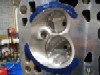
On The Tree
Joined: Oct 2003
Posts: 150
Likes: 0
From: harrisburg PA
#1, looks like you are pressing too hard. you should have less than 1lb of force when smoothing. Also, don't be afraid to slow the grinder down! I normally semi and finish less than 10k revs.
#2 get some dykem, or another type of layout fluid...a Sharpie will work in a pinch...and a scripe, or scratch all.
#3 grinder control and technique takes time!!! practice makes perfect. Get some junk heads.
for SSR, and mid port work, you should have atleast a 4", I normally buy the 6" mandrels by the bag (I think they are less than $3 a piece from MSC or JL industrial) and cut them to length.
I find a flipped rolled over used roll workes better than tapers for SSR work, most of the time now, I work the back of used rolls until they blow apart when you get to the adhesive seam.
Do you have a local flowbench you can buy an hour or so on?
Best of luck
Dennis
#2 get some dykem, or another type of layout fluid...a Sharpie will work in a pinch...and a scripe, or scratch all.
#3 grinder control and technique takes time!!! practice makes perfect. Get some junk heads.
for SSR, and mid port work, you should have atleast a 4", I normally buy the 6" mandrels by the bag (I think they are less than $3 a piece from MSC or JL industrial) and cut them to length.
I find a flipped rolled over used roll workes better than tapers for SSR work, most of the time now, I work the back of used rolls until they blow apart when you get to the adhesive seam.
Do you have a local flowbench you can buy an hour or so on?
Best of luck
Dennis
On The Tree
Joined: Oct 2003
Posts: 150
Likes: 0
From: harrisburg PA
On a funny note for Greg....
I have a guy that helps with finishing work on intake manifolds...virgin in the field...has only been around the grinder for 4 months or so... I had to do some flow testing with a sprint customer, and asked him to take over on the manifold I was working on. I guess his ego felt he could go from the 1/4hp grinder that I let him use, to the 1hp grinder I was using with a 5" mandrel. He thinks the big IR grinders sound cool...I heard a free rev, then a helicopter!!!!! Thank god he did not hurt himself. The grinder/helicopter pulled out of his hand, and the safety shut it off....After a change of underwear....he asked how I run that thing! My answer...DON'T FREE REV IT!
I guess it doesn't help that I have the regulators drilled on my big grinders
Dennis
I have a guy that helps with finishing work on intake manifolds...virgin in the field...has only been around the grinder for 4 months or so... I had to do some flow testing with a sprint customer, and asked him to take over on the manifold I was working on. I guess his ego felt he could go from the 1/4hp grinder that I let him use, to the 1hp grinder I was using with a 5" mandrel. He thinks the big IR grinders sound cool...I heard a free rev, then a helicopter!!!!! Thank god he did not hurt himself. The grinder/helicopter pulled out of his hand, and the safety shut it off....After a change of underwear....he asked how I run that thing! My answer...DON'T FREE REV IT!
I guess it doesn't help that I have the regulators drilled on my big grinders
Dennis


On The Tree
Joined: Sep 2004
Posts: 188
Likes: 1
From: Houston, TX
Yeah, ya' gotta watch those long polishing mandrels. They're soft as butter and will go 90 degrees on ya' if you free wheel them.
I've never had it happen (common sense), but I bet the guys that did crapped their pants.
I've never had it happen (common sense), but I bet the guys that did crapped their pants.
Same here but my nephew came over one day when I was doin up a TB and he grabbed it and free spooled it and he was very quick to put it back down, it bent the crap out of it. He knows better now 

I made my own sandpaper mandrel just by slitting
a piece of 1/4" rod stock, and use a piece of
"plumber's roll" (cloth backed plumbing sandpaper).
I've been using long shank burrs on the LS6 heads
and they do whip a lot, electric 1/4" I'm running off
a Variac at about 50% line voltage, and wearing
welding gloves so the shank spins between my
fingers like chopsticks. Good control that way and
some "feel" for the surface. At low voltage it doesn't
have enough torque or speed to make much trouble
or heat. I figure slow is smart.
a piece of 1/4" rod stock, and use a piece of
"plumber's roll" (cloth backed plumbing sandpaper).
I've been using long shank burrs on the LS6 heads
and they do whip a lot, electric 1/4" I'm running off
a Variac at about 50% line voltage, and wearing
welding gloves so the shank spins between my
fingers like chopsticks. Good control that way and
some "feel" for the surface. At low voltage it doesn't
have enough torque or speed to make much trouble
or heat. I figure slow is smart.
I could prob find a place that'll let me use their flowbench. Do you use
it just to make sure all of the ports flow close to the same amount?
I guess the speed of my grinder could be another problem...it only
has one speed and I think its around 18k-20k rpm's...
it just to make sure all of the ports flow close to the same amount?
I guess the speed of my grinder could be another problem...it only
has one speed and I think its around 18k-20k rpm's...

are you using a air grinder?
If so check the specs on the grinder if max speed is 20k rpm @ 100 psi then set it to 100 psi and apply 50% throttle see what is sounds like then lower the air pressure till it sounds how it it did at 50% at full throttle.
Hope it's not to confusing
If so check the specs on the grinder if max speed is 20k rpm @ 100 psi then set it to 100 psi and apply 50% throttle see what is sounds like then lower the air pressure till it sounds how it it did at 50% at full throttle.
Hope it's not to confusing