







Where to get good HID kit?

I'd like to get some HIDs but before I waste my money but I have some n00bish questions.
Do i need separate kits for low beams and high beams?
The "D" bulbs require a different light housing?
Are there disadvantages to the "H" bulbs? I see they are not "true" HIDs?
The most visible light spectrum for our eyes is ~4500k? (pure white)?
Suggestions for fog light HIDs?
Do i need separate kits for low beams and high beams?
The "D" bulbs require a different light housing?
Are there disadvantages to the "H" bulbs? I see they are not "true" HIDs?
The most visible light spectrum for our eyes is ~4500k? (pure white)?
Suggestions for fog light HIDs?
Last edited by feelnlo; May 3, 2009 at 06:36 PM.
you want the 9006 kit for the low beams
and the 880 kit for the foglights
depends of your definition of true hid's. they are real hid's but most will argue they are not true hid conversions because your not using a projector headlight
and the 880 kit for the foglights
depends of your definition of true hid's. they are real hid's but most will argue they are not true hid conversions because your not using a projector headlight
Also why is the 3000k kit $5 more on DDM website...? I mean is it the most desirable color?
3000k would be pure white and as you go higher it becomes more blue right? (Up to a certain point, then begins to change colors?)
Projectors give a more even spread of light and don't scatter it like reflectors. Point of focus is different on HID bulbs so the reflector housings can scatter light and cause excess glare for oncoming traffic.
3000k is really yellow. 4500-5000k is white, (highest lumen output) then it starts getting bluer as you go up towards 10k or so then more purple above that.
3000k is really yellow. 4500-5000k is white, (highest lumen output) then it starts getting bluer as you go up towards 10k or so then more purple above that.
How long does it take these HID lights to come on?
For example:
Say I had an HID kit installed for low AND HI beams.
I'm driving down the road at night, low beams on, and i want to turn on my HI beams.
Will there be a delay from the time i flip the switch to HI beams until I actually see the HI beam lights come on and illuminate the road?
I've heard ppl say there is a "warm up" period with these lights when you first turn them on. I've never owned HIDs...
For example:
Say I had an HID kit installed for low AND HI beams.
I'm driving down the road at night, low beams on, and i want to turn on my HI beams.
Will there be a delay from the time i flip the switch to HI beams until I actually see the HI beam lights come on and illuminate the road?
I've heard ppl say there is a "warm up" period with these lights when you first turn them on. I've never owned HIDs...
Last edited by feelnlo; May 3, 2009 at 09:19 PM.
They are almost "instant" but not full brightness for several seconds. Mine take about 5 seconds to get to full brightness. I have HIDs on my low beams.
I wouldn't put HIDs in the brights because they don't like being turned on/off a lot, plus the delay would be a nuisance. I'm using normal bright halogens for my brights and that works fine.
I wouldn't put HIDs in the brights because they don't like being turned on/off a lot, plus the delay would be a nuisance. I'm using normal bright halogens for my brights and that works fine.
LS1 Tech Stories
The Best V8 Stories One Small Block at Time

6 Common C5 Corvette Failures and What's Involved In Repairing Them
Pouria Savadkouei
Retro Modern Bandit Pontiac Trans AM Comes With Burt Reynolds' Autograph
Verdad Gallardo
Top 10 Greatest Cadillac V Series Performance Models Ever, Ranked
Pouria Savadkouei
Top 10 Most Powerful Chevy Trucks Ever Made!

Hennessey's New Supercharged Silverado ZR2 Has 700 HP
Verdad Gallardo
Coachbuilt N2A Anteros Is an LS2-Powered C6 Corvette In Italian Clothes
Verdad Gallardo
Awesome K5 Blazer Restomod Comes With C7 Corvette Power
Verdad Gallardo
10 Camaros You Should Never Buy

10 LS Engine Myths That Refuse to Die
Verdad Gallardo Looks like Silverstar 9005SU ULTRA bulbs would be a good choice for the high beams. 4100K and 65W and would probably match decently to the HID kit if i choose the right color light output.
Last edited by feelnlo; May 3, 2009 at 10:15 PM. Reason: typo

Copy & Paste Moderator


Joined: Apr 2002
Posts: 9,764
Likes: 208
From: Eastern MA
Here is a primer...
HID = High Intensity Discharge
Its a bulb and ballast assembly. Instead of a filament glowing in a glass tube (incandescent & halogen), HID is a arc of electricity at a high voltage in a glass tube.
Projector Housing
Its a light housing with a reflector "bowl" in the rear, cut-off shield in the middle, and curved glass focus in front. It produces a wide even light pattern with a sharp flat or stepped line with light below and little to no light above. Some projectors are halogen, some are HID.
Reflector Housing
Standard incandescent & Halogen housing with a reflector in the rear and either Clear or Fresnel or Parabolic glass in front. The cut-off and general pattern is not as well defined as a projector. There is no cut-off shield. The beam pattern is determined by the glass pattern and reflector shape. Almost all reflector housings are halogen or incandescent. Only a couple HID reflector setups were available from the OEMs.
Check out the Lighting FAQ for some more info on Headlight upgrades and projectors. HID Planet's Forums is also a great place for information.
You shouldn't install HID in the High Beam location because they can't be flashed quickly. You'd loose the ability to signal other drivers with the high beams. Vehicles that come from the factory with HID high beam have Bi-Xenon projectors. Its one projector housing for low beam and high beam with a movable cut-off shield. For the high beam, the cut-off shield moves to let more light upwards like a standard high beam pattern.
Here are some examples of bare projectors:

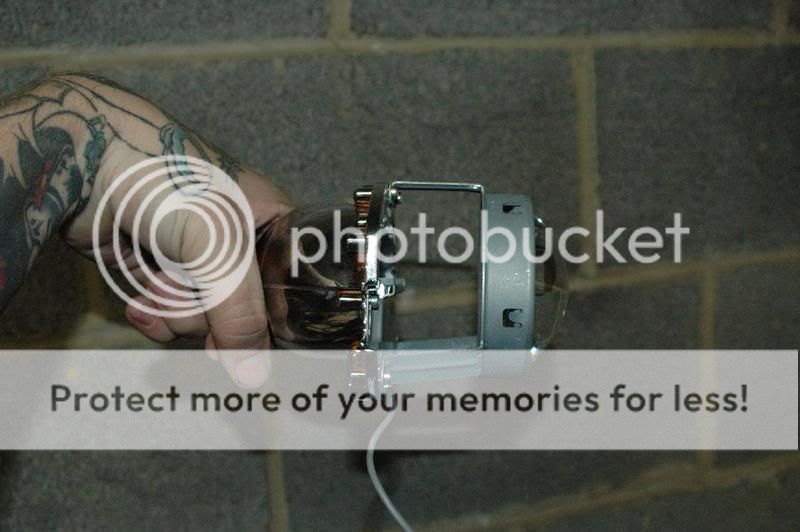
(Not my hand.)
Here is an example of a projector beam pattern:
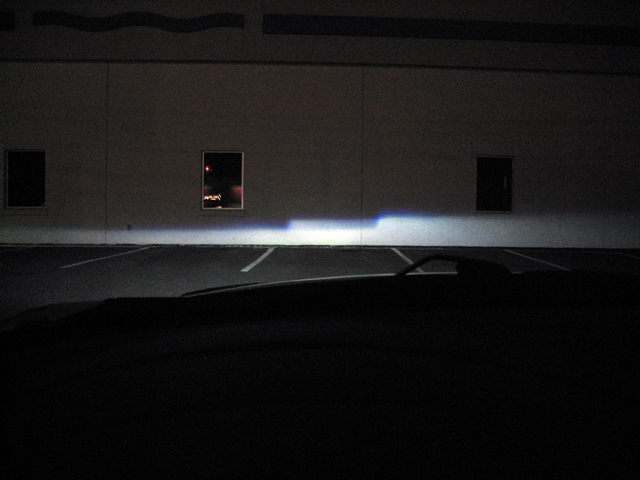
(My 2001 Formula with Hella 90mm H9 projector, modified cut-off, and 4300K HID kit.)

(tadpole's Miata with FX35 projectors)
(Please note that those pics were not taken at the same place or settings so you can't compare brightness. That being said, the FX projectors are brighter, wider, and have better spread than the Hella 90mm.)
Here is some good reading:
http://www.danielsternlighting.com/t...nversions.html
http://www.danielsternlighting.com/t...e/bad/bad.html
http://www.danielsternlighting.com/t...good/good.html
Some good discussion here:
https://ls1tech.com/forums/appearanc...un-around.html
Regarding HID Kits:
Basically Halogen and HID produce light differently (glowing filament vs. arc of light) and HID kits don't always place the arc in the same place as the Halogen filament. And some halogen filaments are horizontal to the glass tube. All HID arcs are vertical in the glass tube. Which means that the focal point will be off and you'll get a bad light pattern. Also, HID puts out a lot more light than Halogen. Therefore a Halogen Reflector Housing intended to spread a certain amount of light of a certain shape over a certain area now has a lot more light going outside this area not necessarily where it is needed and often where it shouldn't be (high, blotchy, and often into the eyes of others).
This problem becomes compounded with dual filament hi/lo applications. I've seen four kinds of so-called "bi-xenon" HID kits designed for dual filament applications:
1.) One fixed/non-movable HID capsule
You lose high beam but its position and resulting pattern is like the high beams are stuck on and you are blinding everyone.
2.) One HID capsule for low beam and One Halogen bulb for high beam attached to same base
Neither is positioned correctly and the high beam bulb is not replicable. Sucks for you if it blows.
3.) Two HID capsules on one base. Neither is positioned correctly and you have way too much light coming out for high beam and you can't flash-to-pass because HID starts up slowly and you can damage the bulbs and ballasts from frequent flashing.
4.) One Movable HID capsule often with a built-in shield/cap. This is the "best" of these options because it tries to put the arc in close to the correct position for high/low operation. The capsule will move depending on whether you have the high or low beam activated. The beam pattern is still not good, but not as bad as the above options.
For clarification, a bi-xenon projector has only one fixed/non-movable HID bulb. When high beam is activated, the cut-off shield inside the projector moves to allow more light higher through the lens.
Check out the Lighting FAQ: https://ls1tech.com/forums/showthread.php?t=710357
The K number is the color temp. It is not the brightness (well not directly, I'll explain). 4000K - 5000K is the brightest. Continuing up the color scale, the light gets bluer then purpler and the lumen output (the actual measurement of light) decreases. In other words, a 10000K HID kit is dimmer than a 4300K HID kit. Our eyes are least sensitive to blue light. Blue light also scatters more easily. In the end, we can see better with 4300K HID for many reasons.
For the 1993-1997 Firebird, you'd need a bi-xenon setup otherwise you'd lose high beams.
HID = High Intensity Discharge
Its a bulb and ballast assembly. Instead of a filament glowing in a glass tube (incandescent & halogen), HID is a arc of electricity at a high voltage in a glass tube.
Projector Housing
Its a light housing with a reflector "bowl" in the rear, cut-off shield in the middle, and curved glass focus in front. It produces a wide even light pattern with a sharp flat or stepped line with light below and little to no light above. Some projectors are halogen, some are HID.
Reflector Housing
Standard incandescent & Halogen housing with a reflector in the rear and either Clear or Fresnel or Parabolic glass in front. The cut-off and general pattern is not as well defined as a projector. There is no cut-off shield. The beam pattern is determined by the glass pattern and reflector shape. Almost all reflector housings are halogen or incandescent. Only a couple HID reflector setups were available from the OEMs.
Check out the Lighting FAQ for some more info on Headlight upgrades and projectors. HID Planet's Forums is also a great place for information.
You shouldn't install HID in the High Beam location because they can't be flashed quickly. You'd loose the ability to signal other drivers with the high beams. Vehicles that come from the factory with HID high beam have Bi-Xenon projectors. Its one projector housing for low beam and high beam with a movable cut-off shield. For the high beam, the cut-off shield moves to let more light upwards like a standard high beam pattern.
Here are some examples of bare projectors:
(Not my hand.)
Here is an example of a projector beam pattern:
(My 2001 Formula with Hella 90mm H9 projector, modified cut-off, and 4300K HID kit.)
(tadpole's Miata with FX35 projectors)
(Please note that those pics were not taken at the same place or settings so you can't compare brightness. That being said, the FX projectors are brighter, wider, and have better spread than the Hella 90mm.)
Here is some good reading:
http://www.danielsternlighting.com/t...nversions.html
http://www.danielsternlighting.com/t...e/bad/bad.html
http://www.danielsternlighting.com/t...good/good.html
Some good discussion here:
https://ls1tech.com/forums/appearanc...un-around.html
Regarding HID Kits:
Basically Halogen and HID produce light differently (glowing filament vs. arc of light) and HID kits don't always place the arc in the same place as the Halogen filament. And some halogen filaments are horizontal to the glass tube. All HID arcs are vertical in the glass tube. Which means that the focal point will be off and you'll get a bad light pattern. Also, HID puts out a lot more light than Halogen. Therefore a Halogen Reflector Housing intended to spread a certain amount of light of a certain shape over a certain area now has a lot more light going outside this area not necessarily where it is needed and often where it shouldn't be (high, blotchy, and often into the eyes of others).
This problem becomes compounded with dual filament hi/lo applications. I've seen four kinds of so-called "bi-xenon" HID kits designed for dual filament applications:
1.) One fixed/non-movable HID capsule
You lose high beam but its position and resulting pattern is like the high beams are stuck on and you are blinding everyone.
2.) One HID capsule for low beam and One Halogen bulb for high beam attached to same base
Neither is positioned correctly and the high beam bulb is not replicable. Sucks for you if it blows.
3.) Two HID capsules on one base. Neither is positioned correctly and you have way too much light coming out for high beam and you can't flash-to-pass because HID starts up slowly and you can damage the bulbs and ballasts from frequent flashing.
4.) One Movable HID capsule often with a built-in shield/cap. This is the "best" of these options because it tries to put the arc in close to the correct position for high/low operation. The capsule will move depending on whether you have the high or low beam activated. The beam pattern is still not good, but not as bad as the above options.
For clarification, a bi-xenon projector has only one fixed/non-movable HID bulb. When high beam is activated, the cut-off shield inside the projector moves to allow more light higher through the lens.
Check out the Lighting FAQ: https://ls1tech.com/forums/showthread.php?t=710357
The K number is the color temp. It is not the brightness (well not directly, I'll explain). 4000K - 5000K is the brightest. Continuing up the color scale, the light gets bluer then purpler and the lumen output (the actual measurement of light) decreases. In other words, a 10000K HID kit is dimmer than a 4300K HID kit. Our eyes are least sensitive to blue light. Blue light also scatters more easily. In the end, we can see better with 4300K HID for many reasons.
For the 1993-1997 Firebird, you'd need a bi-xenon setup otherwise you'd lose high beams.
https://ls1tech.com/forums/showthread.php?t=710357

I got that headlight retofit from a pair of OEM 2006 BMW M5 Hella Bi-Xenin HID E55 or E60 or E65


I concern about the bulb holder on back side of this headlight. I buy the HID package, will come with the bulb holder?

Is that headlight come with motor that can move upside/downside/left/right?
Anyone can help which those color wires should be connected?
I concern about the bulb holder on back side of this headlight. I buy the HID package, will come with the bulb holder?
Is that headlight come with motor that can move upside/downside/left/right?
Anyone can help which those color wires should be connected?
Copy & Paste Moderator
Joined: Apr 2002
Posts: 9,764
Likes: 208
From: Eastern MA
Originally Posted by Jeff Smith
I concern about the bulb holder on back side of this headlight. I buy the HID package, will come with the bulb holder?
Originally Posted by Jeff Smith
Is that headlight come with motor that can move upside/downside/left/right?
Anyone can help which those color wires should be connected?
Anyone can help which those color wires should be connected?
I suggest you do some reading over on HID Planet's forums.
a 9006 hid kit plugs directly into the headlight housing, the base is the same as a regular 9006 bulb. in the pictures of the projector you posted i cant tell what kind of bulbs is used
a projector helps focus the light pattern. in a regular headlight housing your using may 65% of the effective light output, and a projector helps define the beam so your getting a 95% effeciency of light output. you dont NEED to buy a projector setup to run hid's
my bulbs take about 10 seconds to warm up. i have the very blue 10k bulbs im not sure what the delay would be on the 4300k color. im NOT running a projector setup but i still have noticed a big difference in terms of light output, the 9006 hid kit gave me about twice the light as the silverstar ultras and 2-3 times the lifespan for bulbs
i think the opposite would be true for high beams, atleast for my use. my main problem is switching back to regular lighting from the brights, so im going from seeing a lot to seeing virtually nothing for ten seconds while my eyes adjust to dark blue and the bulbs warm up. switching to high beam means there is no one else around to irritate your vision, switching back to low beams however means there is oncoming traffic to blind you while your low beams warm up
a projector helps focus the light pattern. in a regular headlight housing your using may 65% of the effective light output, and a projector helps define the beam so your getting a 95% effeciency of light output. you dont NEED to buy a projector setup to run hid's
my bulbs take about 10 seconds to warm up. i have the very blue 10k bulbs im not sure what the delay would be on the 4300k color. im NOT running a projector setup but i still have noticed a big difference in terms of light output, the 9006 hid kit gave me about twice the light as the silverstar ultras and 2-3 times the lifespan for bulbs
i think the opposite would be true for high beams, atleast for my use. my main problem is switching back to regular lighting from the brights, so im going from seeing a lot to seeing virtually nothing for ten seconds while my eyes adjust to dark blue and the bulbs warm up. switching to high beam means there is no one else around to irritate your vision, switching back to low beams however means there is oncoming traffic to blind you while your low beams warm up
Last edited by chrysler kid; May 4, 2009 at 12:50 PM.
Copy & Paste Moderator
Joined: Apr 2002
Posts: 9,764
Likes: 208
From: Eastern MA
Originally Posted by chrysler kid
a 9006 hid kit plugs directly into the headlight housing, the base is the same as a regular 9006 bulb. in the pictures of the projector you posted i cant tell what kind of bulbs is used
Originally Posted by chrysler kid
i think the opposite would be true for high beams, atleast for my use. my main problem is switching back to regular lighting from the brights, so im going from seeing a lot to seeing virtually nothing for ten seconds while my eyes adjust to dark blue and the bulbs warm up. switching to high beam means there is no one else around to irritate your vision, switching back to low beams however means there is oncoming traffic to blind you while your low beams warm up
You could mod your headlights to keep all four on at the same time like the Firebirds. I'd recommend getting/making relay harnesses to handle the load if you do that.
I plan to put it on my 2001 Camaro. Yeah it s D2R for low beam and the H7 is for high beam. I probably choose H7>>55w. ballast 10K Deep Blue color. One thing I need look for the bulb holder. I will check on HID Stores if those HID come with bulb holder, would be great...
An HID kit or OEM HID setup will not come with the bulb holder. The bulb holder is a part specific to the projector.
Where are you putting these? Do these projectors have AFS or auto-leveling motors in addition to the bi-xenon solenoid? If so, it may be more trouble than its worth to wire up the AFS and auto-leveling (keep the bi-xenon).
I suggest you do some reading over on HID Planet's forums.
Where are you putting these? Do these projectors have AFS or auto-leveling motors in addition to the bi-xenon solenoid? If so, it may be more trouble than its worth to wire up the AFS and auto-leveling (keep the bi-xenon).
I suggest you do some reading over on HID Planet's forums.

Just think first before you choose your color (temperature). I have 12,000K in my lows, which is a deep blue/purple, and I really wish I just went with pure white. The lighting would be better, and much less obnoxious.
Copy & Paste Moderator
Joined: Apr 2002
Posts: 9,764
Likes: 208
From: Eastern MA
I plan to put it on my 2001 Camaro. Yeah it s D2R for low beam and the H7 is for high beam. I probably choose H7>>55w. ballast 10K Deep Blue color. One thing I need look for the bulb holder. I will check on HID Stores if those HID come with bulb holder, would be great...
The stock 2001 Camaro headlights are:
Low: 9006
High: 9005
If you are going to use the M5 bi-xenon projector, you need a D2S bulb, not D2R (S = HID Projector, R = HID Reflector).
Where is the H7 going to go? Do you have a H7 high beam projector?
Do it. I did a long time ago. Much better than kicking the HIDs on and off, they'll last longer plus you won't have that wait time.
I plan build custom headlights for my '01 Camaro to use one headlights that M-5 Bi-Xenon projector so I can play on headlight bracket move(upside/downside/left/right). I would not use the Camaro headlights.
I'm a bit confused by your bulb choices.
The stock 2001 Camaro headlights are:
Low: 9006
High: 9005
If you are going to use the M5 bi-xenon projector, you need a D2S bulb, not D2R (S = HID Projector, R = HID Reflector).Yeah, Correct> D2S. I sorry I mistyped that words.
Where is the H7 going to go? Do you have a H7 high beam projector?Someone told me that M5 bi-xenon can interchangable to H7 or D2S
The stock 2001 Camaro headlights are:
Low: 9006
High: 9005
If you are going to use the M5 bi-xenon projector, you need a D2S bulb, not D2R (S = HID Projector, R = HID Reflector).Yeah, Correct> D2S. I sorry I mistyped that words.
Where is the H7 going to go? Do you have a H7 high beam projector?Someone told me that M5 bi-xenon can interchangable to H7 or D2S