




4l60e clnstantly breaking

Thread Starter
On The Tree
Joined: Feb 2013
Posts: 125
Likes: 1
From: HAvelock NC
 4l60e clnstantly breaking
 I have replaced my 4l60e 4 times in the past year, 3 of them in the last 3 months. The 3-4 clutches keep burning up, and we can not figure out why, all of the shifts seem solid except the 3-4 shift, what should we look for to fix them problem?

Teching In
Joined: Feb 2014
Posts: 27
Likes: 0
Here are a few things to check; (1)replace the capsule assembly in the case where the 2/4 servo pistons go, or remove the capsule and install a cup plug at the bottom of the bore. (2)check for excessive leakage around the input shaft and the input clutch housing. (3) make sure the air bleed and ball assembly is in the input housing. (4) set the 3-4 clutch clearance at 0.020-0.040.
Thread Starter
On The Tree
Joined: Feb 2013
Posts: 125
Likes: 1
From: HAvelock NC
Here are a few things to check; (1)replace the capsule assembly in the case where the 2/4 servo pistons go, or remove the capsule and install a cup plug at the bottom of the bore. (2)check for excessive leakage around the input shaft and the input clutch housing. (3) make sure the air bleed and ball assembly is in the input housing. (4) set the 3-4 clutch clearance at 0.020-0.040.

Moderator


Joined: Aug 2010
Posts: 7,323
Likes: 529
From: Ann Arbor, MI
Here are a few things to check; (1)replace the capsule assembly in the case where the 2/4 servo pistons go, or remove the capsule and install a cup plug at the bottom of the bore. (2)check for excessive leakage around the input shaft and the input clutch housing. (3) make sure the air bleed and ball assembly is in the input housing. (4) set the 3-4 clutch clearance at 0.020-0.040.
More important than selecting the friction/steel combo is taking all necessary steps to ensure there are no leaks in the 3/4 circuit. I regularly read how long original stock 4L60E last and conversely how short lived many rebuilds are. IMO, many budget rebuilds do not fully address all the possible leaks, and therefore result in early 3/4 clutch failure. I won't detail the the steps for checking for leaks here other than summarizing them:
* Ensure check ball (capsule) in the 3rd accumulator does not leak
* Ensure teflon seals on the input shaft are new
* Ensure input shaft is tight in input drum without leaks
* Ensure fitting for the bleed hole in input drum is secure
* Ensure check ball in input drum does not leak
Note: The Transgo HD2 kit replaces it with a cartridge, claiming
the check ball can leak under high RPM
I suspect you have a major leak; the mentioned capsule is often overlooked. Another builder told me he has seen the bleed hole in the input drum blow out.
Moderator
Joined: Aug 2010
Posts: 7,323
Likes: 529
From: Ann Arbor, MI
Here are a few things to check; (1)replace the capsule assembly in the case where the 2/4 servo pistons go, or remove the capsule and install a cup plug at the bottom of the bore. (2)check for excessive leakage around the input shaft and the input clutch housing. (3) make sure the air bleed and ball assembly is in the input housing. (4) set the 3-4 clutch clearance at 0.020-0.040.
More important than selecting the friction/steel combo is taking all necessary steps to ensure there are no leaks in the 3/4 circuit. I regularly read how long original stock 4L60E last and conversely how short lived many rebuilds are. IMO, many budget rebuilds do not fully address all the possible leaks, and therefore result in early 3/4 clutch failure. I won't detail the the steps for checking for leaks here other than summarizing them:
* Ensure check ball (capsule) in the 3rd accumulator does not leak
* Ensure teflon seals on the input shaft are new
* Ensure input shaft is tight in input drum without leaks
* Ensure fitting for the bleed hole in input drum is secure
* Ensure check ball in input drum does not leak
Note: The Transgo HD2 kit replaces it with am orifice, claiming
the check ball can leak under high RPM
I suspect you have a major leak; the mentioned capsule is often overlooked. Another builder told me he has seen the bleed hole in the input drum blow out. A leak between the input shaft and drum can be very difficult to detect.
Personally I would start with a new (or used) input drum and:
1. Install the Sonnax reinforcement ring; this requires using an old-style aluminum forward piston.
2. Replace the check ball with a drilled plug (orifice), e.g. from the HD2 kit.
Hopefully the next rebuild will be better.
Trending Topics
My car was on at least it's 3rd 4L60. The stocker, and 2 well known rebuilds by 2 different companies. When it blew this last time(lost 3rd and 4th) i decided to do what someone should have done a long time ago and went 4L80 
LS1 Tech Stories
The Best V8 Stories One Small Block at Time

Topdon ONE vs. Artidiag 800 BT2: Which is the Diagnostic Tablet For You?
Pouria Savadkouei
Gas Monkey Built a 6-Wheel Ferrari Testarossa With a Corvette LT4 Engine
Verdad Gallardo
7 Most Reliable High-Performance Engines GM Has Ever Built
Verdad Gallardo
Amazing '71 Camaro Restomod Is Modern Muscle Car Under the Skin
Verdad Gallardo
6 Common C5 Corvette Failures and What's Involved In Repairing Them
Pouria Savadkouei
Retro Modern Bandit Pontiac Trans AM Comes With Burt Reynolds' Autograph
Verdad Gallardo
Top 10 Greatest Cadillac V Series Performance Models Ever, Ranked
Pouria Savadkouei
Top 10 Most Powerful Chevy Trucks Ever Made!

Hennessey's New Supercharged Silverado ZR2 Has 700 HP
Verdad Gallardo Thread Starter
On The Tree
Joined: Feb 2013
Posts: 125
Likes: 1
From: HAvelock NC
I don't have the money for a 4l80e swap, I would not even be able to get it built if it wasn't under warranty. I've pretty much decided I'm selling the car as soon as I get it back this time, it's just not practical anymore

TECH Fanatic
Joined: Mar 2011
Posts: 1,050
Likes: 2
From: Odessa, TX

Well, just in case you want to attack it from another
angle, I'd say
- You are not breaking it, you're burning it.
- Burnt frictions comes from either too much torque
or not enough line pressure when it counts - bet on
the latter with minimal motor mods, although the high
stall converter also applies more torque multiplication
than stock.
- Low line pressure can come from bad air mass flow
data, like a ghetto-modded MAF or unrealistically low
VE table values at low-mid throttle
- Force motor table and the "mystery" mapping of air
mass to torque to line% to PCS duty cycle combine
to give you really weak pressure at low to mid pedal
and all of this is whacked once you get into motor
mods and trans modes that elevate torque unbeknownst
to the PCM. Often this first manifests as TCC slip but
the gear frictions are not far behind. So you can burn
(glaze) them in moderate mid-pedal driving over time,
sometimes not much of it.
So I'd suggest you quit looking to the victim (trans)
and turn to the motor tune and maybe the high STR
of the converter (which simply wants more pressure
to hold, if you're not past the capacity of the frictions
given adequate pressure).
angle, I'd say
- You are not breaking it, you're burning it.
- Burnt frictions comes from either too much torque
or not enough line pressure when it counts - bet on
the latter with minimal motor mods, although the high
stall converter also applies more torque multiplication
than stock.
- Low line pressure can come from bad air mass flow
data, like a ghetto-modded MAF or unrealistically low
VE table values at low-mid throttle
- Force motor table and the "mystery" mapping of air
mass to torque to line% to PCS duty cycle combine
to give you really weak pressure at low to mid pedal
and all of this is whacked once you get into motor
mods and trans modes that elevate torque unbeknownst
to the PCM. Often this first manifests as TCC slip but
the gear frictions are not far behind. So you can burn
(glaze) them in moderate mid-pedal driving over time,
sometimes not much of it.
So I'd suggest you quit looking to the victim (trans)
and turn to the motor tune and maybe the high STR
of the converter (which simply wants more pressure
to hold, if you're not past the capacity of the frictions
given adequate pressure).
The VE tables and MAF is what likely caused mine... When i bought the car it was said to have had a tune that was spot on and it drove well(as far as i could tell). Little did i know the VE tables were stock, MAF was completely unused(shut off) and the car was essentially running speed density... The tune was an absolute MESS. This likely caused not enough line pressure and therefore burned it up... With my 80 now i will be doing a full, street driven tune by a very well known tuner here in MN. The dude is top notch. He takes the car for 2 days, does some minor tuning before he takes it out, then drives it for a couple days, tuning it in real world conditions and under normal driving conditions, not just on a dyno. Also my 80 is run off a vacuum modulator
Moderator
Joined: Aug 2010
Posts: 7,323
Likes: 529
From: Ann Arbor, MI
Jimmyblue: Thanks for reminding everyone that a bad tune (or erroneous engine sensors) can cause a trans to slip and fail prematurely.
That is one reason I recommend the Sonnax boost valve (or from a shift kit) - it increases line pressure across the board by 25% or so.
That is one reason I recommend the Sonnax boost valve (or from a shift kit) - it increases line pressure across the board by 25% or so.
Thread Starter
On The Tree
Joined: Feb 2013
Posts: 125
Likes: 1
From: HAvelock NC
I don't see how a bad tune could cause it though considering the stick transmission lasted for years with the Same tune and same mods, but now I can't even get a rebuilt transmission to last
My builder says he is tracking down everywhere the fluid could go to see if there is a leak, he is dead set that that is the problem
My builder says he is tracking down everywhere the fluid could go to see if there is a leak, he is dead set that that is the problem
Moderator
Joined: Aug 2010
Posts: 7,323
Likes: 529
From: Ann Arbor, MI
I don't see how a bad tune could cause it though considering the stick transmission lasted for years with the Same tune and same mods, but now I can't even get a rebuilt transmission to last
My builder says he is tracking down everywhere the fluid could go to see if there is a leak, he is dead set that that is the problem
My builder says he is tracking down everywhere the fluid could go to see if there is a leak, he is dead set that that is the problem
Your builder is correct that a leak is causing your problems. Ask if he replaced the 3rd accumulator check ball in the case (behind the servo) and consider getting a new input drum with input shaft. I thinks its about $250 from the dealer; IIRC Sonnax sells it too. There could also be a leak in the pump or severe wear inside the pump's stator shaft. A careful air test with the fully assembled input drum installed into the pump might reveal the leak.
In this picture I am air testing the 3/4 clutch circuit:
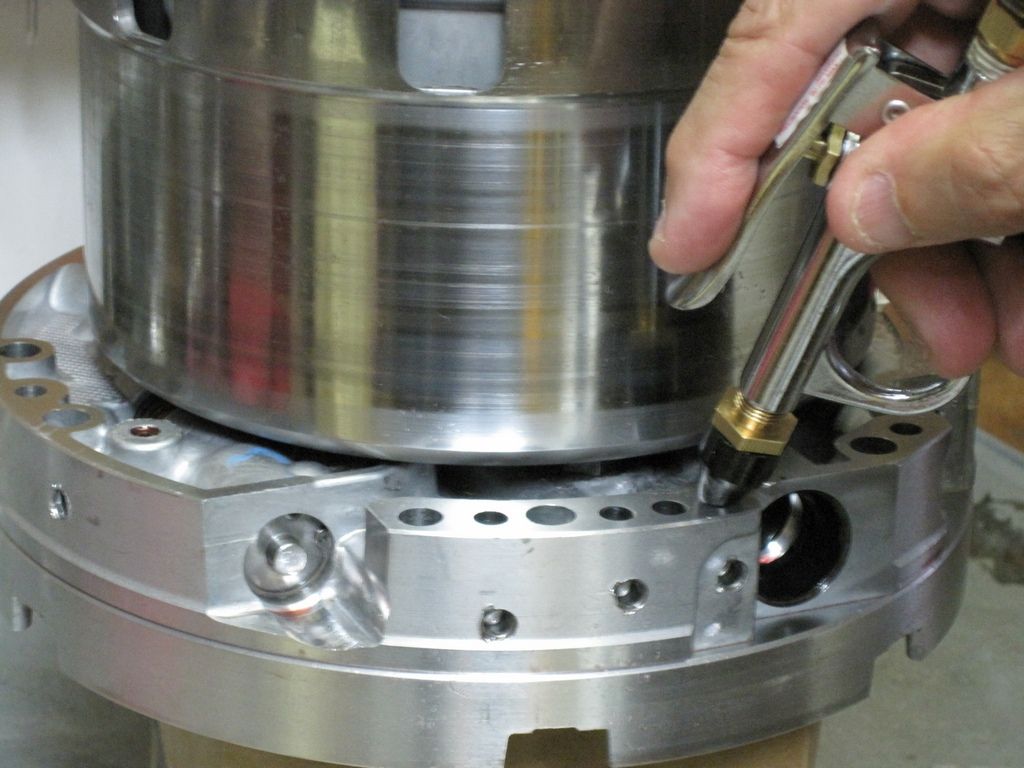
There will be some normal air leakage, but the clutches should apply very firmly. Some air leakage is normal from between the pump halves, but air will leak through tiny openings that will not leak much ATF.
Last edited by mrvedit; Mar 7, 2014 at 12:53 PM.
When I see trans after trans in the same car failing the
same way, I tend to believe it's not a trans internal fault -
that would be too much of a coincidence.
The description seems to me, to be this way. Why would
4 different transmissions burn up the same way? All four
with the same leak? Either somebody's consistently bad
at their job, or the problem is something else that fits the
failure mode. Or multiple somethings, but still why all fail
the same when the transmissions are not "defected" the
same (unless you won the Lotto of Suck)??
same way, I tend to believe it's not a trans internal fault -
that would be too much of a coincidence.
The description seems to me, to be this way. Why would
4 different transmissions burn up the same way? All four
with the same leak? Either somebody's consistently bad
at their job, or the problem is something else that fits the
failure mode. Or multiple somethings, but still why all fail
the same when the transmissions are not "defected" the
same (unless you won the Lotto of Suck)??
Moderator
Joined: Aug 2010
Posts: 7,323
Likes: 529
From: Ann Arbor, MI
I've lost track if you broke completely different transmissions or if the same one was just rebuilt multiple times, but as jimmyblue says, it is unlikely that different ones would fail in the same way.
However if the same one was just rebuilt multiple times, replace at least the items I mentioned earlier.
However if the same one was just rebuilt multiple times, replace at least the items I mentioned earlier.
Thread Starter
On The Tree
Joined: Feb 2013
Posts: 125
Likes: 1
From: HAvelock NC
When I see trans after trans in the same car failing the
same way, I tend to believe it's not a trans internal fault -
that would be too much of a coincidence.
The description seems to me, to be this way. Why would
4 different transmissions burn up the same way? All four
with the same leak? Either somebody's consistently bad
at their job, or the problem is something else that fits the
failure mode. Or multiple somethings, but still why all fail
the same when the transmissions are not "defected" the
same (unless you won the Lotto of Suck)??
same way, I tend to believe it's not a trans internal fault -
that would be too much of a coincidence.
The description seems to me, to be this way. Why would
4 different transmissions burn up the same way? All four
with the same leak? Either somebody's consistently bad
at their job, or the problem is something else that fits the
failure mode. Or multiple somethings, but still why all fail
the same when the transmissions are not "defected" the
same (unless you won the Lotto of Suck)??
