When you click on links to various merchants on this site and make a purchase, this can result in this site earning a commission. Affiliate programs and affiliations include, but are not limited to, the eBay Partner Network.
Hi
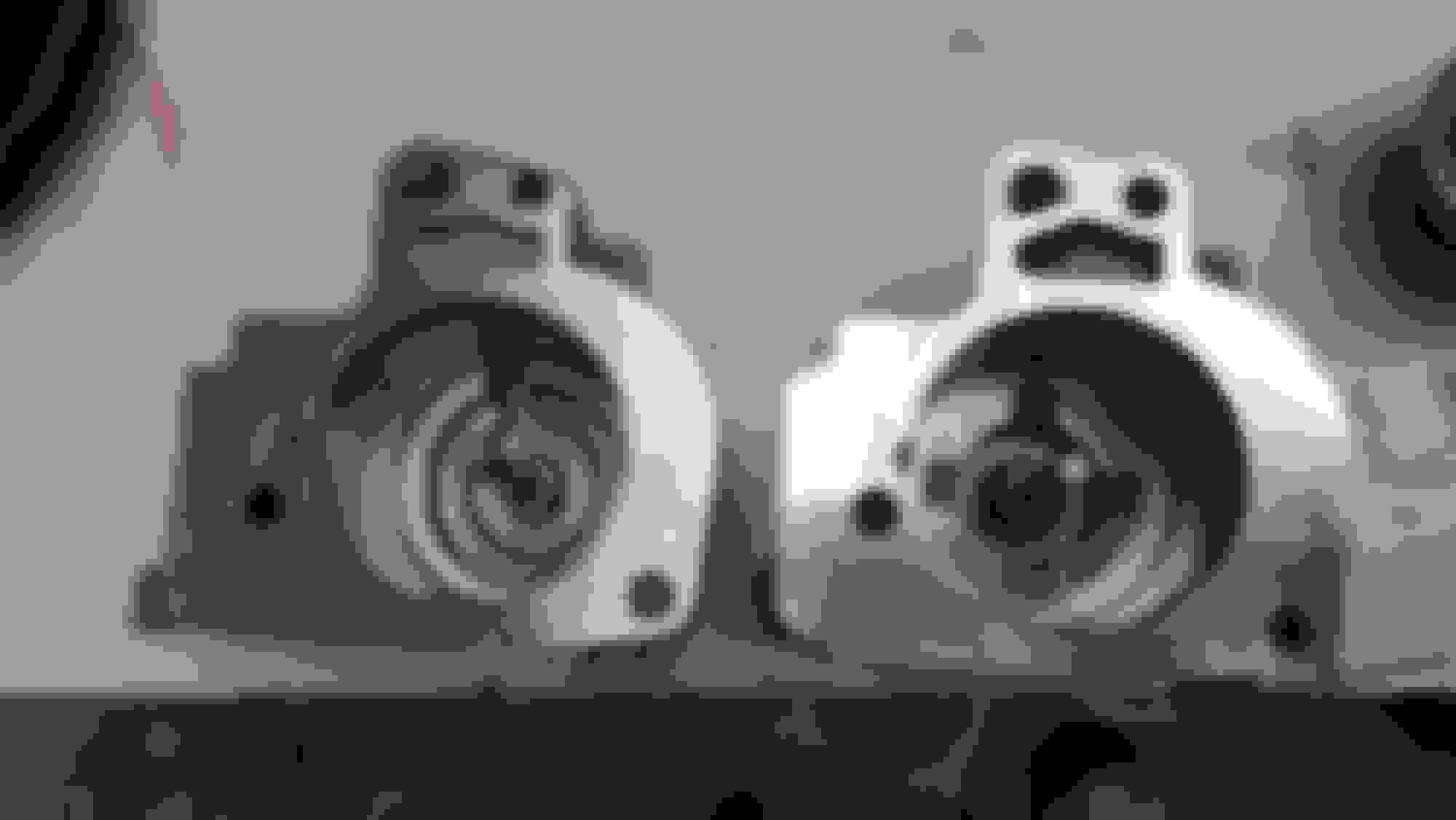
Just dropped pan on new car with 2001 4L60e trans as it shifts hard from 1-2, I found this set up in the 1-2 accumulator which I believe is the reason for hard shift, (already tested tps) can anyone tell me anything about brand/setup this is is as it shifts pretty hard and wouldnt mind adjusting with different springs, the housing is also a different shape on the inside from a spare stock one i have. Housing has WTDC 11 24219937 stamped on it. Big spring is also a bit deformed and doesnt sit square
pic parts in order of removal, standard housing is on the right
any information would be appreciated
Thanks
Hi
Just dropped pan on new car with 2001 4L60e trans as it shifts hard from 1-2, I found this set up in the 1-2 accumulator which I believe is the reason for hard shift, (already tested tps) can anyone tell me anything about brand/setup this is is as it shifts pretty hard and wouldnt mind adjusting with different springs, the housing is also a different shape on the inside from a spare stock one i have. Housing has WTDC 11 24219937 stamped on it. Big spring is also a bit deformed and doesnt sit square
pic parts in order of removal, standard housing is on the right
any information would be appreciated
Thanks
The left housing is the newer style (which should be in a 2001 trans). I'd put the springs in the housing, then the piston in with the dimples facing up. Maybe get a new spring since it's deformed and they do break. That looks like a superior products shift kit so there may be other things making it shift hard.
EDIT: accumulation comes from the piston moving into the housing. Example, no spring in the housing=no accumulation=hard shift. Theres not going to be much accumulation with that little stiff spring in there.
Also it's ideal for the legs on the piston to bottom out before any spring coil binds. Old set up's used to coil bind the springs and break them. The stock set up with that housing (both actually) had a short stiff spring to cushion it before the piston bottoms out, the large diameter spring would be mainly for accumulation. Those springs are definitely not stock, but they may be close enough, when arranged like stock, to shift softer.
Last edited by Jays_SSZ28; Sep 9, 2018 at 12:20 PM.
looks like TG to me ( spring beneath and above the piston ).....i have been wrong before....but does not look stock
It's not stock and not transgo. Transgo uses big springs on both sides and they're always orange and blue for the hd-2 kit. For the SK kit it's the same orange spring with a white one that fits tight in the ID of that orange spring and no blue spring.
I suggested to the OP here to put both springs inside, then the piston with the bumps out, legs inside. This is the stock set up with different springs, assuming the op has no stock springs laying around.
I used Superior Products kits in th350's back then, these remind me of that brand. But it could be anything, it could be someones mismatch of a homemade shift kit.
Thanks I put it back together with standard springs in standard order but used alloy piston instead of standard one and it now shifts much better.
wanted to ease up on the shifts as sounds like trans is rumbling and fluid was brown and smelt burnt
engine has a kelford cams B-12 with standard stall too. Will be looking at higher stall as it pushes abit on standard one and will idle along in D at 35mph.
Thanks for the help
The left housing is the newer style (which should be in a 2001 trans). I'd put the springs in the housing, then the piston in with the dimples facing up. Maybe get a new spring since it's deformed and they do break. That looks like a superior products shift kit so there may be other things making it shift hard.
EDIT: accumulation comes from the piston moving into the housing. Example, no spring in the housing=no accumulation=hard shift. Theres not going to be much accumulation with that little stiff spring in there.
Also it's ideal for the legs on the piston to bottom out before any spring coil binds. Old set up's used to coil bind the springs and break them. The stock set up with that housing (both actually) had a short stiff spring to cushion it before the piston bottoms out, the large diameter spring would be mainly for accumulation. Those springs are definitely not stock, but they may be close enough, when arranged like stock, to shift softer.
This is wrong. 2nd feed is applied to the back side of the piston, forcing it towards the separator plate.
This is wrong. 2nd feed is applied to the back side of the piston, forcing it towards the separator plate.
Accumulation is the compression of the springs. Thats how putting the right springs in helped the op's shifts get softer.
Also strange how you block the movement of the springs with spacers the shift gets hard/firm.
Accumulation is more than just the compression against the spring (the spring does matter...but there is more to it). It's also fluid volume. You have to fill that entire cavity with fluid at the same time you're trying to fill the volume beneath the apply piston (or servo). So if you use a soft spring but limit the piston travel by half, you're going to have a more firm shift also. It's a two fold equation.
Accumulation is more than just the compression against the spring (the spring does matter...but there is more to it). It's also fluid volume. You have to fill that entire cavity with fluid at the same time you're trying to fill the volume beneath the apply piston (or servo). So if you use a soft spring but limit the piston travel by half, you're going to have a more firm shift also. It's a two fold equation.
It was a generalization.
When you see an accumulator you know the dampening effect happens based on what happens on the spring side.
Someone said it's wrong.
So what do you say?
What causes a hard or soft shift, what happens between the piston and housing or what happens between the piston and plate?
And this is about accumulators, the 1-2 to be specific. Lets please not get into feed hole sizes, servo sizes, etc, etc.
Well, lets actually discuss the function a little more just for fun. Maybe I'll learn something today. This is from the hydramatic guide:
"Upshift Control
During a 1-2 upshift (as shown in Example), 2nd clutch fluid is
routed to both the servo assembly and the 1-2 accumulator
assembly. The rapid buildup of fluid pressure in the 2nd clutch
fluid circuit strokes the accumulator piston against spring force and accumulator fluid pressure. This action absorbs some of the
initial buildup of 2nd clutch fluid pressure and provides a time
delay to cushion the 2-4 band apply.
As 2nd clutch fluid pressure moves the accumulator piston,
some accumulator fluid is forced out of the 1-2 accumulator
assembly. This fluid pressure is routed back to the accumulator
valve. The increase in accumulator fluid pressure acting on the
end of the accumulator valve moves the valve against spring
force and torque signal fluid pressure. This blocks D4 fluid and
regulates the exhaust of the excess accumulator fluid pressure
past the accumulator valve and through an exhaust port. This
regulation provides additional control for the accumulation of
2nd clutch fluid and apply of the 2-4 band."
As I highlighted in red, it says that the 2nd clutch fluid strokes AGAINST spring force...but the diagram makes it appear as though with the stock setup 2nd clutch fluid is actually getting assisted by the spring to stroke against the accumulation fluid (in green).
So, if we were to just leave the setup as-is in stock form, but say swap the spring out for a stiffer spring, how will that affect shift quality? Nothing else changed, just a stiffer spring in the 1-2.
The slower the accumulator piston strokes or bottoms is the firmer the shift will be.
The faster it strokes the softer the shift will be.
So, for the 1-2 accumulator in a 4l60e, in the stock setup...your spring has pressure holding it compressed before the shift with accumulator oil and the spring tension is released during the shift.
So then a weaker spring will create a firmer shift and a heavier spring will create a softer shift if all else is equal.
For the 3-4 accumulator, where you have a spring that is extended before the shift and becomes compressed during a shift...then YES, a stiffer spring will indeed make for a firmer shift.
Is what I have above correct? Or do you disagree Jays?
FYI I know you are very knowledgeable and help here alot...so I'm not at all trying to start a pissing match. I'm just trying to get everybody involved for a civil discussion so we all can have some fun and learn from each other.
softer springs firmer shift ? the sonnax springs in their shift kit are hella stiff.....and the shift is a lot harsher ( firmer ) compared to stock.....I changed my springs to ones recommended by clinebarger ( lot softer ) and I really enjoy the shift quality MUCH better
I think a good discussion is the difference in stiffness between the outer and inner spring.....soft outer ...stiff inner.....or ???
wish I had a spring tester to find out the rate of these springs
my .02
Last edited by sjsingle1; Sep 19, 2018 at 11:51 AM.
Well the guy who said I was wrong has the answer.
I know what to do to get a shift to feel the way I want it to.
I am not a good teacher and can't explain things well enough for everyone to understand.
I will say that the hydramatic book does seem to contradict itself.
So is built408's statement correct or incorrect? In your opinion.
Originally Posted by built408
This is wrong. 2nd feed is applied to the back side of the piston, forcing it towards the separator plate.
If you are using the stock setup (springs in first) then the stiffer spring would make for a softer shift. When using the TransGo (over and under) setup, you can tailor the shift by addressing the accumulator valve in the valve body. This over and under setup can give you best of both worlds, IF you change the accumulator valve in the valve body itself. when using the TransGo Performance Shift kit. There are 4 different accumulator valves that have been common over the years.
"A" accumulator valve in 700R4's
"B" accumulator valve in 700R4's & early 4L60E's
"C" & "CX" accumulator valve in 4L60E's in the late 1990's
"D" & "DX" accumulator valve in 4L60E's late 1990's through 2005???
When using the TransGo over & under setup I have found the "A" and "B" to be the best using the white accumulator spring. With the factory spring setup, I have found that "C" best and "CX" second best. Second gear feed hole size is dependent on diameter and stall of the torque converter. This is using the Corvette servo or the Sonnax 2nd apply servo. Working the accumulator valve can make a real difference in part throttle shifts. WOT shifts are barely affected by the accumulator valve, more to do with the second gear feed hole size. Ideally you want a smooth fairly quick part throttle shift and the shift getting quicker with more throttle. Playing with the computer to firm up shifts, affects part to medium throttle only (I advise against it) and nothing for WOT. You can use the 700R4 "A" or "B" accumulator valve in the 4L60E, just open up pin hole size. I hope this helps you some.
Maybe the guy saying I was wrong didn't understand something. Maybe I explained it wrong.
This I know:
Way back whenever, I made the first dumb mistake with a transmission. During a filter change I took the 1-2 accumulator housing off and replaced the springs with a few 3/8 nuts. This replicates a very very stiff incompressible spring.
The 1-2 shift was brutal. It's the only thing I did. The piston could move up towards the plate just as before. So why was the shift so brutal if accumulation comes from the piston moving up?
I obviously put the stock springs back in and from that point on learned that a stiff spring makes for a hard shift.
That does seem correct. Looks right on the hydramatic book as well. 2nd gear fluid acts on the "back" side of the piston and moves it towards the separator plate. First pic shows that 2nd gear feed oil goes through the accumulator housing and puts pressure on the piston to force it towards the separator plate.
BUT this is where some of the confusion lies...because this is not ALWAYS the setup when it comes to the spring.
You can find all kinds of info out there on how to set up the accumulator...and it was setup multiple different ways from the factory. Below are some pictures that just go to show the differences.
Some show the spring behind the piston...some show it in front of the piston.
For setups where the spring starts compressed and then is de-compressed during a shift...a lighter spring will make for a firmer shift.
For setups where the spring starts extended then is compressed during the shift...a stiffer spring will make for a firmer shift.
How's that for introducing some confusion eh!!!
p.s.I also don't leave the stock setup in there and I know exactly how to make it shift the way I want haha.
If you are using the stock setup (springs in first) then the stiffer spring would make for a softer shift. When using the TransGo (over and under) setup, you can tailor the shift by addressing the accumulator valve in the valve body. This over and under setup can give you best of both worlds, IF you change the accumulator valve in the valve body itself. when using the TransGo Performance Shift kit. There are 4 different accumulator valves that have been common over the years.
"A" accumulator valve in 700R4's
"B" accumulator valve in 700R4's & early 4L60E's
"C" & "CX" accumulator valve in 4L60E's in the late 1990's
"D" & "DX" accumulator valve in 4L60E's late 1990's through 2005???
When using the TransGo over & under setup I have found the "A" and "B" to be the best using the white accumulator spring. With the factory spring setup, I have found that "C" best and "CX" second best. Second gear feed hole size is dependent on diameter and stall of the torque converter. This is using the Corvette servo or the Sonnax 2nd apply servo. Working the accumulator valve can make a real difference in part throttle shifts. WOT shifts are barely affected by the accumulator valve, more to do with the second gear feed hole size. Ideally you want a smooth fairly quick part throttle shift and the shift getting quicker with more throttle. Playing with the computer to firm up shifts, affects part to medium throttle only (I advise against it) and nothing for WOT. You can use the 700R4 "A" or "B" accumulator valve in the 4L60E, just open up pin hole size. I hope this helps you some.
Kind of getting way off track now.
So why when someone uses spacers under the piston, like a B&M kit, does it make the 1-2 shift way too hard?
Gas Monkey Built a 6-Wheel Ferrari Testarossa With a Corvette LT4 Engine
Slideshow: The controversial Ferrari F6 swaps its original flat-12 for a Corvette Z06-derived LT4 V8 and sends power to four rear wheels through a custom-built drivetrain.
7 Most Reliable High-Performance Engines GM Has Ever Built
Slideshow:These GM engines didn't just make huge power, they survived abuse, boost, track days, and six-digit mileage with a reputation for refusing to quit.
6 Common C5 Corvette Failures and What's Involved In Repairing Them
Slideshow: From wobbling harmonic balancers to failed EBCMs, these are the issues that define long-term C5 ownership and what repairs typically involve.
Retro Modern Bandit Pontiac Trans AM Comes With Burt Reynolds' Autograph
Slideshow: A modern Camaro transformed into a retro icon, this limited-run "Bandit" build blends nostalgia with brute force in a way few revivals manage.
Top 10 Greatest Cadillac V Series Performance Models Ever, Ranked
Slideshow: Cadillac didn't just crash the high-performance luxury vehicle party, it showed up loud, supercharged, and occasionally a little unhinged...










 1-2 accumulator ID