When you click on links to various merchants on this site and make a purchase, this can result in this site earning a commission. Affiliate programs and affiliations include, but are not limited to, the eBay Partner Network.
Is my radiator causing my overheating? Regarding the rows in the radiator
When I bought my 1970 Chevelle, it came with a (I think) 4 row radiator (I will confirm when I get home).
With 187 thermostat (or whatever stock is), I always seem to slowly creep up to 210 degrees, then all of a sudden it just starts climbing and climbing. I always turn the car off when I get to 230 degrees. I have two high power fans on the radiator, but even with that, it does this over heating trend when when cruising on the highway. I swapped in a 160 thermostat, it stays at around 190, but then slowly creeps up to 230degrees.
I've bought a radiator funnel, and have made the all of the bubbles are you of the system with the heater blasting.
It only does this in the dead of the summer (Houston, 100 degree +), it never overheats in the winter. I also notice that if I turn the heater on, the temperature starts to drop
I just read that a 4 row (or 3 row) aluminum radiator is actually very inefficient at cooling, due to the tubes being very small. Could this be my issue? My friend has the same car (Chevelle) with an LS2. He has a 2 row radiator, with 1" tubes, and with his 160 thermostat, the car rarely breaks 190 in the same heat.
I run a 16" x 24" aluminum with 2 1" rows of tubes/fins. So far mine stays either right at the normal head temp (196F with a 187F t'stat on the inlet side) or right at the fan control temp (203F) if I'm not going fast enough to move enough air to cool it without the fans. Even in 90+ temps with A/C on - the temp never moves beyond as described above.
A bit on multi-tube radiators --- some folks used to think that if they went from a 2 row to a 3 row -- that they'd pick up 50% more cooling capability; if they went to a 4 row - 100% more than the 2 row. Doesn't work that way -- as the air moves across the first row, it picks up heat. Since the air is hotter when it hits the 2nd row, it can't remove as much heat from the 2nd row because the delta-T is now smaller. Same thing for the 3rd row and the 4th row - each one becomes a good bit less effective at removing heat from the motor. The rule of thumb I've used is moving from a 2 row to a 3 row adds about 25% more heat rejection ability; adding a 4th row only adds about 10% more. So the same size (L x W) 4 row (same size tubes) will remove more heat than a 2 row -- but not as much more as one might think. This contrasts with staying with a 2 row, but altering the L x W of the core. If you want 50% more cooling capability - here's an example. A 20" x 20" unit has 400 sq. inches -- go to 600 sq. inches (20 x 30) with the same number of rows and you'll get your 50% increase in heat rejection capacity. If, in fact, your 4 tube has smaller tubes in it than the same size 2 tube, that has an impact too. But I'm having a hard time believing that a clean/unclogged 4 row aluminum in a L x W size that's appropriate for your car won't keep it cool. Usually it's either a problem with the radiator (internal deposits interfering with heat transfer) or a fan problem (not moving enough air).
Will the car stay cool at idle with the a/c on? If the car stays cool standing still then the fans are sufficient. Cruising down the road the fans rarely run because you should have enough airflow passing through the radiator to not need them. Is your radiator shrouded and does it have flaps for air to blow through?
You need to get more airflow through the radiator when moving.
Like someone said when moving you shouldn't need the fans.
Make sure the air goes through and not around the radiator. Nothing blocking the inlet and no big gaps on the sides or top of the radiator for air to flow around. Make sure the fan shrouds are not blocking natural airflow. Many have flaps on large flat parts.
Make sure the air can get out of the engine bay. Shouldn't be an issue with a Chevelle I would think.
On some cars an airdam or "chin pan" on the frame right behind the radiator can prevent turbulence and smooth out the airflow through the radiator.
Also rev the engine and make sure the lower radiator hose isn't collapsing. there should be a spring in there to prevent the water pump suction from closing off the hose
64SS' post reminded me to go back and re-read the OP's initial post. This is happening on the highway and not at low speed?
If so, I agree with 64SS - likely not a fan issue. Could be a fouled radiator -- engine output/thermal load greater at highway speed than in traffic. But it could also be that you need to create a bit of low pressure behind/below the radiator in order to entice air to flow across the rad at speed. Most newer cars (say, last 30-35 years) have some sort of air dam or "splash shield" that blocks off air flow below the radiator. The creates an area of low pressure behind and below the radiator. That makes it easy for air to move through the rad at speed and exit under the bottom of the car. The old fox body Mustangs had a little black plastic 'air dam' that lived a good 2' back of the nose of the car right under the radiator. Those would occasionally get knocked off on a curb or folks would remove them -- and then the cars often tended to run hot on the highway. Put the 'dam' back on -- voila, no more overheating on the highway.
So I just got home and looked into the radiator after I drained some fluid out. .Doesn't look as good as I thought it was, as far as cleanliness. IDK how old the radiator is or where it came from. Has to be older than 5 years though, and was sitting in the previous owners garage without fluid in it for a while. I attached some pictures at the end of the post
Originally Posted by Michael Yount
^^^^How old is the radiator? What brand of fans?
I run a 16" x 24" aluminum with 2 1" rows of tubes/fins. So far mine stays either right at the normal head temp (196F with a 187F t'stat on the inlet side) or right at the fan control temp (203F) if I'm not going fast enough to move enough air to cool it without the fans. Even in 90+ temps with A/C on - the temp never moves beyond as described above.
A bit on multi-tube radiators --- some folks used to think that if they went from a 2 row to a 3 row -- that they'd pick up 50% more cooling capability; if they went to a 4 row - 100% more than the 2 row. Doesn't work that way -- as the air moves across the first row, it picks up heat. Since the air is hotter when it hits the 2nd row, it can't remove as much heat from the 2nd row because the delta-T is now smaller. Same thing for the 3rd row and the 4th row - each one becomes a good bit less effective at removing heat from the motor. The rule of thumb I've used is moving from a 2 row to a 3 row adds about 25% more heat rejection ability; adding a 4th row only adds about 10% more. So the same size (L x W) 4 row (same size tubes) will remove more heat than a 2 row -- but not as much more as one might think. This contrasts with staying with a 2 row, but altering the L x W of the core. If you want 50% more cooling capability - here's an example. A 20" x 20" unit has 400 sq. inches -- go to 600 sq. inches (20 x 30) with the same number of rows and you'll get your 50% increase in heat rejection capacity. If, in fact, your 4 tube has smaller tubes in it than the same size 2 tube, that has an impact too. But I'm having a hard time believing that a clean/unclogged 4 row aluminum in a L x W size that's appropriate for your car won't keep it cool. Usually it's either a problem with the radiator (internal deposits interfering with heat transfer) or a fan problem (not moving enough air).
The fans came with the radiator, so idk what brand they are. They pull a lot of air though. The issue happens even on the highway, going 60mph or 70mph or any speed really. The overheating will slow down once I get on the highway, but it will continue to climb.
I've been reading up on how aluminum radiators are not efficient above 2 rows, and that 3 rows + are just a gimmick to sell, because the math doesn't add up as far as cooling area when considering the surface area and also the resistance a 4/3 row creates with wind resistance (as this article stated)
Originally Posted by 1964SS
Will the car stay cool at idle with the a/c on? If the car stays cool standing still then the fans are sufficient. Cruising down the road the fans rarely run because you should have enough airflow passing through the radiator to not need them. Is your radiator shrouded and does it have flaps for air to blow through?
The car won't stay cool with the ac on at idle, it slowly creeps up. If I turn the heater on, it will slowly climb down. The radiator is not shrouded, so at highway speeds I shouldn't have an issue cooling, but I am. If I have the AC on and am on the highway, the temps climbs even faster
Originally Posted by Pop N Wood
You need to get more airflow through the radiator when moving.
Like someone said when moving you shouldn't need the fans.
Make sure the air goes through and not around the radiator. Nothing blocking the inlet and no big gaps on the sides or top of the radiator for air to flow around. Make sure the fan shrouds are not blocking natural airflow. Many have flaps on large flat parts.
Make sure the air can get out of the engine bay. Shouldn't be an issue with a Chevelle I would think.
On some cars an airdam or "chin pan" on the frame right behind the radiator can prevent turbulence and smooth out the airflow through the radiator.
Also rev the engine and make sure the lower radiator hose isn't collapsing. there should be a spring in there to prevent the water pump suction from closing off the hose
It happens on the highway, but I will check to make sure the radiator hose isn't collapsing. No fan shroud to block airflow either
Originally Posted by Michael Yount
64SS' post reminded me to go back and re-read the OP's initial post. This is happening on the highway and not at low speed?
If so, I agree with 64SS - likely not a fan issue. Could be a fouled radiator -- engine output/thermal load greater at highway speed than in traffic. But it could also be that you need to create a bit of low pressure behind/below the radiator in order to entice air to flow across the rad at speed. Most newer cars (say, last 30-35 years) have some sort of air dam or "splash shield" that blocks off air flow below the radiator. The creates an area of low pressure behind and below the radiator. That makes it easy for air to move through the rad at speed and exit under the bottom of the car. The old fox body Mustangs had a little black plastic 'air dam' that lived a good 2' back of the nose of the car right under the radiator. Those would occasionally get knocked off on a curb or folks would remove them -- and then the cars often tended to run hot on the highway. Put the 'dam' back on -- voila, no more overheating on the highway.
It's another thought...
It's happening at highway speeds and at idle. It's like it can handle cooling it until I guess the under hood temps start to rise, then the temp just slow rises and rises and rises. I'm going to compared my Chevelle to my friends to see if I am missing any air dams or something similar around the radiator
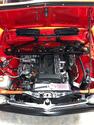
Here are the pics of the inside of the radiator, not super clean. Not sure if this is my problem or not. Fluid is super clean and green, I don't know what all that residue is from. Previous owner did say he threw a rod through the oil pan with that radiator on the car, seems like the radiator would be way dirtier if that got oil in the coolant (maybe I'm wrong). It is a 3 row radiator btw
How big is the radiator L x W? What BRAND of fans? No-name speed shop specials are notorious for folks thinking they're moving a lot of air when they're not. Shroud actually helps a lot at low speeds as it assures that air gets pulled across the entire radiator. Of course, flaps in the shroud help allow flow through at speed.
Usually when the overheating is occurring everywhere/all the time -- it's usually the radiator that is the culprit. Either fouled, dirty or simply not enough capacity.
How big is the radiator L x W? What BRAND of fans? No-name speed shop specials are notorious for folks thinking they're moving a lot of air when they're not. Shroud actually helps a lot at low speeds as it assures that air gets pulled across the entire radiator. Of course, flaps in the shroud help allow flow through at speed.
Usually when the overheating is occurring everywhere/all the time -- it's usually the radiator that is the culprit. Either fouled, dirty or simply not enough capacity.
It's a 33" x 19" radiator. The fans don't have a brand on them, I'm guessing just generic Jegs or Summit Racing fans. Only issue I see that it's not the fans (at this point) is that it still over heats at highways speeds
On my friends car, when he would rev it with the radiator cap off, the coolant would rush violently through the radiator. On mine, it sort of trickles out, but with a little more force than a trickle
I wouldn't order a new one --- without at least trying to clean the old one. Cap off the openings and get some CLR in that thing; rinse, repeat. See what you can get out of it. Hell, we may be missing something.
Wouldn't I see much more major problems if I did that?
I did install new head gaskets btw, so now you got me scared lol I followed the directions extremely close installing them though
Edit: I ran LS3 cometic head gaskets, I just read that it doesn't matter which way those are installed (hopefully whoever said that is right?)
Edit #2: I just checked to make sure the head gasket tab is near the front of the engine, and not the back - I was only able to see the driver's side, and it was on the front. On the passenger's side, I couldn't see a tab on the back and my turbo is blocking me from seeing it on the front, but I'm sure it is on the front
6 Common C5 Corvette Failures and What's Involved In Repairing Them
Slideshow: From wobbling harmonic balancers to failed EBCMs, these are the issues that define long-term C5 ownership and what repairs typically involve.
Retro Modern Bandit Pontiac Trans AM Comes With Burt Reynolds' Autograph
Slideshow: A modern Camaro transformed into a retro icon, this limited-run "Bandit" build blends nostalgia with brute force in a way few revivals manage.
Top 10 Greatest Cadillac V Series Performance Models Ever, Ranked
Slideshow: Cadillac didn't just crash the high-performance luxury vehicle party, it showed up loud, supercharged, and occasionally a little unhinged...
Coachbuilt N2A Anteros Is an LS2-Powered C6 Corvette In Italian Clothes
Slideshow: A one-off sports car that looks like a vintage Italian exotic-but hides a C6 Corvette underneath-just sold for the price of a new mid-engine Corvette.








 Is my radiator causing my overheating? Regarding the rows in the radiator