When you click on links to various merchants on this site and make a purchase, this can result in this site earning a commission. Affiliate programs and affiliations include, but are not limited to, the eBay Partner Network.
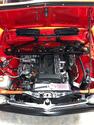
5.3 Gen 3 swapped 240sx. Trying to set up a charcoal canister, tired of smelling like gas... I don't have the one from my LS motor (no hood clearance anyway), but do have the one from the Nissan. It is vacuum powered, and I'm not 100% sure how it works, but think I understand. It has a "Dist vc", "tank" and "purge" line (pics attached). I'm assuming that dist vc is distributor advance vacuum, or pre-throttle body vacuum, only vacuum when the throttle is opened up. So the valve on it only allows the canister to purge with the throttle open, but then probably closes back up at WOT when there isn't much vacuum. My plan was to put a little intake "nipple" or bulkhead type fitting on the plastic end of my cone filter, before the MAF and tee into both the purge and dist vc. Then include a small inline fuel filter on the purge line since the air will not go through the primary engine air filter. This would allow the air coming in this way to be filtered and metered, and allow the original Nissan charcoal canister to work basically as intended. Am I understanding how this works correctly? Would a little fuel filter like that do a good enough job filtering the air? If so, this may also be useful for anyone with an older LS swapped vehicle.
Charcoal canister:
Intake Nipple
Air filter:
I have same car and engine, and looking to do something like this myself pretty soon.
Although I have no fuel smell. I run exhaust to the rear bumper and can't smell a thing with windows down.
If I open the cutout thats another story though.
In for results... lthough I am curious where your fuel smell is coming from.
I've done 40+ swaps in 240sx with various engines and never smell fuel from the original charcoal 3/8" line that comes to the front of the car.
I'm pretty sure it runs through some kind of plastic box in the rear bumper area (on an S14) that also has some kind of valve inside it.
never really cared much but, I am interested in 'controlling' the vacuum status of the fuel tank in order to protect high ethanol content fuel in the tank from the atmosphere.
I have same car and engine, and looking to do something like this myself pretty soon.
Although I have no fuel smell. I run exhaust to the rear bumper and can't smell a thing with windows down.
If I open the cutout thats another story though.
In for results... lthough I am curious where your fuel smell is coming from.
I've done 40+ swaps in 240sx with various engines and never smell fuel from the original charcoal 3/8" line that comes to the front of the car.
I'm pretty sure it runs through some kind of plastic box in the rear bumper area (on an S14) that also has some kind of valve inside it.
never really cared much but, I am interested in 'controlling' the vacuum status of the fuel tank in order to protect high ethanol content fuel in the tank from the atmosphere.
Edit: did you see
has some good diagrams,
carry on and good luck
Fuel from the cut outs would suggest a fuel rich tune. Mine is basically only right after fill ups, so definitely coming from the tank. After its had a few days to sit, it isn't too bad, but if I pull in the garage shortly after a fill up it has a slight odor.
As for that link, good diagram of the fuel lines getting to the front, but the post is full of misinformation (like most things on Zilvia). The implosion/explosion thing is 100% false. The check valve he is referring to is a check valve that prevents fuel leakage in a rollover, and the fuel cap does not allow implosion. It lets fresh air in if suction occurs. I tested it by taking the cap and pulling a vacuum on it... it will release with any negative pressure. I did not want to have issues with my fuel tank caving in.
Most contemporary efi engines have an ecu operated "purge" valve. It would connect to the "purge" connection on the canister. This purge valve allows the ecu to determine when the vent line from the tank can be connected to the intake manifold allowing flow into the manifold. Most turn off this function in the computer when they're clearing VATS and removing the rear O2 sensor function. PSI conversions turned it off on mine and I removed/capped the purge line connection at the intake. The reason for disabling this is that most systems also have/need a pressure/vacuum sensor in the tank to tell the ecu what's going on with that. My older Volvo didn't have such a sensor and I didn't want to try and retrofit that set up from some other vehicle.
As others have alluded to, be sure that the fuel tank can vent positive pressure and let air in to prevent vacuum from collapsing the tank. I experimented with my vacuum canister to determine how flow moves through it. Vent side connected to the fuel tank. Purge/vacuum side connected to the air inlet pipe upstream of the maf sensor --- your filter connection would be a suitable point as well. I have never had any fuel smell at all related to this system-- car has been V8 converted with this canister since 1996.
I have had fuel smell at one point. I converted the fuel lines in the car using 300 psig fiber braided high temp fuel line - Series 8000 Fragola. Turns out it was not rated SAE30R10 (or newer SAE30R14 rating) for low permeability. The smaller/lighter molecules of fuel were passing in vapor form right through the fuel line. No liquid leak at all - but TERRIBLE fuel smell all the time. Didn't stop til I replaced it all with hard line and the proper rated flexible connections. So it could be that your fuel smell isn't related to tank venting at all.
The issue I am struggling with is, if you simply vent a fuel tank (or any container) and fill it with E85,
Alcohol will quickly absorb water from the atmospheric air and turn to useless ****
So how does one "vent" a fuel tank without allowing it to constantly exchange air with the atmosphere?
I assume a check valve is used. That said, a factory 20-25 year old check valve in an OEM application seems insufficient? Or at least needs to be tested somehow,
as important as it seems to NOT have a fuel tank (explode/implode) due to a "clogged" checkvalve orifice, and as high of a flow rate of E85 (leaving the tank at 1000hp for example) is, I somehow find it difficult to believe that the OEM 25 year old hardware is 100% up to the challenge of both sealing a tank full of E85 and allowing to flow/work at max capacity without fault...
I mean, if someone came to the forum and said "how do i fix my engine"
and we said "follow the service manual"
Doesn't that mitigate any benefit of having an internet forum?
In other words I came here because I know I want to duplicate the GM flex fuel system already, that was pretty clear from the start, obviously. since it works.
but telling me to duplicate the GM flex fuel system after I came to the forum asking how do duplicate the GM flex fuel system (without knowing what a gm flex fuel system is) ... can't you see where I am going with this...
Most contemporary efi engines have an ecu operated "purge" valve. It would connect to the "purge" connection on the canister. This purge valve allows the ecu to determine when the vent line from the tank can be connected to the intake manifold allowing flow into the manifold. Most turn off this function in the computer when they're clearing VATS and removing the rear O2 sensor function. PSI conversions turned it off on mine and I removed/capped the purge line connection at the intake. The reason for disabling this is that most systems also have/need a pressure/vacuum sensor in the tank to tell the ecu what's going on with that. My older Volvo didn't have such a sensor and I didn't want to try and retrofit that set up from some other vehicle.
As others have alluded to, be sure that the fuel tank can vent positive pressure and let air in to prevent vacuum from collapsing the tank. I experimented with my vacuum canister to determine how flow moves through it. Vent side connected to the fuel tank. Purge/vacuum side connected to the air inlet pipe upstream of the maf sensor --- your filter connection would be a suitable point as well. I have never had any fuel smell at all related to this system-- car has been V8 converted with this canister since 1996.
I have had fuel smell at one point. I converted the fuel lines in the car using 300 psig fiber braided high temp fuel line - Series 8000 Fragola. Turns out it was not rated SAE30R10 (or newer SAE30R14 rating) for low permeability. The smaller/lighter molecules of fuel were passing in vapor form right through the fuel line. No liquid leak at all - but TERRIBLE fuel smell all the time. Didn't stop til I replaced it all with hard line and the proper rated flexible connections. So it could be that your fuel smell isn't related to tank venting at all.
Thanks! Did you put any kind of filter on your purge line or just run it to your intake?
Upon further investigation, my hose is the R9 spec, which doesn't have the low permeation requirements. If my charcoal canister doesn't work to reduce smell, I'll look into this. I assumed it was due to removing the canister, since the car had no smell when it was a 4 cylinder and had the canister in place.
Upon further investigation, my hose is the R9 spec, which doesn't have the low permeation requirements. If my charcoal canister doesn't work to reduce smell, I'll look into this. I assumed it was due to removing the canister, since the car had no smell when it was a 4 cylinder and had the canister in place.
When it was an oem injected 4 cylinder it also had an ecu controlled purge valve in place. The hoses I was referring to were primarily the liquid fuel hoses. You won’t get much permeation through the tank vent hose.
6 Common C5 Corvette Failures and What's Involved In Repairing Them
Slideshow: From wobbling harmonic balancers to failed EBCMs, these are the issues that define long-term C5 ownership and what repairs typically involve.
Retro Modern Bandit Pontiac Trans AM Comes With Burt Reynolds' Autograph
Slideshow: A modern Camaro transformed into a retro icon, this limited-run "Bandit" build blends nostalgia with brute force in a way few revivals manage.
Top 10 Greatest Cadillac V Series Performance Models Ever, Ranked
Slideshow: Cadillac didn't just crash the high-performance luxury vehicle party, it showed up loud, supercharged, and occasionally a little unhinged...
Coachbuilt N2A Anteros Is an LS2-Powered C6 Corvette In Italian Clothes
Slideshow: A one-off sports car that looks like a vintage Italian exotic-but hides a C6 Corvette underneath-just sold for the price of a new mid-engine Corvette.









 Mechanical Charcoal canister










