When you click on links to various merchants on this site and make a purchase, this can result in this site earning a commission. Affiliate programs and affiliations include, but are not limited to, the eBay Partner Network.
Andrew your video is very interesting... but I think I'm going to leave me setup as-is for both fuel delivery and fan control. I have a Ron Francis mini-harness with a 70A relay and 60A fuse that has worked well for the previous dual 13" fans, so I'll try it out on my 12"+16" setup as well, just because it's there, routed, and proven thusfar.
For fuel delivery, I eventually want to redo my fuel system to some degree... at the very least move the electrical stuff inside the trunk for ease of servicing.
I currently have:
- dual TRE 300lph high pressure pumps running at the same time in the tank
- single 60A solenoid under the trunk floor, powering the pumps by a 4-pin Deutsche connector
- supply wire to solenoid from the battery has a fuse next to the battery
I want to change to:
- single transfer "pump 1a" running full time in the tank
- secondary back-up "pump 1b" as a reserve in the tank, not running
- both 1a and 1b have individual wiring run to separate connectors inside a "control box" in the trunk, such that if I have a failure of transfer pump 1a while on the road, I simply disconnect the power connector from pump 1a to pump 1b in the trunk
- have a single high-pressure "pump 2a" in a swirl pot in the trunk
- have a secondary high-pressure "pump 2b" in the swirl pot activated by the boost-referenced output I just wired from the Holley ECU (currently set to activate at 4psi boost)
- have all fuses, connectors, and solenoids for various pumps located in one box next to the battery in the trunk, so that the only mechanical failure that would leave me stranded would be a wire that physically rubbed thru (but I would take precautions to prevent that)
Great job tucking the Tilton pump under the transmission. That sits very neatly. Sorry I am not terribly familiar with these pump setups - could you explain why you are restricting flow with the orifice fitting?
I recently responded to a thread on dual pass radiators and for some reason didn't notice until now that you went that route. I don't have practical experience, but the basic problem I would anticipate is greater flow restriction due to forcing the coolant at twice the velocity through through half the cross section twice the distance. Given the water pump is centrifugal, I suspect the flow rate will be reduced, but by how much I'm not sure. This blog estimates 33% flow reduction. I know you are thinking about air flow, but I wonder if you might also want to look at the coolant side of the system too.
Good points Clint.. my general thinking is that previously I had a 16" tall single pass radiator that was single-row of 1" tubes, now I'm using a 19" tall dual pass radiator (so 8.5" entry/exit flow height on the passenger side end tank) but the radiator has dual 1.25" rows... so I think the coolant velocity shouldn't change all that much since the cross-sectional area is approx the same, in fact the area is a little bit larger and likely a bit slower. However you're right, with doubling the flow path length it'll require more work to push the fluid thru both passes... so maybe I'll end up breaking even.... at this point there isn't too much I can do about it...
I hadn't really thought about the additional row or increase in size. That should keep the velocities closer to or maybe lower than before. The coolant will still have to go double the distance which will likely result in decreased flow, but the extra row is giving double the exposure plus the added area for air flow is up a lot. Hopefully the overall balance is an improvement in cooling. It might have been better in a single pass arrangement but as you said the bridge has already been crossed.
Why the restriction on the transmission pump? Is there something wrong with added flow?
The restriction on the trans pump is just to get some type of regulation on the ATF flow. I've tried to do a lot of reading and it's f***ing impossible to find any meaningful info from the very few trans pump setups out there on forums. One guy was using a Paxton supercharger oil squirter, and after some reading it appears those have a 0.070" restriction, my guess is to try to spray/mist the oil a bit better under higher engine oil pressure levels. The gears don't need to be absolutely doused in oil I don't think, just need a cooling/lubricating spray.. so my thought is if I can slow the flow rate down even a bit, that will help with not drain the back of the case as quickly under only moderate acceleration. Again there is hardly any relevant/helpful detailed info on this stuff other that "I put a trans pump in, it works good now lol"... so I'm just applying some engineering thought process and a bit of guesswork to it.
I can feel your frustration trying to find info on how these things are supposed to work. Being an engineer is a damn curse - you start knowing just enough about things to ask questions a lot people don't ask or think about. It seems to me if this pump is running at constant speed all the time, it ought to drain and refill the case on a continuous basis so I don't know if a high flow rate is really a bad thing. I would only be concerned if it starts aerating the oil or if you are pressuring seals, which it sounds like you're not. Having a sprayer nozzle that directs flow to where it's needed is clearly a need - how do you know your nozzle is directed at the critical areas and delivering a good spray pattern? Some guesswork I suppose?
I envy you for having all this build and fabrication work behind and ahead of you. It's great experience and very rewarding to learn skills and show off the stuff you've built. I really wish I had the time to work on a similar level. I will just have to be satisfied with driving mine for now - it doesn't suck either, it's just a different kind of experience.
Not sure if you have an output trigger wire for this, but if the oiling deficiency is only under hard acceleration, could you just turn the pump on at WOT? This may save pump life and have one less thing making noise outside your window.
You're going to make me buy a TIG welder with all of these updates. I've been wanting to get one to try my hand with welding aluminum. That intercooler looks so badass.
People have done this using a solid state relay instead of a regular relay.
The Dominator ECU can be configured to output either a PWM+ or PWM- signal and that signal can be configured how you see fit (the possibilities are limited by your imagination). However, what is more important is "the box in the middle" between the Dominator and the electric motor. For fan control various people have figured out that using a C6 Corvette (Ford Fusion uses same unit) fan controller works very well. It is designed to handle up to about a 32 amp load at max output (the C6 fan is rated for 400watts...do the math). The problem with using the C6 fan controller for fuel is that the controller is very slow to react. If you watch my video, you will see that once a certain duty cycle for the fan is commanded, it takes about 5 seconds for the fan to adjust to that speed. This would be unacceptable for fuel delivery, since it must react very quickly to changing fuel demand conditions. So far the solution has been to use the solid state relay.
Holley does make some fuel pump controllers for their line of brushless fuel pumps, but those are not universal, and as of now the firmware only supports 100% duty cycle or 50%. This is good for drag cars, but not optimal for street.
VaperWerks has PWM fuel pump control, but it is a stand alone system that incorporates its own MAP sensor and has the "logic" built into the controller. What would be awesome is if VaperWerks made a box that handled the motor control and simply had a PWM input. This way a Holley EFI user can program the speed of the fuel pump to meet their demands.
Andrew
Andrew,
We can do a PWM input. However, if I'm understanding your intent above, "programming" the fuel pump speed in a way to produce a fuel pump output vs. PWM signal output won't work for a true returnless setup. No two pumps are the same, nor are the line sizes/restrictions, system voltages, etc. That is why the other PWM controller out there require an external regulator. In this method the return regulator is still returning fuel, just not as much. True returnless needs a liquid pressure sensor.
If the Holley ECU can monitor fuel pressure and adjust the PWM signal to "chase" the targeted fuel pressure, then it should be no problem to use a prototype controller that is already working well in the field as a piggyback system to an OEM fuel computer. Some adjustments may be needed in the fuel system to allow for smooth pump control, and in most cases a mechanical regulator would be needed as a safety device. Like the OEM fuel module, the regulator would be set to 10-15psi higher than the maximum expected fuel pressure in order to work as a blow off valve in case of electronics failure. Care to be a guinea pig ;-)
You're going to make me buy a TIG welder with all of these updates. I've been wanting to get one to try my hand with welding aluminum. That intercooler looks so badass.
A TIG welder was the best investment/tool I ever bought... a lot of guys can bang metal and drill holes, but being able to fuse so many things in so many different ways with such precision makes the TIG my favourite tool, hands down.
Lots of interesting talk here on the PWM... keep it up guys!
Shame I don't have a boosted Holley Dominator setup: I would love to be a guinea pig.
It does not need to be boosted. The fuel pump does not know the difference. It only does what it's told.
Basically what we've been testing since mid-February is a piggyback controller for Gen5. The Gen5 Hella Fuel System Control Module can't support larger pumps without throwing MIL codes or simply being power limited.
So let's say one wants to keep all of the great functionality of an OEM fuel module but needs more flowrate. The CTS-V2 module is a natural and can be upgraded with DW300 or AEM pumps, but that's a 50%+ power increase vs a ZL1. The OE FSCM won't work since it does not like the amount of power needed to drive both pumps, even at idle. The power required is outside of the programmed limits ==> MIL's.
To keep the OE FSCM happy we split the duties between it and a VaporWorx piggyback controller. The piggyback takes the PWM signal from the FSCM output and mimics it. Since the power flowing through the OE FSCM is within the MIL thresholds there is no MIL and all of the OEM CAN buss data remains in place. That means a 750RWHP E85 with full OE FSCM feedback fuel system is easily done.
The advantage to using the VaporWorx controller vs. a relay is that it has much better heat rejection capability, excellent short circuit protection (the output can be shorted to ground with zero problems/start back up once short is removed) and has all the small parts to make the job plug and play. It even has a 0-5v output to control a JMS voltage booster. No MAP, Hobb's, etc. connections needed.
I tried to make a Hella relay work on a ZL1 pump with a 1khz signal. It was seriously hot after just a minute or so. One of the most difficult things in a returnless fuel system to do is dealing with the energy produced by the pump motor(s) during the PWM off period. The traditional method of a shunting diode has shown to be unreliable. Anybody remember the aftermarket Spal fan controller? ;-) We use a much different, and more reliable, technology.
The only other addition to the fuel system that was added is a pulse damper when large injectors are being used. The OE FSCM ignores/filters the injector pulses and operates normally, but when viewed on HPTuners or other tuning/data acquisition system the fuel pressure appears very unstable. The damper (Radium Engineering) cures that.
So how does that fit in here?
If the Dominator can produce a 25khz (OE FSCM) battery voltage PWM signal based on fuel pressure sensor feedback then it should work. There may be some algorithms needed but it's pretty straightforward. A lower frequency will be okay as well.
For those that doubt that PWM can work in high horsepower environments, here's John Koza's SS running a 8.66/166mph pass. The STOCK lower end let go at 1000' so there's a bunch more in it. Triple TI450 pumps + VaporWorx controller.
https://www.facebook.com/KozaAutoandPerformance/videos/468596803577275/UzpfSTUxMDQ3ODUwNjozMDYwNjExMjk0OTk0MTQ6MTA6MDoxNTM1Nzg1MTk5Oi04MTk5NTMzODc5OTg3MzgyMzI3/?fb_dtsg_ag=AdxPxbwQAKbhvP7AoWKjeX7HSkLP6GskEw6h3RbD2brGCQ%3AAdw4-5aQQEb30r3qc8-7JiQRW0nQilv_FJ9-I9O7U0PTLw
Some mundane car work that I otherwise wouldn't post, but thought the routing could be interesting to fellow Nova guys out there. I wrapped up the chassis-side engine bay wiring, I relocated the headlight/signals/fans wiring from the driver side (previously routed under brake master, which I thought was ugly) and heat shielded everything..
I reused the these aluminum clamps that I previously made that tuck the wiring as high as possible up under the fender...
And added a couple P clamps to keep the wiring loom clear of the filter....
Yes the filter is close to the fender, but has about a finger's gap... I wanted to jam the biggest filter possible in there...
This is probably the messiest wiring I've done in a while, however it was reusing most of the previous wiring (after thorough inspection) as well as the Ron Francis fuse/relay setup I previously used. I also repurposed the old oil cooler fan relay and an extra relay to now run the headlights off of relays instead of full current going thru the floor switch, which would get hot after a while.
There is an ugly amount of extra looped length in everything because I plan at some point to redo this nasty setup with a clean power distribution block/box with integrated power/ground bus bars, and pin my own terminals to have fuses and relays all integrated into one clean box. But for now, this will have to do.. oi.
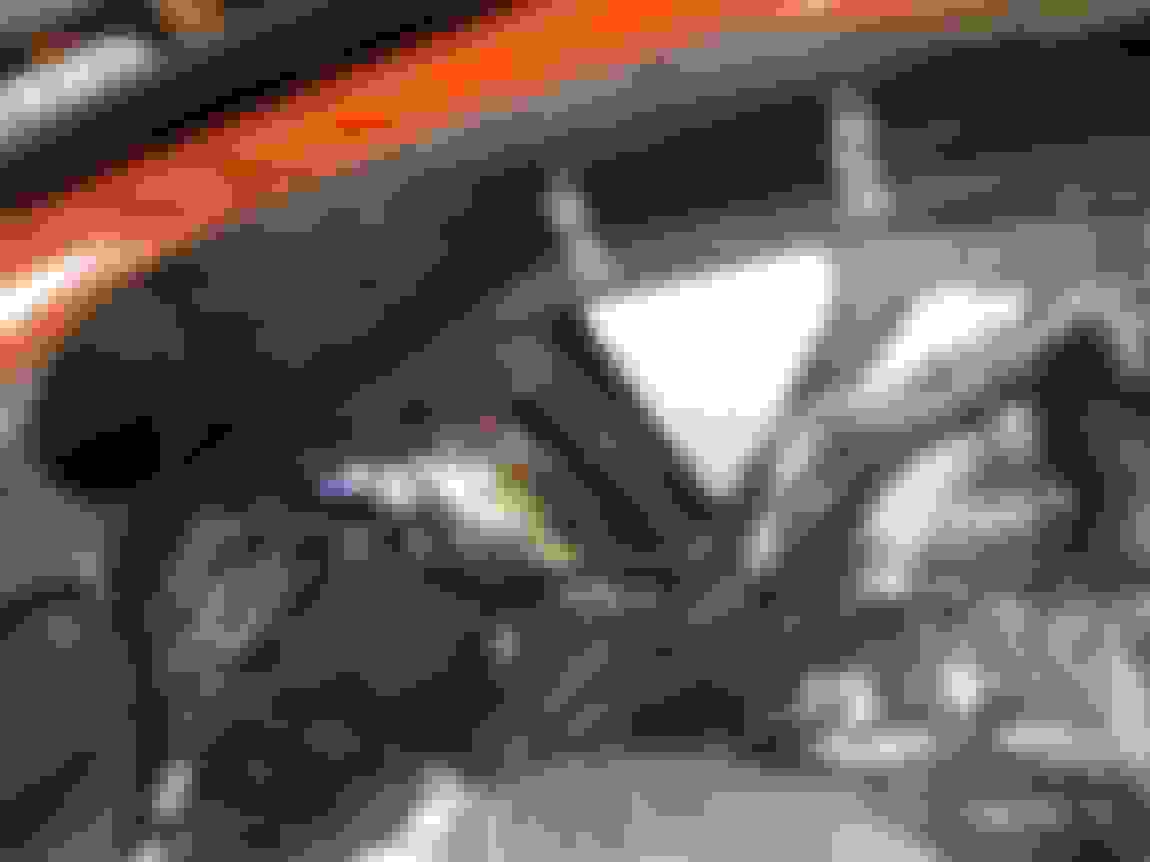
At least the relays and fuse are more accessible now than they were before.. I can snake my hand down in there between the turbo inlet elbow and the rad support...
Is it just the photos, or does that muffler connection look like it's going to be a tight bend?
Edit: The last photo makes it look like the mufflers are right at the axle. I see they're a bit forward, and you can cut down the straight pipe after the mufflers.
Must be the pics.. I have very limited space in the garage and the car is only jacked up so high so my view angles are pretty limited, but there's loads of room for a regular 4"-CLR 3.5" mandrel bend.. it passes by the coilover with 2" of clearance and then another 1.5" of clearance to the trimmed gas tank..
Gas Monkey Built a 6-Wheel Ferrari Testarossa With a Corvette LT4 Engine
Slideshow: The controversial Ferrari F6 swaps its original flat-12 for a Corvette Z06-derived LT4 V8 and sends power to four rear wheels through a custom-built drivetrain.
7 Most Reliable High-Performance Engines GM Has Ever Built
Slideshow:These GM engines didn't just make huge power, they survived abuse, boost, track days, and six-digit mileage with a reputation for refusing to quit.
6 Common C5 Corvette Failures and What's Involved In Repairing Them
Slideshow: From wobbling harmonic balancers to failed EBCMs, these are the issues that define long-term C5 ownership and what repairs typically involve.
Retro Modern Bandit Pontiac Trans AM Comes With Burt Reynolds' Autograph
Slideshow: A modern Camaro transformed into a retro icon, this limited-run "Bandit" build blends nostalgia with brute force in a way few revivals manage.
Top 10 Greatest Cadillac V Series Performance Models Ever, Ranked
Slideshow: Cadillac didn't just crash the high-performance luxury vehicle party, it showed up loud, supercharged, and occasionally a little unhinged...
Coachbuilt N2A Anteros Is an LS2-Powered C6 Corvette In Italian Clothes
Slideshow: A one-off sports car that looks like a vintage Italian exotic-but hides a C6 Corvette underneath-just sold for the price of a new mid-engine Corvette.