


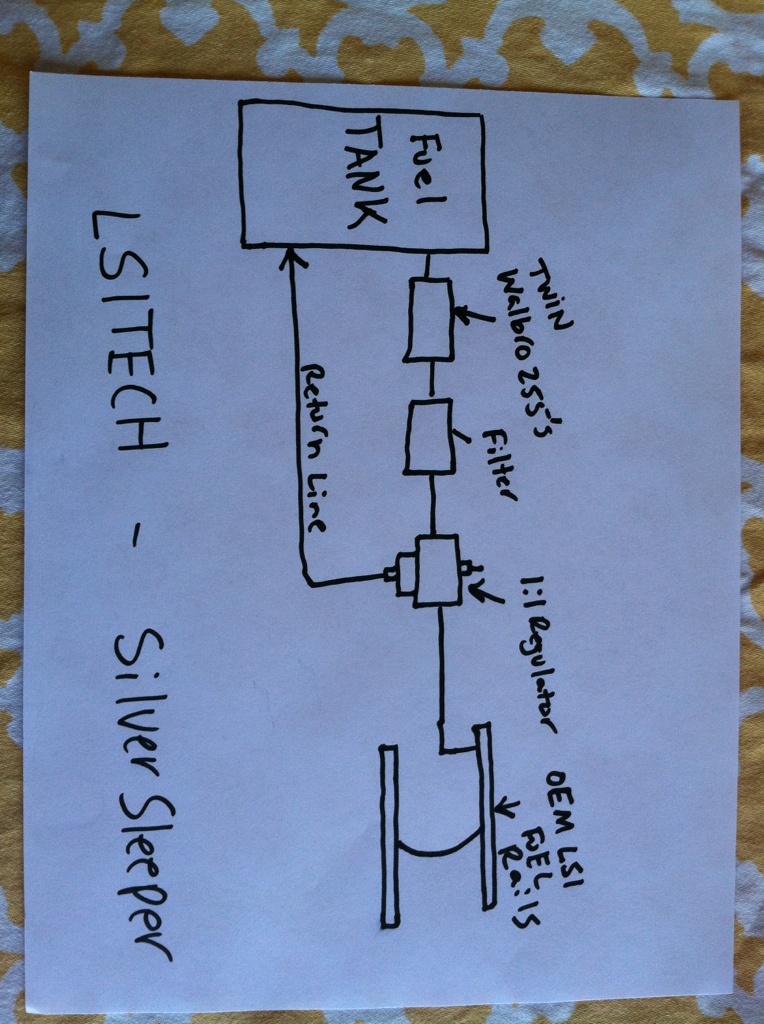





returnless boost reference regulator diagram needed..

should not run it this way. the rails should get the psi, and then the regulator after the rails regulate it down, and return fuel. Doing it like you want to will deadhead the pump more(s) and really heat them up, and burn them up (killing them).

Thread Starter
Launching!
iTrader: (7)
Joined: Jul 2012
Posts: 265
Likes: 0
From: Goldsboro/Pikeville NC
the reason i asked is becuase i found some threads on here and they said it would work, i just wanted to double check..i was told its not ideal but it will work..that was coming from someone who was running 9's with this configuration on yellow bullet
i think im going to run it this way for now..thanks

FormerVendor
Joined: Dec 2001
Posts: 2,444
Likes: 2
From: WWW.SPEEDINC.COM
The further away the regulator is from the rails the less it can compensate for pressure drop across the feed line.
Might not be a problem with a big feed line but the most accurate way to do it is by having the regulator on the return side as close to the rails as possible.
Might not be a problem with a big feed line but the most accurate way to do it is by having the regulator on the return side as close to the rails as possible.
Trending Topics
LS1 Tech Stories
The Best V8 Stories One Small Block at Time

Topdon ONE vs. Artidiag 800 BT2: Which is the Diagnostic Tablet For You?
Pouria Savadkouei
Gas Monkey Built a 6-Wheel Ferrari Testarossa With a Corvette LT4 Engine
Verdad Gallardo
7 Most Reliable High-Performance Engines GM Has Ever Built
Verdad Gallardo
Amazing '71 Camaro Restomod Is Modern Muscle Car Under the Skin
Verdad Gallardo
6 Common C5 Corvette Failures and What's Involved In Repairing Them
Pouria Savadkouei
Retro Modern Bandit Pontiac Trans AM Comes With Burt Reynolds' Autograph
Verdad Gallardo
Top 10 Greatest Cadillac V Series Performance Models Ever, Ranked
Pouria Savadkouei
Top 10 Most Powerful Chevy Trucks Ever Made!

Hennessey's New Supercharged Silverado ZR2 Has 700 HP
Verdad Gallardo

TECH Enthusiast
Joined: May 2010
Posts: 558
Likes: 1
That's how the stock returnless systems run. If GM thinks it works, then it works.
The speed at which a pressure drop at one end is felt by the other end is equivalent to the speed of sound of that medium. So basically, no difference at all. Overall flow rate through this system is equivalent to a return style system because the regulator itself isn't a restriction of flow to the injectors. So having the regulator close to the stock rail or farther away makes absolutely no measurable difference.
The speed at which a pressure drop at one end is felt by the other end is equivalent to the speed of sound of that medium. So basically, no difference at all. Overall flow rate through this system is equivalent to a return style system because the regulator itself isn't a restriction of flow to the injectors. So having the regulator close to the stock rail or farther away makes absolutely no measurable difference.
That's how the stock returnless systems run. If GM thinks it works, then it works.
The speed at which a pressure drop at one end is felt by the other end is equivalent to the speed of sound of that medium. So basically, no difference at all. Overall flow rate through this system is equivalent to a return style system because the regulator itself isn't a restriction of flow to the injectors. So having the regulator close to the stock rail or farther away makes absolutely no measurable difference.
The speed at which a pressure drop at one end is felt by the other end is equivalent to the speed of sound of that medium. So basically, no difference at all. Overall flow rate through this system is equivalent to a return style system because the regulator itself isn't a restriction of flow to the injectors. So having the regulator close to the stock rail or farther away makes absolutely no measurable difference.
FormerVendor
Joined: Dec 2001
Posts: 2,444
Likes: 2
From: WWW.SPEEDINC.COM
The more demand you place on the fuel system the more pressure drop you will see across that line.
Only way to overcome that would be to run a massive feed line and fittings which would be much more expensive than just installing the regulator at the rails.
-8 i saw 5 psi difference from rail to regulator at the back of the car fwiw
Transient responce of manifold pressure to fuel pressure at the rail was actually very good, it surprised me for sure.
I had done it to keep the bay cleaner, i did change it this spring whe. I planned on pushing up the power
Transient responce of manifold pressure to fuel pressure at the rail was actually very good, it surprised me for sure.
I had done it to keep the bay cleaner, i did change it this spring whe. I planned on pushing up the power
TECH Enthusiast
Joined: May 2010
Posts: 558
Likes: 1
100% incorrect.
The more demand you place on the fuel system the more pressure drop you will see across that line.
Only way to overcome that would be to run a massive feed line and fittings which would be much more expensive than just installing the regulator at the rails.
The more demand you place on the fuel system the more pressure drop you will see across that line.
Only way to overcome that would be to run a massive feed line and fittings which would be much more expensive than just installing the regulator at the rails.
For 1/2" (-8) straight fuel lines, you are looking at a pressure drop of between .01 and .02 psi per foot for the fuel flow rates 2 walbros can put out, so putting the regulator 8 feet farther from the rails would only introduce a .16 psi difference between the injectors being turned off and the injectors at full flow. If you are worried about a less than a 1psi variance in fuel pressure at the rails between 2 different setups, then you worry too much

Obviously adding restrictions like right angles and narrower lines tend to add additional pressure drop, it shouldn't be difficult to tune out the difference.
The main reason why people like the regulator up at the rails (besides the bling factor) is because an adjustable regulator is easier to adjust when it's there vs under the car.

9 Second Club
Joined: Nov 2003
Posts: 13,616
Likes: 185
From: Norn Iron
FormerVendor
Joined: Dec 2001
Posts: 2,444
Likes: 2
From: WWW.SPEEDINC.COM
Who said he was using stock 3/8" line?
For 1/2" (-8) straight fuel lines, you are looking at a pressure drop of between .01 and .02 psi per foot for the fuel flow rates 2 walbros can put out, so putting the regulator 8 feet farther from the rails would only introduce a .16 psi difference between the injectors being turned off and the injectors at full flow. If you are worried about a less than a 1psi variance in fuel pressure at the rails between 2 different setups, then you worry too much
Obviously adding restrictions like right angles and narrower lines tend to add additional pressure drop, it shouldn't be difficult to tune out the difference.
The main reason why people like the regulator up at the rails (besides the bling factor) is because an adjustable regulator is easier to adjust when it's there vs under the car.
For 1/2" (-8) straight fuel lines, you are looking at a pressure drop of between .01 and .02 psi per foot for the fuel flow rates 2 walbros can put out, so putting the regulator 8 feet farther from the rails would only introduce a .16 psi difference between the injectors being turned off and the injectors at full flow. If you are worried about a less than a 1psi variance in fuel pressure at the rails between 2 different setups, then you worry too much
Obviously adding restrictions like right angles and narrower lines tend to add additional pressure drop, it shouldn't be difficult to tune out the difference.
The main reason why people like the regulator up at the rails (besides the bling factor) is because an adjustable regulator is easier to adjust when it's there vs under the car.
I guess I just don't understand why you wouldn't just do it correctly and regulate it right at the rails so it's the most accurate rather than trying to "tune out" variances in fuel pressure.
TECH Enthusiast
Joined: May 2010
Posts: 558
Likes: 1
Rotory1307 who posted directly before you stated a 5psi drop with a -8 line. That's more than less than 1psi variance.
I guess I just don't understand why you wouldn't just do it correctly and regulate it right at the rails so it's the most accurate rather than trying to "tune out" variances in fuel pressure.
I guess I just don't understand why you wouldn't just do it correctly and regulate it right at the rails so it's the most accurate rather than trying to "tune out" variances in fuel pressure.
If you think you know better than GM engineers as to how to "do it correctly" then just keep thinking that.
Getting back to the OP's original question. "Will it work?" Yes, it will.
If you want to run 2000 horsepower, you may want to revise the layout, but it will 100% certainly work with the setup you provided.
Last edited by killernoodle; Oct 18, 2012 at 11:17 AM.
FormerVendor
Joined: Dec 2001
Posts: 2,444
Likes: 2
From: WWW.SPEEDINC.COM
He also didn't state how this was measured. Transient pressure drop from 0 throttle to full throttle? Static difference in pressure? With 2 different gauges? With 1 gauge? Hell, you would get a 1psi difference in pressure with the same regulator just mounting it 2 feet lower in the car because of the difference of head pressure.
If you think you know better than GM engineers as to how to "do it correctly" then just keep thinking that.
Getting back to the OP's original question. "Will it work?" Yes, it will.
If you want to run 2000 horsepower, you may want to revise the layout, but it will 100% certainly work with the setup you provided.
If you think you know better than GM engineers as to how to "do it correctly" then just keep thinking that.
Getting back to the OP's original question. "Will it work?" Yes, it will.
If you want to run 2000 horsepower, you may want to revise the layout, but it will 100% certainly work with the setup you provided.
TECH Enthusiast
Joined: May 2010
Posts: 558
Likes: 1
You don't have to boost reference every FI fuel system. If you have 60 psi fuel pressure and are boosting 10 pounds, then you just have 50 psi of effective fuel pressure. As long as you have enough injector flow at 50 psi fuel pressure at that horsepower level, then you can tune in the additional injector duty cycle.