





!!!Compound Boost!!!

Thread Starter
Teching In
Joined: Dec 2014
Posts: 14
Likes: 0
From: Kansas
 !!!Compound Boost!!!
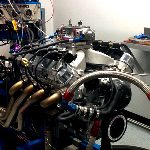
 I am taking the long and difficult plunge into compound boosting an LS motor. This for will be an information place for everything I learn and build.
Proof of concept will be on a 4.8l gen 4 ly2 that I am going through to make sure it will live as much as possible
https://ls1tech.com/forums/conversio...onversion.html
http://www.lsxmag.com/news/twin-turb...-national-gnx/
__________________
-Plan
Build a low compression 6.0L
Proof of concept will be on a 4.8l gen 4 ly2 that I am going through to make sure it will live as much as possible
https://ls1tech.com/forums/conversio...onversion.html
http://www.lsxmag.com/news/twin-turb...-national-gnx/
__________________
-Plan
Build a low compression 6.0L
- Tune on a 1.9L or 2.3L supercharger
- Build turbo kit consisting of turbos off of each manifold and develop a low back pressure setup on the same motor without the supercharger
- Install both setups and work out the bugs
Last edited by compted; Sep 20, 2016 at 11:43 PM. Reason: add links
If you really want to delve into that sort of money pit and tuning problem, compound turbos will make more power than turbo/SC. Look on Yellowbullet for a very informative(but long) thread on the subject. There is a guy building 50#'s of boost on his 2step at the line with a 1.9L motor, and approaching an ideal 1 to 1 backpressure ratio. His road to that was a rough and winding one.

TECH Addict
Joined: Jul 2013
Posts: 2,189
Likes: 123
From: Portland, Oregon
Forget the top mount supercharger. It will be a restriction to the turbo, as seen when you remove the supercharger from most compound boost cobras. So, how do you do it correctly? Here is my version of correct:
F1 centri blower into an A2A intercooler into an S478 turbo into a Lingenfelter A2W intercooled intake. That is a surefire recipe for head lifting/block splitting boost, if you can build an LS engine that wont spray water or grenade at ~4bar, then you have yourself a successful compound boost LS.
I, personally, wouldn't even consider it a serious attempt without an intercooler between the two separate stages of boost. I would probably still run a four nozzle meth injection system with a nozzle before and after each blower. Compound boost LS should absolutely have 6-bolt heads and either an iron LSX/DART block, or a fully prepped ERL ductile iron sleeved aluminum block.
If you want to see how gearheads build compound boost systems, study up on those Cummings sled pullers. They run centri blowers into single turbo setups with great success.
F1 centri blower into an A2A intercooler into an S478 turbo into a Lingenfelter A2W intercooled intake. That is a surefire recipe for head lifting/block splitting boost, if you can build an LS engine that wont spray water or grenade at ~4bar, then you have yourself a successful compound boost LS.
I, personally, wouldn't even consider it a serious attempt without an intercooler between the two separate stages of boost. I would probably still run a four nozzle meth injection system with a nozzle before and after each blower. Compound boost LS should absolutely have 6-bolt heads and either an iron LSX/DART block, or a fully prepped ERL ductile iron sleeved aluminum block.
If you want to see how gearheads build compound boost systems, study up on those Cummings sled pullers. They run centri blowers into single turbo setups with great success.

Trending Topics
I am taking the long and difficult plunge into compound boosting an LS motor. This for will be an information place for everything I learn and build.
__________________
-Plan
Build a low compression 6.0L
__________________
-Plan
Build a low compression 6.0L
- Tune on a 1.9L or 2.3L supercharger
- Build turbo kit consisting of turbos off of each manifold and develop a low back pressure setup on the same motor without the supercharger
- Install both setups and work out the bugs
LS1 Tech Stories
The Best V8 Stories One Small Block at Time

Topdon ONE vs. Artidiag 800 BT2: Which is the Diagnostic Tablet For You?
Pouria Savadkouei
Gas Monkey Built a 6-Wheel Ferrari Testarossa With a Corvette LT4 Engine
Verdad Gallardo
7 Most Reliable High-Performance Engines GM Has Ever Built
Verdad Gallardo
Amazing '71 Camaro Restomod Is Modern Muscle Car Under the Skin
Verdad Gallardo
6 Common C5 Corvette Failures and What's Involved In Repairing Them
Pouria Savadkouei
Retro Modern Bandit Pontiac Trans AM Comes With Burt Reynolds' Autograph
Verdad Gallardo
Top 10 Greatest Cadillac V Series Performance Models Ever, Ranked
Pouria Savadkouei
Top 10 Most Powerful Chevy Trucks Ever Made!

Hennessey's New Supercharged Silverado ZR2 Has 700 HP
Verdad Gallardo TECH Addict
Joined: Jul 2013
Posts: 2,189
Likes: 123
From: Portland, Oregon
If the crankshaft cannot handle the extra 50hp worth of work it takes to spin the blower, then it is not going to survive 45-60 pounds of boost anyways.
This is definitely no small undertaking. Things are going to have to be bulletproof.
I wouldn't consider any combination of parts that resulted in less than a 1.6x rod ratio. That should help the crankshaft survive, as well as reduce side loading of the cylinder walls. The higher rod ratio would also be helping the block survive.
All of this is nothing more than mental masturbation unless the end goal is to surpass what can be accomplished with a conventional turbo(s) setup.
If you wanted something relatively cheap, just to proof the concept, pick up a genIV 4.8, and run a D1SC into a single S366 and see if you can;
A) achieve more boost than the listed maximum for a D1SC blower,
B) achieve more power than a single S366 turbo.
That would be proof of concept, the absolute cheapest way I can image.
This is definitely no small undertaking. Things are going to have to be bulletproof.
I wouldn't consider any combination of parts that resulted in less than a 1.6x rod ratio. That should help the crankshaft survive, as well as reduce side loading of the cylinder walls. The higher rod ratio would also be helping the block survive.
All of this is nothing more than mental masturbation unless the end goal is to surpass what can be accomplished with a conventional turbo(s) setup.
If you wanted something relatively cheap, just to proof the concept, pick up a genIV 4.8, and run a D1SC into a single S366 and see if you can;
A) achieve more boost than the listed maximum for a D1SC blower,
B) achieve more power than a single S366 turbo.
That would be proof of concept, the absolute cheapest way I can image.


9 Second Club
Joined: Nov 2003
Posts: 13,616
Likes: 185
From: Norn Iron
I dont see why people are thinking it would be difficult ?
And would a valley mounted blower really be a restriction ? It's apparent even shitty intakes allow huge power...so when you can move already pressurised air through...AND around the valley blower, why would it be any real restriction worth worrying about ?
Most blowers have a bypass, so this could be operated to allow air both through and around the blower at higher loads.
And a basic valley mounted blower takes up almost no room, and you could easily forego any blower intercooling given it would only be a low rpm use deal after which the turbos would take over and obviously they would have efficient intercoolers.
Not many details, but here is something ?
And would a valley mounted blower really be a restriction ? It's apparent even shitty intakes allow huge power...so when you can move already pressurised air through...AND around the valley blower, why would it be any real restriction worth worrying about ?
Most blowers have a bypass, so this could be operated to allow air both through and around the blower at higher loads.
And a basic valley mounted blower takes up almost no room, and you could easily forego any blower intercooling given it would only be a low rpm use deal after which the turbos would take over and obviously they would have efficient intercoolers.
Not many details, but here is something ?
Thread Starter
Teching In
Joined: Dec 2014
Posts: 14
Likes: 0
From: Kansas
I personally have worked on sled trucks but my plan is to build a gas powered sled truck that will make nasty street level diesels that sled pull worry that I am going to beat them with my distance scores and still be able to drive the thing. So I'm in search of torque and as much as one can make for as long as I can make it. This will be an aftermarket efi setup with e85 or methanol fueling.
Thread Starter
Teching In
Joined: Dec 2014
Posts: 14
Likes: 0
From: Kansas
I dont see why people are thinking it would be difficult ?
And would a valley mounted blower really be a restriction ? It's apparent even shitty intakes allow huge power...so when you can move already pressurised air through...AND around the valley blower, why would it be any real restriction worth worrying about ?
Most blowers have a bypass, so this could be operated to allow air both through and around the blower at higher loads.
And a basic valley mounted blower takes up almost no room, and you could easily forego any blower intercooling given it would only be a low rpm use deal after which the turbos would take over and obviously they would have efficient intercoolers.
Not many details, but here is something ?
Granatelli Motor Sports - LS Compound Boost Motor - YouTube
And would a valley mounted blower really be a restriction ? It's apparent even shitty intakes allow huge power...so when you can move already pressurised air through...AND around the valley blower, why would it be any real restriction worth worrying about ?
Most blowers have a bypass, so this could be operated to allow air both through and around the blower at higher loads.
And a basic valley mounted blower takes up almost no room, and you could easily forego any blower intercooling given it would only be a low rpm use deal after which the turbos would take over and obviously they would have efficient intercoolers.
Not many details, but here is something ?
Granatelli Motor Sports - LS Compound Boost Motor - YouTube

TECH Enthusiast
Joined: Apr 2009
Posts: 723
Likes: 4
Diesels back in the day ran 6 & 8-71's with turbos blowing through them & a few peeps ran turbos on the lightnings back when they first came out: Nothing new.
Matching compressor efficiencies at given pressure ratios is where the problems lie when comparing a roots/whipple + turbo vs compound turbos. Series turbo systems allow a little more flexibility there due to being able to better match the components with one another.
Matching compressor efficiencies at given pressure ratios is where the problems lie when comparing a roots/whipple + turbo vs compound turbos. Series turbo systems allow a little more flexibility there due to being able to better match the components with one another.

I have seen multiple examples of this over the years and even helped my buddy do this with a Mazda V6 about 8-10 years ago. I have seen it brought up about 100 times more than it actually is done. It sounds cool when its talked about, and is why it becomes a pipe dream for many and never comes to reality. Most people who want to go fast will just go turbo(s).