





Official STS help thread

yea i still have the cats for a few more days. i started it this morn and no water came out !!!. however oil did. when i was testing my check valve it looked like it was jacked. i tired one way and zero oil flowed through, so i fliped it around and it poured like normal... however it kept dripping once i turned the car off. stupid thing is broken. anyways the sound is AWESOME. (pics later)
however my oil pump is very noisy... will it quiet down? or do i just need to live with it??
however my oil pump is very noisy... will it quiet down? or do i just need to live with it??
You can use some rubber washers that absorb vibration to help cut down the noise. You can also pull the carpet back and put in dynomat noise deadening material along the floor of pass seat where the pump is. Theyre usually noisy when new. They quiet a little but they are loud for the most part. Youll get used to it, especially when driving youll just hear whistle.
edit: just noticed the new water pics on the last page. That shop did a pretty good job. looks like great ground clearance. Any pics of the charge pipes fastened up?
heres a pic of washers:
edit: just noticed the new water pics on the last page. That shop did a pretty good job. looks like great ground clearance. Any pics of the charge pipes fastened up?
heres a pic of washers:
Last edited by JAvenger007; Jun 9, 2007 at 04:59 PM.
Okay. PCV question FTL. There have been so many, but... Right now I have a ton of 3/8" hose along w/ a T-fitting, some caps, a catch can, a k/n breather. Can I make a vented functioning system out of that? I can't route the breather to the oil fill because my return is going in there, no chance in rerouting that to the oil pan.
Can I route the breather on the front passengers port. And T- the back ports and run them to the catch can to a check valve which goes intake manifold? Would that work and end up capping off the throttle body?
Can I route the breather on the front passengers port. And T- the back ports and run them to the catch can to a check valve which goes intake manifold? Would that work and end up capping off the throttle body?
Guys, I just wanted to say thank you for making this thread what it is. I've just read through this entire thread, alot of my questions in regards to STS kits have been answered and you guys have bought some other things to my attention i.e. I-Pipe, voltage booster, etc. Thanks again for the wealth of information you guys have shared about these kit. This thread definitely needs to become a sticky...
LS1 Tech Stories
The Best V8 Stories One Small Block at Time

Topdon ONE vs. Artidiag 800 BT2: Which is the Diagnostic Tablet For You?
Pouria Savadkouei
Gas Monkey Built a 6-Wheel Ferrari Testarossa With a Corvette LT4 Engine
Verdad Gallardo
7 Most Reliable High-Performance Engines GM Has Ever Built
Verdad Gallardo
Amazing '71 Camaro Restomod Is Modern Muscle Car Under the Skin
Verdad Gallardo
6 Common C5 Corvette Failures and What's Involved In Repairing Them
Pouria Savadkouei
Retro Modern Bandit Pontiac Trans AM Comes With Burt Reynolds' Autograph
Verdad Gallardo
Top 10 Greatest Cadillac V Series Performance Models Ever, Ranked
Pouria Savadkouei
Top 10 Most Powerful Chevy Trucks Ever Made!

Hennessey's New Supercharged Silverado ZR2 Has 700 HP
Verdad Gallardo
Originally Posted by reocamaro
Okay. PCV question FTL. There have been so many, but... Right now I have a ton of 3/8" hose along w/ a T-fitting, some caps, a catch can, a k/n breather. Can I make a vented functioning system out of that? I can't route the breather to the oil fill because my return is going in there, no chance in rerouting that to the oil pan.
Can I route the breather on the front passengers port. And T- the back ports and run them to the catch can to a check valve which goes intake manifold? Would that work and end up capping off the throttle body?
Can I route the breather on the front passengers port. And T- the back ports and run them to the catch can to a check valve which goes intake manifold? Would that work and end up capping off the throttle body?
-Back two ports each run into a catch can (which has 2 ports)
-Top port of catch can runs to stock PCV valve then to check valve then into the intake
-Side port of catch can (opposite of inlet ports) runs to check valve then into the inlet side of turbo
-TB port is plugged
This allows crankcase to vent under both boost and vacuum. It also pulls vac on rear ports at all times. When cruising under vacuum, the intake port pulls on rear ports, when under boost, the turbo pulls vacuum since the intake port closes. PCV valve catches any additional oil from catch can before going to intake.


On The Tree
Joined: Jul 2007
Posts: 108
Likes: 0
From: College Station
If your doing a serious build, then delete the system, run breathers on both valve covers and possibly a can on the ls6 plate if you have it.
when the motor reaches a certain point, a filtered catch can will become a hinderance more than anything. At that point, either run breathers directly off the valve covers w/ -10 size ports (may create and oily mess), or have a good catch can with sizable breather.
I throw away the PCV with anything over 8lbs of boost. Ussually 2 breathers or we run the PCV lines to a breather tank.

On The Tree
Joined: Dec 2004
Posts: 100
Likes: 0
From: Satellite Beach, fl
Originally Posted by trtturbo
the port on the side (opening closest to the bolts that hold the top on) is for your boost reference. If you have an intercooler, you should run a vacume line from the wastegate to an intake vacume source. If not, then from the outlet on the compressor housing to the side of the wastegate.
The top port is for a boost controller.
The top port is for a boost controller.

https://ls1tech.com/forums/forced-induction/781028-waste-gate-vlv.html
Anyone from STS or Tial care to comment?
On The Tree
Joined: Dec 2004
Posts: 100
Likes: 0
From: Satellite Beach, fl
Originally Posted by JAvenger007
wouldn't the manifold give the best reference for boost?
Tials way would allow all the boost available from exhaust flow, 10 PSI in my case. While with STS method could allow the boost to escalate because it is no longer being sensed with throttle closed. Key is to keep your turbos spooled.
I've run for a while without a BOV and as much as I like the sound when the turbos deadhead it's definetly not good for them. Just thinking it may be better to control WG pre throttle.
Back to the whole LT's vs. Manifolds debate... People that use the STS with a stock car keep the manifolds, is there any point, like say around 12-15# that it would be better to use LT's and wrap them vice the Manifolds?

Yes, but it may start an argument again, something I have been trying to avoid on this subject. But here goes:
First, wrapping even the stock manifolds will gain power and lower spin up times. I'm not going into the physics again, except to say that heat is the friend of every turbo. The more heat, the more power.
If you put headers on the car, you must absolutely wrap them, for the same reason.
Where headers will gain you more power is when the stock manifolds become a large restriction in the whole air-in-air-out system. An engine is only an air pump, after all. If you increase the flow (such as increasing boost) then you should go with the wrapped headers. It is a type of volumetric flow physics, except you are using gases rather than fluids, which you can Google if you so desire. Just avoid the differential equations, they are a bit advanced.
Hope this helps.
BTW, if the car is not a dd, I would double wrap the headers to retain more heat.
First, wrapping even the stock manifolds will gain power and lower spin up times. I'm not going into the physics again, except to say that heat is the friend of every turbo. The more heat, the more power.
If you put headers on the car, you must absolutely wrap them, for the same reason.
Where headers will gain you more power is when the stock manifolds become a large restriction in the whole air-in-air-out system. An engine is only an air pump, after all. If you increase the flow (such as increasing boost) then you should go with the wrapped headers. It is a type of volumetric flow physics, except you are using gases rather than fluids, which you can Google if you so desire. Just avoid the differential equations, they are a bit advanced.
Hope this helps.
BTW, if the car is not a dd, I would double wrap the headers to retain more heat.
Well, I'm going to try and make it a daily driver again. Blowing off charge pipes here and there make it very uncomfortable to drive around in.
So, I should have not bought the stock exhaust system and just went with taking the headers off, wrapping them and calling it a day?
So, I should have not bought the stock exhaust system and just went with taking the headers off, wrapping them and calling it a day?
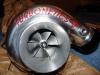
i don't think double wrapping them would gain you much. when wrapping headers you should also use the header wrap spray such that your wrap and your headers don't deteriorate sooner than expected. To design some exhaust manifold that flows better than the stock but you can wrap easily and will retain heat...there ya go. I believe Parish, Tiago and others have custom made headers but I could be wrong.... that looked like factory manifolds but had awesome flow

No he isnt saying that REO... what he is saying, and what I believe all of us have said is that you will have more efficiency in retaining heat with less overall surface area. Thus the preferred method is Manifolds vs: LT's sense LT's are (if I remember the number) 4.7 x the surface area...
Where manifolds become less efficient is when they restrict the airflow of the engine... that means you are loosing HP at the engine to gain efficiency at the turbo. LT's will work with a rear-mount turbo... but with less efficient volume of gases reaching the turbo. Wrapping will help but not completely solve that problem...
To prove this simple thory... Take a laser temp gauge and measure the surface temp of your exhaust housing of your turbo after a cold start of your engine... and letting it idle for say... 10mins. Then we can get someone with Manifolds (not wrapped exhaust) to do the exact same thing. I believe (and would love if we can prove this) that you would have ~20% lower temps in your setup with LT's.
Then someone better at volumetric's of gases then I am could figure out the loss in volume of air (cooler air is denser, thus less volume (Not less quantity)).
Another way to simply visualize this is to fill a balloon up... take a hair dryer on low heat and warm the balloon... measure its size. Then take the balloon and put it in the freezer for 20 mins... take it out and measure it again. Same quantity of air... but the volume is greatly reduced.
Where manifolds become less efficient is when they restrict the airflow of the engine... that means you are loosing HP at the engine to gain efficiency at the turbo. LT's will work with a rear-mount turbo... but with less efficient volume of gases reaching the turbo. Wrapping will help but not completely solve that problem...
To prove this simple thory... Take a laser temp gauge and measure the surface temp of your exhaust housing of your turbo after a cold start of your engine... and letting it idle for say... 10mins. Then we can get someone with Manifolds (not wrapped exhaust) to do the exact same thing. I believe (and would love if we can prove this) that you would have ~20% lower temps in your setup with LT's.
Then someone better at volumetric's of gases then I am could figure out the loss in volume of air (cooler air is denser, thus less volume (Not less quantity)).
Another way to simply visualize this is to fill a balloon up... take a hair dryer on low heat and warm the balloon... measure its size. Then take the balloon and put it in the freezer for 20 mins... take it out and measure it again. Same quantity of air... but the volume is greatly reduced.
i don't think double wrapping them would gain you much. when wrapping headers you should also use the header wrap spray such that your wrap and your headers don't deteriorate sooner than expected. To design some exhaust manifold that flows better than the stock but you can wrap easily and will retain heat...there ya go. I believe Parish, Tiago and others have custom made headers but I could be wrong.... that looked like factory manifolds but had awesome flow
Jared