






boost vs cubes
Thread Starter
TECH Resident
Joined: Aug 2008
Posts: 910
Likes: 0
From: Dubai
 boost vs cubes
 Time to start the displacement wars again lol, I mean seriously; im just learning and I could use some help over here, lets try to get more facts that opinions.
I heard that with a same turbo a smaller displacement engine will make more top-end power, while the bigger displacement engine will make more low-end torque, less top-end power, or equal power at a lower boost level.
If a small displacement car can make more power that defeats the purpose of having a large displacement engine, I know it comes down to what you are looking for, whether a street car, drag car or anything in between.
This is how I understand it:
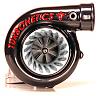
427 CI + T88
&
346 CI + T88
Obviously, to make 800rwhp youll require significantly more boost on the smaller displacement engine.
Advantages of the smaller engine is the fact that you can rev it higher, can have more meat in between the cylinders to run boost (yet thats not a competitive advantage since blocks like the warhawk, LSx provide enough chunk in between the cylinders for boost), also I heard that smaller displacement engines tend to detonate less, can someone verify why?
This is how im thinking of it, a turbo can only provide x amount of air flow whether you have a bigger displacement engine or not. Youll obviously need to BOOST (FORCE) the air into the smaller engine, thus the higher boost pressure measured at the manifold, yet that doesnt mean you are flowing more air.
Think of it in tires:
big tire @ 30PSI
Small tire @ 40PSI
Does this mean that the smaller tire has more air in it? NO.
So why is it any different in engines, I know engines are not tires but my common sense aint able to interpret this.
The advantage of having bigger cubes and less boost outperforms the fact that a smaller engine tend to detonate less (thus be able to tune a little more aggressively). So it makes sense that you could run more on pump gas with the bigger motor + lower boost. yet why am I reading that if the case was with race fuel, the smaller displacement engine + higherboost is a better platform.
Again, lets compare a Single turbo Supra vs a Vette:
427 CI + T88
200 CI + T88
the turbo is maxed out in both applications, those are not true figures just for the sake of comparison, say 15PSI on the 427 and 25PSI on the 200, the turbo should be FLOWING the same AMOUNT of air, yet boost pressure measured at the intake differs because of the engines size/efficiency.
F1 small displacement engines get changed after each race so dont use that as a base for comparison. Nelson Racing engines use a 601 CI motor in their 3000HP application, why?
After writing all this down, I came to realize this: With turbo size equal, the bigger engine will push more air through the turbo at a slower rate (RPM) and thus backpressure might be high, while a smaller engine will flow less amount of air at a faster rate, so the turbo will end up spooling much faster, and thus pushing a higher volume of air CFM NOT PSI.
that was long
I heard that with a same turbo a smaller displacement engine will make more top-end power, while the bigger displacement engine will make more low-end torque, less top-end power, or equal power at a lower boost level.
If a small displacement car can make more power that defeats the purpose of having a large displacement engine, I know it comes down to what you are looking for, whether a street car, drag car or anything in between.
This is how I understand it:
427 CI + T88
&
346 CI + T88
Obviously, to make 800rwhp youll require significantly more boost on the smaller displacement engine.
Advantages of the smaller engine is the fact that you can rev it higher, can have more meat in between the cylinders to run boost (yet thats not a competitive advantage since blocks like the warhawk, LSx provide enough chunk in between the cylinders for boost), also I heard that smaller displacement engines tend to detonate less, can someone verify why?
This is how im thinking of it, a turbo can only provide x amount of air flow whether you have a bigger displacement engine or not. Youll obviously need to BOOST (FORCE) the air into the smaller engine, thus the higher boost pressure measured at the manifold, yet that doesnt mean you are flowing more air.
Think of it in tires:
big tire @ 30PSI
Small tire @ 40PSI
Does this mean that the smaller tire has more air in it? NO.
So why is it any different in engines, I know engines are not tires but my common sense aint able to interpret this.
The advantage of having bigger cubes and less boost outperforms the fact that a smaller engine tend to detonate less (thus be able to tune a little more aggressively). So it makes sense that you could run more on pump gas with the bigger motor + lower boost. yet why am I reading that if the case was with race fuel, the smaller displacement engine + higherboost is a better platform.
Again, lets compare a Single turbo Supra vs a Vette:
427 CI + T88
200 CI + T88
the turbo is maxed out in both applications, those are not true figures just for the sake of comparison, say 15PSI on the 427 and 25PSI on the 200, the turbo should be FLOWING the same AMOUNT of air, yet boost pressure measured at the intake differs because of the engines size/efficiency.
F1 small displacement engines get changed after each race so dont use that as a base for comparison. Nelson Racing engines use a 601 CI motor in their 3000HP application, why?
After writing all this down, I came to realize this: With turbo size equal, the bigger engine will push more air through the turbo at a slower rate (RPM) and thus backpressure might be high, while a smaller engine will flow less amount of air at a faster rate, so the turbo will end up spooling much faster, and thus pushing a higher volume of air CFM NOT PSI.
that was long
http://www.forcedinductions.com/help.htm
Run through a couple of engine sizes and turbo sizes and it will answer most of your questions.
Run through a couple of engine sizes and turbo sizes and it will answer most of your questions.
ok you seem to be a little confused. No matter what, the bigger engine would be better with the proper setup, however with the same sized turbo... say a 76mm a 427 would be way down on power because of the rediculous increase in backpressure say over a 94mm, effectively choking the motor. With a stock sized motor and a t 76 they are like bread and butter, but the same holds true for any application, there is a right combo for everyone. Talk to docturbo and he will be able to hook you up and point you in the right direction.
The big advantage of a big turbo and big motor, is having more power under the curve, and being able to make the same power as a smaller setup with a lot less boost and therefore being able to run lower octane, more reliable, and with a lot more room to grow.
What you need to do is figure out your goals, street, street/strip, or strip. Because once you get to a certain point 700+rwhp things become uber expensive, and you will not be able to put much more power down on the street.
The big advantage of a big turbo and big motor, is having more power under the curve, and being able to make the same power as a smaller setup with a lot less boost and therefore being able to run lower octane, more reliable, and with a lot more room to grow.
What you need to do is figure out your goals, street, street/strip, or strip. Because once you get to a certain point 700+rwhp things become uber expensive, and you will not be able to put much more power down on the street.
ok you seem to be a little confused. No matter what, the bigger engine would be better with the proper setup, however with the same sized turbo... say a 76mm a 427 would be way down on power because of the rediculous increase in backpressure say over a 94mm, effectively choking the motor. With a stock sized motor and a t 76 they are like bread and butter, but the same holds true for any application, there is a right combo for everyone. Talk to docturbo and he will be able to hook you up and point you in the right direction.
The big advantage of a big turbo and big motor, is having more power under the curve, and being able to make the same power as a smaller setup with a lot less boost and therefore being able to run lower octane, more reliable, and with a lot more room to grow.
What you need to do is figure out your goals, street, street/strip, or strip. Because once you get to a certain point 700+rwhp things become uber expensive, and you will not be able to put much more power down on the street.
The big advantage of a big turbo and big motor, is having more power under the curve, and being able to make the same power as a smaller setup with a lot less boost and therefore being able to run lower octane, more reliable, and with a lot more room to grow.
What you need to do is figure out your goals, street, street/strip, or strip. Because once you get to a certain point 700+rwhp things become uber expensive, and you will not be able to put much more power down on the street.
The goals portion is what I would keep in mind- and budget. Whenever you do forced induction things nickel and dime you to death, a fitting here, a gasket there, flanges, welding, pipes, silicone connectors. I think for that reason unless you have DEEP pockets just run a smaller motor and make up the power with boost.
doooohhhhh!!! Oh well I just saw who the op was... after reading ayousef's other thread, I am pretty sure that he already has a plan, and very very very deep pockets. Oh well, here is some free info, and btw your setup sounds totally badass.
Thread Starter
TECH Resident
Joined: Aug 2008
Posts: 910
Likes: 0
From: Dubai
Ill post a thread with the full details soon =D
Thx again guyz.
Trending Topics
It all depends of course, but the issues are that a low compression, small cube engine will be laggier than a large cube and/or high compression engine. So the Supra with the T88 will launch with a lot of lag off idle where the 427ci LSX will launch hard.
A few locals have seen how laggy my Formula can be on the street with the 8:1 348ci LSx + GT47-88mm turbo. I've got to bring it up to launch hard, it will not launch hard off idle. Now if I ran a 76mm turbo with the corrrect exhaust housing it would launch much harder at say 15psi.
What are you trying to figure out or build?
Eventually I will build a new longblock for this 106mm turbo I have lying around, and I'll build something like a 4.030 bore x 4.000 stroke setup. I also kicked around doing a 3.900 stroke to run a piston with more heighth but the guys that are running 7's don't seem to care about that too much and they all run 4.00 stroke cranks right from the asking around that I did recently.
A few locals have seen how laggy my Formula can be on the street with the 8:1 348ci LSx + GT47-88mm turbo. I've got to bring it up to launch hard, it will not launch hard off idle. Now if I ran a 76mm turbo with the corrrect exhaust housing it would launch much harder at say 15psi.
What are you trying to figure out or build?
Eventually I will build a new longblock for this 106mm turbo I have lying around, and I'll build something like a 4.030 bore x 4.000 stroke setup. I also kicked around doing a 3.900 stroke to run a piston with more heighth but the guys that are running 7's don't seem to care about that too much and they all run 4.00 stroke cranks right from the asking around that I did recently.
LS1 Tech Stories
The Best V8 Stories One Small Block at Time

Topdon ONE vs. Artidiag 800 BT2: Which is the Diagnostic Tablet For You?
Pouria Savadkouei
Gas Monkey Built a 6-Wheel Ferrari Testarossa With a Corvette LT4 Engine
Verdad Gallardo
7 Most Reliable High-Performance Engines GM Has Ever Built
Verdad Gallardo
Amazing '71 Camaro Restomod Is Modern Muscle Car Under the Skin
Verdad Gallardo
6 Common C5 Corvette Failures and What's Involved In Repairing Them
Pouria Savadkouei
Retro Modern Bandit Pontiac Trans AM Comes With Burt Reynolds' Autograph
Verdad Gallardo
Top 10 Greatest Cadillac V Series Performance Models Ever, Ranked
Pouria Savadkouei
Top 10 Most Powerful Chevy Trucks Ever Made!

Hennessey's New Supercharged Silverado ZR2 Has 700 HP
Verdad Gallardo
What you need to do is figure out your goals, street, street/strip, or strip. Because once you get to a certain point 700+rwhp things become uber expensive, and you will not be able to put much more power down on the street.[/QUOTE]
Not true! From a 1st gear roll I can plant 1100rwhp with nittos and loose suspension.
Not true! From a 1st gear roll I can plant 1100rwhp with nittos and loose suspension.
Thread Starter
TECH Resident
Joined: Aug 2008
Posts: 910
Likes: 0
From: Dubai
on a prepped drag strip MAYBE.
Im talking about 20" wheels and on the street
Im talking about 20" wheels and on the street[/QUOTE]
So am I.....but with 17inch wheels and yes on the street as well....Just beat up a buddy's cobra, and he is about 950 rwhp and he hooks from a slow roll just fine too.
Thread Starter
TECH Resident
Joined: Aug 2008
Posts: 910
Likes: 0
From: Dubai
with the Z06s extremely tall 1st gear, even with stock power you're smoke the tires from 1st, well the Cobra does have alittle extra weight to help it with traction vs the Z06, but what other mods were on the car to make it plant that much power on the ground?


TECH Apprentice
Joined: Mar 2006
Posts: 361
Likes: 1
From: australia
Time to start the displacement wars again lol, I mean seriously; im just learning and I could use some help over here, lets try to get more facts that opinions.
I heard that with a same turbo a smaller displacement engine will make more top-end power, while the bigger displacement engine will make more low-end torque, less top-end power, or equal power at a lower boost level.
If a small displacement car can make more power that defeats the purpose of having a large displacement engine, I know it comes down to what you are looking for, whether a street car, drag car or anything in between.
This is how I understand it:
427 CI + T88
&
346 CI + T88
Obviously, to make 800rwhp youll require significantly more boost on the smaller displacement engine.
Advantages of the smaller engine is the fact that you can rev it higher, can have more meat in between the cylinders to run boost (yet thats not a competitive advantage since blocks like the warhawk, LSx provide enough chunk in between the cylinders for boost), also I heard that smaller displacement engines tend to detonate less, can someone verify why?
This is how im thinking of it, a turbo can only provide x amount of air flow whether you have a bigger displacement engine or not. Youll obviously need to BOOST (FORCE) the air into the smaller engine, thus the higher boost pressure measured at the manifold, yet that doesnt mean you are flowing more air.
Think of it in tires:
big tire @ 30PSI
Small tire @ 40PSI
Does this mean that the smaller tire has more air in it? NO.
So why is it any different in engines, I know engines are not tires but my common sense aint able to interpret this.
The advantage of having bigger cubes and less boost outperforms the fact that a smaller engine tend to detonate less (thus be able to tune a little more aggressively). So it makes sense that you could run more on pump gas with the bigger motor + lower boost. yet why am I reading that if the case was with race fuel, the smaller displacement engine + higherboost is a better platform.
Again, lets compare a Single turbo Supra vs a Vette:
427 CI + T88
200 CI + T88
the turbo is maxed out in both applications, those are not true figures just for the sake of comparison, say 15PSI on the 427 and 25PSI on the 200, the turbo should be FLOWING the same AMOUNT of air, yet boost pressure measured at the intake differs because of the engines size/efficiency.
F1 small displacement engines get changed after each race so dont use that as a base for comparison. Nelson Racing engines use a 601 CI motor in their 3000HP application, why?
After writing all this down, I came to realize this: With turbo size equal, the bigger engine will push more air through the turbo at a slower rate (RPM) and thus backpressure might be high, while a smaller engine will flow less amount of air at a faster rate, so the turbo will end up spooling much faster, and thus pushing a higher volume of air CFM NOT PSI.
that was long
I heard that with a same turbo a smaller displacement engine will make more top-end power, while the bigger displacement engine will make more low-end torque, less top-end power, or equal power at a lower boost level.
If a small displacement car can make more power that defeats the purpose of having a large displacement engine, I know it comes down to what you are looking for, whether a street car, drag car or anything in between.
This is how I understand it:
427 CI + T88
&
346 CI + T88
Obviously, to make 800rwhp youll require significantly more boost on the smaller displacement engine.
Advantages of the smaller engine is the fact that you can rev it higher, can have more meat in between the cylinders to run boost (yet thats not a competitive advantage since blocks like the warhawk, LSx provide enough chunk in between the cylinders for boost), also I heard that smaller displacement engines tend to detonate less, can someone verify why?
This is how im thinking of it, a turbo can only provide x amount of air flow whether you have a bigger displacement engine or not. Youll obviously need to BOOST (FORCE) the air into the smaller engine, thus the higher boost pressure measured at the manifold, yet that doesnt mean you are flowing more air.
Think of it in tires:
big tire @ 30PSI
Small tire @ 40PSI
Does this mean that the smaller tire has more air in it? NO.
So why is it any different in engines, I know engines are not tires but my common sense aint able to interpret this.
The advantage of having bigger cubes and less boost outperforms the fact that a smaller engine tend to detonate less (thus be able to tune a little more aggressively). So it makes sense that you could run more on pump gas with the bigger motor + lower boost. yet why am I reading that if the case was with race fuel, the smaller displacement engine + higherboost is a better platform.
Again, lets compare a Single turbo Supra vs a Vette:
427 CI + T88
200 CI + T88
the turbo is maxed out in both applications, those are not true figures just for the sake of comparison, say 15PSI on the 427 and 25PSI on the 200, the turbo should be FLOWING the same AMOUNT of air, yet boost pressure measured at the intake differs because of the engines size/efficiency.
F1 small displacement engines get changed after each race so dont use that as a base for comparison. Nelson Racing engines use a 601 CI motor in their 3000HP application, why?
After writing all this down, I came to realize this: With turbo size equal, the bigger engine will push more air through the turbo at a slower rate (RPM) and thus backpressure might be high, while a smaller engine will flow less amount of air at a faster rate, so the turbo will end up spooling much faster, and thus pushing a higher volume of air CFM NOT PSI.
that was long
unless you are racing on weight breaks ..( ie 5.5 lbs / cube ..... etc)
the larger engine will make the power easier.
also easier on engine maintance to make say 3 hp / cube instead of 5 or 6 hp / cube with smaller engine.
other than that, there is no better feeling that beating a large cube engine with a smaller one.
ash

On The Tree
Joined: Nov 2004
Posts: 199
Likes: 0
This is how I understand it:
427 CI + T88
&
346 CI + T88
Obviously, to make 800rwhp youll require significantly more boost on the smaller displacement engine.
Advantages of the smaller engine is the fact that you can rev it higher, can have more meat in between the cylinders to run boost (yet thats not a competitive advantage since blocks like the warhawk, LSx provide enough chunk in between the cylinders for boost), also I heard that smaller displacement engines tend to detonate less, can someone verify why?
:
427 CI + T88
&
346 CI + T88
Obviously, to make 800rwhp youll require significantly more boost on the smaller displacement engine.
Advantages of the smaller engine is the fact that you can rev it higher, can have more meat in between the cylinders to run boost (yet thats not a competitive advantage since blocks like the warhawk, LSx provide enough chunk in between the cylinders for boost), also I heard that smaller displacement engines tend to detonate less, can someone verify why?
:
Again, lets compare a Single turbo Supra vs a Vette:
427 CI + T88
200 CI + T88
the turbo is maxed out in both applications, those are not true figures just for the sake of comparison, say 15PSI on the 427 and 25PSI on the 200, the turbo should be FLOWING the same AMOUNT of air, yet boost pressure measured at the intake differs because of the engines size/efficiency.
427 CI + T88
200 CI + T88
the turbo is maxed out in both applications, those are not true figures just for the sake of comparison, say 15PSI on the 427 and 25PSI on the 200, the turbo should be FLOWING the same AMOUNT of air, yet boost pressure measured at the intake differs because of the engines size/efficiency.

it depends on NA hp I think. if NA hp is 200 and you run 14.7lbs of boost you'll get 400hp.
now, run the same 14.7 lbs of boost on a 496 making 550hp NA and youre looking at 1100hp. of course, you'll have to size the turbo correctly.
a turbo that works for your 200 CID,200hp NA car will be far too small on the 496, unless you use 2, and a turbo that flows for the 496 will be way too big for the 200CID.
so, in summary, given the same amount of boost, the engine with more NA hp will be more powerful under boost
now, run the same 14.7 lbs of boost on a 496 making 550hp NA and youre looking at 1100hp. of course, you'll have to size the turbo correctly.
a turbo that works for your 200 CID,200hp NA car will be far too small on the 496, unless you use 2, and a turbo that flows for the 496 will be way too big for the 200CID.
so, in summary, given the same amount of boost, the engine with more NA hp will be more powerful under boost
Thread Starter
TECH Resident
Joined: Aug 2008
Posts: 910
Likes: 0
From: Dubai
boost is cause by the restrictions in the engine NOT Displacement. your example with 427 and 346 with the same t-88 will require about the same amount of boost to achieve 800 rwhp.The advantage with a smaller engine is that it loses less power to friction.
The supra would make more power than the vette.
The supra would make more power than the vette.

boost is cause by the restrictions in the engine NOT Displacement. your example with 427 and 346 with the same t-88 will require about the same amount of boost to achieve 800 rwhp.The advantage with a smaller engine is that it loses less power to friction.
The supra would make more power than the vette.
The supra would make more power than the vette.
And the whole 427" vette vs the 200ci supra thing was more of a hypothetical question, so where you decided that the supra would make more power is beyond me. There are way too many factors to just state that.
TECH Apprentice
Joined: Mar 2006
Posts: 361
Likes: 1
From: australia
i think you missed the turbo class lessons...
boost is not power..
boost is a measurement of restriction in the intake manifold.
cfm or lb's /min is power...
a high flowing small cube, can produce more power than a low flowing larger cube engine... seen it heaps of times
our sbc tt , with twin 66mm turbos , made less boost but same power when i changed the cam from 258 @ .050 too 275 @ .050..
less restriction via large camshaft , allowed MORE flow threw the engine..
it actually dropped 9 psi....
race prepped small cube engine, with high flowing ports / cam / exhaust will crack all over a larger cube with std flowing heads / manifolds etc..
even tho the boost psi , is the same... one will flow more lb's of air per minute which equals more hp...
does this help you understand flow dynamics of an internal combustion engine.
what your saying is, a 76mm turbo @ 25 psi is flowing the same as a 66mm turbo @ 25 psi ???
same boost.... different flow of air...different power rating
cheers
ash
Last edited by crashly; Aug 10, 2008 at 05:03 AM.
Thread Starter
TECH Resident
Joined: Aug 2008
Posts: 910
Likes: 0
From: Dubai
ash I am aware of this, but im talking about two engines that are MADE for boost, so we cannot jump into saying that the smaller cube engine has high-flow heads, better exhaust, camshaft while the other doesnt etc... I am talking solely displacement with all else equal, I know its hard/impossible for everything else to be equal but you get my point.