


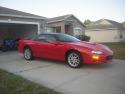






2010 COPO Camaro????
 2010 COPO Camaro????
 so maybe im a little out of date on things cuz im in Iraq but i was reading a GM high tech performance magazine and they had a small article about the COPO camaro that was pretty much saying its lagite and is coming out but ive heard no talk of it on here... anyone got some info? cuz im sure we all want it.... an SS with an LS7 at 500+ hp??? im sold
yeah no doubt this is not only gonna be a fast car but just look at how much the old COPO and Yenko camaro's are worth these days! i can only imagine. i would love to have one we will see
Trending Topics
LS1 Tech Stories
The Best V8 Stories One Small Block at Time

6 Common C5 Corvette Failures and What's Involved In Repairing Them
Pouria Savadkouei
Retro Modern Bandit Pontiac Trans AM Comes With Burt Reynolds' Autograph
Verdad Gallardo
Top 10 Greatest Cadillac V Series Performance Models Ever, Ranked
Pouria Savadkouei
Top 10 Most Powerful Chevy Trucks Ever Made!

Hennessey's New Supercharged Silverado ZR2 Has 700 HP
Verdad Gallardo
Coachbuilt N2A Anteros Is an LS2-Powered C6 Corvette In Italian Clothes
Verdad Gallardo
Awesome K5 Blazer Restomod Comes With C7 Corvette Power
Verdad Gallardo
10 Camaros You Should Never Buy

10 LS Engine Myths That Refuse to Die
Verdad Gallardo

TECH Enthusiast
Joined: Nov 2007
Posts: 700
Likes: 0
From: Louisiana, USA

Not even close to what the COPO heritage is about. COPO cars were built to be raced. Many of the COPO cars that still exist are worth more b/c of their documented racing heritage.
Ever heard of the "Rule of Seven"? Putting money into good equities or even solid mutual funds would be much smarter if you are looking for a return on your investment. Plus, your mutual fund shares don't have rubber and plastic components to them that will rot in 25 years.
 Your stock or mutual fund shares also don't take up a parking space in your garage.
Anyway, here's the rule of seven:
An investment doubles in 10 years if it earns 7% and doubles in 7 years if it earns 10%.

Launching!
Joined: Nov 2001
Posts: 259
Likes: 0
From: Viginia Beach, VA
They have yet to pick up that the originals were made with more supply than demand. That the reason such few examples exist is because people drove them and raced them, so some were actually destroyed or were too far gone to be restored. The reason they became sought after in the 80's was not just because of their rarity, but because they were seen at the drag strip in their day knocking down Hemi Cuda's and 429 Cobra Jet Mustangs. Fred Gibb and the likes made the cars what they are today by racing them.

On The Tree
Joined: Aug 2007
Posts: 175
Likes: 0
Chevrolet developed the Central Office Production Order system to meet the need for a procedure to build non-standard cars with Regular Production Order parts. It was intended for fleet orders: fleets of police cars; fleets of low-powered strippers for meter readers; fleets of taxicabs. It enabled Chevrolet and its dealers to compete effectively for large orders of exceptionally boring vehicles.
A few intrepid dealers saw in the COPO system a means to a very different end.
That was to build vehicles more powerful, more purposeful and more specialized than anything Chevrolet could justify offering through the Regular Production Option system. The most common of these was COPO 9561 which put the 427 cubic inch, 425 horsepower Mark IV big block V-8 into the Camaro where the biggest RPO engine was the L89 396/375hp aluminum head big block. COPO 9561 was sparingly used. It is believed that only 822 were built with 4-speeds plus another 193 with automatic transmissions.
In addition to the 427/425hp V-8 COPO 9561 included the ZL2 cowl induction hood, L78 cowl induction air cleaner, heavy duty springs, 12-bolt Positraction rear axle with 4.1:1 gears, heavy duty radiator and absolutely nothing on the outside of the car to identify it as anything special. It was a serious racer's car that made its statements with performance, not posturing.
The COPO cars where not a factory option race car, Here is the actual story of COPO cars. On another note because these cars where baseline cars GM really didnt make any money on them. As for a new production of COPO? That would certainly be something nice to see. Remember the last of the more Hipo- Camaro's & TA's or even Firebirds they had just about every option on the car making the car very pricey, which from a stand point in my book is what killed the FBody cars, only people making descent money could afford them, in which case this was generally the middle aged guy going through his mid-life crissis and he would usually get bitch slapped by his old lady because putting kids and stuff in the back seat was a PIA and had to trade it in for a minivan. Or you waited till they become basically good and used in order to afford it.
Chevrolet developed the Central Office Production Order system to meet the need for a procedure to build non-standard cars with Regular Production Order parts. It was intended for fleet orders: fleets of police cars; fleets of low-powered strippers for meter readers; fleets of taxicabs. It enabled Chevrolet and its dealers to compete effectively for large orders of exceptionally boring vehicles.
A few intrepid dealers saw in the COPO system a means to a very different end.
That was to build vehicles more powerful, more purposeful and more specialized than anything Chevrolet could justify offering through the Regular Production Option system. The most common of these was COPO 9561 which put the 427 cubic inch, 425 horsepower Mark IV big block V-8 into the Camaro where the biggest RPO engine was the L89 396/375hp aluminum head big block. COPO 9561 was sparingly used. It is believed that only 822 were built with 4-speeds plus another 193 with automatic transmissions.
In addition to the 427/425hp V-8 COPO 9561 included the ZL2 cowl induction hood, L78 cowl induction air cleaner, heavy duty springs, 12-bolt Positraction rear axle with 4.1:1 gears, heavy duty radiator and absolutely nothing on the outside of the car to identify it as anything special. It was a serious racer's car that made its statements with performance, not posturing.
Chevrolet developed the Central Office Production Order system to meet the need for a procedure to build non-standard cars with Regular Production Order parts. It was intended for fleet orders: fleets of police cars; fleets of low-powered strippers for meter readers; fleets of taxicabs. It enabled Chevrolet and its dealers to compete effectively for large orders of exceptionally boring vehicles.
A few intrepid dealers saw in the COPO system a means to a very different end.
That was to build vehicles more powerful, more purposeful and more specialized than anything Chevrolet could justify offering through the Regular Production Option system. The most common of these was COPO 9561 which put the 427 cubic inch, 425 horsepower Mark IV big block V-8 into the Camaro where the biggest RPO engine was the L89 396/375hp aluminum head big block. COPO 9561 was sparingly used. It is believed that only 822 were built with 4-speeds plus another 193 with automatic transmissions.
In addition to the 427/425hp V-8 COPO 9561 included the ZL2 cowl induction hood, L78 cowl induction air cleaner, heavy duty springs, 12-bolt Positraction rear axle with 4.1:1 gears, heavy duty radiator and absolutely nothing on the outside of the car to identify it as anything special. It was a serious racer's car that made its statements with performance, not posturing.
Exactly. They were a majority of stripper cars. No special amenities or or features, making them a very accessible street machine price wise. And many of them had dealer installed options.

Staging Lane
Joined: Feb 2004
Posts: 88
Likes: 0
From: On the fringe...
Concerning early COPOs:
Vince Piggins was the one who "suggested" the usage of the COPO "vehicle", pre-packaged as a "basic platform". Once the COPO content was selected, ANY non-competing Factory-available RPO could ALSO be ordered. That's why some 9560-9561s were ordered as RS, some with Vinyl Roof, and even one or two with Power Windows. And some were double-COPO, with the Sports Package. But generally they were kept as de-contented cars...witness the Automatics as column shift cars if ordered without the Floor Console...and most were...
COPO, through Piggins, also skirted the then-in-place GM edict that less-than-full-size cars would have no more than 400 cu. in. displacement engines. It was the "only" Factory-built way to put 427s in '69 Camaros and Malibus. Of course, Model Year 1970 saw all that change...for ALL GM Divisions...
Vince Piggins was the one who "suggested" the usage of the COPO "vehicle", pre-packaged as a "basic platform". Once the COPO content was selected, ANY non-competing Factory-available RPO could ALSO be ordered. That's why some 9560-9561s were ordered as RS, some with Vinyl Roof, and even one or two with Power Windows. And some were double-COPO, with the Sports Package. But generally they were kept as de-contented cars...witness the Automatics as column shift cars if ordered without the Floor Console...and most were...
COPO, through Piggins, also skirted the then-in-place GM edict that less-than-full-size cars would have no more than 400 cu. in. displacement engines. It was the "only" Factory-built way to put 427s in '69 Camaros and Malibus. Of course, Model Year 1970 saw all that change...for ALL GM Divisions...


will it be a COPO or ZL1!!!! hell id love to see these body styled new camaros with a ZL1 phase III package... probably equally priced to the ZR1 and prob will have its entire drivetrain and hopefully 700HP but in the bad *** camaro chassis
Staging Lane
Joined: Feb 2004
Posts: 88
Likes: 0
From: On the fringe...
Hey folks, do me a favor...
Post, or PM me, with YOUR thoughts on the vehicle content of a "buyable" COPO Camaro...one YOU would actually consider paying for...
1SS?
2SS?
LS7? (+ $15K, warranteed)
LSA/LS9? (+$25K, warranteed)
Stick?
Automatic?
"Understated", and racy?
Loaded, and cruisable?
Your answers may NOT be in vain...
Thanks!
Post, or PM me, with YOUR thoughts on the vehicle content of a "buyable" COPO Camaro...one YOU would actually consider paying for...
1SS?
2SS?
LS7? (+ $15K, warranteed)
LSA/LS9? (+$25K, warranteed)
Stick?
Automatic?
"Understated", and racy?
Loaded, and cruisable?
Your answers may NOT be in vain...
Thanks!