


I am about to O.D. on all this!!!



no..
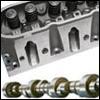
the only cams that that begins to start becoming a problem with are the ms4, polluter, trex.. then you have to use stock valves and shiznit..
you cant run regular 5.3 2.5s prc ls6 stg 2.5s...
you can use prc ls6 stg 1s and so on..
anything with stock valve sizes it will clear.
the only cams that that begins to start becoming a problem with are the ms4, polluter, trex.. then you have to use stock valves and shiznit..
you cant run regular 5.3 2.5s prc ls6 stg 2.5s...
you can use prc ls6 stg 1s and so on..
anything with stock valve sizes it will clear.
Lightly ported LS6 heads with stock valves and a good valve job would go a long way to help out, but these cams need compression too. You should look into cutting the pistons for proper Valve Clearance, milling the heads to build more compression, and running a thinner gasket to get the most bang for your buck. If you can get 11:1 or better, you'll have a lot more snap when you aren't at full throttle, and pickup 10-15 more HP upstairs.
It's all in the details, and how much effort you are willing to put into it.
Good Luck!

Thread Starter
TECH Regular
iTrader: (1)
Joined: Oct 2008
Posts: 416
Likes: 0
From: Riverside/Los Angeles, Ca
It is probably worth noting here that these 230+ cams should clear with stock size valves, stock head gaskets, and stock size combustion chambers - as long as the cam has been properly degreed. Many will take the chance that the new tiing chain is spot on, but a couple degrees of error, a thinner gasket and a head deck that has been cleaned up can all conspire to ruin your day.
Lightly ported LS6 heads with stock valves and a good valve job would go a long way to help out, but these cams need compression too. You should look into cutting the pistons for proper Valve Clearance, milling the heads to build more compression, and running a thinner gasket to get the most bang for your buck. If you can get 11:1 or better, you'll have a lot more snap when you aren't at full throttle, and pickup 10-15 more HP upstairs.
It's all in the details, and how much effort you are willing to put into it.
Good Luck!
Lightly ported LS6 heads with stock valves and a good valve job would go a long way to help out, but these cams need compression too. You should look into cutting the pistons for proper Valve Clearance, milling the heads to build more compression, and running a thinner gasket to get the most bang for your buck. If you can get 11:1 or better, you'll have a lot more snap when you aren't at full throttle, and pickup 10-15 more HP upstairs.
It's all in the details, and how much effort you are willing to put into it.
Good Luck!
Good questions, I try to answer them for you here.
Higher compression will require more octane to avoid deonation. You'll want to run the highest octane commonly available in your area, 93 if you have it. More compression is our way to fight the loss of low end snap that occurs when we alter the valve events for more top end. There is a whole lot of reading on Static Compression, camshaft selection and Dynamic Compression here in the forums.
Stock heads do have thinner deck surfaces, but we're not going to take too much off. Once you remove .030" to .040" material, you start to hurting airflow into and out of the cylinder and negate any gains from the extra squeeze.
PTV clearance is dependant upon the correct valve events, and the available valve drop, or distance that the valve moves off the seat before it contacts the theoretical plane of the deck surface. When we mill the head, we remove some of that clearance. Same when we use a thinner head gasket.
The easiest way is to stick with what is recommended by your cam grinder. They have put together hundreds (if not more) setups like yours, and know the safe clearance within an allowable range. Since you aren't looking at MS3/MS4 cams, you should have a fairly large margin of error.
That large margin leaves room for improvment. How much depends on what steps you are willing to take to get an extra 10-20rwhp out of your investment. The costs to get the tools to degree the cam and check piston to valve clearance fall pretty much in line with the $/hp spent on cams, heads, etc. The real benefit comes from optimizing your combination.
Ok..I might be understanding this wrong..But getting higher compression means you have to run 93+ octane or is it vise versa?
Milling too much puts the rigidity of the heads in question?
And while T2 or T3 will clear without problems, flycutting is needed?...If it all fits and clears and degreed right..Why would i need to cut the pistons?..
The easiest way is to stick with what is recommended by your cam grinder. They have put together hundreds (if not more) setups like yours, and know the safe clearance within an allowable range. Since you aren't looking at MS3/MS4 cams, you should have a fairly large margin of error.
That large margin leaves room for improvment. How much depends on what steps you are willing to take to get an extra 10-20rwhp out of your investment. The costs to get the tools to degree the cam and check piston to valve clearance fall pretty much in line with the $/hp spent on cams, heads, etc. The real benefit comes from optimizing your combination.
Thread Starter
TECH Regular
iTrader: (1)
Joined: Oct 2008
Posts: 416
Likes: 0
From: Riverside/Los Angeles, Ca
Good questions, I try to answer them for you here.
Higher compression will require more octane to avoid deonation. You'll want to run the highest octane commonly available in your area, 93 if you have it. More compression is our way to fight the loss of low end snap that occurs when we alter the valve events for more top end. There is a whole lot of reading on Static Compression, camshaft selection and Dynamic Compression here in the forums.
Stock heads do have thinner deck surfaces, but we're not going to take too much off. Once you remove .030" to .040" material, you start to hurting airflow into and out of the cylinder and negate any gains from the extra squeeze.
PTV clearance is dependant upon the correct valve events, and the available valve drop, or distance that the valve moves off the seat before it contacts the theoretical plane of the deck surface. When we mill the head, we remove some of that clearance. Same when we use a thinner head gasket.
The easiest way is to stick with what is recommended by your cam grinder. They have put together hundreds (if not more) setups like yours, and know the safe clearance within an allowable range. Since you aren't looking at MS3/MS4 cams, you should have a fairly large margin of error.
That large margin leaves room for improvment. How much depends on what steps you are willing to take to get an extra 10-20rwhp out of your investment. The costs to get the tools to degree the cam and check piston to valve clearance fall pretty much in line with the $/hp spent on cams, heads, etc. The real benefit comes from optimizing your combination.
Higher compression will require more octane to avoid deonation. You'll want to run the highest octane commonly available in your area, 93 if you have it. More compression is our way to fight the loss of low end snap that occurs when we alter the valve events for more top end. There is a whole lot of reading on Static Compression, camshaft selection and Dynamic Compression here in the forums.
Stock heads do have thinner deck surfaces, but we're not going to take too much off. Once you remove .030" to .040" material, you start to hurting airflow into and out of the cylinder and negate any gains from the extra squeeze.
PTV clearance is dependant upon the correct valve events, and the available valve drop, or distance that the valve moves off the seat before it contacts the theoretical plane of the deck surface. When we mill the head, we remove some of that clearance. Same when we use a thinner head gasket.
The easiest way is to stick with what is recommended by your cam grinder. They have put together hundreds (if not more) setups like yours, and know the safe clearance within an allowable range. Since you aren't looking at MS3/MS4 cams, you should have a fairly large margin of error.
That large margin leaves room for improvment. How much depends on what steps you are willing to take to get an extra 10-20rwhp out of your investment. The costs to get the tools to degree the cam and check piston to valve clearance fall pretty much in line with the $/hp spent on cams, heads, etc. The real benefit comes from optimizing your combination.


Thread Starter
TECH Regular
iTrader: (1)
Joined: Oct 2008
Posts: 416
Likes: 0
From: Riverside/Los Angeles, Ca









