








advice on heads

Thread Starter
Staging Lane
Joined: Dec 2016
Posts: 52
Likes: 3
 advice on heads
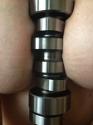
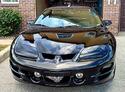
 looking to add heads to my car. car has a unknown grind from previous owner with supporting mods listed and 4:10 gear rear end car put down 398 hp.....my question how to go about choosing heads......start over with new cam or try to match this cam

TECH Addict
Joined: Jul 2013
Posts: 2,189
Likes: 123
From: Portland, Oregon
Welcome to the forums.
Personally, I would ditch the comp cam out of principle and start with something you know. Get one of the vendors on this site to spec you something specifically for your combination of parts and how you want to drive your car.
Surprising that BBK intake beat the LS6 intake in HotRod Magazine's 20 intake test, which is neat. And you already have 1-7/8" headers.
As for heads, are you wanting to get your current castings ported or buy fresh heads entirely?
If you have 241's and want to get them ported, then contact Phil @ Advanced Inductions for his 219cc High Compression program, and have him spec you a cam at the same time.
If you want new heads, then you cannot go wrong with TFS 220 Fast as Cast touched up by Brian Tooley, and you can get one of his cams at the same time.
Personally, I would ditch the comp cam out of principle and start with something you know. Get one of the vendors on this site to spec you something specifically for your combination of parts and how you want to drive your car.
Surprising that BBK intake beat the LS6 intake in HotRod Magazine's 20 intake test, which is neat. And you already have 1-7/8" headers.
As for heads, are you wanting to get your current castings ported or buy fresh heads entirely?
If you have 241's and want to get them ported, then contact Phil @ Advanced Inductions for his 219cc High Compression program, and have him spec you a cam at the same time.
If you want new heads, then you cannot go wrong with TFS 220 Fast as Cast touched up by Brian Tooley, and you can get one of his cams at the same time.
I would assume that since you made almost 400 to the wheels, the cam in the car is decently sized. I would keep the cam and run some ported 243s from ai or tea, or if you didn't want to get castings to send out, the PRC 227 heads would be a good option depending on your budget.
Without knowing what cam you currently have, it's hard to pick cylinder heads. If this is going to be an NA setup, you'll want to bump compression, which you can't really do safely without knowing what size cam you're currently running.
As far as heads go, it really depends on your budget. You can get a set of 243's/799's ported by companies like Advanced Induction, TEA, Livernois, Texas Speed, etc. If you're in the market for aftermarket castings, take a look at Trick Flow, AFR, MAST, MMS, etc. You could also browse the classified section on here. Oftentimes people are selling used aftermarket castings for a fraction of the cost new heads run.
As far as heads go, it really depends on your budget. You can get a set of 243's/799's ported by companies like Advanced Induction, TEA, Livernois, Texas Speed, etc. If you're in the market for aftermarket castings, take a look at Trick Flow, AFR, MAST, MMS, etc. You could also browse the classified section on here. Oftentimes people are selling used aftermarket castings for a fraction of the cost new heads run.
Trending Topics
Also, I'd generally say that if you are comparing two heads and one has slightly more top end flow, but worse velocity, and the other has slightly worse flow, but better velocity, go with the velocity over the peak flow number. This has the effect of "taming" aggressive cams and really not sacrificing much up top.
The metric I favor is the port efficiency, which is CFM flow at 0.600 valve lift divided by the port runner volume. And you need to make sure they are tested on your bore - or at least on an identical bore plate (big bore plate easy way to cheat the number).
--So, lets say you have a head that flows 320 @ .600" lift on a 220cc runner. Thats 320/220 = 1.45 port efficiency
--Similar head flows 330 @ 0.600" lift on a 235 runner. That's 1.40 port efficiency.
--Third option, a head flows 300 @ 0.600" lift on a 215 runner. That's 1.39 port efficiency.
--So, given the above heads, the 220cc runner will deliver the best torque AND will carry power very well up high.
And don't ignore exhaust flow either, but this is where cam selection comes in. In general, I see the best performing engines on stock type heads with 8-12 degrees of split, but the aftermarket castings, I tend to see 4-8 degrees of split. This is an example of why to choose heads first and then cam accordingly - to compliment the heads virtues and make up for the heads weaknesses.
LS1 Tech Stories
The Best V8 Stories One Small Block at Time

Topdon ONE vs. Artidiag 800 BT2: Which is the Diagnostic Tablet For You?
Pouria Savadkouei
Gas Monkey Built a 6-Wheel Ferrari Testarossa With a Corvette LT4 Engine
Verdad Gallardo
7 Most Reliable High-Performance Engines GM Has Ever Built
Verdad Gallardo
Amazing '71 Camaro Restomod Is Modern Muscle Car Under the Skin
Verdad Gallardo
6 Common C5 Corvette Failures and What's Involved In Repairing Them
Pouria Savadkouei
Retro Modern Bandit Pontiac Trans AM Comes With Burt Reynolds' Autograph
Verdad Gallardo
Top 10 Greatest Cadillac V Series Performance Models Ever, Ranked
Pouria Savadkouei
Top 10 Most Powerful Chevy Trucks Ever Made!

Hennessey's New Supercharged Silverado ZR2 Has 700 HP
Verdad Gallardo Thread Starter
Staging Lane
Joined: Dec 2016
Posts: 52
Likes: 3
What are you're thoughts on the pic as cast 225cc heads vs 2.5 ls6 heads slightly cheaper and slightly less flow. End result is like good useable power across board and if possible hit 430ish at the wheels
either head will get you there, honestly. I tend to prefer aftermarket castings, so I would do the PRC between those two. But, at that price for just a tiny smidge more, I'd opt for the trick flow castings. TFS 220 heads are very nice pieces.
If you want an off the shelf grind, here's a few:
Cam motion Titan 5
Tick SNS 2
Flowtech Streetsweeper HT
Really, anything in the 227-230 intake range and 234-238 exhaust range with 111 to 113 LSA is going to perform fairly similarly. I'd personally call cam motion up, because they could get you whatever you want.
Sort of spitballing here, but if you ran a 229/235-113+2 and milled your heads to 59-60cc, you'd have very good mid range torque and throttle response, carry power nicely up high, and with only 6 degrees overlap, not really have to fight the cam that much. If you wanted something smoother idle and easier to drive, something like 227/233-114+2 would be tamer and still rev nicely.
Cam motion Titan 5
Tick SNS 2
Flowtech Streetsweeper HT
Really, anything in the 227-230 intake range and 234-238 exhaust range with 111 to 113 LSA is going to perform fairly similarly. I'd personally call cam motion up, because they could get you whatever you want.
Sort of spitballing here, but if you ran a 229/235-113+2 and milled your heads to 59-60cc, you'd have very good mid range torque and throttle response, carry power nicely up high, and with only 6 degrees overlap, not really have to fight the cam that much. If you wanted something smoother idle and easier to drive, something like 227/233-114+2 would be tamer and still rev nicely.
Thread Starter
Staging Lane
Joined: Dec 2016
Posts: 52
Likes: 3
Now would those choices work for the pecs and what ballpark are we looking at hp/torque wise car is a toy so daily drive ability is not a concern however I wanna be able to drive it on the street and still whip *** so to speak
look at threads where guys have moved to smaller cams cause the car was a pain in the *** to drive. Good heads and moderate cams are where it's at.
I wish there was somewhere you could go to drive a 23x/23x cam on a ported LS6 head vs a 22x/23x cam on an Uber head and feel the difference. then, later on, if you decide you are willing to sacrifice driveability for power, you only need a 23x cam vs a 24x cam to get really good power.
I know a guy who made 460 (IIRC) on a 239/251-107 cam and stock-ish LS6 heads. He needed 4.56 gears, and ran out of gear at the track - almost couldn't shift fast enough, etc, and now has a stock LS3 and REFUSES to cam that motor, because "I don't want to make it a piece of ****"

227/241 at .050, I wouldn't say that is a hopeless cam but you could do better. Basically, more lift and the same or more intake duration and less exhaust duration. Make more power and less sound effects. A Tick SNS2 227/235 or LPE GT12 227/235 or the BTR 227/234 will all likely make more power and drive better and be easier to tune - thats my guess.
***** Thumpr Hydraulic Roller Camshaft GM LS Seires Lift: .563"/.546"1
http://www.jegs.com/i/COMP-Cams/249/54-601-11/10002/-1
COMP Cams 54-601-11 Details
GM LS Series Gen III/IV Three-Bolt 8 Cyl. 1997-Present
***** Thumpr
1997-Current Three-Bolt 4.8/5.3/5.7/6.0L LS1/Gen III/IV
Valve Setting: Intake - Hyd, Exhaust - Hyd
RPM Operating Range: 2300 to 6600
Cam Grind Number: 283THR7
Duration Advertised: Intake - 283, Exhaust - 303
Duration @ .050'': Intake - 227, Exhaust - 241
Valve Lift: Intake - .563, Exhaust - .546
Lobe Sep. Angle: 109°
Specifications: