When you click on links to various merchants on this site and make a purchase, this can result in this site earning a commission. Affiliate programs and affiliations include, but are not limited to, the eBay Partner Network.
While the LS6 stream tube may contribute, I bought a take out LS1 some years ago with LS1 intake & LS1 stream tube that had wasted #7. Pulled motor apart #7 had a replacement piston in it so it had had issues before too. Based on that experience, I would expect the LS1 steam tube to automatically prevent the problem.
Making sure the fuel system is in top condition & the cooling system is too is always worth while maintenance. For road course, upgrading the cooling system couldn't hurt.
what's an NNBS intake? Why did you swap, though it was the stock intakes fault?
its the trailblazer ss / new-new body style truck intake
GM redesigned it for more midrange torque and I swapped because it supposedly helped with the "lean in #7" thing according some bs thread i read on performance trucks. i've actually never hurt an LS, I am really conservative with my tuning, especially under boost.
NNBS truck intake
OBS truck intake
so if it its not the steam ports, and not the intake, then its either the way coolant passes through the block or ????
It won't save a motor if you have other problems lol
Originally Posted by truckdoug
its the trailblazer ss / new-new body style truck intake
GM redesigned it for more midrange torque and I swapped because it supposedly helped with the "lean in #7" thing according some bs thread i read on performance trucks. i've actually never hurt an LS, I am really conservative with my tuning, especially under boost.
NNBS truck intake
OBS truck intake
so if it its not the steam ports, and not the intake, then its either the way coolant passes through the block or ????
i know less now than I did before
I gotcha, thats cool. I didnt realize there was a change to the truck manifolds.
Regardless of the intake direction or fuel injector chosen for the number 7 or 8 cylinder, the cooler water from the pump enters the front of the block and continues to "pick up" or remove BTUs of heat from each of the cylinders until it gets to the two rear cylinders where it's now been super heated.
Warren Johnson used to shut the water pump off after the burnout and stage/launch the car with the engine in the 180-185 degree range. He believed that no coolant circulation around any of the cylinders for 6.5 seconds and the engine made its most amount of power at 192 degrees
Last edited by A.R. Shale Targa; Jan 11, 2017 at 11:46 AM.
OK, your Truck Intake choice was a VERY good upgrade for a Turbosupercharged engine.
MY report is ALSO correct, the back cylinders get a cooler water temp report.
I DO NOT "guess", as we know the heads are the same with EACH head having a sensor location, thus an EASY test.
I have done so MANY times due to my "Buggy" customer requests, "use the rear temp sensor location".
This is about a twenty degree LOWER read.
There may be SOME here that understand Water Flow through the engine block, most of the water that flows through the block EXITS the rear of the block, the REAR cylinders, into the REAR of the heads FIRST.
The engine coolant is then HEATED by the cylinder head as it moves to the front.
I do not argue that head, particular cylinder, temperatures effect detonation, they DUE.
I have modified cooling systems into "reverse cooling" , head first, as was done by my friend John Drake, the builder of the most successful racing engine TO THIS DAY.
The answer, a "fix", could be SO SIMPLE.
Lets spend some time on the ability to modify the head gasket to provide MORE water flow to #7.
A new location, a thermocouple probe location, could be created for #7.
My first guess would be to block off the water flow to #8, to lower that flow amount ?
If I had this engine on my test bench, my ECU could "read" #7 cylinder's crankshaft acceleration and compare it to the other cylinders.
My ECU-882C can provide a specific spark timing for EACH cylinder.
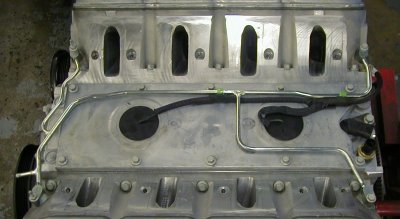
The early LS1s had a steam vent that went to all four corners of the engine. GM did away with that for the LS6 intake because the bottom of the intake didn't allow for any room for the tube.
The early LS1s had a steam vent that went to all four corners of the engine. GM did away with that for the LS6 intake because the bottom of the intake didn't allow for any room for the tube.
have you read the thread at all? We're specifically talking about using the ls1 4 port crossover vs. The 2 port ls6 and blocked off rear ports. And you CAN use the 4 port on an ls6 intake you just have to be willing to shave the bottom of the intake a bit.
since more seem to have issues when the steam ports are blocked a la ls6, it seems like the steam ports being blocked is the issue.
If it were a steam port issue, the LS1 wouldn't have the problem, but it does. If it were an intake issue, you would see differences between various intakes, but you don't.
The early LS1s had a steam vent that went to all four corners of the engine. GM did away with that for the LS6 intake because the bottom of the intake didn't allow for any room for the tube.
You can't possibly believe that GM did away with something supposedly so important just to gain like 2hp. The steam vent isn't the problem. #7 runs hot on ALL of GM's V8's, this is nothing new. The back of every engine always runs hot.
And there's nothing stopping GM from simply creating a different routing path for the rear steam vents if they were really as necessary as you guys make them out to be. GM deleted them for a reason.
I think we should all pay attention to Pantera EFI's comment about the water circulation.
If I understood correctly. Water moves Front of block to back of block, then moves UP to the REAR cylinder heads then toward the front. The cylinder head will have MORE heat than the engine block so the REAR of the cylinders get better cooling than the front.
Given the rear of the cylinder head is cooled first explains why GM was able to change the steam vents for the LS6 intake. The water isn't hot enough yet to need the the LS1 intake style stream vents at the back of the engine, so they could be eliminated/reduced for the LS6 intake.
His data based on racing supports the rear cylinders run cooler.
This implies it is not a cooling issue in the cylinder head or block.
Looks more like a timing advance & tune issue based on the information provided.
He also said with this ECM system and 58x crank relucator, none of his customers had had the #7 issue. Being able to adjust timing uniquely tailored to each specific cylinder sounds very interesting.
Some of what he says goes against what I've learned re: combustion temps and timing.
So he is saying the rear cylinders run cooler, thus are over-feuled and don't have optimum spark advance--so a rich mixture in the rear cylinders and too much advance, or inaccurate advance due to a reluctor wheel with less resolution, is the problem? .
I had always thought:
richer mixtures burn cooler than leaner, thus are safer.
I think we should all pay attention to Pantera EFI's comment about the water circulation.
If I understood correctly. Water moves Front of block to back of block, then moves UP to the REAR cylinder heads then toward the front. The cylinder head will have MORE heat than the engine block so the REAR of the cylinders get better cooling than the front.
Given the rear of the cylinder head is cooled first explains why GM was able to change the steam vents for the LS6 intake. The water isn't hot enough yet to need the the LS1 intake style stream vents at the back of the engine, so they could be eliminated/reduced for the LS6 intake.
His data based on racing supports the rear cylinders run cooler.
This implies it is not a cooling issue in the cylinder head or block.
Looks more like a timing advance & tune issue based on the information provided.
He also said with this ECM system and 58x crank relucator, none of his customers had had the #7 issue. Being able to adjust timing uniquely tailored to each specific cylinder sounds very interesting.
You've definitely misunderstood. The water doesn't flow all the way through the block before it flows into the head. The water simply flows from the block to the head and then to the pump. That's why there are coolant passages all along the head and block. The rear-most cylinders get their coolant last.
And not sure where that guy got his information about his rear cylinders running cooler. Either he's an idiot, or, well, I don't know what else he could possibly be.
This is usually reduced by having four corner cooling like the LS1 & 6 had. But, some people will argue against it. I say it can't hurt and it can help.
I also heard this. I have also read about it in the wil handzel how to build high performance Gen111 book they mention that running the early style under the manifold steam ventilation pipes helps to prevent issues with num 7.
Retro Modern Bandit Pontiac Trans AM Comes With Burt Reynolds' Autograph
Slideshow: A modern Camaro transformed into a retro icon, this limited-run "Bandit" build blends nostalgia with brute force in a way few revivals manage.
Top 10 Greatest Cadillac V Series Performance Models Ever, Ranked
Slideshow: Cadillac didn't just crash the high-performance luxury vehicle party, it showed up loud, supercharged, and occasionally a little unhinged...
Coachbuilt N2A Anteros Is an LS2-Powered C6 Corvette In Italian Clothes
Slideshow: A one-off sports car that looks like a vintage Italian exotic-but hides a C6 Corvette underneath-just sold for the price of a new mid-engine Corvette.