When you click on links to various merchants on this site and make a purchase, this can result in this site earning a commission. Affiliate programs and affiliations include, but are not limited to, the eBay Partner Network.
I have a stock motored 2003 GMC Sierra with a gasoline 5.3L (LM7) that has the notorious Castech 706 heads. The truck is at 87k miles, and I want to get ahead of the head cracking issue that, from all accounts, sounds inevitable. I know there are a number of aftermarket and performance option I can go with, but at the end of the day, this is a daily driver-ish truck that I just want to run for as long as possible, so I'm inclined to go with a replacement head that can utilize factory components and tune (does this mean I'm getting old?)
So here are my questions.
1) Is there an alternate 706/862 head casting (non-Castech) that can be purchased new today that won't have the cracking issue down the road? This is the ideal option for me as it wouldn't require any aftermarket head components or a tune.
2) I know one popular replacement option is a 243/799 head which would require milling in order to bring the compression ratio back in line with the stock head. Assuming factory LM7 springs/pushrods/etc were used, would this enable use of the stock engine tune?
3) Aside from going with full blown aftermarket performance heads, are there any other options for handling the Castech 706 head issue?
The head cracking is "inevitable" at around 140k miles, give or take.
Plenty of people repair the Castech heads by welding up the places that fail.
The 243/799 is OK, BUT, if you have a 5.3 from your year, they will lower the compression significantly. They are good on a flat-top (MUCH later) 5.3 but not so much on a dished one like you & I have.
I've heard it said that a cracked repaired Castech head is better than a non-failed one, but I won't vouch for that. Personally a thing that I know is likely to fail creeps me out, much worse than something that I know is going to fail, already has, and the failure has been dealt with in a permanent fashion.
I'd recommend either finding a set of non-Castech 706 or 862, or, a set of repaired ones. They're CHEEEEEEEEEEP, especially when you consider that as part of the repair, they get a valve job. (obviously the quality of those varies dramatically... you'd want a 3-angle one minimum, preferably a 5-angle) You can buy a pair, put em on the shelf as insurance against the predictable opportunity for a solution, and swap em out when that day comes and the solution is needed. It only takes an afternoon (good weather of course, if you're outdoors) to swap those. Not all that painful in the grand scheme, really.
The head cracking is "inevitable" at around 140k miles, give or take.
Plenty of people repair the Castech heads by welding up the places that fail.
The 243/799 is OK, BUT, if you have a 5.3 from your year, they will lower the compression significantly. They are good on a flat-top (MUCH later) 5.3 but not so much on a dished one like you & I have.
I've heard it said that a cracked repaired Castech head is better than a non-failed one, but I won't vouch for that. Personally a thing that I know is likely to fail creeps me out, much worse than something that I know is going to fail, already has, and the failure has been dealt with in a permanent fashion.
I'd recommend either finding a set of non-Castech 706 or 862, or, a set of repaired ones. They're CHEEEEEEEEEEP, especially when you consider that as part of the repair, they get a valve job. (obviously the quality of those varies dramatically... you'd want a 3-angle one minimum, preferably a 5-angle) You can buy a pair, put em on the shelf as insurance against the predictable opportunity for a solution, and swap em out when that day comes and the solution is needed. It only takes an afternoon (good weather of course, if you're outdoors) to swap those. Not all that painful in the grand scheme, really.
Yes agreed , I use to call the 862 the good heads , because some of 706 being castech but like mentioned above they can be fixed ,weak prone areas need to be
reenforced . I have come full circle , I actually prefer the 706 if you want to use in stock form . This is what I would look for....... stay away from earlier pre 2003 heads , This will increase your chances of Not finding problem castech or notched heads.. While both of these can be fixed by welding and then decking it is an expense .
The head cracking is "inevitable" at around 140k miles, give or take.
Plenty of people repair the Castech heads by welding up the places that fail.
The 243/799 is OK, BUT, if you have a 5.3 from your year, they will lower the compression significantly. They are good on a flat-top (MUCH later) 5.3 but not so much on a dished one like you & I have.
I've heard it said that a cracked repaired Castech head is better than a non-failed one, but I won't vouch for that. Personally a thing that I know is likely to fail creeps me out, much worse than something that I know is going to fail, already has, and the failure has been dealt with in a permanent fashion.
I'd recommend either finding a set of non-Castech 706 or 862, or, a set of repaired ones. They're CHEEEEEEEEEEP, especially when you consider that as part of the repair, they get a valve job. (obviously the quality of those varies dramatically... you'd want a 3-angle one minimum, preferably a 5-angle) You can buy a pair, put em on the shelf as insurance against the predictable opportunity for a solution, and swap em out when that day comes and the solution is needed. It only takes an afternoon (good weather of course, if you're outdoors) to swap those. Not all that painful in the grand scheme, really.
also, since we're on the subject, and my google-fu has been lacking on this subject, are pretty much all castech 706 heads suspect? TSB said "small number," which seems like BS.
what casting method was used on these heads? it makes me worried about other castech castings made during this time period. Quite a number of 243's were done by castech. i've never read of a problem with 243 castings, though.
2004 Tahoe with LM7, .... Would I have the Castech heads?
There's a strong possibility. Not sure what percentage or anything. It's more than a "small number" of them though. My 04 Avalanche LM7 had them; they cracked at around 150k if memory serves.
The welding is actually quite simple. They crack right above the head bolts that are in the row across the middle of the heads. The coolant leaks into the crankcase and makes a giant mess out of the oil. The weld doesn't even have to be machined back down or anything, as long as it doesn't leave such a giant lump that you can't get a socket on the bolt or something like that. Seems like maybe the casting must be real thin right there. Not sure whether any other castings they made were like that, I don't think so but don't take my word for it.
Look for the casting mark that looks kinda like a D-cell battery. Google "castech heads" images, there's lots of photos. In fact, the one I posted elsewhere of mine with the crack, comes up on the 1st page of them. Unfortunately I've seen where sometimes when people fix them, they machine the logo off. But, if you see the mark that looks like a battery, be mentally prepared that it might happen to you someday.
A little incident right after I bought it might be telling. The reservoir was cracked (unbeknownst to me), and leaked all the coolant until it got hot. It needed a water pump as a result. Would that not have triggered a crack? It runs very well now, with 5k more miles on it.
I have a 2004 Tahoe with LM7, with just over 170k miles. Would I have the Castech heads?
I recommend pulling off the heads to check for any cracks. While the heads are off you will have to reduce the swirl ramp, remove the rocker stud boss lump, backcut the intake valves, and use a thinner head gasket. Should bring the Tahoe to life
I recommend pulling off the heads to check for any cracks. While the heads are off you will have to reduce the swirl ramp, remove the rocker stud boss lump, backcut the intake valves, and use a thinner head gasket. Should bring the Tahoe to life
If/when the time comes, a good bowl blend, multi-angle valve job and about a.020 mill with .040 head gaskets (10:1 compression) should get the job done. Plus getting the mentioned lumps out...
Good ideas!
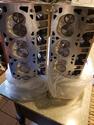
No need to pull the heads off to look for cracks. Your valve covers will be full of yellowish glop, your car will smoke heavily at startup, and you'll be able to see places near head bolts that look like this; all steam-cleaned looking. You'll have to remove the rocker rail to see it.
This was my 04 LM7.
I would NOT under any circumstances WHATSOEVER try to fix it with any kind of stop-leak.
Bought a take out LM7 longblock a few years ago. 70k mile that was removed for a “slow coolant loss” that was never found.
Still have the 706 heads that I’ve slowly been porting.
Castech castings of course.
Never paid any attention to this cracking issue.
Now I know what the mysterious coolant loss likely was. Too bad, they cleaned up like new. I’m thinking recycle bin. Didn’t really have a use for them anyway
They're VERY EEEEEEZY and VERY CHEEEEEEEEEEP to fix; and the fix is quite reliable.
I'd find somebody that can weld aluminum and just have em do all 6 spots. (at least, I don't think the end ones are susceptible; butt hay, you have em do those other 4 too if you want)
I should also mention, a truck with this going on will generally have low oil pressure since the AF turns the oil into something that doesn't pressurize well and doesn't lubricate, and it will have a tendency for lifters to tick. Altogether a nasty but easily identified and repaired situation.
They're VERY EEEEEEZY and VERY CHEEEEEEEEEEP to fix; and the fix is quite reliable.
I'd find somebody that can weld aluminum and just have em do all 6 spots. (at least, I don't think the end ones are susceptible; butt hay, you have em do those other 4 too if you want)
I should also mention, a truck with this going on will generally have low oil pressure since the AF turns the oil into something that doesn't pressurize well and doesn't lubricate, and it will have a tendency for lifters to tick. Altogether a nasty but easily identified and repaired situation.
Truckdoug can weld them then. It can be a project for him. He lives close.
The Engine was surprisingly clean inside. With the exception of a good 1.5” of gray muck in the pan. So bad the pickup screen was indented into it.
Rod and main bearings excellent. Cam bearings not so hot.
Basically gave the block to a friend in need. Was already tanked and had new cam bearings.
Since 243 heads now seem scarce, even though millions were made, I’ll hang onto these for a possible LS1 project.
i don't see how 243 heads are scarce. perhaps low mile ones are, or early castings... there are tons on ebay and in yards, they just need significant reconditioning.
i don't see how 243 heads are scarce. perhaps low mile ones are, or early castings... there are tons on ebay and in yards, they just need significant reconditioning.
I meant decent pairs, not singles from core shops etc. Here in Portland OR, I've never seen a pair on CL etc.
Missed a 6k mile pair here on our own classifieds last week for $200...….and I responded with a higher offer a few hours after they were listed. Those would have been sweet.
If/when the time comes, a good bowl blend, multi-angle valve job and about a.020 mill with .040 head gaskets (10:1 compression) should get the job done. Plus getting the mentioned lumps out...
Good ideas!
lol sure, but hopefully your heads are fine. But if they are not well might as well.
6 Common C5 Corvette Failures and What's Involved In Repairing Them
Slideshow: From wobbling harmonic balancers to failed EBCMs, these are the issues that define long-term C5 ownership and what repairs typically involve.
Retro Modern Bandit Pontiac Trans AM Comes With Burt Reynolds' Autograph
Slideshow: A modern Camaro transformed into a retro icon, this limited-run "Bandit" build blends nostalgia with brute force in a way few revivals manage.
Top 10 Greatest Cadillac V Series Performance Models Ever, Ranked
Slideshow: Cadillac didn't just crash the high-performance luxury vehicle party, it showed up loud, supercharged, and occasionally a little unhinged...
Coachbuilt N2A Anteros Is an LS2-Powered C6 Corvette In Italian Clothes
Slideshow: A one-off sports car that looks like a vintage Italian exotic-but hides a C6 Corvette underneath-just sold for the price of a new mid-engine Corvette.





 5.3L Castech 706 - easiest replacement options