When you click on links to various merchants on this site and make a purchase, this can result in this site earning a commission. Affiliate programs and affiliations include, but are not limited to, the eBay Partner Network.
Can't tell or safely assume from the pic but it looks like the valves are hitting the clay not the piston. You need to measure the thickness of the clay where the valves hit.
If valve not open with lifter on cam base circle, it's not the push rod causing too much lift. Where was the cam ICL installed at? Side note - what method did you use to identify correct push rod length with TS rockers? Not sure what TS changed that would require a 0.175" shorter PR (i.e. it's not .02 ratio difference).
You made the hydraulic lifter a solid so as to not be fooled by the plunger dropping good idea. That also means you dont add any length to what you are using to check PTV clearance. Use the zero lash length for the check. If you added the preload and are still using the lifter that has the fixed plunger then you are opening valve too far....and as stated above probably not closing the valve when on the base circle.
You made the hydraulic lifter a solid so as to not be fooled by the plunger dropping good idea. That also means you dont add any length to what you are using to check PTV clearance. Use the zero lash length for the check. If you added the preload and are still using the lifter that has the fixed plunger then you are opening valve too far....and as stated above probably not closing the valve when on the base circle.
I will definitely do this now but really wasn’t planning on it if the valve to piston would of checked out.
Originally Posted by tblentrprz
If valve not open with lifter on cam base circle, it's not the push rod causing too much lift. Where was the cam ICL installed at? Side note - what method did you use to identify correct push rod length with TS rockers? Not sure what TS changed that would require a 0.175" shorter PR (i.e. it's not .02 ratio difference).
you have me a great idea!!!! The pushrod does push the valve open when it’s on the base circle. Thank you sir!!!
Originally Posted by freeridesnomore
You made the hydraulic lifter a solid so as to not be fooled by the plunger dropping good idea. That also means you dont add any length to what you are using to check PTV clearance. Use the zero lash length for the check. If you added the preload and are still using the lifter that has the fixed plunger then you are opening valve too far....and as stated above probably not closing the valve when on the base circle.
The valve is opening on the base circle of the cam when the rocker arm is tightened down. Would you Please explain What you mean “if you added the preload and are still using the lifter that has the fixed plunger then you are opening the valve too far”.
Thank you guys for the help.
so I messed with it some more this morning... went back to step one. Checking pushrod size using comp cam rod checker and the zero lash method.
I’m using the old lifter that I made into solid lifters by reversing the bottom plunger in the lifter.
I’m putting two (2) pushrods into the intake and the exhaust of cylinder #1.
I’ve got the crank and timing set marks pointing to one another at 12:00 and 6:00 respectively.
I’m finding the base circle of the intake Lobe on the cam by feeling the upward movement of the exhaust valve pushrod.
using the lash method on the rod checker... I get zero lash at a length of 7.225.
The method I use for base circle certainty is exhaust open to intake closed. Then rotate an additional 45-90 degrees. Works like a charm, and those both valves are on the base circle. FWIW, you have over 180 degrees from the time the intake closes until the exhaust opens, so that extra 45-90 degree rotation will still be on base circle.
If you still have that solid lifter in there, set the pushrod up for zero lash, then use the zero lash length to check the PTV.
If you still find PTV hitting, don't just make sure the dots line up. I can show you if you're a tooth off that it can look like they're aligned - especially if the oil pump is still on. If the pushrod length is correct and you still get PTV, you need to degree the cam with a wheel and dial indicator. FInd the true ICL vs the specified ICL. I have had cams ground off 9 degrees, factory timing sets off by 6 degrees, etc. If it's properly degreed, proper length pushrod and still hitting, time to flycut or go to a cam with less overlap. That said, the cam you have should not need to flycut
The method I use for base circle certainty is exhaust open to intake closed. Then rotate an additional 45-90 degrees. Works like a charm, and those both valves are on the base circle. FWIW, you have over 180 degrees from the time the intake closes until the exhaust opens, so that extra 45-90 degree rotation will still be on base circle.
If you still have that solid lifter in there, set the pushrod up for zero lash, then use the zero lash length to check the PTV.
If you still find PTV hitting, don't just make sure the dots line up. I can show you if you're a tooth off that it can look like they're aligned - especially if the oil pump is still on. If the pushrod length is correct and you still get PTV, you need to degree the cam with a wheel and dial indicator. FInd the true ICL vs the specified ICL. I have had cams ground off 9 degrees, factory timing sets off by 6 degrees, etc. If it's properly degreed, proper length pushrod and still hitting, time to flycut or go to a cam with less overlap. That said, the cam you have should not need to flycut
Thank you so much Darth,
I will try that Today although I am pretty sure I’m on the base circle. Oil pump is not on yet. I have also ordered the new pushrods.
But I think there is something else going on here. I haven’t degree the cam because I have to get the dial and dial indicator. Im saying there is something else because I can understand the pushrod being too long due to using the 1.72 rockers from TS (Which call for a .175 shorter rod) but Yesterday I used one of the original Stock rockers And it was still pushing down on the valve when I was on the base circle. Keep in mind the head was only milled down .025.
im going to use your method for finding the base circle and see what happens. I’ll report back but I hope this cam is ground properly.
thanks again.
edit: I have the old stock timing set too... I’ll mess around with those too so to make sure I don’t spot something glaring.
Last edited by Urocmyiroc; Oct 2, 2020 at 09:51 AM.
Reason: Additional information
If you're serious about building an engine with a non stock cam, get the right tools and degree the cam per the suppliers recommended ICL. Some might consider this an optional step just like PTV clearance checking. You can tweak cam timing from there depending on application/goals. If you want to be just an installer, install cam dot to dot and live with the results or back up and diagnose when things don't work so well. Hope this makes sense. Off soap box!
If you're serious about building an engine with a non stock cam, get the right tools and degree the cam per the suppliers recommended ICL. Some might consider this an optional step just like PTV clearance checking. You can tweak cam timing from there depending on application/goals. If you want to be just an installer, install cam dot to dot and live with the results or back up and diagnose when things don't work so well. Hope this makes sense. Off soap box!
I get it and you’re right. The problem is people get comfortable with the LS due to its commonality. This is the third LS1 I’ve put together and the first time I’m having this kind of issue. Usually I’d just do a piston to valve clearance with the modelling clay... guess I’m graduating from installer status. Lolll.
I’m going to degree the cam... just waiting for the kit to show up.
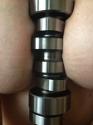
so I ordered a comp cams degree set for the LS... calculated my intake Center line and got 109.5. Cam card says 109.
cam card does not have values for exhaust.
OK, very good. I never measure on the exhaust side, as I usually find that the intake side confirms the cam. I'm surprised but glad for you that I was wrong about the cam being off. Makes the rest easier.
Now, I assume you have an old HG laying around. If possible, see if you can swap out a spring for a checker spring. This will allow you to use the pushrod measuring tool without risking damaging it from excess spring pressure. if you have dual springs, removing the outer spring and leaving the inner spring on will suffice for this as well.
You said in your OP that you measured 7.15, then added 0.070 for preload. For this purpose, reinstall your solid lifter, and set the pushrod tool to 7.15 (no preload, because the lifter is solid), then install the rocker. The rocker should be tight, and might slightly wiggle. That's fine, as long as it doesn't have tons of movement. If it's tight, and you're still turning the bolt, you're actually lifting the valve off the seat. Take some length out of the checker tool until you can get an almost tight fit.
Then turn the engine over and see how it does.
If it still hits, you will need to flycut the pistons. I would not have thought you'd need to on this cam, but it is what it is.
OK, very good. I never measure on the exhaust side, as I usually find that the intake side confirms the cam. I'm surprised but glad for you that I was wrong about the cam being off. Makes the rest easier.
Now, I assume you have an old HG laying around. If possible, see if you can swap out a spring for a checker spring. This will allow you to use the pushrod measuring tool without risking damaging it from excess spring pressure. if you have dual springs, removing the outer spring and leaving the inner spring on will suffice for this as well.
You said in your OP that you measured 7.15, then added 0.070 for preload. For this purpose, reinstall your solid lifter, and set the pushrod tool to 7.15 (no preload, because the lifter is solid), then install the rocker. The rocker should be tight, and might slightly wiggle. That's fine, as long as it doesn't have tons of movement. If it's tight, and you're still turning the bolt, you're actually lifting the valve off the seat. Take some length out of the checker tool until you can get an almost tight fit.
Then turn the engine over and see how it does.
If it still hits, you will need to flycut the pistons. I would not have thought you'd need to on this cam, but it is what it is.
I do want to know how the preload on these solid lifters is going to work out when I install the hydraulic lifters... does it mean I’ll have more than the PTV I’m showing now?
If so, is a thinner gasket advisable?
or should I opt for the next size up (7.230) on the pushrods since I needed 7.226 and I went with the 7.225 Due to it being closer in value.
I think it's time to bolt down a head with a used gaskets and the lifters as they should be (not converted to solid) and measure preload and valve clearance and see where you're at. And what you need.
I gonna take a wild guess and guess that you're valve clearance will be fine and that you'll be around .080 preload with the 7.225's. But you'll have to measure to see.
The preload wont actually change your valve clearance, in and by itself, but the squish that comes from running them will actually reduce your lift a little and increase valve clearance a little. But very little and should never be considered a safety margin because there may be times the lifters don't deflect any of the lift.
6 Common C5 Corvette Failures and What's Involved In Repairing Them
Slideshow: From wobbling harmonic balancers to failed EBCMs, these are the issues that define long-term C5 ownership and what repairs typically involve.
Retro Modern Bandit Pontiac Trans AM Comes With Burt Reynolds' Autograph
Slideshow: A modern Camaro transformed into a retro icon, this limited-run "Bandit" build blends nostalgia with brute force in a way few revivals manage.
Top 10 Greatest Cadillac V Series Performance Models Ever, Ranked
Slideshow: Cadillac didn't just crash the high-performance luxury vehicle party, it showed up loud, supercharged, and occasionally a little unhinged...
Coachbuilt N2A Anteros Is an LS2-Powered C6 Corvette In Italian Clothes
Slideshow: A one-off sports car that looks like a vintage Italian exotic-but hides a C6 Corvette underneath-just sold for the price of a new mid-engine Corvette.








 Engine assembly but Piston hits valve... help













