When you click on links to various merchants on this site and make a purchase, this can result in this site earning a commission. Affiliate programs and affiliations include, but are not limited to, the eBay Partner Network.
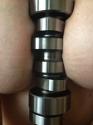
Darth, thanks for chiming in. If I had to guess, I agree it is probably 5150. I don't know what the cam core is for sure because it was called in to Allan Futral, who had CM grind it to his specs; .603" lift I., .608" E., 112° LSA, 232° duration intake, 250° duration exhaust. I have the cam info sheet, I'll see if it specifies material. I've always liked CM cams, too. After all, I did buy 2 of them. Since the cam heels showed no wear, and all 16 measured in at 56-58 RC, EXCEPT the really bad lobe, which measured only 30-32 RC, I believe that cam lobe is not hard enough. This is in an LS7, with 3/8" Trend PRs, .080" wall. Yes, the PRs could be heavier wall. But if that's the case why aren't all the lobes totally trashed, since the springs checked fine?
Yeah, agreed on all points. And I was pretty sure it wasn't a setup issue. Rather I was pointing out how I would expect a setup issue to present, and I'm not really seeing it. And at 30-32 HRC, my guess is that somehow that lobe ended up near the flame source and got over-tempered after quenching. At work, I routinely quench to a 52 HRC and temper the case back to 30 for ductility during rolling. But yeah, with .007" wear, no way the hardened case wore off. Hardened cases are typically .080-.100" thick. I'm sure you know that much without me saying it. You seem like a pretty savvy machinist from what I've been reading.
Darth, what's your take on the core? I was kinda leaning towards 5150, but when my cam bearing journals all measured 59-62 RC, and after what you just posted, maybe it was 8620. I know the cam was a bit over $400 in 2020, if price is any indication. Also wondering; why would the journals would be harder than the lobes? Thank you for your compliments, but I obviously don't know everything, or I wouldnt be asking any questions!!
Someone mentioned nitriding earlier in the thread, and I'm pretty sure the cams are not nitrided. it's generally not needed.
That would be me, stating that as one of two methods of heat treating.
Originally Posted by grinder11
I clearly stated I ran LS7 lifters. One guy here kept insisting I was running Johnson lifters!
Nope that's not what it was, as you said it earlier in the thread one might call that "selective reading".
You mentioned you were changing to Johnson Lifters which have a different pre-load and the guy chimed in with that spec. He clearly went out of his way, above and beyond to give you that spec. You know that whole community coming together thing you criticized as that doesn't happen anymore..
Originally Posted by grinder11
Most of those guys have strangely disappeared. I took a lot of my time doing the hardness testing, sending the springs to Tony, etc. Hell, I had to dig those springs out of my garage garbage can, and clean them up. Not much incentive to try and contribute factual info, I must say.
You literally posted this several hours ago. Some of us have day jobs. We aren't 70, home, and bored.
The other guys can chime in on their behalf, or maybe they got tired of repeating themselves with someone who likes to agrue..
Darth, what's your take on the core? I was kinda leaning towards 5150, but when my cam bearing journals all measured 59-62 RC, and after what you just posted, maybe it was 8620. I know the cam was a bit over $400 in 2020, if price is any indication. Also wondering; why would the journals would be harder than the lobes? Thank you for your compliments, but I obviously don't know everything, or I wouldnt be asking any questions!!
If I may, the cam journals don't have as much material removed from them when they are finished. If you look at the side profile of the journal or the lobe, you can some times see the discoloration from the heat. It's no indication of exact depth or hardness but it is usually visible.
Sorry don't have a cam with me at the moment to show.
Just got done testing the original 1905 valve springs on a very accurate Intercomp valve spring tester
I will admit I was surprised to see how well they hung in there with the amount of miles on them. For a more affordable valve spring you certainly cant complain one bit....Im impressed actually
At 1.800 the installed seat pressure varied from 149 - 161 (advertised at 160 @ 1.800). Note I didnt actually measure their original installed height because I got the heads disassembled from Mike but I was informed they were set up at 1.760 so even the weakest spring at that height measure 164 lbs on the seat
With Mikes OEM rockers and the cam he had I would say with a high degree of confidence that reduced spring pressure (and potential valve bounce) wasn't the cause of the issue. This assumes smoother cam lobe designs and I don't have any info on those particular lobes but for the spring to last this long the lobes must have been smooth.
Btw the rate of the spring was advertised at 392 lbs per inch.....even the weakest spring came in at 420 lbs per inch (which is somewhat common....in the sense I see quite a few springs from the higher quality spring manufacturers come in above stated spring rates).
What else....hardness test on the cam lobes....to me it makes sense the really worn lobe had the lowest hardness as it had the most material removed. Surface hardness only goes down so deep and with more material gone the material that was left should have shown a lower hardness value
A big reason I was never a fan of cutting cranks .010 under....while you get the journal nice and round again the actual surface of that journal is softer than what it was at the OEM diameter due to the depth of the material cut and a lower hardness at that depth.
Also the depth of the heat treat is really dependent on how the part is heat treated so that's a moving target also
Anyway....we didnt find the smoking gun with the spring testing and good on PAC Racing to offer a spring at this price providing that much longevity
I don't regret pushing Mike to go with the higher quality 1200 series though....too much riding on the springs to save a few bucks there if your goal is trying to get yourself the most reliability possible
Not to mention I pushed the lift up a bit on the new cam and the better spring is just the right call for this build for many reasons
That would be me, stating that as one of two methods of heat treating.
Nope that's not what it was, as you said it earlier in the thread one might call that "selective reading".
You mentioned you were changing to Johnson Lifters which have a different pre-load and the guy chimed in with that spec. He clearly went out of his way, above and beyond to give you that spec. You know that whole community coming together thing you criticized as that doesn't happen anymore..
You literally posted this several hours ago. Some of us have day jobs. We aren't 70, home, and bored.
The other guys can chime in on their behalf, or maybe they got tired of repeating themselves with someone who likes to agrue..
From the beginning I felt like my intelligence and credentials were being put down. After the first question I asked I was attacked by the OP. Since there are two threads on this I don't remember which one that initially happened in.
I mentioned I've been running a cam motion cam and went through the motor last winter with no signs of issues which answered the op's question directly if I had personal experience or issues with cam motion. I did not, but then I was attacked as being a fan boy or working for them. I consider myself neither of those. Bottom line I got tired of being attacked for asking questions about the parts used in the combo and the setup of the valvetrain.
I never once said the setup was the cause those things seem like important details to know when trying to help find the root cause, but the OP got very defensive and attacked me stating I had the intelligence of a 5-year-old and he was superior with his better measuring skills without knowing anything about my personal work experience. He never did disclose the valve guide issue he experienced with the heads as that was only discovered by another member who remembered the op's previous thread about the issue. I've been beating on my current motor for over 5 years running in the 5's in the 1/8th with a nearly full weight GTO (terrible chassis for drag racing) and complete daily driveability no issues thus far, but nothing lasts forever when I'm constantly spinning it to 7200 rpm.
I feel like the thread would have gone a different direction had the op answered the questions about the combination, setup, use, etc without the I'm better than you attitude how dare you ask my any questions about how I built the motor. Anyone who asked a question about the parts used or the setup of the valvetrain was attacked immediately and told they were less intelligent and less skilled than the op.
That is why I originally left the thread. I saw Tony posted today so I came back to read his post. I will never reply to the op again in any thread as he is too superior to talk to us like an equal.
Darth, what's your take on the core? I was kinda leaning towards 5150, but when my cam bearing journals all measured 59-62 RC, and after what you just posted, maybe it was 8620. I know the cam was a bit over $400 in 2020, if price is any indication. Also wondering; why would the journals would be harder than the lobes? Thank you for your compliments, but I obviously don't know everything, or I wouldnt be asking any questions!!
Normally, my go-to is 8620. not sure who is going to grind the new cam, so I'm not sure I know all the options. Given what you're already dealing with, i would ask about 8660 if it's available, as you're highly likely to get over a 60 HRC. I think comp does 5150 for most of their cores. Any of them make for good base materials. I just really like the nickel-moly steels, because they make a great combination of hardenability and material toughness. the -60 will be a harder material, and the -20 will be tougher. Again, given what you've dealt with twice now, i'd err on the side of harder.and go with the -60
Fun fact, on these alloys, the last two digits are the carbon content
Carbon = harder and reduction in toughness / ductility. Since you won't be using the cam as a drift while hammering pins into place, you'd probably do better with 8660. Sorry for the long answer to a short question. Everyone always tells me that they want to cut one of my hands off, so i quit saying "but on the other hand..."
Darth, that looks like Thompson shafting we use in machine building. Many times the shafting would be parted down thru the case to expose the softer core, then it was sent to the bandsaw to cut the rest of the way. Man, that stuff would squeal like a pig when using a parting tool!!!! Smoked like crazy when cutting oil is applied, too!!
Darth, that looks like Thompson shafting we use in machine building. Many times the shafting would be parted down thru the case to expose the softer core, then it was sent to the bandsaw to cut the rest of the way. Man, that stuff would squeal like a pig when using a parting tool!!!! Smoked like crazy when cutting oil is applied, too!!
LOL! I use glycol when cutting hardened stuff like that.
here is a simple example of a case hardened 1" bar. Polished and etched, you can REALLY see the difference.
There is a look at it under a microscope. The etch is kinda crappy - should used nital 4%, but whatever.
Can definitely see where the grain structure changes.
Originally Posted by BCNUL8R
I feel like the thread would have gone a different direction had the op answered the questions about the combination, setup, use, etc without the I'm better than you attitude how dare you ask my any questions about how I built the motor. Anyone who asked a question about the parts used or the setup of the valvetrain was attacked immediately and told they were less intelligent and less skilled than the op.
That is why I originally left the thread. I saw Tony posted today so I came back to read his post. I will never reply to the op again in any thread as he is too superior to talk to us like an equal.
The lesson I learn is to not be that ******* when I get to that age. I'm glad as young as I am that I can learn these humbling experiences and enjoy life.
Last edited by Che70velle; Aug 21, 2024 at 05:53 PM.
Nice to see Tony jumped in and set the record straight on the valve springs. I suppose the springs, and valves were able to withstand the rigors of an unstable valve train and we'll never really know if it actually was the results of a bad cam core. My guess is that you had the softer metal stick in that motor and that there was other underlying reasons why some of the cam lobes took a beating while most didn't.
I don't think my valvetrain was unstable at all. The LS7 heads have a reputation, well deserved, for having excessive guide wear, even with stock cams and springs. We'll never know for sure what happened with some of the lobes which didn't wear as badly as the worst one. However, in my professional opinion, that really bad lobe was too soft. The hardness test verified that. It could be that some of the metal shrapnel off that one bad lobe could've contributed to the increased wear on the other lobes. I have piston squirters, and in this kind of scenario they could've been "juggling" some the junk back up into the lobes and lifter wheels, over and over. Who knows for sure. But I stand by my hardness testing, and that lobe sucked!!
Can definitely see where the grain structure changes.
I read it all and the pissy responses back, and I'm still laughing honestly. Considering he didn't build the setup maybe he didn't want that known. Some of us in here do our own work, all of it. Keep in mind the little clique we see in this whole thread. Cliques are highschool **** and some people never graduated that mentally.
End of the day, when these people come along and act the way they do, you're not going to change it because they have been decades set in their ways. The lesson I learn is to not be that ******* when I get to that age. I'm glad as young as I am that I can learn these humbling experiences and enjoy life.
I do my own work. My original engine was built, and the pushrod length set up by, one of the premier shops in the country. The one, and ONLY reason they built it, instead of me doing it, is because I was working 13 hours a day, 5 days a week, and 8 hours daily on Saturday and Sunday, for an entire summer. After AHP installed new guides, I set up the installed height with a spring micrometer I made myself in the toolroom. How many spring height micrometers have you built? When you work in the toolroom as many years as I did, on highly technical jobs, putting an engine together isn't a problem. Problems do come about when inferior parts are used, like that junk cam core. The springs were set up at the same installed height as Tony Mamo used to set up my new springs at 1.760", +-.005". You shoot your mouth off, and nothing but nothing but blanks come out. You can't handle facts from someone who has forgotten more than you'll ever know. Your brains are as good as new. You should shut up before you get farther behind.
I do my own work. My original engine was built, and the pushrod length set up by, one of the premier shops in the country. The one, and ONLY reason they built it, instead of me doing it, is because I was working 13 hours a day, 5 days a week, and 8 hours daily on Saturday and Sunday, for an entire summer. After AHP installed new guides, I set up the installed height with a spring micrometer I made myself in the toolroom. How many spring height micrometers have you built? When you work in the toolroom as many years as I did, on highly technical jobs, putting an engine together isn't a problem. Problems do come about when inferior parts are used, like that junk cam core. The springs were set up at the same installed height as Tony Mamo used to set up my new springs at 1.760", +-.005". You shoot your mouth off, and nothing but nothing but blanks come out. You can't handle facts from someone who has forgotten more than you'll ever know. Your brains are as good as new. You should shut up before you get farther behind.
Can't come at me with the holier than thou attitude when your first sentence was literally "I do my own work" followed by "my engine was built by a shop". Don't even care the reason, literally foot in mouth here. Sounds like my local Corvette group, must be a Corvette owner thing probably why I don't hang out with them..
I work in a machine shop, and have for years. Aircraft related stuff, so you should know that precision with your all knowing attitude.
You can't handle people saying stuff you don't want to hear. Should mic that skin, seems a little thin. You popped an attitude with a few people in here and got called on it. Fact. Just calling out the stuff that which again, you don't want to hear. I'm definitely not anywhere behind in anything, Maybe "behind" packing some feelings, and definitely not shooting blanks there.
Go build your car, we'll be here.
Honestly laughing the admin staff has to edit what I type. Truth hurts. I thought nobody cares if you're offended...
Don't worry I'll stop before I use the word hypocrisy..
Last edited by the_merv; Aug 21, 2024 at 07:45 PM.
Does the heel have a lot of wear? Further below the surface, it'll start to read softer. So if there's significant enough wear, that could be the reason for a low value, not necessarily the other way around.
When you're referring to work hardening, are you talking about during the grinding process? Machining can increase hardness if done improperly, but in correct practice shouldn't. As far as the use goes, there's not enough heat and pressure to add any significant hardness (especially if the valvetrain was setup properly).
I don't recall if all the other responses in detail. But I believe intended messages regardless of the delivery are centered around a couple key points:
There are a ton of critical factors involved that can influence premature wear in the case of a valvetrain.
Failure of the part, doesn't necessarily mean the part itself is incorrectly designed or defective. Often people make the connection that way, but it can be incorrect more often than not, especially as you add factors of a system.
So it's not to dismiss the camshaft being defective, but rather be open to the idea the root cause may lie somewhere else. Yes bad cams happen. But so does bad valvetrain setup, bad oil, bad rollers, weak rocker arms, weak springs, etc. etc. etc. also.
Anyway I wish you well in your build. And I hope you do find your root cause whether it's the cam itself, the valvetrain setup, or another defective component causing the cam to go bad.
I was referring to work hardening happening inside the engine. What I was trying to say was that heel was 32RC, and the entire lobe was probably 32RC, as Darth stated. It may have reached the 51RC only thru work hardening. Didn't mean to imply it happened while machining, which I've also had happen, and that sucks, for sure, lol!!
The Cores are heat treated in batches Prior to grinding. I am sure you already know that.
The problem with Nitrating or any any type of hardening process AFTER the grinding is done is that it can warp the cam and it will no longer be straight. You also have to go back over every lobe and journal to refinish the surface.
You are absolutely right. Virtually any heat treating process after finish grinding will alter the part in a bad way. I once saw a guy who had an old Packard cam that he was going to "straighten" thru normalizing. Packard cams are pretty tough to come by. I told him not to do it. I think you know what happened.......
You are absolutely right. Virtually any heat treating process after finish grinding will alter the part in a bad way. I once saw a guy who had an old Packard cam that he was going to "straighten" thru normalizing. Packard cams are pretty tough to come by. I told him not to do it. I think you know what happened.......
I do... Poor guy.
Yeah, I looked into heat treating cams after the fact for regrind purposes with a local cam grinder. By the time you go through the hassle, It's better and faster to just start with a new core. There are a few cases were this is the only option and they have no choice but to do it that way. New cores are simply not available for that application.