







180 Headers - Why always Snake nest?
 180 Headers - Why always Snake nest?
 Just thinking out loud and highly under-educated on the subject - why is it that 180* headers are designed in the snake nest fashion, rather than just a cross over?
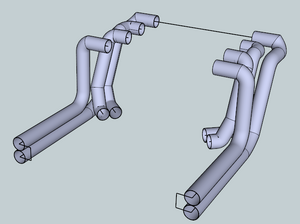
Something where the 2nd and 3rd pipe on each side cross over to the collector on the opposite side? Aside from being a huge pain in the *** size wise, and if you ever had to remove it in car that would be a double pain in the ***, but is there a big flaw to a design like this?
The biggest thing i see is the unequal overall length of the primary, although i feel the large number of bends seen in 180 headers could be more inhibiting than that? I dont know, someone school me on this maybe and tell me why this design isnt as common and im thinking it should be maybe?
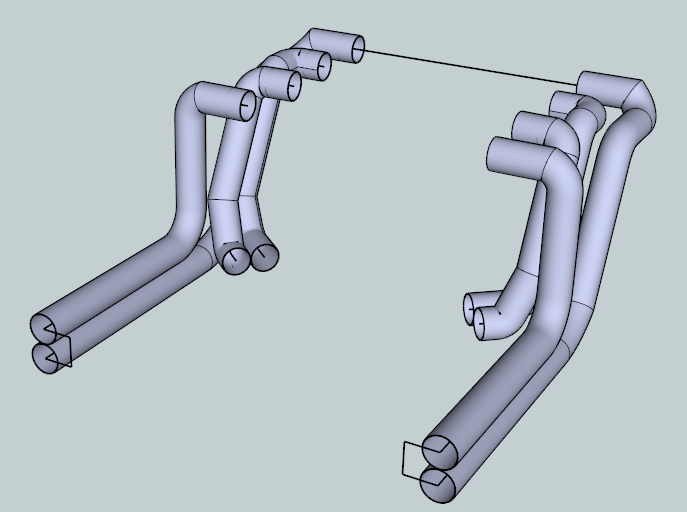
Something where the 2nd and 3rd pipe on each side cross over to the collector on the opposite side? Aside from being a huge pain in the *** size wise, and if you ever had to remove it in car that would be a double pain in the ***, but is there a big flaw to a design like this?
The biggest thing i see is the unequal overall length of the primary, although i feel the large number of bends seen in 180 headers could be more inhibiting than that? I dont know, someone school me on this maybe and tell me why this design isnt as common and im thinking it should be maybe?
I think it has to do with the firing order compared to where those cylinders exit in the engine bay. I don't know much at all about the headers but I think they are designed around which cylinders fire in what order and then combine them in a specific way. But I could be totally off base about it too.
I believe the ls engine fires in a 1-8-7-2-6-5-4-3 pattern. So if you look at the engine that means it fires R-L-R-L-L-R-L-R (and if you repeat that ends up giving you 2 R in a row)
The 180 design eliminates the double L and double R pattern, if you cross 4 and 6 over, and 5 and 3 over you get R-L-R-L-R-L-R-L back and forth repeating. 4 and 6 and 3 and 5 are the middle two primaries on each side, so all you need to do is have those 2 pipes from each side cross over into the other collector, which is no secret or anything special like that.
My concern is why always the snakes nest, is that trying to keep with a 36" primary? Or at least equal length primaries? Whats the reason for that design over a simple header with the middle crossed over.
Biggest negatives - there will be a section of decreased ground clearance where these pipes cross over.
Some of the primaries will be longer than the rest - Thoughts to eliminate this were to go with a Y style at the point where the primaries are all of a similar length, then continue the larger diameter tube until it meets with the larger tube of the Y from the primaries that didnt cross over, and then having these 2 larger pipes merge into a collector. Sort of like a tri-Y but much extended.
Anyone have any ideas on this id super appreciate it, im hoping to fab up this exhaust myself, im just looking for someone who has some insight on this to advise me otherwise with solid reasoning
The 180 design eliminates the double L and double R pattern, if you cross 4 and 6 over, and 5 and 3 over you get R-L-R-L-R-L-R-L back and forth repeating. 4 and 6 and 3 and 5 are the middle two primaries on each side, so all you need to do is have those 2 pipes from each side cross over into the other collector, which is no secret or anything special like that.
My concern is why always the snakes nest, is that trying to keep with a 36" primary? Or at least equal length primaries? Whats the reason for that design over a simple header with the middle crossed over.
Biggest negatives - there will be a section of decreased ground clearance where these pipes cross over.
Some of the primaries will be longer than the rest - Thoughts to eliminate this were to go with a Y style at the point where the primaries are all of a similar length, then continue the larger diameter tube until it meets with the larger tube of the Y from the primaries that didnt cross over, and then having these 2 larger pipes merge into a collector. Sort of like a tri-Y but much extended.
Anyone have any ideas on this id super appreciate it, im hoping to fab up this exhaust myself, im just looking for someone who has some insight on this to advise me otherwise with solid reasoning
I won't claim to be the super knowledgeable here, but if we look at this logically...
-The purpose of a 180 degree header is to get the pulses to the collector in an orderly fashion.
-If the pipes are not all equal length (depending on the pulse speed) you will have pulses arriving at the collector from the crossover at an uneven interval when compared to the pulses on the original side.
-Therefore any 180 degree system without equal length tubing would effectively negate the value of the 180 degree system in the first place.
How all these factors fit together, I will not even hazard to guess.
-The purpose of a 180 degree header is to get the pulses to the collector in an orderly fashion.
-If the pipes are not all equal length (depending on the pulse speed) you will have pulses arriving at the collector from the crossover at an uneven interval when compared to the pulses on the original side.
-Therefore any 180 degree system without equal length tubing would effectively negate the value of the 180 degree system in the first place.
How all these factors fit together, I will not even hazard to guess.
Brilliant!!
That is exactly what im talking about. Do you know about how long the primaries are?
my thoughts were to use a Long tube header designed for an F-body, that way having all the engine bay routing already dealt with, then cut and weld where needed.
Also, any sound clips?
That is exactly what im talking about. Do you know about how long the primaries are?
my thoughts were to use a Long tube header designed for an F-body, that way having all the engine bay routing already dealt with, then cut and weld where needed.
Also, any sound clips?
Trending Topics
LS1 Tech Stories
The Best V8 Stories One Small Block at Time

Retro Modern Bandit Pontiac Trans AM Comes With Burt Reynolds' Autograph
Verdad Gallardo
Top 10 Greatest Cadillac V Series Performance Models Ever, Ranked
Pouria Savadkouei
Top 10 Most Powerful Chevy Trucks Ever Made!

Hennessey's New Supercharged Silverado ZR2 Has 700 HP
Verdad Gallardo
Coachbuilt N2A Anteros Is an LS2-Powered C6 Corvette In Italian Clothes
Verdad Gallardo
Awesome K5 Blazer Restomod Comes With C7 Corvette Power
Verdad Gallardo
10 Camaros You Should Never Buy

10 LS Engine Myths That Refuse to Die
Verdad Gallardo
Five Reasons the Camaro Was the Most Pivotal Player in the Pony Car Wars 2.0
Brett Foote
TECH Regular
Joined: May 2011
Posts: 433
Likes: 1
The idea behind 180 degree headers/extractors is to creative a spiralling pulse ring to draw out/scavenge from the next cylinder.
This is achieved with a single collector.
The set up shown above is simply a tri Y set of pipes with a cross over, it still has 6 colllectors.
Cylinders 3,5,2, and 8 are together, 1,7, 4, and 6 are tied together, how is that tri-y?
Edit: hmm, I guess it's considered tri-y, never looked for it to be "tri-y" just used the 180 concept, equalled them out, and set the cylinders together.
Edit: hmm, I guess it's considered tri-y, never looked for it to be "tri-y" just used the 180 concept, equalled them out, and set the cylinders together.
Last edited by Tony Nichols; Aug 15, 2013 at 07:12 PM.

Correct, which the above set up does not do.
The idea behind 180 degree headers/extractors is to creative a spiralling pulse ring to draw out/scavenge from the next cylinder.
This is achieved with a single collector.
The set up shown above is simply a tri Y set of pipes with a cross over, it still has 6 colllectors.
The idea behind 180 degree headers/extractors is to creative a spiralling pulse ring to draw out/scavenge from the next cylinder.
This is achieved with a single collector.
The set up shown above is simply a tri Y set of pipes with a cross over, it still has 6 colllectors.
With that in mind, a firing order of 1-8-2-6-5-4-3 with 1-7-6-4 all ending up in one tube, having the 1 & 7 tubes connected in a Y, and the 6 & 4 tubes connected in a Y, and then connected together, dont you maintain that pattern of one-after-the-other in the same tube? Youd get 7 immediately after 1, and then 4 immediately after 6. And dont the tri-Y's scavenge better than a typical collector? Or is that only if they are directly in contact (the first 2 Y tubes collect and go directly into the final Y tube)?
