




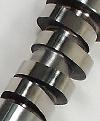





Reverse torquer cam (the other side of the coin)

Originally Posted by PREDATOR-Z
Just to show: this is a graph of a TR230, cam only, MAC, TB and other bolt on on a A4 with a 4000 stall:
https://ls1tech.com/forums/attachmen...chmentid=62788
https://ls1tech.com/forums/attachmen...chmentid=62788
 I'm famous!!
I love the response of the reverse splits and they make great power as my graph above shows. My main complaint is all the gas they use because I can't keep my foot out of it.

When you have a really good exhaust and are somewhat intake restricted, reverse splits make a lot of sense. A perfect example is when you're running stock heads with LS6 intake and long tube headers with off-road exhaust. A single pattern cam or reverse split cam works great there.
If you had really good cylinder heads with strong exhaust flow, but were still running LS6 intake and 78mm TB, then the single pattern or reverse split would make sense. Or, if you just wanted to limit your overlap while keeping your intake lobe as large as possible, then the reverse splits work well. I really like them for specific applications and will spec them from time to time. Mark (Predator) is right on with his thinking (as usual).
If you had really good cylinder heads with strong exhaust flow, but were still running LS6 intake and 78mm TB, then the single pattern or reverse split would make sense. Or, if you just wanted to limit your overlap while keeping your intake lobe as large as possible, then the reverse splits work well. I really like them for specific applications and will spec them from time to time. Mark (Predator) is right on with his thinking (as usual).
__________________

2013 Corvette Grand Sport A6 LME forged 416, Greg Good ported TFS 255 LS3 heads, 222/242 .629"/.604" 121LSA Pat G blower cam, ARH 1 7/8" headers, ESC Novi 1500 Supercharger w/8 rib direct drive conversion, 747rwhp/709rwtq on 93 octane, 801rwhp/735rwtq on race fuel, 10.1 @ 147.25mph 1/4 mile, 174.7mph Half Mile.
2016 Corvette Z51 M7 Magnuson Heartbeat 2300 supercharger, TSP LT headers, Pat G tuned, 667rwhp, 662rwtq, 191mph TX Mile.
2009.5 Pontiac G8 GT 6.0L, A6, AFR 230v2 heads. 506rwhp/442rwtq. 11.413 @ 121.29mph 1/4 mile, 168.7mph TX Mile
2000 Pewter Ram Air Trans Am M6 heads/cam 508 rwhp/445 rwtq SAE, 183.092 TX Mile
2022 Cadillac Escalade 6.2L A10 S&B CAI, Corsa catback.
2023 Corvette 3LT Z51 soon to be modified.
Custom LSX tuning in person or via email press here.
2013 Corvette Grand Sport A6 LME forged 416, Greg Good ported TFS 255 LS3 heads, 222/242 .629"/.604" 121LSA Pat G blower cam, ARH 1 7/8" headers, ESC Novi 1500 Supercharger w/8 rib direct drive conversion, 747rwhp/709rwtq on 93 octane, 801rwhp/735rwtq on race fuel, 10.1 @ 147.25mph 1/4 mile, 174.7mph Half Mile.
2016 Corvette Z51 M7 Magnuson Heartbeat 2300 supercharger, TSP LT headers, Pat G tuned, 667rwhp, 662rwtq, 191mph TX Mile.
2009.5 Pontiac G8 GT 6.0L, A6, AFR 230v2 heads. 506rwhp/442rwtq. 11.413 @ 121.29mph 1/4 mile, 168.7mph TX Mile
2000 Pewter Ram Air Trans Am M6 heads/cam 508 rwhp/445 rwtq SAE, 183.092 TX Mile
2022 Cadillac Escalade 6.2L A10 S&B CAI, Corsa catback.
2023 Corvette 3LT Z51 soon to be modified.
Custom LSX tuning in person or via email press here.
Originally Posted by Patrick G
When you have a really good exhaust and are somewhat intake restricted, reverse splits make a lot of sense. A perfect example is when you're running stock heads with LS6 intake and long tube headers with off-road exhaust. A single pattern cam or reverse split cam works great there.
If you had really good cylinder heads with strong exhaust flow, but were still running LS6 intake and 78mm TB, then the single pattern or reverse split would make sense. Or, if you just wanted to limit your overlap while keeping your intake lobe as large as possible, then the reverse splits work well. I really like them for specific applications and will spec them from time to time. Mark (Predator) is right on with his thinking (as usual).
If you had really good cylinder heads with strong exhaust flow, but were still running LS6 intake and 78mm TB, then the single pattern or reverse split would make sense. Or, if you just wanted to limit your overlap while keeping your intake lobe as large as possible, then the reverse splits work well. I really like them for specific applications and will spec them from time to time. Mark (Predator) is right on with his thinking (as usual).

Thread Starter
TECH Senior Member
Joined: Mar 2004
Posts: 14,620
Likes: 17
From: BFE
Originally Posted by Patrick G
When you have a really good exhaust and are somewhat intake restricted, reverse splits make a lot of sense. A perfect example is when you're running stock heads with LS6 intake and long tube headers with off-road exhaust. A single pattern cam or reverse split cam works great there.
If you had really good cylinder heads with strong exhaust flow, but were still running LS6 intake and 78mm TB, then the single pattern or reverse split would make sense. Or, if you just wanted to limit your overlap while keeping your intake lobe as large as possible, then the reverse splits work well. I really like them for specific applications and will spec them from time to time. Mark (Predator) is right on with his thinking (as usual).
If you had really good cylinder heads with strong exhaust flow, but were still running LS6 intake and 78mm TB, then the single pattern or reverse split would make sense. Or, if you just wanted to limit your overlap while keeping your intake lobe as large as possible, then the reverse splits work well. I really like them for specific applications and will spec them from time to time. Mark (Predator) is right on with his thinking (as usual).
Reverse splits have their place in certain applications. The ones that interest me is cam only enthusiasts, that just want more power with simple bolt ons.
With big standard splits what we see is good peak numbers, but with low trq output. Meaning it requires tighter gears (or stall), and heads, and intake to maximize its true potential or reaching the band.
Now with a reverse the cam makes use of the existing intake, lower flowing heads to its benefit and gives good output and excellent trq.
So they cater more to the power hungry, budget oriented crowd since the use the stock setups with better eficiency.
Keep in mind that with the right heads they even make more power.
Last edited by PREDATOR-Z; Feb 5, 2007 at 02:18 AM.
I've got a question:
How does the f13(230/232-.595/.585-114+4) compare to the TR230/224 as far as under the curve? By looking at futral's dynos and sotp, they make awesome all-round power, especially under the curve. I've seen a couple of posts saying that the f13 actually is a reverse split in the lower lift. Is that how it makes so much torque down low in addition to having a 4* advance ground in it?
How does the f13(230/232-.595/.585-114+4) compare to the TR230/224 as far as under the curve? By looking at futral's dynos and sotp, they make awesome all-round power, especially under the curve. I've seen a couple of posts saying that the f13 actually is a reverse split in the lower lift. Is that how it makes so much torque down low in addition to having a 4* advance ground in it?
hum, i thought i had my mind made up on a 228/232 lsk/xer 109+0 with prc ported ls6 heads.
i wont be going to a 90/90 set up, to me the $1000+ is not worth it.
for a 6500 shift point what reverse split would have good low end but a very strong top end or should i stick with the 228/232
i wont be going to a 90/90 set up, to me the $1000+ is not worth it.
for a 6500 shift point what reverse split would have good low end but a very strong top end or should i stick with the 228/232
LS1 Tech Stories
The Best V8 Stories One Small Block at Time

Topdon ONE vs. Artidiag 800 BT2: Which is the Diagnostic Tablet For You?
Pouria Savadkouei
Gas Monkey Built a 6-Wheel Ferrari Testarossa With a Corvette LT4 Engine
Verdad Gallardo
7 Most Reliable High-Performance Engines GM Has Ever Built
Verdad Gallardo
Amazing '71 Camaro Restomod Is Modern Muscle Car Under the Skin
Verdad Gallardo
6 Common C5 Corvette Failures and What's Involved In Repairing Them
Pouria Savadkouei
Retro Modern Bandit Pontiac Trans AM Comes With Burt Reynolds' Autograph
Verdad Gallardo
Top 10 Greatest Cadillac V Series Performance Models Ever, Ranked
Pouria Savadkouei
Top 10 Most Powerful Chevy Trucks Ever Made!

Hennessey's New Supercharged Silverado ZR2 Has 700 HP
Verdad Gallardo


This isn't a new discussion. This is old school!  One of our more popular cams over three years ago was a 232/228, .595"/.588", 112 LSA. We had a graph up of 400 RWHP cam-only on an LS1 intaked car. We also installed a set of PRC heads on a local customer's '01 Z28 (has since sold it) about 10 mos. ago that made 445 RWHP with this cam and PRC heads. His ls1tech name was "Buford". The only time we really grind reverse-split cams anymore would be for turbo applications, unless customers specifically request one. They do make some nice torque under the curve, but the traditional splits were/are more popular because of the few extra ponies up top. It would make for a great road-race cam and/or daily driver.
Trevor
Texas Speed & Performance
One of our more popular cams over three years ago was a 232/228, .595"/.588", 112 LSA. We had a graph up of 400 RWHP cam-only on an LS1 intaked car. We also installed a set of PRC heads on a local customer's '01 Z28 (has since sold it) about 10 mos. ago that made 445 RWHP with this cam and PRC heads. His ls1tech name was "Buford". The only time we really grind reverse-split cams anymore would be for turbo applications, unless customers specifically request one. They do make some nice torque under the curve, but the traditional splits were/are more popular because of the few extra ponies up top. It would make for a great road-race cam and/or daily driver. Trevor
Texas Speed & Performance
__________________


the cam i have is a 232/228 573 571 113 and I believe it was a TSP grind from a few years back. It made 372/367 unlocked untuned. Its a great cam and has run good e.ts. Thats with LS6 Intake,Ported TB and Longtubes O/R Y Catback.

Originally Posted by bad6as
hum, i thought i had my mind made up on a 228/232 lsk/xer 109+0 with prc ported ls6 heads.
i wont be going to a 90/90 set up, to me the $1000+ is not worth it.
for a 6500 shift point what reverse split would have good low end but a very strong top end or should i stick with the 228/232
i wont be going to a 90/90 set up, to me the $1000+ is not worth it.
for a 6500 shift point what reverse split would have good low end but a very strong top end or should i stick with the 228/232
.006" 277/277
.050" 227/232
.200" 153/149
If your looking into a 6500 rpm peak, I think it would be a good cam. Since your limiting yourself on the intake side, the reverse split should make up for lost TQ on the low-end that you might not have with a traditional split camshaft.

Originally Posted by Trevor @ Texas Speed & Perf.
This isn't a new discussion. This is old school! One of our more popular cams over three years ago was a 232/228, .595"/.588", 112 LSA. We had a graph up of 400 RWHP cam-only on an LS1 intaked car. We also installed a set of PRC heads on a local customer's '01 Z28 (has since sold it) about 10 mos. ago that made 445 RWHP with this cam and PRC heads. His ls1tech name was "Buford". The only time we really grind reverse-split cams anymore would be for turbo applications, unless customers specifically request one. They do make some nice torque under the curve, but the traditional splits were/are more popular because of the few extra ponies up top. It would make for a great road-race cam and/or daily driver.
Trevor
Texas Speed & Performance
One of our more popular cams over three years ago was a 232/228, .595"/.588", 112 LSA. We had a graph up of 400 RWHP cam-only on an LS1 intaked car. We also installed a set of PRC heads on a local customer's '01 Z28 (has since sold it) about 10 mos. ago that made 445 RWHP with this cam and PRC heads. His ls1tech name was "Buford". The only time we really grind reverse-split cams anymore would be for turbo applications, unless customers specifically request one. They do make some nice torque under the curve, but the traditional splits were/are more popular because of the few extra ponies up top. It would make for a great road-race cam and/or daily driver. Trevor
Texas Speed & Performance
right on trevor on the great road race cam/ and or daily driver!! from doing all these searches thats what i found out bout the reverse split cams. they do pretty good for just a daily driver car and like what predator says bout making power under the curve. ive seen alot of big cam guys making torque that a little 224 cam makes!! i myself am leaning towards the reverse split cam wether it be TR230 or MTI X1. but i wonder which would be a better all around as far as power throughout the powerband versus like a torquer v.2 on a 112. cuz the torquer 2 would be the biggest i would go for a daily driver.

Glad to see reverse split cams in the limelight of discussion. If you search my name and "TR230" or "230/224," you'll certainly see where I sing the praises of the reverse split with a composite GM intake. The TR230 has always ran like a "raped ape" (pardon the expression) up top... all with making the same torque as smaller cams off idle. There is a jpeg floating around with an overlay of a 224/224 112 and a 230/224 and the torque graphs are IDENTICAL below 5,000 RPM.
Also, as pointed out the reverse split allows you to still have a relatively large intake lobe while simultaneously limiting overlap. I've personally watched a 230/224 pickup up less than 5 rwhp on a dynojet going from a restrictive aftermarket 3" catback VS. an open cut out. This grind has enough overlap for rev-ability, but not so much as to become particularly sensitive to intake or exhaust restrictions. This small gain in peak power is indicative of the limited amount of overlap this 111 LSA camshaft has, yet it'll still pull cleanly to 6800-6900 RPM in gear. I know I'd like to see some continuing developement of the reverse split camshafts for GEN III small blocks.
EDIT:
Oh, and I nearly forgot, the Thunder Racing TRak cam that's been working well is also a reverse split cam under the surface. I know I read of atleast one 430rwhp STOCK LS1 headed car with that camshaft.
Ben T.
Also, as pointed out the reverse split allows you to still have a relatively large intake lobe while simultaneously limiting overlap. I've personally watched a 230/224 pickup up less than 5 rwhp on a dynojet going from a restrictive aftermarket 3" catback VS. an open cut out. This grind has enough overlap for rev-ability, but not so much as to become particularly sensitive to intake or exhaust restrictions. This small gain in peak power is indicative of the limited amount of overlap this 111 LSA camshaft has, yet it'll still pull cleanly to 6800-6900 RPM in gear. I know I'd like to see some continuing developement of the reverse split camshafts for GEN III small blocks.
EDIT:
Oh, and I nearly forgot, the Thunder Racing TRak cam that's been working well is also a reverse split cam under the surface. I know I read of atleast one 430rwhp STOCK LS1 headed car with that camshaft.
Ben T.
Last edited by Studytime; Feb 5, 2007 at 06:52 PM.

I've been reading this thread and am just really starting to get my thinking cap on for cams and how they work with these motors.
I just want to say huge thanks for your brain storming, not only are you coming up with great ideas you break them down and debate the strenghts and weaknesses of each cam.
I just want to say huge thanks for your brain storming, not only are you coming up with great ideas you break them down and debate the strenghts and weaknesses of each cam.
Originally Posted by Ace$nyper
I've been reading this thread and am just really starting to get my thinking cap on for cams and how they work with these motors.
I just want to say huge thanks for your brain storming, not only are you coming up with great ideas you break them down and debate the strenghts and weaknesses of each cam.
I just want to say huge thanks for your brain storming, not only are you coming up with great ideas you break them down and debate the strenghts and weaknesses of each cam.
+1.. predator and patrick are the heat!! real helpful guys!!

I agree with Trever.This is old but probly new nowadays.
We've tested a ton of reverse splits and they work better than most people think,even on todays heads. You guy's can math out all you want but you'll be very surprised with the real world result's of stuff that is said not to work
Yes,I'm dangling the answers up high
We've tested a ton of reverse splits and they work better than most people think,even on todays heads. You guy's can math out all you want but you'll be very surprised with the real world result's of stuff that is said not to work
Yes,I'm dangling the answers up high

I really like this thread. I'm still relatively new to modding my car and this theory is nice for after I get sick of the whole racing thing.
And the reverse split cam then outpowers it up top? If so, that's sweet. But most 224 cams don't even hit 400hp do they?
Yeah but they carry it out longer, making more HP, winning races.
Originally Posted by Studytime
There is a jpeg floating around with an overlay of a 224/224 112 and a 230/224 and the torque graphs are IDENTICAL below 5,000 RPM.
Originally Posted by TXZ28LS1
ive seen alot of big cam guys making torque that a little 224 cam makes!!
Originally Posted by bad6as
you lost me on that ^^^^^^ beast