


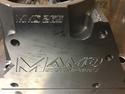



CO-2 Chamber Spark Testing for Coil Output

Thread Starter
FormerVendor
iTrader: (1)
Joined: Nov 2008
Posts: 2,155
Likes: 18
From: Santa Ana, CA. USA
 CO-2 Chamber Spark Testing for Coil Output
 Hi All, I too agree with Scientific Method.
That reason caused my design of an eight channel, eight Spark Plug, CO-2 Pressure test chamber with Sight Glass observation of ignition quality and sell this to all who would ask.
The common coil output test of a Pico Load (SAE Method) is a fixed load.
My "chamber" can test Spark Plugs, SPW, Coils easily.
The ability to connect to a Scope is also easy.
I can change the Chamber Pressure, the boost, on the "fly".
My ability to test ANY coil, SPW, SP, etc. exists.
WHAT WAS FOUND : The BRISK Spark Plug was tested in my chamber with cutting of the ceramic allowing a "drop" of the center electrode into the chamber bottom, good luck it was NOT into a cylinder !
Who would be interested/join me in this project ?
Lance
That reason caused my design of an eight channel, eight Spark Plug, CO-2 Pressure test chamber with Sight Glass observation of ignition quality and sell this to all who would ask.
The common coil output test of a Pico Load (SAE Method) is a fixed load.
My "chamber" can test Spark Plugs, SPW, Coils easily.
The ability to connect to a Scope is also easy.
I can change the Chamber Pressure, the boost, on the "fly".
My ability to test ANY coil, SPW, SP, etc. exists.
WHAT WAS FOUND : The BRISK Spark Plug was tested in my chamber with cutting of the ceramic allowing a "drop" of the center electrode into the chamber bottom, good luck it was NOT into a cylinder !
Who would be interested/join me in this project ?
Lance

TECH Senior Member


Joined: Jun 2016
Posts: 22,291
Likes: 3,616
From: Central Cal.
Thread Starter
FormerVendor
iTrader: (1)
Joined: Nov 2008
Posts: 2,155
Likes: 18
From: Santa Ana, CA. USA
Cylinder Pressure = DCR Hi King/Gary, thanks for the kind words/interest.
THESE are the questions we need to help LS-1 Tech Members.
MY chamber will go to 800PSI of CO2, on a Hot Day.
Now understand the start of combustion, the cranking cylinder pressure of 200-400 as common.
This is the pressure point that the Spark Plug MUST ionize the gas.
ONCE the Arc has been established, the Voltage Requirement for Current Flow DROPS a great amount.
I AM SURE many here have witnessed the "firing line" on a Snap-ON engine scope.
ANOTHER GREAT measurement is ARC Duration vs Spark Plug Gap in Micro Seconds.
THUS I ask ALL here WHY is this time measurement important ?
Lance
THESE are the questions we need to help LS-1 Tech Members.
MY chamber will go to 800PSI of CO2, on a Hot Day.
Now understand the start of combustion, the cranking cylinder pressure of 200-400 as common.
This is the pressure point that the Spark Plug MUST ionize the gas.
ONCE the Arc has been established, the Voltage Requirement for Current Flow DROPS a great amount.
I AM SURE many here have witnessed the "firing line" on a Snap-ON engine scope.
ANOTHER GREAT measurement is ARC Duration vs Spark Plug Gap in Micro Seconds.
THUS I ask ALL here WHY is this time measurement important ?
Lance
Last edited by pantera_efi; Feb 27, 2018 at 09:40 AM.
The Spark Plug Burn Time duration is used to determine the condition of secondary ignition components ( anything after the secondary windings of the ignition coil- spark plugs, wires, central HT lead, coil tower.)
If the duration of one cylinder is much shorter or longer than the others, a problem with that cylinder is indicated.
The length of the spark burn time is directly affected by the amount of secondary coil voltage available, the amount of voltage required to overcome secondary circuit resistance and create the spark, and the amount of voltage remaining to sustain the spark ( in relation to the conditions within the combustion chamber of course)
If the duration of one cylinder is much shorter or longer than the others, a problem with that cylinder is indicated.
The length of the spark burn time is directly affected by the amount of secondary coil voltage available, the amount of voltage required to overcome secondary circuit resistance and create the spark, and the amount of voltage remaining to sustain the spark ( in relation to the conditions within the combustion chamber of course)
Thread Starter
FormerVendor
iTrader: (1)
Joined: Nov 2008
Posts: 2,155
Likes: 18
From: Santa Ana, CA. USA
ARC Duration Hi Gary, your term "spark duration" is a rating of the IGN-1A coil specification with definition as the term of Arc Duration as the SAE common word/term standard with a report of 3.2mS at a Coil Dwell of 3mS/14 volts.
Now your longer/better analogy is understood/fair WHEN older style ignition types, MSD CDI styles, are compared.
When a coils ARC Duration is MUCH GREATER, modern coils, the Arc Duration CAN be TOO LONG. (energy wasted)
The Scott tech is also correct, a very good way to describe HOW those items effect Arc Duration AND how EASY it is to make changes in the spark firing line.
What Scott stated was the a SPW wire of 50 OHMs per foot compared to a SPW of 250 OHMs per foot WILL effect Current Flow into the cylinder, which I too AGREE.
This IS WHY a higher resistance SPW of LS style (1/2 foot in length) at 250 Ohms WILL increase the ARC Duration over a LOW OHM wire.
Scott stated that the Spark Plug effects the Arc Duration, true, with that specification of Spark Plug Gap.
One goal of mine is to test each LS coil, CO2 Chamber testing, by Scope measurement/pressure measurement observation AND report best SPG/Wire resistance for a specific RPM/Boost Pressure/NOS shot.
Am I on the correct path ?
Lance
Now your longer/better analogy is understood/fair WHEN older style ignition types, MSD CDI styles, are compared.
When a coils ARC Duration is MUCH GREATER, modern coils, the Arc Duration CAN be TOO LONG. (energy wasted)
The Scott tech is also correct, a very good way to describe HOW those items effect Arc Duration AND how EASY it is to make changes in the spark firing line.
What Scott stated was the a SPW wire of 50 OHMs per foot compared to a SPW of 250 OHMs per foot WILL effect Current Flow into the cylinder, which I too AGREE.
This IS WHY a higher resistance SPW of LS style (1/2 foot in length) at 250 Ohms WILL increase the ARC Duration over a LOW OHM wire.
Scott stated that the Spark Plug effects the Arc Duration, true, with that specification of Spark Plug Gap.
One goal of mine is to test each LS coil, CO2 Chamber testing, by Scope measurement/pressure measurement observation AND report best SPG/Wire resistance for a specific RPM/Boost Pressure/NOS shot.
Am I on the correct path ?
Lance
Trending Topics
LS1 Tech Stories
The Best V8 Stories One Small Block at Time

6 Common C5 Corvette Failures and What's Involved In Repairing Them
Pouria Savadkouei
Retro Modern Bandit Pontiac Trans AM Comes With Burt Reynolds' Autograph
Verdad Gallardo
Top 10 Greatest Cadillac V Series Performance Models Ever, Ranked
Pouria Savadkouei
Top 10 Most Powerful Chevy Trucks Ever Made!

Hennessey's New Supercharged Silverado ZR2 Has 700 HP
Verdad Gallardo
Coachbuilt N2A Anteros Is an LS2-Powered C6 Corvette In Italian Clothes
Verdad Gallardo
Awesome K5 Blazer Restomod Comes With C7 Corvette Power
Verdad Gallardo
10 Camaros You Should Never Buy

10 LS Engine Myths That Refuse to Die
Verdad Gallardo


the only thing I know about ignitions is from a book written by Dr Jacobs, who used to run jacobs electronics and they sold various ignition products witch I owned many of....sadly he sold his company off and his products are not the same as they once were
but the book might be relevant today....if you can find a copy.....but very informative none the less
but the book might be relevant today....if you can find a copy.....but very informative none the less
Thread Starter
FormerVendor
iTrader: (1)
Joined: Nov 2008
Posts: 2,155
Likes: 18
From: Santa Ana, CA. USA
Energy = Amps 302mj/12 AMPS@10K NOT Hi Gary, I too agree with YOU AND their OWN Data REPORTED of a CDI output of 302mj at the RPM of 10K with a input of 12 AMPS ?
The MATH is NOT Correct, the AMP rerquirement should be greater than 35 RMS.
The first Jacobs product was a DC/DC converted that raised coil voltage from 12-16 volts, a GOOD thing in that day. (WWII)
My NEW TFD coil/ignition system runs at 46-48 Volts powered by my Red Rover batteries 12@3.74 Volts.
Lance
The MATH is NOT Correct, the AMP rerquirement should be greater than 35 RMS.
The first Jacobs product was a DC/DC converted that raised coil voltage from 12-16 volts, a GOOD thing in that day. (WWII)
My NEW TFD coil/ignition system runs at 46-48 Volts powered by my Red Rover batteries 12@3.74 Volts.
Lance
I do remember Jacobs selling a voltage step up device....primary aimed for audio....increased voltage and filter for cleaner signal....never had one but wanted it !
speaking of which ....I have seen voltage steppers ( 12 v to 14 or 16v ? ) designed to increase voltage to the coils ( or just ignition circuit in general ? ) for the LS1s....any thoughts on this device ?
speaking of which ....I have seen voltage steppers ( 12 v to 14 or 16v ? ) designed to increase voltage to the coils ( or just ignition circuit in general ? ) for the LS1s....any thoughts on this device ?
Thread Starter
FormerVendor
iTrader: (1)
Joined: Nov 2008
Posts: 2,155
Likes: 18
From: Santa Ana, CA. USA
Coil Supply Vss Hi Sj, electrically your are correct about the fact that a higher supply voltage WILL Increase coil Flux Speed.
Thus Coil Dwell times would be lower.
There ARE LS coils with internal IGBT Current Sense circuits, NOT GOOD for a Voltage Increase.
The Modern PCM measures changes a Battery Voltage with the same changes in Dwell Time to stabilize coil output.
Sorry SJ, a good thought though this method worked well when ONE coil was used with a Distributed Ignition System, NOT my DIS. (COP/CNP)
Lance
Thus Coil Dwell times would be lower.
There ARE LS coils with internal IGBT Current Sense circuits, NOT GOOD for a Voltage Increase.
The Modern PCM measures changes a Battery Voltage with the same changes in Dwell Time to stabilize coil output.
Sorry SJ, a good thought though this method worked well when ONE coil was used with a Distributed Ignition System, NOT my DIS. (COP/CNP)
Lance