



Valve shrouding
 Valve shrouding
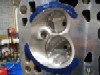
 We talk a lot about valves being shrouded, as in how close they are to the cylinder walls. I recently cleanup up some combustion chambers and was looking at the distance between the edge of the valve and the combustion chamber/cylinder wall. I did some math and found that a 2.08 valve on an ls2 (4.005) actually sits .016 farther away from the cylinder wall than a 2.00 valve in a stock ls1 head sits from the cylinder wall (with the ls1 bore of 3.893). My point, if any, is that most people will tell you that a 2.08 valve is too big for a 4.000 bore. I wonder if anyone has flowed a 2.08 head on a stock bore ls1 and compared it to a 2.00 valved head with similar ports. I wonder if the loss in flow with the larger valve would be offset by the larger opening which helps the flow? How close to the cylinder wall does the edge of the valve need to be in order for shrouding to make a significant difference in flow?
Alot of it has to do with the valve job. If the person doing the head knows that the large valve heads will be used on a smaller bore, than he can take that into consideration when cutting the valve. I remember a test being done a while back where a porter found that the optimum comprimise on a stock bore was a 2.04 valve. Anything bigger started to have comprimising effects on the flow per the smaller bore. I wouldn't think that a 2.08 valve would be to big at all on a 4" bore. If you figure an increase of roughly .100" on the bore, it seems that a increase of .04" on the valve would only help. JMO anyways.
Funny I've put a 2.120" valve on a 4" bore.
Sometimes you will not see flow gains on the bench with a larger valve but the increase in curtian area will help you go faster and make more power at higher RPM.
Usually it's the head casting itself that will limit putting a larger valve in the head effectively.
Bret
Sometimes you will not see flow gains on the bench with a larger valve but the increase in curtian area will help you go faster and make more power at higher RPM.
Usually it's the head casting itself that will limit putting a larger valve in the head effectively.
Bret

TECH Resident
Joined: Dec 2004
Posts: 881
Likes: 1
ET has some flow numbers with different bores and the same valve sizes.
Generally, shrouding is one more thing to look at. It is why a 4.125 bore is better than a 4.0 is better than a 3.9, even if displacement is constant. For power, emissions can be a different story.
On SBCs, people relocate the cylinder to further reduce shrouding.
The size of the bore may be a limiting factor on valve size. However a 2.0 intake and 1.6 exhaust leave .3 or .4 extra room. So adding a tenth or so shouldn't be an issue. However, the port must also be appropriate for the valve size. To large a valve for a given port can be just as bad as too small a valve.
Generally, shrouding is one more thing to look at. It is why a 4.125 bore is better than a 4.0 is better than a 3.9, even if displacement is constant. For power, emissions can be a different story.
On SBCs, people relocate the cylinder to further reduce shrouding.
The size of the bore may be a limiting factor on valve size. However a 2.0 intake and 1.6 exhaust leave .3 or .4 extra room. So adding a tenth or so shouldn't be an issue. However, the port must also be appropriate for the valve size. To large a valve for a given port can be just as bad as too small a valve.

TECH Enthusiast


Joined: Sep 2003
Posts: 730
Likes: 66
Valve shrouding has to do with the distance to the edge of the combustion chamber on the head itself. If you use a bigger bore then you can open the chamber up to the edge of the bore. On a smaller bore, this is limited.
A ported head that is intended for use on a bigger bore already has an enlarged area around the valve to unshroud it.
A ported head that is intended for use on a bigger bore already has an enlarged area around the valve to unshroud it.

TECH Apprentice
iTrader: (3)
Joined: Nov 2005
Posts: 387
Likes: 1
From: Tinker till it blows, then back it off a notch, maybe!!
While AFR is coming out with 225 small bore heads, what about their current or older 225 heads?
Many have used them on small bore motors. We are looking at 4" or 4.125" gasket (to match the chamber) on a 3.905" cylinder.
A side view crossection of that combo has to look a little like a mushroom, yet many have done it. What effects can that have on the big picture?
Many have used them on small bore motors. We are looking at 4" or 4.125" gasket (to match the chamber) on a 3.905" cylinder.
A side view crossection of that combo has to look a little like a mushroom, yet many have done it. What effects can that have on the big picture?
Trending Topics
LS1 Tech Stories
The Best V8 Stories One Small Block at Time

Topdon ONE vs. Artidiag 800 BT2: Which is the Diagnostic Tablet For You?
Pouria Savadkouei
Gas Monkey Built a 6-Wheel Ferrari Testarossa With a Corvette LT4 Engine
Verdad Gallardo
7 Most Reliable High-Performance Engines GM Has Ever Built
Verdad Gallardo
Amazing '71 Camaro Restomod Is Modern Muscle Car Under the Skin
Verdad Gallardo
6 Common C5 Corvette Failures and What's Involved In Repairing Them
Pouria Savadkouei
Retro Modern Bandit Pontiac Trans AM Comes With Burt Reynolds' Autograph
Verdad Gallardo
Top 10 Greatest Cadillac V Series Performance Models Ever, Ranked
Pouria Savadkouei
Top 10 Most Powerful Chevy Trucks Ever Made!

Hennessey's New Supercharged Silverado ZR2 Has 700 HP
Verdad Gallardo TECH Apprentice
iTrader: (3)
Joined: Nov 2005
Posts: 387
Likes: 1
From: Tinker till it blows, then back it off a notch, maybe!!
Originally Posted by SStrokerAce
That might be another place to yank out falacies... the bore and chamber matching each other.
Bret
Bret
Thanks
PSI've been working on your Dart heads

TECH Apprentice
iTrader: (3)
Joined: Nov 2005
Posts: 387
Likes: 1
From: Tinker till it blows, then back it off a notch, maybe!!
Originally Posted by MadBill
FWIW, many BBCs have factory-relieved bores adjacent to the intake valve... (and some reworked ones ditto on the exhaust.)

Originally Posted by ChucksZ06
My point, if any, is that most people will tell you that a 2.08 valve is too big for a 4.000 bore.
I wouldn't say that myself.
Yes valve shrouding can reduce flow some, but it's usually in such a limited area that it's insignificant, and not so bad as to negate the increase in valve size. To me it's more important to keep the seat diameter near 90% of the valve diameter. A good porter can shape the throat area adjacent to the shrouding such that the effect of the nearby cylinder wall is minimal.
A lot of flow is directed from the cylinder wall side towards the center of the cylinder anyway, so I don't see a little shrouding being a showstopper.

On The Tree
Joined: Nov 2005
Posts: 184
Likes: 0
Originally Posted by white2001s10
I wouldn't say that myself.
Yes valve shrouding can reduce flow some, but it's usually in such a limited area that it's insignificant, and not so bad as to negate the increase in valve size. To me it's more important to keep the seat diameter near 90% of the valve diameter. A good porter can shape the throat area adjacent to the shrouding such that the effect of the nearby cylinder wall is minimal.
A lot of flow is directed from the cylinder wall side towards the center of the cylinder anyway, so I don't see a little shrouding being a showstopper.
Yes valve shrouding can reduce flow some, but it's usually in such a limited area that it's insignificant, and not so bad as to negate the increase in valve size. To me it's more important to keep the seat diameter near 90% of the valve diameter. A good porter can shape the throat area adjacent to the shrouding such that the effect of the nearby cylinder wall is minimal.
A lot of flow is directed from the cylinder wall side towards the center of the cylinder anyway, so I don't see a little shrouding being a showstopper.
On The Tree
Joined: Oct 2003
Posts: 150
Likes: 0
From: harrisburg PA
Boy, if it was only this easy. Their is no "automagical" formula to determine if a valve is shrouded. The chamber itself will determine how far you can go. A concave chamber design can stomach less then a convex chamber. As in case with the 241 castings and similar where you have a right angle to deal with, best of luck with any valve.
When working with smaller bores, you are better to try and work with what you have instead of reinventing the wheel. A smaller valve opened farther may be a better approach.
As always stated, and rarely listened too...it's about a little more then just "flow"
Dennis
When working with smaller bores, you are better to try and work with what you have instead of reinventing the wheel. A smaller valve opened farther may be a better approach.
As always stated, and rarely listened too...it's about a little more then just "flow"
Dennis
Originally Posted by airflowdevelop
Boy, if it was only this easy. Their is no "automagical" formula to determine if a valve is shrouded. The chamber itself will determine how far you can go. A concave chamber design can stomach less then a convex chamber. As in case with the 241 castings and similar where you have a right angle to deal with, best of luck with any valve.
When working with smaller bores, you are better to try and work with what you have instead of reinventing the wheel. A smaller valve opened farther may be a better approach.
As always stated, and rarely listened too...it's about a little more then just "flow"
Dennis
When working with smaller bores, you are better to try and work with what you have instead of reinventing the wheel. A smaller valve opened farther may be a better approach.
As always stated, and rarely listened too...it's about a little more then just "flow"
Dennis

Teching In
Joined: Dec 2005
Posts: 2
Likes: 0
I have seen heads flow exceptionally well in some cases, despite the chamber being very close to the valve.
But contrary to what some may expect, the proximity to the cylinder wall can significantly aid flow.
I've seen 20+ cfm go away if the valve was too far away from the cylinder wall.
It is still better for the valve to be, too far away..
than even a little too close to the bore.
But contrary to what some may expect, the proximity to the cylinder wall can significantly aid flow.
I've seen 20+ cfm go away if the valve was too far away from the cylinder wall.
It is still better for the valve to be, too far away..
than even a little too close to the bore.
Originally Posted by white2001s10
Dennis would you please go into a little more detail about what you're saying. At first glance it looks like you're saying that with a 241 casting that you get better bias & swirl by using a smaller valve, and kill swirl with the bigger valve. Is this right?
Yep..... but it deals more with loading the pressure on the valve equally. The smaller the valve the higher the discharge coef and normally you will dispearse the air/fuel charge more evenly around the valve when you have a higher discharge coef... or so the theory goes.
Bret
