







Extending Valve Spring Life?
Thread Starter
10 Second Club
iTrader: (5)
Joined: Nov 2003
Posts: 1,649
Likes: 0
From: Ft. Lauderdale, FL
 Extending Valve Spring Life?
 Extending Valve Spring Life?
I am planning on running a solid roller in my next build and it will be a street/strip set-up.
What can I do to extend the life of the Valve Spring?
Like Cryo, REM, Mirconite, DLC ect.
I am looking for options
Bob
I am planning on running a solid roller in my next build and it will be a street/strip set-up.
What can I do to extend the life of the Valve Spring?
Like Cryo, REM, Mirconite, DLC ect.
I am looking for options
Bob
Best spring life extenders are letting your car warm up for a couple minutes before driving and not letting it live near redline. Those are the two main factors that you can control that contribute to valvespring life. As far as I know, none of that other stuff is worth doing on the springs.
Shimming the spring to within .050" of coil bind will lower the chance of spring surge and increase spring life.
__________________

2013 Corvette Grand Sport A6 LME forged 416, Greg Good ported TFS 255 LS3 heads, 222/242 .629"/.604" 121LSA Pat G blower cam, ARH 1 7/8" headers, ESC Novi 1500 Supercharger w/8 rib direct drive conversion, 747rwhp/709rwtq on 93 octane, 801rwhp/735rwtq on race fuel, 10.1 @ 147.25mph 1/4 mile, 174.7mph Half Mile.
2016 Corvette Z51 M7 Magnuson Heartbeat 2300 supercharger, TSP LT headers, Pat G tuned, 667rwhp, 662rwtq, 191mph TX Mile.
2009.5 Pontiac G8 GT 6.0L, A6, AFR 230v2 heads. 506rwhp/442rwtq. 11.413 @ 121.29mph 1/4 mile, 168.7mph TX Mile
2000 Pewter Ram Air Trans Am M6 heads/cam 508 rwhp/445 rwtq SAE, 183.092 TX Mile
2022 Cadillac Escalade 6.2L A10 S&B CAI, Corsa catback.
2023 Corvette 3LT Z51 soon to be modified.
Custom LSX tuning in person or via email press here.
2013 Corvette Grand Sport A6 LME forged 416, Greg Good ported TFS 255 LS3 heads, 222/242 .629"/.604" 121LSA Pat G blower cam, ARH 1 7/8" headers, ESC Novi 1500 Supercharger w/8 rib direct drive conversion, 747rwhp/709rwtq on 93 octane, 801rwhp/735rwtq on race fuel, 10.1 @ 147.25mph 1/4 mile, 174.7mph Half Mile.
2016 Corvette Z51 M7 Magnuson Heartbeat 2300 supercharger, TSP LT headers, Pat G tuned, 667rwhp, 662rwtq, 191mph TX Mile.
2009.5 Pontiac G8 GT 6.0L, A6, AFR 230v2 heads. 506rwhp/442rwtq. 11.413 @ 121.29mph 1/4 mile, 168.7mph TX Mile
2000 Pewter Ram Air Trans Am M6 heads/cam 508 rwhp/445 rwtq SAE, 183.092 TX Mile
2022 Cadillac Escalade 6.2L A10 S&B CAI, Corsa catback.
2023 Corvette 3LT Z51 soon to be modified.
Custom LSX tuning in person or via email press here.
Originally Posted by Patrick G
Shimming the spring to within .050" of coil bind will lower the chance of spring surge and increase spring life.
Yes and no.... this will help prevent catasrtophic faluires due to bad harmonics but on the other hand it will reduce fatigue life. Meaning you will lose spring pressure quicker than if running at a lower seat pressure.
Aside from using the PROPER spring for your combination sufficient warm up time is the No.1 thing you can do to help them live IMO.
Aside from that:
Use the lightest valvetrain parts you can. Carbon Fiber pushrods,Hollow and/or Ti valves etc.
Break all sharp edges on the spring.
Use a vibratory polisher to remove stress raisers you cannot remove by hand.
I have seen improvements in spring (non automotive springs) life from Cryogenic Processing. I see no reason why it would not help with valvesprings as well.
David Vizard has claimed coatings from Polydyne and Swaintech increase spring life a small amount as well.
Aside from that:
Use the lightest valvetrain parts you can. Carbon Fiber pushrods,Hollow and/or Ti valves etc.
Break all sharp edges on the spring.
Use a vibratory polisher to remove stress raisers you cannot remove by hand.
I have seen improvements in spring (non automotive springs) life from Cryogenic Processing. I see no reason why it would not help with valvesprings as well.
David Vizard has claimed coatings from Polydyne and Swaintech increase spring life a small amount as well.
Last edited by Cheatin' Chad; Sep 4, 2006 at 06:39 AM.
Setting up the system to prevent spring surge is huge. Part of that is the coil bind clearance but the lobe shape over the nose AND the stiffness of the pushrod are the other part of that.
Cooling the springs is huge as well. Either way the quality of the spring is important here. Isky Tool Room or Comp 26000 series springs are what I would use if I cared about valvespring life. I've seen them live for a LONG LONG time.
Bret
Cooling the springs is huge as well. Either way the quality of the spring is important here. Isky Tool Room or Comp 26000 series springs are what I would use if I cared about valvespring life. I've seen them live for a LONG LONG time.
Bret
Trending Topics
Getting heat in the motor before bringing up the RPMs if first and foremost. Why not save the money on any treatments and put the money towards another set. I think youve crossed the point of diminishing returns on investment.
LS1 Tech Stories
The Best V8 Stories One Small Block at Time

6 Common C5 Corvette Failures and What's Involved In Repairing Them
Pouria Savadkouei
Retro Modern Bandit Pontiac Trans AM Comes With Burt Reynolds' Autograph
Verdad Gallardo
Top 10 Greatest Cadillac V Series Performance Models Ever, Ranked
Pouria Savadkouei
Top 10 Most Powerful Chevy Trucks Ever Made!

Hennessey's New Supercharged Silverado ZR2 Has 700 HP
Verdad Gallardo
Coachbuilt N2A Anteros Is an LS2-Powered C6 Corvette In Italian Clothes
Verdad Gallardo
Awesome K5 Blazer Restomod Comes With C7 Corvette Power
Verdad Gallardo
10 Camaros You Should Never Buy

10 LS Engine Myths That Refuse to Die
Verdad Gallardo


Originally Posted by GuitsBoy
Getting heat in the motor before bringing up the RPMs if first and foremost. Why not save the money on any treatments and put the money towards another set. I think youve crossed the point of diminishing returns on investment.
The cost/benefit ratio of spring oilers and cryogenics is not nearly worth it over just buying a new set of springs.
Alot of good points made here. I think you have to take a good hard look at what you're trying to accomplish and why.
Endurance racing? Then you should look into Oilers,Coatings and Cryo Processing because you can't swap springs in the middle of a race
Street use?Drag Racing? Being prepared to buy and install another set might be your best bet as you have the time to to this.
Making sure that you know what you're trying to do will be the best way to get the most out of your money and time.
Endurance racing? Then you should look into Oilers,Coatings and Cryo Processing because you can't swap springs in the middle of a race
Street use?Drag Racing? Being prepared to buy and install another set might be your best bet as you have the time to to this.
Making sure that you know what you're trying to do will be the best way to get the most out of your money and time.

TECH Resident
Joined: Dec 2004
Posts: 845
Likes: 0
From: K-W, Ontario
If you have easy access to removing valve covers and don't drive all year,
I like to remove the rockers during the off season.
Since I reset my valves every season, this is a no-brainer for me. It also
keeps the springs in a non-compressed position when sitting over the winter.
I like to remove the rockers during the off season.
Since I reset my valves every season, this is a no-brainer for me. It also
keeps the springs in a non-compressed position when sitting over the winter.

Closed ex-Sponsor Account
Joined: Jul 2006
Posts: 72
Likes: 0
We make a lot of springs and do an enormous amount of testing to determine what makes good springs and why some are bad. Basically a engine builder cannot really do anything that will help the life of the springs. The best thing to do is purchase springs from a reputable source. Buying cheap springs is scary considering how much harm could come to an engine from them breaking. Cryo works only if the springs were junk to start with. REM or other polishing can work if the springs see extended high rpms or surge. I have seen several polished springs break due to the shiny surfaces holding water better than oil.
Beleive me if there were easy things to do we would have incorporated it into our springs. Proper installation is the best method for life increases.
Beleive me if there were easy things to do we would have incorporated it into our springs. Proper installation is the best method for life increases.

Teching In
Joined: Sep 2006
Posts: 18
Likes: 0
Another approach
Originally Posted by PAC Racing Springs
We make a lot of springs and do an enormous amount of testing to determine what makes good springs and why some are bad. Basically a engine builder cannot really do anything that will help the life of the springs. The best thing to do is purchase springs from a reputable source. Buying cheap springs is scary considering how much harm could come to an engine from them breaking. Cryo works only if the springs were junk to start with. REM or other polishing can work if the springs see extended high rpms or surge. I have seen several polished springs break due to the shiny surfaces holding water better than oil.
Beleive me if there were easy things to do we would have incorporated it into our springs. Proper installation is the best method for life increases.
Beleive me if there were easy things to do we would have incorporated it into our springs. Proper installation is the best method for life increases.
A 'stupid' question:
Given that a valve spring is suffering a full compression and a full extension in every cycle of a conventional engine (either the engine idles or it operates at medium revs or at red),
and
given that with a VVA (like pattakon VVA) most of the time the valve spring is only slightly compressed (for instace having 12mm maximum valve stroke, with the pattakon VVA the valve spring is compressed for 0.2 mm at idling, for 1.0 to 4.0 mm as long as the engine revs at medium to low revs, and for 12 mm only at high revs and full load to get a good amount or all posible power output,
and
given that even in pure racing use most of the time the engine operates at partial loads and at revs lower than red (i.e. if it was a VVA the valve spring stroke would be much shorter than maximum)
what would be the expected life for the same valve springs in a conventional engine and in the same engine equiped with VVA system (let say an LS1 engine with the 'pushrod VVA' described in the 'Why hasn't VTEC been adapted to pushrod engines' thread of this forum).
The conventional way:

and the VVA way

Note that the horizontal axis is time (it is not crank angle).
Just compare the 'valve - time' area (i.e. the area below each curve) at low revs and high revs in case of conventional and of VVA.
If the 'valve-time' area at 7500 rpm is enough to completely fill up the cylinder with mixture, then at 500 rpm the conventional engine offers 15 times more 'valve-time' area (to the suction process) than necessary!
You can see a plot of such valve lifts used in a working VVA engine (with a single intake cam lobe you can get any one of the intake valve lift profiles you like - the black curves at right - and similarly for exhaust). Open the:
http://www.pattakon.com/vvar/OnBoard/Assembly.exe
and then press the D key on the keyboard to see the diagram.
Dispite prototype's small capacity (1600 cc, 16 valve, DOHC) in everyday use rarely the valve lift needs to exceed 3 mm. Does such use add to valve sping fatigue?
The valve spring warming:
In the VVA way the engine starts and progressively warms up without the need of full or even medium compression of the valve springs (i.e. you can start and drive the car for hours without exceeding 2 or 3 mm valve spring stroke). With the conventional engine even at cranking the cold valve springs have to perform full compression.
And the creeping:
When the conventional car is parked, a few of the valve springs are kept in full compression and stay there until the car is again driven (after an hour or a month or a year). All this time the creeping process is working on the compressed valve springs.
In a VVA engine ALL valve springs stay uncompressed when the gas pedal is released (and as long as the car is parked), bypassing the creeping.
OK it is an unconventional way but it seems it increases valve spring life by several times.
Manolis Pattakos
Last edited by manolis; Sep 10, 2006 at 12:56 AM.
Closed ex-Sponsor Account
Joined: Jul 2006
Posts: 72
Likes: 0
What really kills valve springs is aggressive camshafts with high rpm and high lift. Anytime that you reduce any of these the springs will last longer everything else being equal. Actually, sometimes reducing lift, such as with more valve lash, can be worse to the springs. The initial lift of the valve is extremely fast since the event occurs on a faster portion of the cam. I do not think this occurs with most VVA systems but that is a concern to watch out for.
Check out the high speed video on www.RacingSprings.com and you get a good idea of what goes on underneath the valve covers.
Check out the high speed video on www.RacingSprings.com and you get a good idea of what goes on underneath the valve covers.
Teching In
Joined: Sep 2006
Posts: 18
Likes: 0
Originally Posted by PAC Racing Springs
What really kills valve springs is aggressive camshafts with high rpm and high lift. Anytime that you reduce any of these the springs will last longer everything else being equal. Actually, sometimes reducing lift, such as with more valve lash, can be worse to the springs. The initial lift of the valve is extremely fast since the event occurs on a faster portion of the cam. I do not think this occurs with most VVA systems but that is a concern to watch out for.
Check out the high speed video on www.RacingSprings.com and you get a good idea of what goes on underneath the valve covers.
Check out the high speed video on www.RacingSprings.com and you get a good idea of what goes on underneath the valve covers.
http://www.pattakon.com/vvar/VTECtoV...peration2D.exe
(this mechanism currently works into one of pattakon’s prototypes)
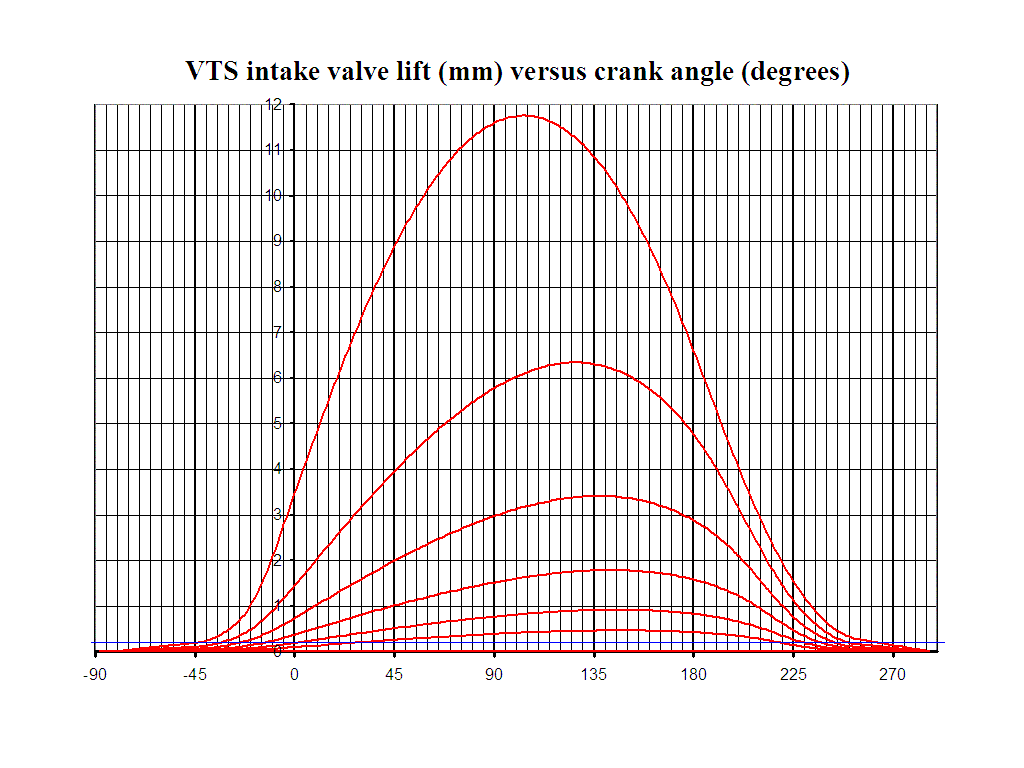
as the control shaft is rotated to another angle – in order to get a different valve lift – the valve lash stays completely constant, and this happens for the whole valve lift range. This is one of the basic characteristics of the mechanism: it can change from zero to a maximum the valve lift keeping at the same time the valve lash constant.
At the animation
http://www.pattakon.com/vva/SideCam.exe
which suits to pushrod engines like LSx, the rotation of the control shaft leaves completely unaffected the valve lash, i.e. the valve lash is constant for the whole valve lift range.
Designing a new cam lobe for the pattakon VVA system, the valve lash is a main parameter. The evaluation of the result is based, among others, on the resulting acceleration and jerk for the whole valve lift range. It is more complicated than designing a cam lobe for a conventional engine, but it offers control on the working medium of other quality.
The plot below is from the third pattakon's prototype (a 1600 cc Citroen-Peugeot VTS). The horizontal blue line stands for the valve lash.
Things get easier with hydraulic lash adjusters.
But it is not only valve spring life that matter.
When the valve springs are completely compressed the whole valve train mechanism suffers, energy is lost as friction, and the components involved (like timing belt, cam lobes, camshaft bearings, rocker arms etc) suffer from stresses and wear.
To take an idea: removing the timing belt and trying to rotate, by both hands, the intake camshaft of the Honda prototype, when the control shaft is rotated at an angle for full lift, it is really hard. The same camshaft can be rotated by the small finger of one hand when the control shaft is at an angle giving very short valve lift.
It is also a matter of smoothness. Think why.
So it seems pattakon’s VVA engine does extends valve spring life by a few times.
Manolis Pattakos
