When you click on links to various merchants on this site and make a purchase, this can result in this site earning a commission. Affiliate programs and affiliations include, but are not limited to, the eBay Partner Network.
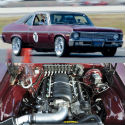
I got the 2011 Camaro SS fuel pump installed, and a quick run with 2+ gallons of gas suggests it's a success! It revs to 6500 now with no stumbles or loss of pressure, whereas previously it fell flat just off-idle. I also nearly put it into a wall shifting into second in the middle of a turn; again, not used to immediate power delivery.
Time will tell how it works out, and if I continue having the issue with dying at idle. I will also be monitoring my fuel tank for leaks where the ring was installed. I used a fuel tank repair epoxy to help seal it, but you can't be too sure.
I actually didn't take pics, but it was essentially the same as this great write-up. Note that all photos are from ryeguy2006a, with my notes added.
Parts list:
Late model GM fuel pump ring: $27 for the entire tank at the junkyard. Vaporworx sells a stainless or aluminum ring, or a full tray with the ring attached that you can weld to an existing tank. You'll need room for an 8" diameter circle in order to install.
Quick-connect to AN fitting: $15 each. This one is screw-on with an o-ring seal, as opposed to the previous design that featured a plastic insert that had a tendency to come off. I replaced the one at the fuel rail while I was at it.
4th gen fuel pressure regulator: $65. Replaces the 5th gen FPR, which is integral to the fuel pump module.
FPR adapter: $15. To adapt the 4th gen FPR to the fuel pump module. Here's their instructions for installation; it takes 15 minutes.
2011 Camaro SS fuel pump: $85 (eBay). RockAuto has them for $130 new.
Fuel pump O-ring: Mine came with the tank.
Fuel pump lock ring: Mine came with the tank. $12.50 at vaporworx
Fuel level float: 0-90 ohm. I was able to keep my OEM-style unit. The Camaro pump module has a float, but it's 60-240(?) ohm, which would work if you have gauges you can calibrate.
I found a 2010 Chevy HHR at the junkyard for the fuel pump install ring. I cut it out of the plastic tank with a sawzall. I had initially looked at a couple mid-2000s GM vehicles, including a 4th gen Trans Am and 5.3L Tahoe, but they're about 1" smaller diameter.
I flattened the bottom side similar to what ryeguy did. I also used a viton gasket and Permatex fuel tank epoxy.
Ryeguy modified his tank, but mine already had the recessed tray, though it was about 1/4" too shallow, forcing me to use spacers between the tank and underbody of the car. I made a template similar to his, and cut a rough circle with some aviation snips. #protip: get green (clockwise cut) or red (anti-clockwise cut) for cutting a circle. The yellow-handle guys are designed for straight lines and gradual curves. NOTE: You need 5.5" - 6.5" depth in order to install the Camaro pump. I had 5.9".
You'll remember that I had a fuel tray tack welded into my tank. I had to (painfully) remove it, leaving the passenger-side wall where my fuel level float was attached.
Here's his finished product; note that the ring is bolted to the tank. Mine is slightly messier due to the Permatex fuel tank repair epoxy I used to seal. I finished it with spray-on truck bedliner, but I recommend something more resistant to abrasion and fuel, as it's peeling from other areas of my tank.
Last edited by hookemdevils22; Feb 10, 2017 at 09:52 AM.
No, but the fuel pump itself is within the bucket, which features jet pumps with one-way valves so fuel can't drain out. Further, the regulator returns fuel into the bucket. Now, it may pose an issue on a road coarse, with longer turns, but it should be fine for the short bursts in autocross. But a reason for the transfer tubes in the Camaro is that the tank has a hump to clear the drive shaft.
My previous setup still allowed fuel to drain out of the bucket, and the pump pickup would get air during sharp turns as the fuel sloshed over the relatively short walls.
Thanks for the reply. Maybe you can add corner pickups down the road if it's a problem. What did you do with that siphon inlet for now? Did you block it?
This thread has some more details on the pump and explains some of the features. http://www.stevesnovasite.com/forums...d.php?t=192282 The bucket with check valve is an improvement, but I'm not sure how much it would help if you're doing a lot of hard turning on a low tank. For sure it's a better solution than what you had or what I have now. I'll be interested to hear how it does on a low tank. What are you going to do about the high fuel pressure? Gauge shows close to 65psi now?
I'm interested to see how long these pumps last when running constant compared to PWM. I have noticed my fuel pump getting louder as my tank gets low and I'll bet the PWM control would reduce that noise considerably. I haven't ran my tank down more than couple times so far though.
Last edited by -TheBandit-; Feb 10, 2017 at 03:06 PM.
Nice job on getting all to work out. With your baffles, I would not worry to much.
If you viewed my Nova build gas tank set up. I made a bucket for my sump / baffles. Cut a opening on the bottom and welded the sump/bucket in it but and leaving the bottom of the bucket a 1" below the fuel tanks bottom. That way the tank fuel always drains into the sump area and keeps the pump submerged until I am empty.
I have been able to run the car almost completely dry... cause I did once. After getting it running around for a few day.. it quit on me. Had someone shake the car while I had my ear to the filler... could not hear much fuel moving inside.
I plan to add corner pickups if necessary. I didn't plug the siphon jet, but I emailed Carl at vaporworx to see if I should. And it's amazingly quiet.
I plan to stick a rental gauge on my rail to check fuel pressure. While troubleshooting the old pump, the rental was a couple psi lower than what mine showed, so it could be showing slightly high.
Finally, constant voltage doubtless diminishes pump life, but they're designed to exceed 100k in factory form. Even a quarter of that will be a decade-plus for me at the rate I've been going. Here's to putting some more miles on her though!
nah, I like the ability to bounce ideas off one another. and despite being an engineer, I don't consider myself as analytical as you or joe.
I'm not ready to declare victory just yet... I still get that sick feeling that it's going to die while idling at a light, which won't go away anytime soon. I plan to pull the tank and check how fuel resistant the epoxy actually is after burning through a tank or two, and I'd like to see how it fares near empty. I'm definitely going to drive the pants off the thing the next few months though.
nah, I like the ability to bounce ideas off one another. and despite being an engineer, I don't consider myself as analytical as you or joe.
HEY! I find that...... offensive? Haha. All three of us are engineers.. and we all show different levels of OCD.. but at least we are all mechanically capable! Can't say that about a lot of other theoretical-world bookworm enginerds.
Great progress.. Can't wait to see some video of it all working well while being beat on!
I've gone through a few tanks of gas now, and can report that I haven't had a hiccup yet, even running it past E a couple times with zero issues. I'm dropping the tank this weekend to see how things are holding up.
Unfortunately, I haven't tested on the course, as Good Guys snuck up on me earlier this month. I'll be stepping up to SCCA SOLO and/or NASA-X, which should provide more than the two runs I usually get at GG.
I can also report that correctly-installed door seals make a HUGE difference, especially at highway speeds.
Dropped the tank, everything appeared to be fine, couldn't find evidence of fuel leaks, which is nice.
I had always assumed that the door seals were flattened over years of use, but that's not the case: a PO had installed them backwards. I have the vent window seals and window channels left, but the difference thus far has been night and day.
Update: fix something, improve driveability, drive the pants off her... or in this case, ladder bars. Luckily the exhaust(!) kept the crossmember and ladders from hitting the road at speed.
I knew the suspension was not optimal for street or auto cross, but wow. Thankfully those are bolt-in subframe connectors. Maybe this is a sign I should finally just pull the trigger on a 4-link.
Wow!!! Whoever welded this needs be shot!!! LOL!!! (I suppose it wasnt you) Its clear those booger'd up welds are not up to the task of anything and also, the thickness of metal looks to me very minimal. Maybe get some real parts and have them be installed by someone who knows what hes doing (or do it yourself if your ok with this).
Im a pretty good welder and even i am considering having a friend help with my cage welding as i know he certified many cars. Safety is not a thing to play with.
6 Common C5 Corvette Failures and What's Involved In Repairing Them
Slideshow: From wobbling harmonic balancers to failed EBCMs, these are the issues that define long-term C5 ownership and what repairs typically involve.
Retro Modern Bandit Pontiac Trans AM Comes With Burt Reynolds' Autograph
Slideshow: A modern Camaro transformed into a retro icon, this limited-run "Bandit" build blends nostalgia with brute force in a way few revivals manage.
Top 10 Greatest Cadillac V Series Performance Models Ever, Ranked
Slideshow: Cadillac didn't just crash the high-performance luxury vehicle party, it showed up loud, supercharged, and occasionally a little unhinged...
Coachbuilt N2A Anteros Is an LS2-Powered C6 Corvette In Italian Clothes
Slideshow: A one-off sports car that looks like a vintage Italian exotic-but hides a C6 Corvette underneath-just sold for the price of a new mid-engine Corvette.