When you click on links to various merchants on this site and make a purchase, this can result in this site earning a commission. Affiliate programs and affiliations include, but are not limited to, the eBay Partner Network.
I'll definitely keep the updates coming. It's been slow recently.. been out of town so haven't driven it since June 15... hopefully going to swap to stiffer front coil springs this weekend and get it out in the wild again.
For temp I have 2 X coolant sensors (both electric, one for Holley and one for dash gauge), a pre-intercooler IAT sensor (at compressor outlet of passenger side turbo) and a pre-throttlebody IAT sensor right at the intercooler top outlet.
Here's a recap of the non-standard and standard sensors I have on the thing, and their locations:
Passenger side - hot side, pre-turbo:
- Exhaust gas temp thermocouple (half way between exhaust manifold & turbo)
- Exhaust gas pressure sensor (half way between exhaust manifold & turbo)
Passenger side - cold side:
- Charge air temperature sensor, pre-intercooler (at compressor outlet of passenger side turbo)
- Charge air pressure sensor, pre-intercooler (at compressor outlet of passenger side turbo)
Passenger side - hot side, post-turbo:
- WB02 sensor (~20" down from turbo on passenger downpipe)
- Plugged bung for future Exhaust Gas Temp sensor in downpipe (~18" down from turbo)
- Plugged bung for future Exhaust Gas Pressure sensor in downpipe (~18" down from turbo, to measure downpipe backpressure)
Other sensors:
- Charge air temperature sensor, post-intercooler (right before throttlebody, used for Holley IAT)
- Manifold absolute pressure sensor (front of intake manifold, used for Holley MAP)
- Dome pressure sensor (single sensor tee'd into both wastegate domes)
- Rad fan shroud pressure sensor (to measure under-shroud pressure vs speed with fans on & off, to see if I need to add rubber flaps to vent shroud pressure)
Not too much to report with the car. August and September has been ridiculously unseasonably rainy.. so I haven't driven it too much.
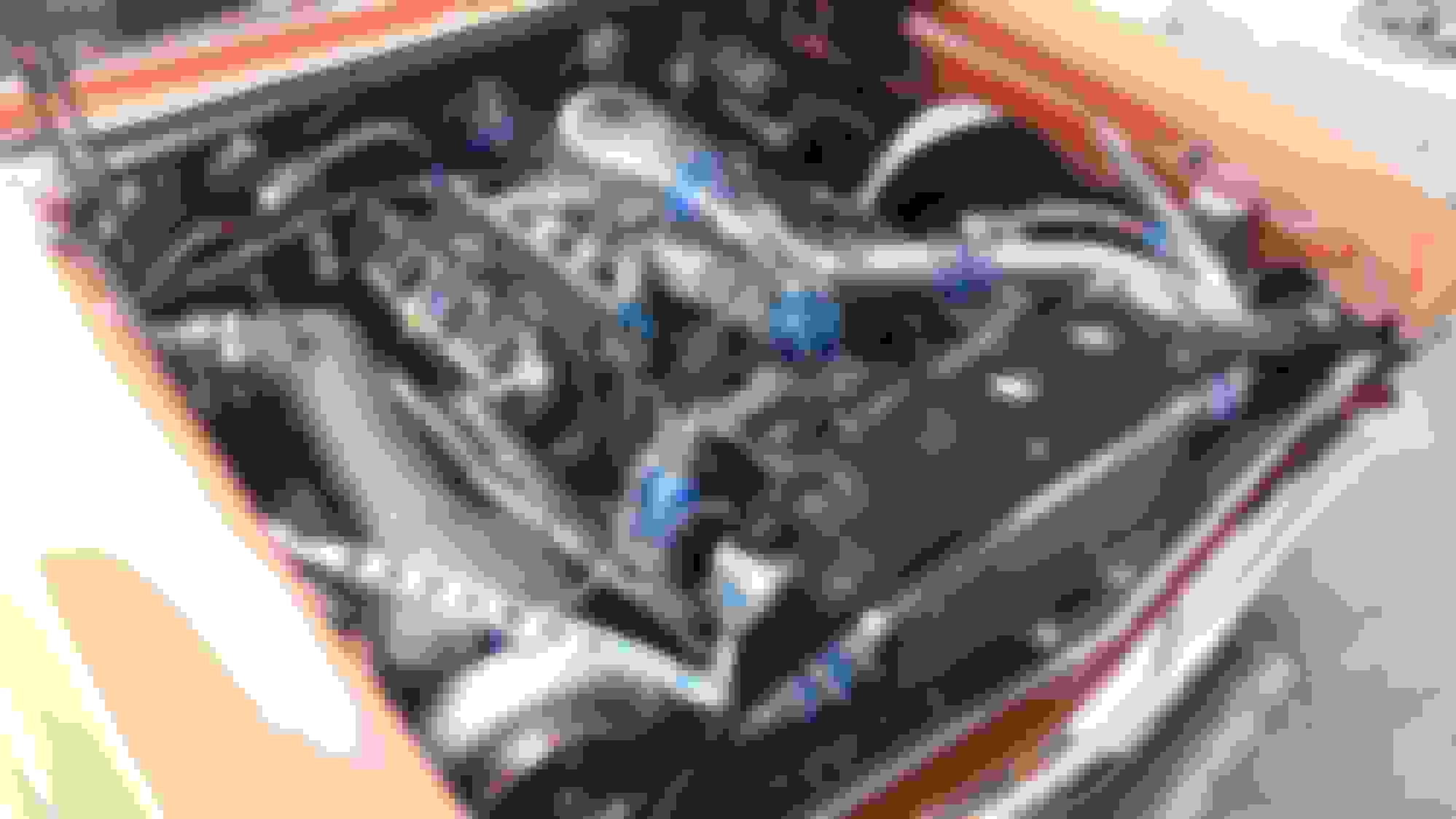
At the end of August I did manage to take it to a friend's shop and put the car on a lift for the first time ever... just to give it a post-summer inspection and see my exhaust work from further than 16" from my face haha....
Hi Joe,
The exhaust looks killer. Ground clearance is perfect. You can tell its well thought out. What is the reasoning for the double flex connecters and what brand? Do you recall the P/N's for the DynoMax mufflers? One last thing, Is that a trans fluid pump next to the trans? Is that normal if so?
Thanks! Doubling up on flex connectors was an attempt to allow the dual pipes to shift parallel to the engine, and allow even more vibration isolation from the engine. My thinking was that if I used a single flex connector per bank, that would want to bend much more easily than shift/sway laterally... so by adding two flex couplers I can have the section between them bend/sway/flex as needed but the dual pipes behind them will stay inline with the car.
The trans pump is just a fluid pump to move ATF from the back of the case to the front of the case under sustained acceleration... there also really was nowhere else to put it haha.
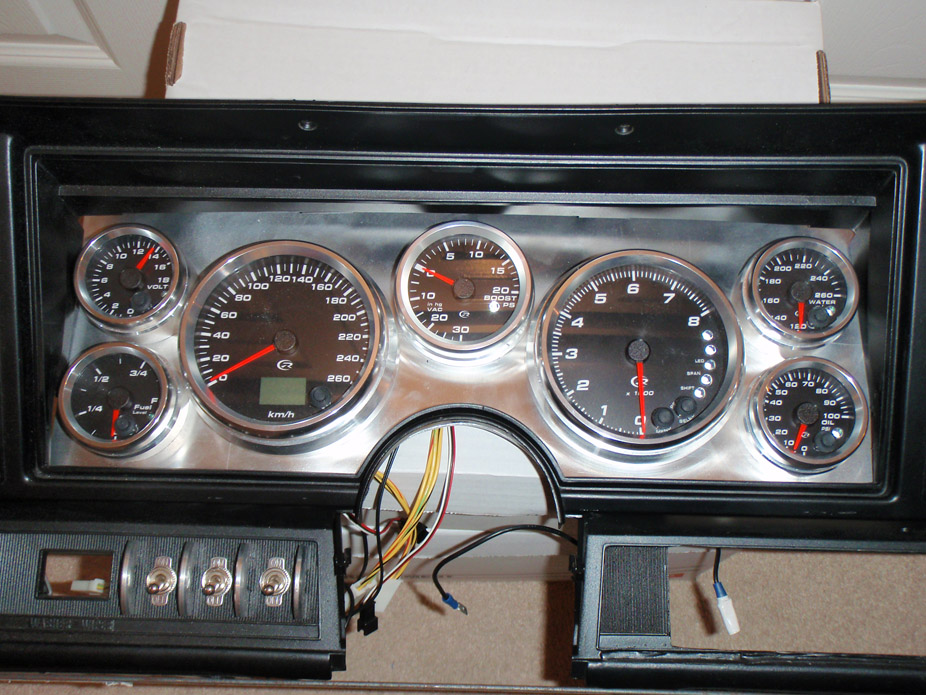
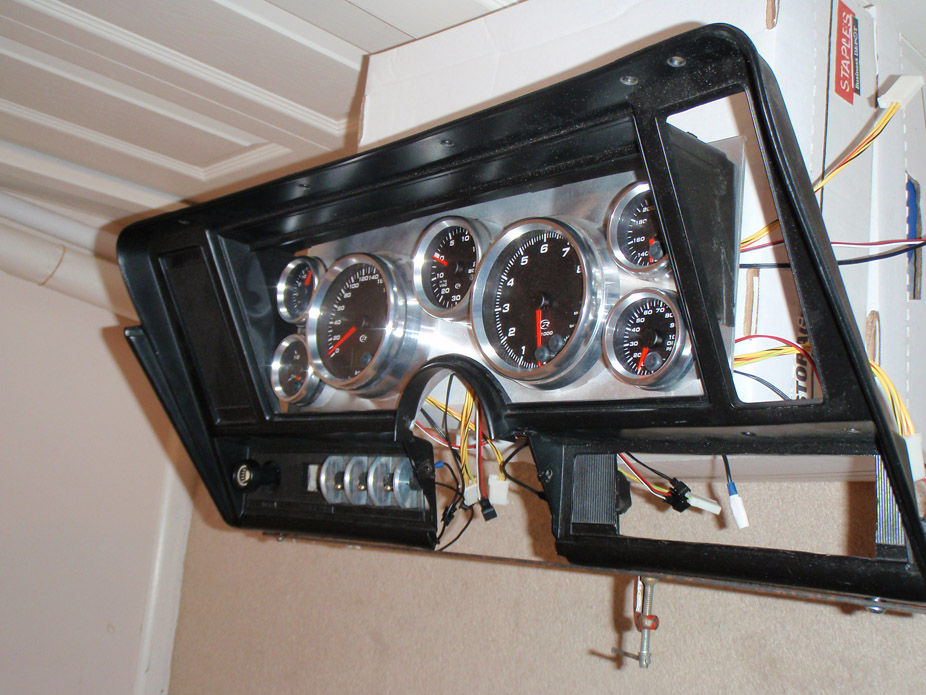
Thanks for the compliment! I honestly don't have many details for the gauge cluster... I made it sometime around 2008 I think. I mocked up of the gauges on a flat piece of cardboard to see how they could group together, then I used that sizing to hack away at the plastic instrument panel to make the gauges fit within, and once I had the plastic opened up I made a final cardboard template for the backing plate that I then transferred over to aluminum sheet.
Nothing really new to post about for the Nova.. it's insured for the summer and has been driven a handful of times, but we have been getting absolutely **** wet weather this past May/June... ugh.
In other news, my gf and I bought a house! I have a 20x20 garage all to my own to build out and do future work on the Nova. Rest assured, once it's a decently organized and functioning work area, I have a few things planned to do to the Nova (hood vents, engine oil cooler, new rear axle, etc)...
For anyone who is interested, I just started a garage build thread on Garage Journal. Much the same style as this build thread.. but will be garage/shop/yard/organizational stuffs.
You'll fill it up way too quickly. I barely have room to work in my 2-car, and I have a small attached room (8x10') and another 12x20' detached shop. I ought to browse GJ a bit more to get some ideas. I assume yours will eventually be the metric equivalent to the 12-gauge garage.
I was pressed for time and tried sifting through for more info on your oil pan mod. Did you have any warpage on gasket area after welding. I too was going to do this as i am a millwright and have access to welding equipment and trying to save $$$. I had my boss run test bead on it to see how well it would take tig welding into the cast and was fine after a polish before welding(like most aluminum). We also have a smaller machine shop with a bar so I could mill it if need be.
And thanks for the power steering right up as well. Also worked for a hydraulics company that is located on our complex so that can be done on the cheap as well.
Bringing back an old question regarding going from single to twin turbos...
Originally Posted by -TheBandit-
Joe I can't help but think you are re re doing what is already done. What problem(s) are you trying to overcome from your existing single turbo setup? What are your primary goals for this new setup? Improved response/driveability? More power? One-upping Mark (in which case, can I suggest a 3rd turbo or an inline supercharger for outrageousness)?
Originally Posted by frojoe
Hey Clint.. great questions, I appreciate the fact checking as I've wondered the same questions for the last couple years until I finally decided after much thought that changing up my setup was the only viable solution, let me try to explain:
1) first and foremost is cooling, for a couple reasons:
- current turbo hotside pipes wrap around in front of the waterpump and have limited my radiator thickness.. I physically can't put in a thicker rad and fan stack without removing the grill and pushing the intercooler forwad above the bumper, or removing the hotside crossover piping
- to reduce underhood pressure as much as possible and make the radiator the most efficient, I need inner fenders.. with my low ride height I simply cannot fit an inner fender in the passenger side with the 275 tire at full left steering lock
2) power/response:
- I'm at the physical limit of turbo that I can fit under the hood in the current location.. remember I don't have subframe bushings to my hood is now that 3/4" lower to the engine.. the max turbo size would be a Precision 78/75 but that's only a small step up from current
- for the single setup I tried to keep the hot piping similar lengths side to side, but there is still ~3ft of passenger side piping and probably 4+ft of driver side piping, at 2.5" OD pipe it's oversized and slowing exhaust velocity down, and likely what is introducing lag from what I've read
- I want to go from a horizontal flow intercooler to a vertical flow to spread the airflow path wider and shorter for less pressure drop..
- I need to remake the exhaust anyways, so I might as well start that project as dual 3.5" pipes from two turbine housings instead of a single 4" pipe from one turbo and possibly redo later
The upsides I can see from going single to twins:
- frees up several inches of room between the rad and the waterpump, allowing a thicker but also taller rad core that fits an upsized dual fan setup, to help pull air thru the thicker core
- significantly shorter turbo hotside (from ~4ft @ 2.375" ID per side to hopefully <1ft @ 2.25" ID)
- better airflow overall (for if I decide to go bigger cubes now or later on) by having dual 2.5" compressor outlets to single 3.5" feeding the throttlebody
- turbos moved forward allows more room for inner fenders, which are essential for lowering the underhood pressure and making the pressure drop across the rad larger
- I've always liked the idea of twins, even since before Mark started his project (I'll naturally be a tad larger than his 6265 Precisions, just because)
- Lastly.. why not? If I've done a single turbo setup to pretty good success (self admittedly, for a first ever attempt that I fabricated in my early 20's) there's only one direction to naturally progress to!
So the car has been up and running with twins for a while yet. Do you feel like you met some of these goals? What did you learn from all this?
Bringing back an old question regarding going from single to twin turbos......
.......So the car has been up and running with twins for a while yet. Do you feel like you met some of these goals? What did you learn from all this?
Whoops, didn't see this post till now!
Originally Posted by frojoe
1) First and foremost is cooling, for a couple reasons:
- current turbo hotside pipes wrap around in front of the waterpump and have limited my radiator thickness.. I physically can't put in a thicker rad and fan stack without removing the grill and pushing the intercooler forward above the bumper, or removing the hotside crossover piping -> I've had great success with the new cross-flow radiator, high density fins, two big fans (16"+13") and moving the turbo hot pipes the hell away from the shroud. I can get repeatedly boosty in 25*C weather (~80*F) with no heat soak or creep, and maintain 185-190*F coolant temp with the fans cycling on/off. I will still temp creep up to 200*F when stuck in hot stop-and-go traffic... but it doesn't slowly creep to 205, 210, 215*F like it used to with the single turbo piping setup.
- to reduce underhood pressure as much as possible and make the radiator the most efficient, I need inner fenders.. with my low ride height I simply cannot fit an inner fender in the passenger side with the 275 tire at full left steering lock -> still haven't made inner fenders for it... those are next up I think once I move all my fabrications tools to the new house I just bought.
2) power/response:
- I'm at the physical limit of turbo that I can fit under the hood in the current location.. remember I don't have subframe bushings to my hood is now that 3/4" lower to the engine.. the max turbo size would be a Precision 78/75 but that's only a small step up from current -> I'm happy that I gained about 2" of turbo housing clearance to the tires at full lock, which then gained some room for inner fenders (yet to be fabbed)
- for the single setup I tried to keep the hot piping similar lengths side to side, but there is still ~3ft of passenger side piping and probably 4+ft of driver side piping, at 2.5" OD pipe it's oversized and slowing exhaust velocity down, and likely what is introducing lag from what I've read -> I nerded the **** out of making the hot side piping diameter/x-section and lengths identical left to right... and I feel like it's helped with FAST response on my arguably-bigger-than-necessary 64mm turbos...
- I want to go from a horizontal flow intercooler to a vertical flow to spread the airflow path wider and shorter for less pressure drop.. -> This was a big win for me. Going from a small horizontal-flow eBay 3" intercooler, to a quality Garrett 3.5" core with turbulators.. I get temperature rise of only a few degrees, and if I'm just cruising at speed in moderate temperature, I see a temp DROP across the intercooler of 2-3 degrees (to the best of my recollection, and with identical temp senders on either side of intercooler)
- I need to remake the exhaust anyways, so I might as well start that project as dual 3.5" pipes from two turbine housings instead of a single 4" pipe from one turbo and possibly redo later -> It's loud, the exhaust looks good, I still love the 4" tips notched into the rear bumper. I haven't thrown a pressure sensor on the downpipe to measure exhaust backpressure.. but I can't imagine it's significant, if it even exists.
The upsides I can see from going single to twins:
- frees up several inches of room between the rad and the waterpump, allowing a thicker but also taller rad core that fits an upsized dual fan setup, to help pull air thru the thicker core -> real happy with the improved accessory drive clearances, like mentioned above for rad/shroud/fan. I now also have hand room to replace the belt with just a 15mm wrench, which is a big improvement compared to before.
- significantly shorter turbo hotside (from ~4ft @ 2.375" ID per side to hopefully <1ft @ 2.25" ID)
- better airflow overall (for if I decide to go bigger cubes now or later on) by having dual 2.5" compressor outlets to single 3.5" feeding the throttlebody
- turbos moved forward allows more room for inner fenders, which are essential for lowering the underhood pressure and making the pressure drop across the rad larger -> for this, still want to add hood vents to blow off any residual underhood pressure (with or without inner fenders), but also vent out underhood heat
- I've always liked the idea of twins, even since before Mark started his project (I'll naturally be a tad larger than his 6265 Precisions, just because)
- Lastly.. why not? If I've done a single turbo setup to pretty good success (self admittedly, for a first ever attempt that I fabricated in my early 20's) there's only one direction to naturally progress to! -> this is still pretty accurate. Also popping the hood and having people just go "holy F*&%" is satisfying, followed with saying I did it all myself
I'll be fully transparent... I'm heavily considering acquiring an additional car... a notch Fox body, to swap the alloy 4.8L into that was originally destined for my BMW (car is just too good in stock form to change). Alloy gen4 5.3L block, gen4 4.8L rotating assembly, light valvetrain, nasty cam, N/A, lightened flywheel, possibly carb'd or keep EFI... have it a snappy revving engine to bring some of the fun back into driving... I literally just run out of road with the Nova, not to mention I've been told you can hear it from like 6 blocks away.
Thank you for the excellent update. It sounds like you are happy with where you ended up and I"d say that's a very good thing!
I can see the desire to build another car after getting this to a point of zenith, but you made a statement about bringing "the joy back to driving". Does that imply something has been lost in all this? Or is it just time to have something different to renew your interest?
After having my car for so long, I've had my ups and downs, periods of lost interest, and periods where I was really rev'd up about new projects or experiences. Getting into autocross, even just a little, brought me back to the car in a very different way. Also my children and their love of cruising with dad gave me yet another experience. I'm looking forward to road trips after I get the six speed into my car. I'd be happy to just spend a few weeks on the road exploring. I still have plenty of upgrade meat on the bone, so I'm just in a different place.
Your Nova is one of the finest examples out there. Thanks for continuing to take us along in your journey.
Lemme ask, Is it this - You get to the point where you have more than enough power to make the car dangerous at any speed, You cant use it all, But all the downsides are there with you ALL THE TIME. Many of us have been there. I dont know what the ideal power VS downside would be for a street car ? 500WHP ? Maybe lower ?
Going through the same thing with a friends Nova I tune.. Not as clean as yours....(Sorry for the hijack Joe)
I can see the desire to build another car after getting this to a point of zenith, but you made a statement about bringing "the joy back to driving". Does that imply something has been lost in all this? Or is it just time to have something different to renew your interest?
I didn't mean that I've lost the joy of driving the Nova, if that's how it sounded... it is my pride and joy, I love everything about it, I start it and idle/rev it, and boost it.. it all gives me a ****-eating grin. However it is obnoxiously loud and unruly-fast, and our roads aren't that great here... and I can't really use it to its max often... I just run out of room. I have no desire to change it from what it is, and NO desire to sell it... it is just a car I can't drive all the time.
I know that's a strange sentence for you to be hearing Clint as you drive yours all the time, but Mark gets it... it's something that you just can't quite allow yourself to get used to, with that much power always on tap and having to constantly reign it in.
What I am desiring as a sort of yin-yang to the Nova... a car that is smaller, lighter, manual, N/A.... "sporty". Low but not too low, firm but not harshly stiff... something I can mash the pedal and let 350hp rev up reasonably quickly without worrying about always "being on it" and having the rear kick out in X gear. More of a "driver's car".. that's really all I'm getting at. The BMW is an amazing piece of automobile refinement meant for comfortably cruising, that I just can't bring myself to alter. And the 24V Dodge is more and more turning into an ever-muddy tree smashing faux-rockcrawler camping rig haha.
Originally Posted by gjestico
Lemme ask, Is it this - You get to the point where you have more than enough power to make the car dangerous at any speed, You cant use it all, But all the downsides are there with you ALL THE TIME. Many of us have been there. I dont know what the ideal power VS downside would be for a street car ? 500WHP ? Maybe lower ?
I think the ideal power for a turbo street car is how much it will predictably connect to the pavement. I've found with my 305/35/18's it's around the 750-800hp mark. That power level is enough to ALWAYS leave you satisfied, and not wishing for more power. It's enough power that a quick stab will make 1st and 2nd be meaningless, 3rd gear is a very predictable 50/50 split of traction or slippage.. not depending on where you are in the rpm's but how quickly you stab the throttle. 4th gear is grip almost always, unless sideways or cold, and 5th pulls harder than most N/A cars in 2nd.
What is the ideal HP level on ANY street car? I'm not sure. 500hp seems to be the number most people will throw out for "usable power on the street"... maybe that means in terms of predictable traction, or passing power, or red-light clutch drops, or just generally happy acceleration without "running out of road" too quickly.
For this "other car" I mentioned above.. for me... personal opinion........ I think 325-400hp is the happy range. Smaller displacement and higher-rev'ing to attain it would be just fine with me. Keeping it light, nimble-ish, and not having the revs just climb away from you every time you mash it.. to me that sounds like a different, new kind of "street car fun".
Very interesting post. I don't blame you for wanting to build something else. I go through sort of the same process with my GTO. I have owned that car for 34 years and it is what it is. I keep having ideas about how great it would be if I did this or that, but the reality is that it is what it is...
I actually think you would really enjoy something like my Cougar. With your mad skills I would enjoy seeing you take on a more unique project than a Mustang...There are many great platforms to choose from.
I like the way you positioned it. I suspect another project car would be just fine to fill the space between the extreme of the Nova and the comfort of the BMW. I hope you find what you're looking for. If not, the Nova can always be reinvented if/when you get your fill of horsepower.
Cheers and thank you again for showing us what's possible. I'm still waiting for that burnout or donut video.
This is something I also go through all the time as well. If I only were able to have 1 car, I'd pick my boosted, all wheel drive BMW. Handling, power, comfort, and reasonably safe to probably up to 700HP.
Let's face it, except for the few that track these cars, these high HP builds are mostly bragging rights. I used to track my previous turbo daily driver about once a week until they closed the track near me. Even though my turbo Vette was designed to be track capable, it mostly sees car shows.
Luckily with high HP turbo cars, it's drivable as long as you don't mash the pedal.
I went to the local auto parts store and found an assortment of springs to test. I needed it to be 7/8" outer diameter or less, to fit inside the lockout housing, but I was flexible on free length, wire diameter, and outer diameter.
After testing several, I settled on this spring as the base.. 7/8" OD with a 0.080" wire diameter...
I cut the spring down in length until it was the right length (to bump up the spring rate), then I made a 3.5mm thick spacer to preload the spring to bump up the starting force...
Fully compressed, no coil bind...
New setup is 60N force for 7mm travel, so 49 lb/in.. a good starting point to test...
How did this work out for you? It seems you dropped the preload by about 90% and the spring rate by about half. Does it still function well to keep you out of reverse?
Originally Posted by frojoe
While I was doing reverse lockout stuff, I decided to tweak the shifter position a bit too, to push the shift **** forward a bit but more importantly to angle it left, moving it closer to the steering wheel. So I made this little angled wedge threaded adapter...
I like that you spent the time to get this position where you wanted it. Do you know/remember how much you angled the shifter arm in both directions? It appears to be angled both toward the driver and forward.
Gas Monkey Built a 6-Wheel Ferrari Testarossa With a Corvette LT4 Engine
Slideshow: The controversial Ferrari F6 swaps its original flat-12 for a Corvette Z06-derived LT4 V8 and sends power to four rear wheels through a custom-built drivetrain.
7 Most Reliable High-Performance Engines GM Has Ever Built
Slideshow:These GM engines didn't just make huge power, they survived abuse, boost, track days, and six-digit mileage with a reputation for refusing to quit.
6 Common C5 Corvette Failures and What's Involved In Repairing Them
Slideshow: From wobbling harmonic balancers to failed EBCMs, these are the issues that define long-term C5 ownership and what repairs typically involve.
Retro Modern Bandit Pontiac Trans AM Comes With Burt Reynolds' Autograph
Slideshow: A modern Camaro transformed into a retro icon, this limited-run "Bandit" build blends nostalgia with brute force in a way few revivals manage.
Top 10 Greatest Cadillac V Series Performance Models Ever, Ranked
Slideshow: Cadillac didn't just crash the high-performance luxury vehicle party, it showed up loud, supercharged, and occasionally a little unhinged...
Coachbuilt N2A Anteros Is an LS2-Powered C6 Corvette In Italian Clothes
Slideshow: A one-off sports car that looks like a vintage Italian exotic-but hides a C6 Corvette underneath-just sold for the price of a new mid-engine Corvette.




 [/QUOTE]