







Dyno proven TFS Head/Cam combinations

Thread Starter
FormerVendor
iTrader: (13)
Joined: Oct 2002
Posts: 1,943
Likes: 9
From: Bardstown, KY
 Dyno proven TFS Head/Cam combinations
 TFS has come out with 3 new head/cam packages for LS1's based off their new TFS 215cc cylinder head. I was asked to post this info, so I will try to answer your questions the best that I can. The heads and cams also come as a complete package with all gaskets and bolts, additional discounts are applied to the package. The cam specs and part #'s are:
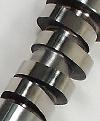
TFS Stg 1 cam is a 216/220 .560/.560 114+4 part # TFS-30602001
TFS Stg 2 cam is a 220/224 .575/.575 112+4 part # TFS-30602002
TFS Stg 3 cam is a 228/230 .585/.585 112+4 part # TFS-30602003
These cams sell for $269.95 and are in stock at Summit and TEA and can be bought from any TFS dealer.
The TFS 215 heads feature unique 13.5 degree valve angles and more piston to valve clearance then a stock LS1/LS6 head. They contain 2.04/1.57 valves, 215cc intake port, 80cc exhaust port volumes, 64cc chambers, Gold dual springs. Their part # is TFS-3060T001-C01 and sell for $2395
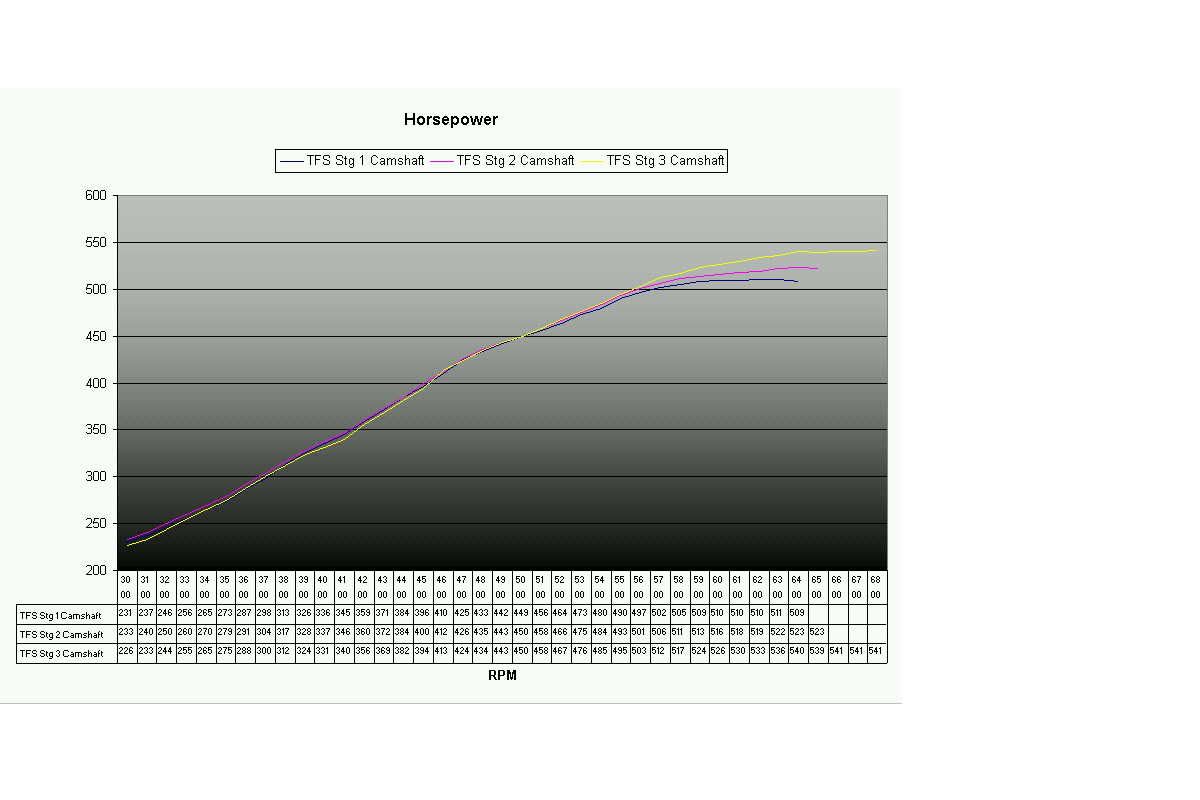
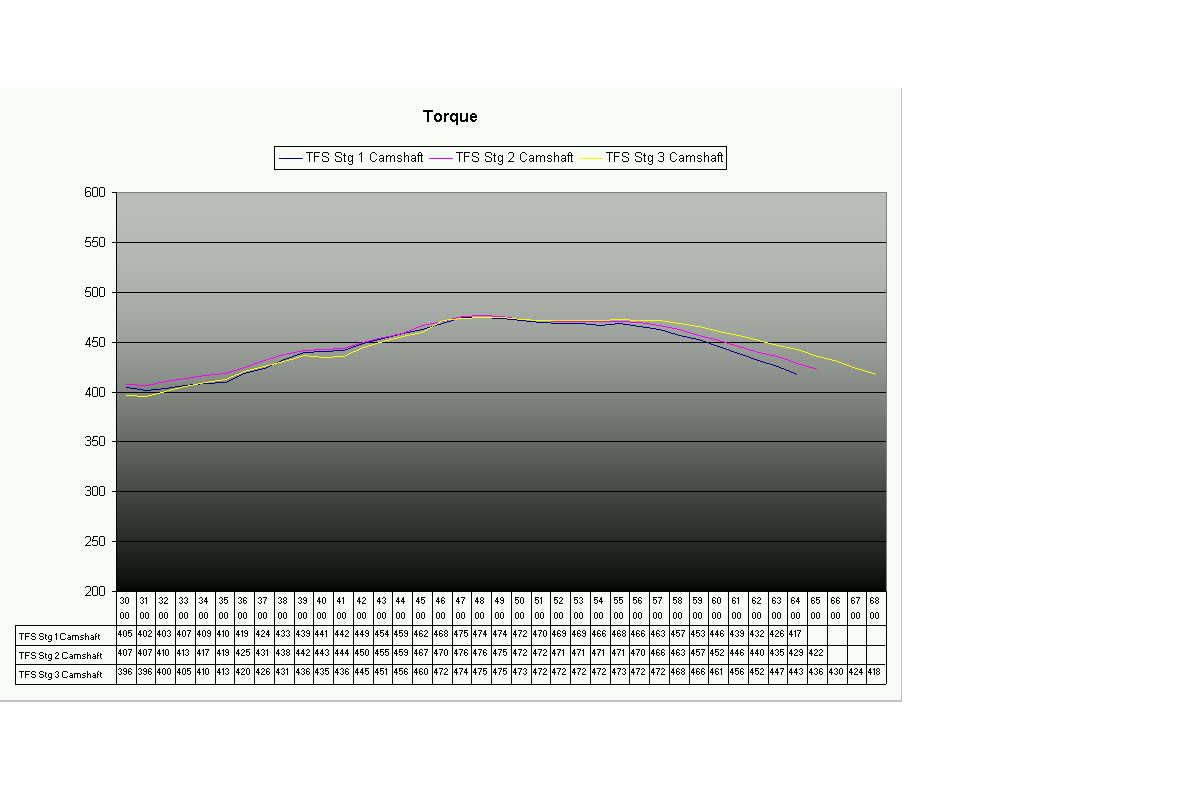
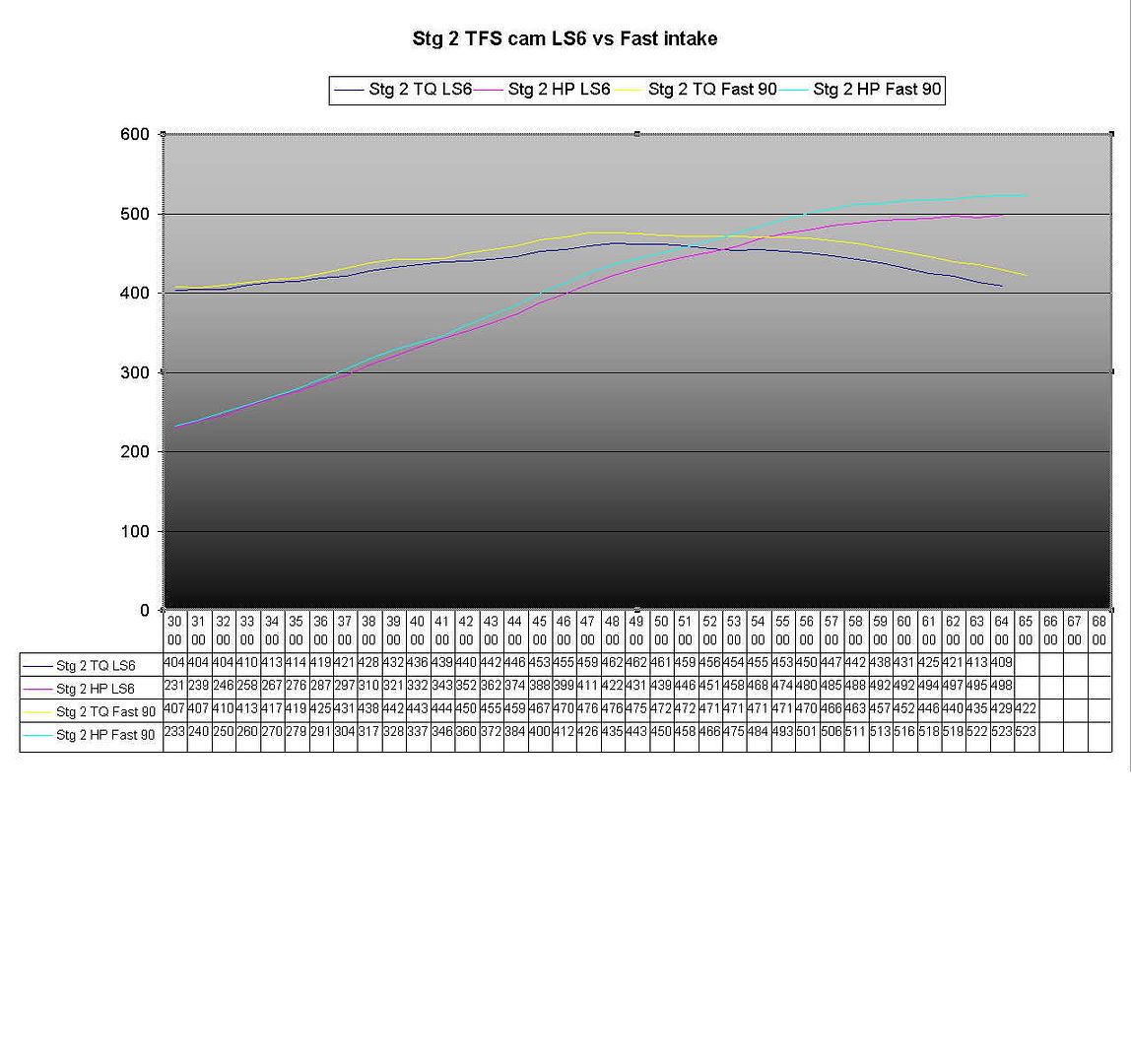
The dyno results are from a stock LS1 short block with Hooker 1 3/4" headers coupled to a Y pipe and then open from there, there were no accessories on the front of the engine. The base engine with headers, stock heads and LS6 intake with no tuning was 380 HP.
The final dyno numbers were with a Fast 90/90 setup and the heads were unmilled TFS at 64cc chamber volume.
I think the results are very interesting, all 3 cams made almost the same torque at the same point, the bigger cams simply held out longer. The TFS heads make excellent power and pull great at high RPM also, pulling 300 RPM past another 215 head that was tested while out powering it by 10 HP as well. So the final results with the biggest cam was a whooping 160 HP increase over the stock heads and LS6 intake. I also have graphs with the TFS head/cams with a LS6 intake that I can post as well if someone wants to see it.
TFS tested almost 20 cam profiles to come up with what they have, some of the bigger cams with more lift actually made less power, they may have made more power if they had more compression, but these cams would make more power with more compression as well. These dyno numbers are at the crank shaft and have not been inflated, these packages will make this power on most any engine dyno, and probably more, as the base engine power was 20 down from what others have tested. The best part of all is that these parts are in stock at Summit, and can also be bought from any TFS dealer. Sorry for the poor quality of the pics, I will try to improve those as well.
TFS Stg 1 cam is a 216/220 .560/.560 114+4 part # TFS-30602001
TFS Stg 2 cam is a 220/224 .575/.575 112+4 part # TFS-30602002
TFS Stg 3 cam is a 228/230 .585/.585 112+4 part # TFS-30602003
These cams sell for $269.95 and are in stock at Summit and TEA and can be bought from any TFS dealer.
The TFS 215 heads feature unique 13.5 degree valve angles and more piston to valve clearance then a stock LS1/LS6 head. They contain 2.04/1.57 valves, 215cc intake port, 80cc exhaust port volumes, 64cc chambers, Gold dual springs. Their part # is TFS-3060T001-C01 and sell for $2395
The dyno results are from a stock LS1 short block with Hooker 1 3/4" headers coupled to a Y pipe and then open from there, there were no accessories on the front of the engine. The base engine with headers, stock heads and LS6 intake with no tuning was 380 HP.
The final dyno numbers were with a Fast 90/90 setup and the heads were unmilled TFS at 64cc chamber volume.
I think the results are very interesting, all 3 cams made almost the same torque at the same point, the bigger cams simply held out longer. The TFS heads make excellent power and pull great at high RPM also, pulling 300 RPM past another 215 head that was tested while out powering it by 10 HP as well. So the final results with the biggest cam was a whooping 160 HP increase over the stock heads and LS6 intake. I also have graphs with the TFS head/cams with a LS6 intake that I can post as well if someone wants to see it.
TFS tested almost 20 cam profiles to come up with what they have, some of the bigger cams with more lift actually made less power, they may have made more power if they had more compression, but these cams would make more power with more compression as well. These dyno numbers are at the crank shaft and have not been inflated, these packages will make this power on most any engine dyno, and probably more, as the base engine power was 20 down from what others have tested. The best part of all is that these parts are in stock at Summit, and can also be bought from any TFS dealer. Sorry for the poor quality of the pics, I will try to improve those as well.

TECH Senior Member
iTrader: (3)
Joined: Apr 2006
Posts: 6,524
Likes: 1
From: Western Burbs of Detroit
Looks like identical results until the top just like you stated. Great job. Just curious how these cars are going to run if set up exactly the same except for the cam. Is there enough difference between the 3 to show a few tenths in the 1/4 or in the 0-60. It appears if stg I runs 12.0 the stg II might run 11.8
Not trying to sound negative, just expressing that they are all very very close. I am sure you guys did your homework and have put out some good options for the guys who would prefer a friendlier cam that drives like stock but performs like one of the big boys. Good Job.
Did you say the numbers were at the rearwheel or at the flywheel??
Not trying to sound negative, just expressing that they are all very very close. I am sure you guys did your homework and have put out some good options for the guys who would prefer a friendlier cam that drives like stock but performs like one of the big boys. Good Job.
Did you say the numbers were at the rearwheel or at the flywheel??
TECH Senior Member
iTrader: (3)
Joined: Apr 2006
Posts: 6,524
Likes: 1
From: Western Burbs of Detroit
How much milling would be possible without flycutting? What compression are you seeing at 64 cc?? Do you advise milling the heads on this pkg for more hp??? Again 3 good pkgs to choose from. I would like to have seen your stg II be where your stg III is and your stg III something wild and crazy. Just my .02
Originally Posted by allngn_c5
I would like to have seen your stg II be where your stg III is and your stg III something wild and crazy. Just my .02
Thread Starter
FormerVendor
iTrader: (13)
Joined: Oct 2002
Posts: 1,943
Likes: 9
From: Bardstown, KY
Originally Posted by allngn_c5
How much milling would be possible without flycutting? What compression are you seeing at 64 cc?? Do you advise milling the heads on this pkg for more hp??? Again 3 good pkgs to choose from. I would like to have seen your stg II be where your stg III is and your stg III something wild and crazy. Just my .02
The cam choices were not mine, this is what TFS came up with, I think it is a good spread, anything bigger then the Stg 3 will lose bottom end torque for top end horsepower. The bigger cams in testing just were not impressive, they basically didn’t make any more power then the Stg 3 cam. I think BIG cams are good when you have poor heads, good heads just don’t require a ton of cam to work.
Originally Posted by lilbuddy1587
Those look to be old XE-r lobes too ?
Replied in the internal section too:
Assuming 64cc chamber, .052 head gasket and 50 degrees ramp rate from .006" to .050", I get the following IVCs and DCR for the TFS cams.
216/220 114LSA +4 = 38 degree IVC ABDC at .050", 8.82:1 DCR
220/224 112LSA +4 = 38 degree IVC ABDC at .050", 8.51:1 DCR
228/230 112LSA +4 = 42 degree IVD ABDC at .050", 8.25:1 DCR
It's pretty easy to see why cam 1 held its own in the torque department. Just look at the high DCR. Cam 2 is a pretty balanced cam. Cam 3 is very similar to other popular cams on the board including one of my favorites (228/232 110LSA +2). If you notice one common thing, that's the intake centerline being at 108. To make good dynamic compression with lower static compression, it's necessary to have an earlier intake centerline. In Brian's case, he chose a little wider LSA than I like, which brought the overlap a little far to the exhaust side of TDC, but since the TFS heads seem to breathe very well, this doesn't seem to hurt them in power development above peak power.
Again, this is a textbook example of following a recipe. Just because these cam combinations worked well does not necessarily mean they'll be perfect for stock heads (or other fine CNC ported aftermarket heads). They are perfect for TFS heads. So if you want to follow the recipe for success, it would pay dividends to copy the cam selections if running TFS heads.
Assuming 64cc chamber, .052 head gasket and 50 degrees ramp rate from .006" to .050", I get the following IVCs and DCR for the TFS cams.
216/220 114LSA +4 = 38 degree IVC ABDC at .050", 8.82:1 DCR
220/224 112LSA +4 = 38 degree IVC ABDC at .050", 8.51:1 DCR
228/230 112LSA +4 = 42 degree IVD ABDC at .050", 8.25:1 DCR
It's pretty easy to see why cam 1 held its own in the torque department. Just look at the high DCR. Cam 2 is a pretty balanced cam. Cam 3 is very similar to other popular cams on the board including one of my favorites (228/232 110LSA +2). If you notice one common thing, that's the intake centerline being at 108. To make good dynamic compression with lower static compression, it's necessary to have an earlier intake centerline. In Brian's case, he chose a little wider LSA than I like, which brought the overlap a little far to the exhaust side of TDC, but since the TFS heads seem to breathe very well, this doesn't seem to hurt them in power development above peak power.
Again, this is a textbook example of following a recipe. Just because these cam combinations worked well does not necessarily mean they'll be perfect for stock heads (or other fine CNC ported aftermarket heads). They are perfect for TFS heads. So if you want to follow the recipe for success, it would pay dividends to copy the cam selections if running TFS heads.
__________________
2013 Corvette Grand Sport A6 LME forged 416, Greg Good ported TFS 255 LS3 heads, 222/242 .629"/.604" 121LSA Pat G blower cam, ARH 1 7/8" headers, ESC Novi 1500 Supercharger w/8 rib direct drive conversion, 747rwhp/709rwtq on 93 octane, 801rwhp/735rwtq on race fuel, 10.1 @ 147.25mph 1/4 mile, 174.7mph Half Mile.
2016 Corvette Z51 M7 Magnuson Heartbeat 2300 supercharger, TSP LT headers, Pat G tuned, 667rwhp, 662rwtq, 191mph TX Mile.
2009.5 Pontiac G8 GT 6.0L, A6, AFR 230v2 heads. 506rwhp/442rwtq. 11.413 @ 121.29mph 1/4 mile, 168.7mph TX Mile
2000 Pewter Ram Air Trans Am M6 heads/cam 508 rwhp/445 rwtq SAE, 183.092 TX Mile
2022 Cadillac Escalade 6.2L A10 S&B CAI, Corsa catback.
2023 Corvette 3LT Z51 soon to be modified.
Custom LSX tuning in person or via email press here.
2013 Corvette Grand Sport A6 LME forged 416, Greg Good ported TFS 255 LS3 heads, 222/242 .629"/.604" 121LSA Pat G blower cam, ARH 1 7/8" headers, ESC Novi 1500 Supercharger w/8 rib direct drive conversion, 747rwhp/709rwtq on 93 octane, 801rwhp/735rwtq on race fuel, 10.1 @ 147.25mph 1/4 mile, 174.7mph Half Mile.
2016 Corvette Z51 M7 Magnuson Heartbeat 2300 supercharger, TSP LT headers, Pat G tuned, 667rwhp, 662rwtq, 191mph TX Mile.
2009.5 Pontiac G8 GT 6.0L, A6, AFR 230v2 heads. 506rwhp/442rwtq. 11.413 @ 121.29mph 1/4 mile, 168.7mph TX Mile
2000 Pewter Ram Air Trans Am M6 heads/cam 508 rwhp/445 rwtq SAE, 183.092 TX Mile
2022 Cadillac Escalade 6.2L A10 S&B CAI, Corsa catback.
2023 Corvette 3LT Z51 soon to be modified.
Custom LSX tuning in person or via email press here.
Trending Topics
LS1 Tech Stories
The Best V8 Stories One Small Block at Time

Gas Monkey Built a 6-Wheel Ferrari Testarossa With a Corvette LT4 Engine
Verdad Gallardo
7 Most Reliable High-Performance Engines GM Has Ever Built
Verdad Gallardo
Amazing '71 Camaro Restomod Is Modern Muscle Car Under the Skin
Verdad Gallardo
6 Common C5 Corvette Failures and What's Involved In Repairing Them
Pouria Savadkouei
Retro Modern Bandit Pontiac Trans AM Comes With Burt Reynolds' Autograph
Verdad Gallardo
Top 10 Greatest Cadillac V Series Performance Models Ever, Ranked
Pouria Savadkouei
Top 10 Most Powerful Chevy Trucks Ever Made!

Hennessey's New Supercharged Silverado ZR2 Has 700 HP
Verdad Gallardo
Coachbuilt N2A Anteros Is an LS2-Powered C6 Corvette In Italian Clothes
Verdad Gallardo


Banned
Joined: Apr 2006
Posts: 134
Likes: 0
Originally Posted by Patrick G
Replied in the internal section too:
Assuming 64cc chamber, .052 head gasket and 50 degrees ramp rate from .006" to .050", I get the following IVCs and DCR for the TFS cams.
216/220 114LSA +4 = 38 degree IVC ABDC at .050", 8.82:1 DCR
220/224 112LSA +4 = 38 degree IVC ABDC at .050", 8.51:1 DCR
228/230 112LSA +4 = 42 degree IVD ABDC at .050", 8.25:1 DCR
It's pretty easy to see why cam 1 held its own in the torque department. Just look at the high DCR. Cam 2 is a pretty balanced cam. Cam 3 is very similar to other popular cams on the board including one of my favorites (228/232 110LSA +2). If you notice one common thing, that's the intake centerline being at 108. To make good dynamic compression with lower static compression, it's necessary to have an earlier intake centerline. In Brian's case, he chose a little wider LSA than I like, which brought the overlap a little far to the exhaust side of TDC, but since the TFS heads seem to breathe very well, this doesn't seem to hurt them in power development above peak power.
Again, this is a textbook example of following a recipe. Just because these cam combinations worked well does not necessarily mean they'll be perfect for stock heads (or other fine CNC ported aftermarket heads). They are perfect for TFS heads. So if you want to follow the recipe for success, it would pay dividends to copy the cam selections if running TFS heads.
Assuming 64cc chamber, .052 head gasket and 50 degrees ramp rate from .006" to .050", I get the following IVCs and DCR for the TFS cams.
216/220 114LSA +4 = 38 degree IVC ABDC at .050", 8.82:1 DCR
220/224 112LSA +4 = 38 degree IVC ABDC at .050", 8.51:1 DCR
228/230 112LSA +4 = 42 degree IVD ABDC at .050", 8.25:1 DCR
It's pretty easy to see why cam 1 held its own in the torque department. Just look at the high DCR. Cam 2 is a pretty balanced cam. Cam 3 is very similar to other popular cams on the board including one of my favorites (228/232 110LSA +2). If you notice one common thing, that's the intake centerline being at 108. To make good dynamic compression with lower static compression, it's necessary to have an earlier intake centerline. In Brian's case, he chose a little wider LSA than I like, which brought the overlap a little far to the exhaust side of TDC, but since the TFS heads seem to breathe very well, this doesn't seem to hurt them in power development above peak power.
Again, this is a textbook example of following a recipe. Just because these cam combinations worked well does not necessarily mean they'll be perfect for stock heads (or other fine CNC ported aftermarket heads). They are perfect for TFS heads. So if you want to follow the recipe for success, it would pay dividends to copy the cam selections if running TFS heads.
Makes perfect sense. That's why the 224/228 cam that AFR recommends works so well with combinations using AFR heads, including yours. But some credit should be given to Cartek for coming up with that cam a long time ago.
Plus ya can't beat the price of the cams. It's amazing how TFS can sell $400 LS1 cams for $269. I wonder why other guys charge so much for a cam.

Originally Posted by Rubadubdub
Plus ya can't beat the price of the cams. It's amazing how TFS can sell $400 LS1 cams for $269. I wonder why other guys charge so much for a cam.
 I look forward to seeing more rwhp numbers, and the idea of seeing what the LS6 intake would do with these heads is good as well.
Bruce
TECH Senior Member
iTrader: (3)
Joined: Apr 2006
Posts: 6,524
Likes: 1
From: Western Burbs of Detroit
Thanks for explaining my question so well. Glad to hear you don't have to flycut even if you use your stg III milled to 59 cc. You have a lot more PVC to work with. I had to flycut with my G5X3 and AFR 205's milled to 59cc. Did your 13.5* valve angle help add to the ample PVC ?? That's my guess. Thanks again.


Originally Posted by allngn_c5
Thanks for explaining my question so well. Glad to hear you don't have to flycut even if you use your stg III milled to 59 cc. You have a lot more PVC to work with. I had to flycut with my G5X3 and AFR 205's milled to 59cc. Did your 13.5* valve angle help add to the ample PVC ?? That's my guess. Thanks again.
It did add about 10 thousands P/V clearence with the 13.5 design.
However they also start life as a 64cc head instead of 66cc's like AFR.
So you take the extra P/V clearence and mill the 10 thousands off to be the same as a stock head now the Trick Flow head is at 62cc's and still have stock P/V cleanence.
So to mill to 59 you only need an additional 20 thousands milled off.
Using the AFR head to mill from 66 down to 59 your looking at around 45-50 thousands milled off the head.
This can really hurt P/V clearence especially when using some of the bigger cams.
So basicially when compairing the 2 heads at 59cc's the TF head would have a good amount more P/V clearence.
Might make a difference when your trying to not have to flycut.
Thread Starter
FormerVendor
iTrader: (13)
Joined: Oct 2002
Posts: 1,943
Likes: 9
From: Bardstown, KY
Originally Posted by ringram
Id like to see the LS6 intake results to see how much they drop


Thread Starter
FormerVendor
iTrader: (13)
Joined: Oct 2002
Posts: 1,943
Likes: 9
From: Bardstown, KY
Originally Posted by ringram
Thats a significant difference for the Fast90!
Any chance you can overlay the fast and ls6? Even if its just for the stage 2 cam.
Thanks.
Any chance you can overlay the fast and ls6? Even if its just for the stage 2 cam.
Thanks.

Thread Starter
FormerVendor
iTrader: (13)
Joined: Oct 2002
Posts: 1,943
Likes: 9
From: Bardstown, KY
Originally Posted by SVT THIS
Any idea what sort of power would be seen with all the accessories still on the motor? Very nice numbers, just curious as to what a daily driver might see power wise.
Last edited by Brian Tooley Racing; Sep 1, 2006 at 04:52 PM.