



No intercooler w/pump fuel
Thread Starter
Joined: Nov 2009
Posts: 1,621
Likes: 31
From: THORNTON, PA (NEAR PHILLY)
 No intercooler w/pump fuel
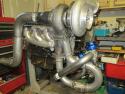
 My Mustang is running a little warm and figured the 31x24x3 a/a china i/c was just blocking the radiator too much. For testing purposes I removed the i/c and put a pipe in place of it and took it for a drive. To my surprise the car didn't run ANY cooler (coolant temp)! However, the IAT's were def up a bit. I did a couple of runs to see what would happen to the IAT, and first thing I noticed is that I gained about 1.5psi of boost. IAT's were now at about 100-120 all the time and rose to around 140* under boost. I'd have to say that's about 40* up from no i/c.
This is with 7.5psi springs in the gate resulting in about 9.5psi of boost, about 82-85* ambient temps. No water/meth, 93 octane.
My question is when do the IAT's become an issue? If IAT's stay at say less that 160* would you leave the i/c off? I havent even started spraying the water/meth...I dont start ramping the water/meth till 11psi.
Another interesting thing...I can really hear the BOV working now!
This is with 7.5psi springs in the gate resulting in about 9.5psi of boost, about 82-85* ambient temps. No water/meth, 93 octane.
My question is when do the IAT's become an issue? If IAT's stay at say less that 160* would you leave the i/c off? I havent even started spraying the water/meth...I dont start ramping the water/meth till 11psi.
Another interesting thing...I can really hear the BOV working now!
140* seems kind of low for almost 10 lbs of boost, be careful with no intercooler! I was showing around 220* on a dyno pull with about 9 lbs on a 90* day. Run some MMT at a minimum! Running no intercooler is like wearing 3 condoms when you don't need to!
Thread Starter
Joined: Nov 2009
Posts: 1,621
Likes: 31
From: THORNTON, PA (NEAR PHILLY)


TECH Regular
Joined: Oct 2014
Posts: 415
Likes: 2
Running an intercooler usually robs you of a few pounds of boost so your results show that. As mentioned detonation is where too much IAT is bad. I would not consider 140 bad though.
If you can't increase airflow to your radiator or fit a larger unit in, fans are really the key. Getting the largest set you can fit with the most air moving capability in is what you want. Pusher fans are more effective than pullers, but a good set of pullers will work (that's what I have and my coolant temps stay pretty cold around 185 ish during normal driving).
As for your IAT's, if they are staying at 140 under the highest boost level you'll be running on a hot day, I wouldn't worry about it too much. If they start climbing or get to a level you don t want but want to stay away from the IC, I would also agree with using meth. I run both a large intercooler, plus meth injection, but I also plan on running 22+ pounds of boost and hope to break 1,000 RWHP. Meth injection itself is dirt cheap. I mix meth with water (50:50 mix) and I can get meth around $3-$5 a gallon. The kits can get a little expensive but if IAT temps are your concern, its definitely the way to go.
If you can't increase airflow to your radiator or fit a larger unit in, fans are really the key. Getting the largest set you can fit with the most air moving capability in is what you want. Pusher fans are more effective than pullers, but a good set of pullers will work (that's what I have and my coolant temps stay pretty cold around 185 ish during normal driving).
As for your IAT's, if they are staying at 140 under the highest boost level you'll be running on a hot day, I wouldn't worry about it too much. If they start climbing or get to a level you don t want but want to stay away from the IC, I would also agree with using meth. I run both a large intercooler, plus meth injection, but I also plan on running 22+ pounds of boost and hope to break 1,000 RWHP. Meth injection itself is dirt cheap. I mix meth with water (50:50 mix) and I can get meth around $3-$5 a gallon. The kits can get a little expensive but if IAT temps are your concern, its definitely the way to go.
Is that 140* with the IAT sensor being hosed down by meth? Spraying pre turbo is the way to go on setups with no IC.
IAT's by themselves aren't relevant. You can have 300* IAT's and no detonation on a low compression engine. Or 150* temps and heavy detonation on a high compression engine. It's all about the CC temps as a whole and at what temp the fuel starts to auto ignite.
That number will be slightly different on all setups, so someone can't tell you a specific IAT to shoot for. A lower the IAT definitely has an effect on CC temps. Though the base compression ratio of the engine has a much more drastic effect.
IAT's by themselves aren't relevant. You can have 300* IAT's and no detonation on a low compression engine. Or 150* temps and heavy detonation on a high compression engine. It's all about the CC temps as a whole and at what temp the fuel starts to auto ignite.
That number will be slightly different on all setups, so someone can't tell you a specific IAT to shoot for. A lower the IAT definitely has an effect on CC temps. Though the base compression ratio of the engine has a much more drastic effect.
Thread Starter
Joined: Nov 2009
Posts: 1,621
Likes: 31
From: THORNTON, PA (NEAR PHILLY)
Is that 140* with the IAT sensor being hosed down by meth? Spraying pre turbo is the way to go on setups with no IC.
IAT's by themselves aren't relevant. You can have 300* IAT's and no detonation on a low compression engine. Or 150* temps and heavy detonation on a high compression engine. It's all about the CC temps as a whole and at what temp the fuel starts to auto ignite.
That number will be slightly different on all setups, so someone can't tell you a specific IAT to shoot for. A lower the IAT definitely has an effect on CC temps. Though the base compression ratio of the engine has a much more drastic effect.
IAT's by themselves aren't relevant. You can have 300* IAT's and no detonation on a low compression engine. Or 150* temps and heavy detonation on a high compression engine. It's all about the CC temps as a whole and at what temp the fuel starts to auto ignite.
That number will be slightly different on all setups, so someone can't tell you a specific IAT to shoot for. A lower the IAT definitely has an effect on CC temps. Though the base compression ratio of the engine has a much more drastic effect.
Seems low, but there is still about 11-12' of i/c piping that may be providing some cooling effect (about 4' is in a direct airpath). I was also thinking that the temps may be low b/c I'm really not working the turbo at this low a boost level. I'm going to do a little more testing this weekend. Just thought the readings so far were interesting.
Trending Topics
Thread Starter
Joined: Nov 2009
Posts: 1,621
Likes: 31
From: THORNTON, PA (NEAR PHILLY)
And just to further complicate things, the IAT sensor is reading apprx 30-40* above ambient just due to heat soak! So at this point I'm just looking at the change in temp rather than what the actual # is.
LS1 Tech Stories
The Best V8 Stories One Small Block at Time

6 Common C5 Corvette Failures and What's Involved In Repairing Them
Pouria Savadkouei
Retro Modern Bandit Pontiac Trans AM Comes With Burt Reynolds' Autograph
Verdad Gallardo
Top 10 Greatest Cadillac V Series Performance Models Ever, Ranked
Pouria Savadkouei
Top 10 Most Powerful Chevy Trucks Ever Made!

Hennessey's New Supercharged Silverado ZR2 Has 700 HP
Verdad Gallardo
Coachbuilt N2A Anteros Is an LS2-Powered C6 Corvette In Italian Clothes
Verdad Gallardo
Awesome K5 Blazer Restomod Comes With C7 Corvette Power
Verdad Gallardo
10 Camaros You Should Never Buy

10 LS Engine Myths That Refuse to Die
Verdad Gallardo
Restricted User
Joined: Mar 2014
Posts: 7,192
Likes: 109
From: Ohio
Water/Meth is more effective than an intercooler. Where an intercooler's effectiveness is basically neutralized once the air hit the combustion chamber, the water/meth injection continues to work its magic.
Our local Extreme Outlaw classes allow 1 type of charge cooling, either intercooler or water/methanol. Not a single one of them run an intercooler.
Our local Extreme Outlaw classes allow 1 type of charge cooling, either intercooler or water/methanol. Not a single one of them run an intercooler.
140* and no water/meth. I dont really start ramping in the w/m until about 11psi.
Seems low, but there is still about 11-12' of i/c piping that may be providing some cooling effect (about 4' is in a direct airpath). I was also thinking that the temps may be low b/c I'm really not working the turbo at this low a boost level. I'm going to do a little more testing this weekend. Just thought the readings so far were interesting.
Seems low, but there is still about 11-12' of i/c piping that may be providing some cooling effect (about 4' is in a direct airpath). I was also thinking that the temps may be low b/c I'm really not working the turbo at this low a boost level. I'm going to do a little more testing this weekend. Just thought the readings so far were interesting.
Water/Meth is more effective than an intercooler. Where an intercooler's effectiveness is basically neutralized once the air hit the combustion chamber, the water/meth injection continues to work its magic.
Our local Extreme Outlaw classes allow 1 type of charge cooling, either intercooler or water/methanol. Not a single one of them run an intercooler.
Our local Extreme Outlaw classes allow 1 type of charge cooling, either intercooler or water/methanol. Not a single one of them run an intercooler.
I’d really like to hear more about those outlaw cars! Guessing they run pretty high octane base fuels? Do they spray pre-turbo? Do they use water and meth or straight meth? Do you know how much fluid volume they are spraying (nozzle size and pressure)VS boost pressure? I’d guess it’s not much when you compare it to the amount of air the engines taking in. With straight meth you’d need 3-4 of the typical “alky” pumps going wide open to make the same dent in the charge temps as a good A2A unit could. Most don’t spray diddly compared to the total air the turbo is flowing.

TECH Resident
Joined: Oct 2009
Posts: 793
Likes: 0
From: Michigan
I think the only real advantages of an intercooler, if you have to choose between the two, are pretty much zero maintenance and better reliability.
TECH Resident
Joined: Oct 2009
Posts: 793
Likes: 0
From: Michigan
Restricted User
Joined: Mar 2014
Posts: 7,192
Likes: 109
From: Ohio
Some of them spray pre-turbo, but not all. Pretty much all of them spray directly after the turbo, and I've even seen one use the boss drilled in the compressor housing for the boost reference fitting as a place for his nozzle.
The problem with an intercooler is turbulence, pressure drop, size restrictions, and the fact that it cannot cool below ambient temps. With methanol, it can cool to far below ambient temps as it evaporates. If you spray it far enough away from the throttle body, it will have more time to cool the air that it is travelling with, and it has combustion benefits, where a typical A2A only makes a marginal % reduction in detonation chances.
I should note that none of them use an A2A intercooler. Some of them do still run A2W.
The problem with an intercooler is turbulence, pressure drop, size restrictions, and the fact that it cannot cool below ambient temps. With methanol, it can cool to far below ambient temps as it evaporates. If you spray it far enough away from the throttle body, it will have more time to cool the air that it is travelling with, and it has combustion benefits, where a typical A2A only makes a marginal % reduction in detonation chances.
I should note that none of them use an A2A intercooler. Some of them do still run A2W.
Regardless of the fluid making it to the CC and pulling more heat from it, it’s been proven many times that an IC will make more power per pound of boost. It is simply more efficient at that task. Assuming you had the ignition system to fire off large volumes of water (most don’t). Water is more efficient at pulling heat from the CC. This may allow you to run more boost overall without detonation, but it won’t make more power per pound of boost which is what most are looking for. Especially when you are turbo limited in a class.
Some of them spray pre-turbo, but not all. Pretty much all of them spray directly after the turbo, and I've even seen one use the boss drilled in the compressor housing for the boost reference fitting as a place for his nozzle.
The problem with an intercooler is turbulence, pressure drop, size restrictions, and the fact that it cannot cool below ambient temps. With methanol, it can cool to far below ambient temps as it evaporates. If you spray it far enough away from the throttle body, it will have more time to cool the air that it is travelling with, and it has combustion benefits, where a typical A2A only makes a marginal % reduction in detonation chances.
I should note that none of them use an A2A intercooler. Some of them do still run A2W.
The problem with an intercooler is turbulence, pressure drop, size restrictions, and the fact that it cannot cool below ambient temps. With methanol, it can cool to far below ambient temps as it evaporates. If you spray it far enough away from the throttle body, it will have more time to cool the air that it is travelling with, and it has combustion benefits, where a typical A2A only makes a marginal % reduction in detonation chances.
I should note that none of them use an A2A intercooler. Some of them do still run A2W.
He was spraying 52+GPH (straight meth) at roughly 1000HP worth of airflow. This was only around 38% efficient at dropping the charge temps. Good A2A unit are 72%+. Also the more power/airflow the engine makes, the less of an effect the water/meth has. Flowing 1000hp worth of air it took 8gph to drop charge temps 15*. At 500hp levels 8gph would drop the temps 30*. Also note these levels are only attainable if you spray pre-compressor. Spraying post compressor won’t be near as efficient at dropping charge temps.
Factor in the 1-2psi pressure drop across the IC core and the 72% efficiency number drops. Even with the added weight and pressure drop, An IC will still net quite a bit more performance per pound of boost than meth inj. alone. An iced A2W IC can be more than 100% efficient at dropping charge temps. No question what is best there.
The problem I see is volume of fluid VS volume of air. Kevins setup above is crazy efficient and not heating the air much for his boost levels. With a typical turbo car and 80* ambient inlet temps you are looking at 333* outlet temps at 25lbs with a typical 70% efficient turbo. Using his numbers above to drop the charge temps to 150* you would need to drop the overall charge temps 183*! That would mean you need to inject 98 GPH pre-turbo. No one is doing that that I know of, you would basically have to inject all your fuel pre-turbo. I rarely see more than 30gph.
Yet a 72% efficient IC (including the 2lb pressure drop) would cool that same 333* charge down to 151*. And some of the nice A2A Garrett cores are reported to be up to 80% efficient these days.
This is pretty handy to calculate all that stuff.
http://www.stealth316.com/2-turbotemp.htm
Last edited by Forcefed86; Apr 29, 2016 at 09:45 AM.
Restricted User
Joined: Mar 2014
Posts: 7,192
Likes: 109
From: Ohio
Spraying pre-compressor helps a lot with turbo efficiency. It doesn't do much for IAT temps, since the heat from the compressor housing and wheel will increase the temps of the methanol to the same temperature as the charge air, effectively canceling its ability to cool. The majority of the cooling effect will go to the aluminum rather than the charge air.
TECH Resident
Joined: Oct 2009
Posts: 793
Likes: 0
From: Michigan
Forcefed, I guess when talking about the measure you are describing being better with an A2A over water injection (to keep this simple, not water/methanol injection), power gain/unit of boost, it is obviously logical that you can make more power at the same boost level with a cooler inlet air temp due to greater O2 content or density.
The part where I think it becomes potentially more advantageous to run water injection or water/methanol injection is that the detonation suppression capacity of it may well allow you to run more than enough additional boost with it to more than overcome the airmass difference from the temperature disadvantage. In this case, the additional charge air temp may actually aid in gaining better distribution of water molecules in the CC, resulting in overall reduced detonation potential.
I think that looking at IAT too much as opposed to knock indicators may mislead. That's why I think the data point from the drag racers mentioned above is a telling indicator of what works. Not saying I'm right, just saying I think this is something to consider.
Also, I do recall Kevin Jewer posting something about him actually wanting the inlet air temperature to assist in this sort of evaporation or distribution effect...
The part where I think it becomes potentially more advantageous to run water injection or water/methanol injection is that the detonation suppression capacity of it may well allow you to run more than enough additional boost with it to more than overcome the airmass difference from the temperature disadvantage. In this case, the additional charge air temp may actually aid in gaining better distribution of water molecules in the CC, resulting in overall reduced detonation potential.
I think that looking at IAT too much as opposed to knock indicators may mislead. That's why I think the data point from the drag racers mentioned above is a telling indicator of what works. Not saying I'm right, just saying I think this is something to consider.
Also, I do recall Kevin Jewer posting something about him actually wanting the inlet air temperature to assist in this sort of evaporation or distribution effect...
Spraying pre-compressor helps a lot with turbo efficiency. It doesn't do much for IAT temps, since the heat from the compressor housing and wheel will increase the temps of the methanol to the same temperature as the charge air, effectively canceling its ability to cool. The majority of the cooling effect will go to the aluminum rather than the charge air.
That’s just not true. The greater the temp differential the more impact the fluid will have. The greater the temp differential the more heat the fluid can pull form the charge. By introducing the meth pre-turbo you are allowing it to pull heat from the air before it is being compressed, during compression (hottest point), and after. Spraying pre-turbo has the largest effect on overall charge temp cooling hands down. It is not cancelling its ability to cool, it is exposing the methanol to the hottest point and allowing it to pull the most heat out of the charge as possible. Basically it does the most work there...
When sprayed post turbo the meth is exposed to less heat total heat with less of a temp differential and is simply less effective. By upping the efficiency of the turbo itself spraying pre-turbo you will make more power per pound of boost. Which again is ultimately the goal. Spraying post turbo does nothing to make the turbo perform better and would strictly be for anti-detonation purposes. Which is good and all, but you are leaving a bunch on the table for no reason.
Much of the class racing is monkey see monkey do. If Bob is winning and he is spraying 30gph of water/meth post turbo with no IC, then that’s what I’m gonna do too. That doesn’t mean there aren't other reasons Bob is winning, or a better method to cool the charge temps.
Last edited by Forcefed86; Apr 29, 2016 at 10:31 AM.
Forcefed, I guess when talking about the measure you are describing being better with an A2A over water injection (to keep this simple, not water/methanol injection), power gain/unit of boost, it is obviously logical that you can make more power at the same boost level with a cooler inlet air temp due to greater O2 content or density.
The part where I think it becomes potentially more advantageous to run water injection or water/methanol injection is that the detonation suppression capacity of it may well allow you to run more than enough additional boost with it to more than overcome the airmass difference from the temperature disadvantage. In this case, the additional charge air temp may actually aid in gaining better distribution of water molecules in the CC, resulting in overall reduced detonation potential.
I think that looking at IAT too much as opposed to knock indicators may mislead. That's why I think the data point from the drag racers mentioned above is a telling indicator of what works. Not saying I'm right, just saying I think this is something to consider.
Also, I do recall Kevin Jewer posting something about him actually wanting the inlet air temperature to assist in this sort of evaporation or distribution effect...
The part where I think it becomes potentially more advantageous to run water injection or water/methanol injection is that the detonation suppression capacity of it may well allow you to run more than enough additional boost with it to more than overcome the airmass difference from the temperature disadvantage. In this case, the additional charge air temp may actually aid in gaining better distribution of water molecules in the CC, resulting in overall reduced detonation potential.
I think that looking at IAT too much as opposed to knock indicators may mislead. That's why I think the data point from the drag racers mentioned above is a telling indicator of what works. Not saying I'm right, just saying I think this is something to consider.
Also, I do recall Kevin Jewer posting something about him actually wanting the inlet air temperature to assist in this sort of evaporation or distribution effect...
Kevin was running 100% methanol as his base fuel. With alcohol you don’t want the charge temps too cool. It’s possible to get them cool enough that the fuel doesn’t vaporize/burn as well. With non-compounded turbo setups your charge temps are usually quite a bit higher than Kevin was seeing. Unless you run a A2W IC chances are you won’t get the charge temps cool enough to worry about the charge temps being too cold.
TECH Resident
Joined: Oct 2009
Posts: 793
Likes: 0
From: Michigan
Ok, the race gas thing does confuse me as to why those guys would choose water/methanol injection over a2a intercooling unless it's that the boost loss across the core is more costly to power production than the lesser charge cooling of the water/methanol injection.... Or maybe it's just monkey see monkey do as you said.