








ARP Crank Bolt

Thread Starter
TECH Apprentice

Joined: Oct 2007
Posts: 311
Likes: 4
 ARP Crank Bolt
 Big dilemma folks the ls1/6 bolt I used to secure my underdrive pulley broke off inside the crank. A few days ago it was brought to my attention that I had put my timing cover seal wrong. So I went a head and removed the need stuff to gedet the bolter off and then it came to removing the ARP bolt it took two people a broken 1/2 , inch drive socket, than a huge *** cheater bar. I was making progress with that until I heard a "bink" and at that point I was screwed. Now I can't find a easy out long enough to remove the bolt. So I guess my question is what size easy out has anybody used to remove the easy out and what size drill bit? I'm about 4 to 5 threads from getting the broke piece out.
A 16 MM bolt is slightly larger than a 5/8 SAE bolt. The screw extractor size depends on what type you use.
The most common is pictured below. The size for a 5/8 bolt is E5. The drill size for THIS TYPE is 19/64. If you can, find a left hand drill bit (it drills when turning in "reverse" when compared to regular drill bits) and it may just spin out the broken bolt without needing the extractor. The broken bolt in the crank should not be tight as it no longer has a head and isn't clamping anything.
It is IMPERATIVE that you drill in the center of the bolt without hitting the threads. If you hit the threads, the crankshaft will be compromised-you may strip the threads when torquing in the new bolt resulting in a junk crankshaft. Start with small drill bits first. It won't be easy as this is a 200,000 PSI specially hardened bolt, it's stronger than a grade 8 or 12.9 bolt.

The most common is pictured below. The size for a 5/8 bolt is E5. The drill size for THIS TYPE is 19/64. If you can, find a left hand drill bit (it drills when turning in "reverse" when compared to regular drill bits) and it may just spin out the broken bolt without needing the extractor. The broken bolt in the crank should not be tight as it no longer has a head and isn't clamping anything.
It is IMPERATIVE that you drill in the center of the bolt without hitting the threads. If you hit the threads, the crankshaft will be compromised-you may strip the threads when torquing in the new bolt resulting in a junk crankshaft. Start with small drill bits first. It won't be easy as this is a 200,000 PSI specially hardened bolt, it's stronger than a grade 8 or 12.9 bolt.
Last edited by Paul Bell; Jul 3, 2011 at 09:34 PM.
Well, I wouldn't get a new crank hub bolt at Sears. I would suggest a call to ARP to see why their bolt broke. By any chance, did you put anything on the threads before you used it?
But Sears is a good place to get an extractor set. Here's a nice one complete with left hand Cobalt drill bits:
http://www.sears.com/shc/s/p_10153_1...6&blockType=G6
But Sears is a good place to get an extractor set. Here's a nice one complete with left hand Cobalt drill bits:
http://www.sears.com/shc/s/p_10153_1...6&blockType=G6

TECH Senior Member


Joined: Apr 2002
Posts: 6,080
Likes: 17
From: So.Cal.
Ouch... that ARP crank bolt is huge and the torque spec is 258 ftlb (or somewhere close)... I cannot imagine it breaking unless something was wrong...
Does the break surface show anything irregular like a bubble or inclusion...?
I'm curious what ARP have to say when they analyze your broken bolt.
Does the break surface show anything irregular like a bubble or inclusion...?
I'm curious what ARP have to say when they analyze your broken bolt.
Trending Topics
LS1 Tech Stories
The Best V8 Stories One Small Block at Time

Topdon ONE vs. Artidiag 800 BT2: Which is the Diagnostic Tablet For You?
Pouria Savadkouei
Gas Monkey Built a 6-Wheel Ferrari Testarossa With a Corvette LT4 Engine
Verdad Gallardo
7 Most Reliable High-Performance Engines GM Has Ever Built
Verdad Gallardo
Amazing '71 Camaro Restomod Is Modern Muscle Car Under the Skin
Verdad Gallardo
6 Common C5 Corvette Failures and What's Involved In Repairing Them
Pouria Savadkouei
Retro Modern Bandit Pontiac Trans AM Comes With Burt Reynolds' Autograph
Verdad Gallardo
Top 10 Greatest Cadillac V Series Performance Models Ever, Ranked
Pouria Savadkouei
Top 10 Most Powerful Chevy Trucks Ever Made!

Hennessey's New Supercharged Silverado ZR2 Has 700 HP
Verdad Gallardo
I've gotta wonder how many of these bolt "problems" are caused by dirty threads. After all, the balancer area is a cr@p-magnet and fairly hard to clean in the car. Likely, peeps are installing good clean bolts into filthy crank threads thus causing self-induced problems...

I've gotta wonder how many of these bolt "problems" are caused by dirty threads. After all, the balancer area is a cr@p-magnet and fairly hard to clean in the car. Likely, peeps are installing good clean bolts into filthy crank threads thus causing self-induced problems...
Same thing happened to me a few months bac. ended up getting a taper and bottoming tap and re-tapped the crank snout and got a new fully threaded shorter bolt. I check it every once in a while and it remains very tight
Thread Starter
TECH Apprentice
Joined: Oct 2007
Posts: 311
Likes: 4
Well, I wouldn't get a new crank hub bolt at Sears. I would suggest a call to ARP to see why their bolt broke. By any chance, did you put anything on the threads before you used it?
I used medium locktite when i installed it. Thanks for the link Paul i just picked up a sears drill bit. hope it works.
But Sears is a good place to get an extractor set. Here's a nice one complete with left hand Cobalt drill bits:
http://www.sears.com/shc/s/p_10153_1...6&blockType=G6
I used medium locktite when i installed it. Thanks for the link Paul i just picked up a sears drill bit. hope it works.
But Sears is a good place to get an extractor set. Here's a nice one complete with left hand Cobalt drill bits:
http://www.sears.com/shc/s/p_10153_1...6&blockType=G6
Ouch... that ARP crank bolt is huge and the torque spec is 258 ftlb (or somewhere close)... I cannot imagine it breaking unless something was wrong...
Does the break surface show anything irregular like a bubble or inclusion...?
I'm curious what ARP have to say when they analyze your broken bolt.
Does the break surface show anything irregular like a bubble or inclusion...?
I'm curious what ARP have to say when they analyze your broken bolt.

 I'd bet you can attribute all of the failures to improper installation, torque, or cleanliness...
 Thread Starter
TECH Apprentice
Joined: Oct 2007
Posts: 311
Likes: 4
I'm gonna say using the old crank bolt to install the damper somehow damaged the threads in the crank. While trying to remove the new bolt, it cross threaded and locked. With enough torque (from the huge *** cheater bar) the bolt failed.
Sadly, if this is the case, that broken bit of bolt is never gonna come out. Even the best bolt extractor isn't as strong as the original bolt.
Further, given the bolt's hardness compared to the crank, you'll never perfectly drill it out perfectly on center to tap to the next size bolt, it'll be off center.
It's been said many times here, the damper bolt should not be used to install the damper, it'll tear up the crank threads.
Sadly, if this is the case, that broken bit of bolt is never gonna come out. Even the best bolt extractor isn't as strong as the original bolt.
Further, given the bolt's hardness compared to the crank, you'll never perfectly drill it out perfectly on center to tap to the next size bolt, it'll be off center.
It's been said many times here, the damper bolt should not be used to install the damper, it'll tear up the crank threads.
Thread Starter
TECH Apprentice
Joined: Oct 2007
Posts: 311
Likes: 4
I'm gonna say using the old crank bolt to install the damper somehow damaged the threads in the crank. While trying to remove the new bolt, it cross threaded and locked. With enough torque (from the huge *** cheater bar) the bolt failed.
Sadly, if this is the case, that broken bit of bolt is never gonna come out. Even the best bolt extractor isn't as strong as the original bolt.
Further, given the bolt's hardness compared to the crank, you'll never perfectly drill it out perfectly on center to tap to the next size bolt, it'll be off center.
It's been said many times here, the damper bolt should not be used to install the damper, it'll tear up the crank threads.
Sadly, if this is the case, that broken bit of bolt is never gonna come out. Even the best bolt extractor isn't as strong as the original bolt.
Further, given the bolt's hardness compared to the crank, you'll never perfectly drill it out perfectly on center to tap to the next size bolt, it'll be off center.
It's been said many times here, the damper bolt should not be used to install the damper, it'll tear up the crank threads.
It's a mystery what happened. We can only assume the crank got damaged the last time the bolt was used to install the damper.
A balancer installer threads into the crank then uses a much larger nut with a thrust bearing to push on the balancer. The threads in the crank, while fully engaged by the tool, is not rotated into under the tremendous stress it takes to install the balancer.
Here's a very good installer kit at a very good price. I've owned a kit just like it for at least 25 years:
http://www.summitracing.com/parts/CCA-4920/?rtype=10
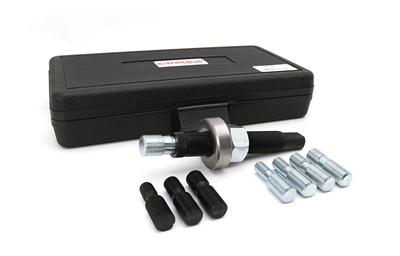
A balancer installer threads into the crank then uses a much larger nut with a thrust bearing to push on the balancer. The threads in the crank, while fully engaged by the tool, is not rotated into under the tremendous stress it takes to install the balancer.
Here's a very good installer kit at a very good price. I've owned a kit just like it for at least 25 years:
http://www.summitracing.com/parts/CCA-4920/?rtype=10